
TL;DR: No scientific evidence shows that Tarot, whether read by AI or a human, predicts the future correctly. A 2025 study by Brooks and colleagues found that a querent's sense of a reading being accurate and useful was not linked to mystical belief or fantasy proneness. The main difference lies in interaction: AI is fast, cheap, and always available but lacks contextual observation and emotional connection, while a skilled human reader picks up on expression, voice, and personal narrative.
What is AI Tarot reading and how does it differ from a human reader?
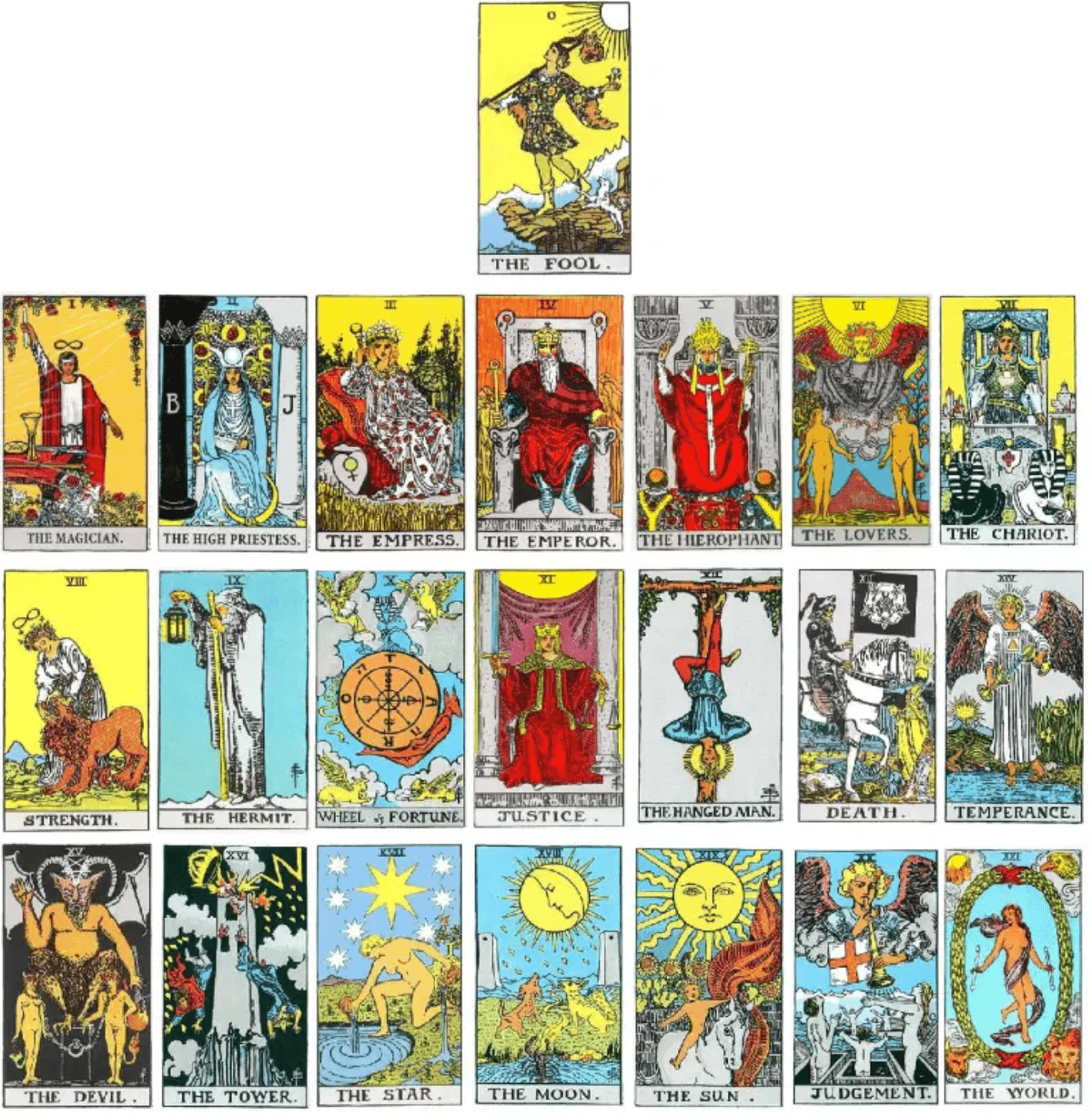
AI Tarot reading is the use of a language model or automated app to draw cards, look up the meanings of the 78 cards, and assemble advice, usually within seconds. A real reader works more slowly: they observe the querent, choose the spread, ask follow-up questions, and adjust the interpretation based on in-the-moment reactions. The core difference is not in the cards, since both use the same 78-card deck, but in the interaction and context after the cards are face up.
Historically, Tarot began as a game in 15th-century Europe, and only from around the late 18th century onward was it attached to divination and spirituality. By the late 20th century, the New Age movement turned Tarot into a mass-market spiritual commodity, detaching it from its mystical roots and bringing it into cafes, phone apps, and social media. This process itself paved the way for AI Tarot products: once Tarot was understood as a self-reflection tool, a machine that knows card meanings could play a similar role.
| Criterion | AI Tarot | Human reader |
|---|---|---|
| Speed | Seconds, no appointment needed | 30 to 90 minutes per spread |
| Cost | Free or very low | From a few hundred thousand to a few million dong |
| Ability to observe context | None, based only on typed text | Reads voice, expression, hesitation, silence |
| Follow-up questions | Limited, scripted | Flexible, digs deeper based on reactions |
| Consistency | High, same input gives same output | Varies with mood and experience |
| Emotional connection | Low | High if the reader is skilled |
| Risk | Overly confident answers, little hedging | Depends on the reader's character and ethics |
What does science say about Tarot's accuracy?
To date, no peer-reviewed study has proven that Tarot predicts future events correctly. What interests psychology researchers more is why querents find a reading "accurate" and "useful."
A study by Thomas R. Brooks and colleagues published in 2025 in the Journal of Articles in Support of the Null Hypothesis surveyed participants right after they received a Tarot reading. The authors measured three things: belief in paranormal phenomena, fantasy proneness (the tendency to become absorbed in vivid imagination), and the querent's sense that the reading was accurate and useful. The results showed no significant relationship among these three factors. In other words, people who believe in the paranormal did not find the reading more accurate than non-believers, and people prone to fantasy did not find it more useful.
The authors explain that Tarot has become "secularized": it has gradually lost its mystical quality in popular imagination and become a self-reflection tool much like journaling or sandplay. This result has not yet been replicated by an independent research group, so it should be read cautiously. The study was also conducted only in the southwestern United States, a region with a strong conservative and Catholic culture, so generalizability is limited.
One psychological mechanism often mentioned is the Barnum effect, named after psychologist Bertram Meehl when he described it in 1956. This effect makes people see a general description such as "you are both strong and vulnerable" as true of themselves. With Tarot, this effect explains much of the feeling "how did it know exactly?", regardless of which cards are drawn.
Some authors in the tradition of Carl Jung's analytical psychology link Tarot to the Fool's Journey, treating the 22 Major Arcana as stages of the individuation process. This reading does not prove that Tarot prophesies; it turns Tarot into a storytelling map of a human life.
Why can AI and a human reader give different results?
Given the same question and the same spread, AI and a real reader often give two different answers. There are four main reasons.
- Different data sources. AI looks up card meanings from its trained text corpus, usually popular Tarot books. A real reader uses personal experience, memories of previous readings, and observation of the querent.
- Ability to read nonverbal context. A real reader can hear a trembling voice, see averted eyes, and notice that the querent is avoiding a topic. AI only has the text the user types, so it easily answers off-target.
- Follow-up questions. When a card is ambiguous, a real reader can ask more or draw more cards. AI usually settles on a single answer and rarely asks back.
- Hedging and responsibility. Experienced readers usually make clear what is a suggestion and what is the querent's decision. AI may answer in a firm tone, making users over-trust it.
Technically, current language models do not "draw cards" in a truly random way unless the developers design a random mechanism. They choose cards based on probabilities from training data. Therefore, the same repeated question can give the same result, unlike shuffling by hand.
Can AI Tarot be used in psychological counseling?
There is preliminary evidence that Tarot can be used as a self-reflection tool in counseling contexts, but not enough to recommend widespread use. Brooks and colleagues concluded that mystical belief does not affect whether querents find a reading accurate or useful, so Tarot may fit counseling spaces. Scholars such as Semetsky (2005, 2006, 2011) have theorized Tarot as a projective technique, similar to sandplay in psychotherapy. Lavin (2021) argues that Tarot can help develop spirituality and empathy by facing uncertainty.
A notable contribution is the qualitative study by Krow and colleagues, currently under peer review, suggesting that long-term Tarot use may improve symptoms of depression and anxiety while increasing a sense of control over life. Since this is qualitative research not yet officially published, it should be seen as an early signal, not a conclusion.
Tarot is not yet a common tool in mainstream counseling. Only a small number of counselors and psychologists openly integrate it into practice. Brooks and colleagues argue that it is too early to recommend that counselors learn to read Tarot.
With AI Tarot, the story is more complicated. An app can help users write out their feelings, but it cannot replace the therapeutic relationship, where the counselor bears ethical and legal responsibility. If used, it should be treated as a journaling tool with prompts, not as therapy.
When should you choose AI, and when should you seek a human reader?
There is no right answer for everyone. The choice depends on what you need from a reading.
- Choose AI when: you need an opening question for reflection, want to try many spreads in a short time, or cannot afford to pay. AI suits journaling, asking yourself questions, and playing for fun.
- Choose a human reader when: you are facing a major decision about work, relationships, or mental health, or need a space where you are fully heard. The human element, including presence, well-timed silence, and nonverbal feedback, is something AI cannot simulate.
- Avoid both when: you are seeking medical, legal, or financial advice, or are in an acute psychological crisis. Tarot does not replace a doctor, lawyer, or financial expert.
In the reading tradition, a good reader usually does not promise outcomes but helps the querent see their own choices clearly. AI can mimic that tone, but there is no responsibility attached.
Risks to know when using AI Tarot
AI Tarot has three main risks. First, overly confident answers: language models often write fluently, making readers mistake fluency for accuracy. Second, lack of hedging: an answer may sound like a diagnosis when it is actually only an inference from a card. Third, dependence: if AI is used in place of self-decision, users may postpone responsibility for themselves.
A safer way to use it is to turn AI's answer into a question for yourself: "What does this card suggest to me?", "Am I avoiding something?" At that point, AI Tarot becomes a reflection tool, not an authority that passes judgment.
Nhật Nguyệt's suggestion
If you are curious about AI Tarot, try it as a journaling session with prompts. Ask open questions, read the result with healthy skepticism, and ask yourself what in it truly touches you. If you are facing a big issue, seek an experienced and ethical reader, or better, a trained counselor. Tarot, whether read by AI or a human, does not replace your decisions, and does not replace experts in fields that require expertise.