



TL;DR: Strong/Weak Self refers to the strength of the Day Master in BaZi, determined by its interaction with other elements. Correctly identifying it helps interpret personality and fortune, but it is not an absolute judgment of good or bad.
Why must strength and weakness be measured before doing anything else?
Because everything else in the chart is read through its relationship with the Day Master. Bát Tự (BaZi) records the moment of birth using four pillars: Hour, Day, Month, Year. Each pillar consists of one Heavenly Stem and one Earthly Branch. The Heavenly Stem of the Day pillar is the Day Master (or Day Ruler), representing the person being read. The remaining Stems and Branches, along with the deities and major luck cycles, only carry meaning when placed in a producing or controlling relationship with the Day Master. If we do not yet know whether the Day Master is strong or weak, we do not know what it can bear and what it needs.
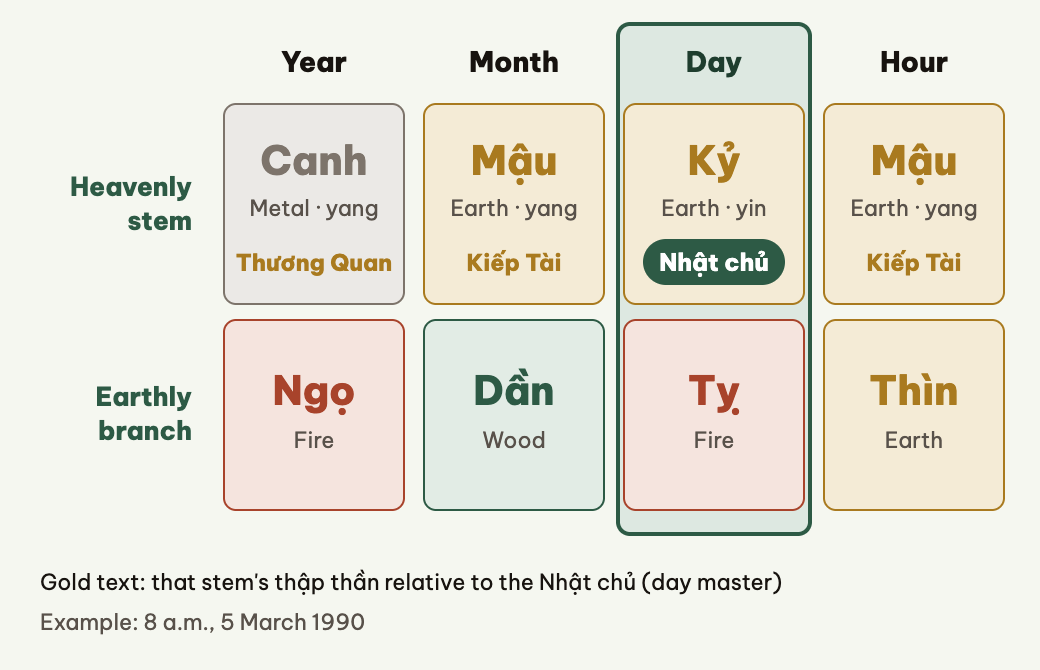
Strong Self and Weak Self (also Strong Day Master, Weak Day Master) are the two energy states of the Day Master at the moment of birth. This is the most important preliminary assessment, but it is not the destination. It is the input for the later step of choosing the chart structure and the useful god.
One thing must be said right away, something many introductory texts skip: strength and weakness are not a number, but a judgment open to debate. Two practitioners looking at the same chart can differ by half a grade. So the entire chain of reasoning below must be read as a grounded procedure, not a calculation that yields a single answer.
What is the month command, and why is it considered first?
The month command is the Earthly Branch of the Month pillar. It is considered first because it tells which season holds power at the moment of birth, and season is something every other element must submit to. A Day Master born in a month that controls it starts out in a weak position, even if the other pillars offer support. Conversely, born in a month that produces it or shares its element, it starts out in a strong position.
The mechanism behind this is the producing and controlling cycle of the five elements tied to the four seasons. Spring belongs to Wood, Summer to Fire, Autumn to Metal, Winter to Water, and the four transitional months (Thìn, Tuất, Sửu, Mùi) belong to Earth. When an element holds the season, it is in the most prosperous state; the element that produces it is in the supporting state; the element it produces is in the resting state; the element that controls it is in the imprisoned state; and the element it controls is in the dead state. This table of states is the basis for saying the month command weighs more than the other Branches: a Branch in a prosperous month carries more weight than the same Branch sitting in the Year pillar.
The month command is also where the chart gets its name. In Tử Bình, whichever deity holds the month command and reveals itself in the Heavenly Stems is taken as the ruling structure, called the chart structure. The chart structure is the mold of the chart: it tells how this chart operates and what it takes as its axis. This is a concept many introductory texts skip, but without it the step of choosing the useful god below has no foundation.
How is the strength or weakness of the Day Master measured?
There is no single formula, but a synthesis of three groups of factors: gaining the command, gaining ground, and gaining force.
Gaining the command examines the month command. A Day Master born in a month that produces it or shares its element is said to gain the command. This is the heaviest of the three factors.
Gaining ground examines the remaining Earthly Branches, especially the Branch of the Day pillar (the palace of the self) and the Branch of the Hour pillar. These Branches contain elements that produce and support, or control and drain, the Day Master. A Branch holds both the main hidden stem and secondary elements, so one must examine what that Branch hides, not just look at the Branch name.
Gaining force examines the number and position of the Heavenly Stems, seeing whether the producing and supporting side (Resource stars, Self and Rival stars) is numerous or the controlling, draining and weakening side (Officer and Seven Killings, Output stars, Wealth stars) is numerous.
After listing these, one must also examine the relationships of combination, clash, punishment, harm, and destruction among the Earthly Branches, because a Branch that is clashed may lose its ability to support, and a Branch that is combined may change element. This is the step that makes the strength conclusion unstable: with the same set of Stems and Branches, changing the birth month or birth hour can flip the conclusion. If the producing and supporting group dominates, the conclusion is Strong Self. If the controlling, draining and weakening group dominates, the conclusion is Weak Self.
The table below compares the two groups of influences, using a Giáp Wood Day Master as an example for ease of following.
| Group of factors | Effect on the Day Master | Example with Giáp Wood | Corresponding Stems and Branches |
|---|---|---|---|
| Being produced | Produces and supports, makes strong | Produced by Water producing Wood | Nhâm, Quý, Hợi, Tý |
| Being helped | Produces and supports, makes strong | Helped by Wood | Ất, Dần, Mão |
| Gaining the command | Produces and supports, makes strong | Born in the Dần or Hợi month | Month Earthly Branch is a producing or same element |
| Being controlled | Controls and drains, makes weak | Controlled by Metal | Canh, Tân, Thân, Dậu |
| Being drained | Controls and drains, makes weak | Wood produces Fire | Bính, Đinh, Tị, Ngọ |
| Being weakened | Controls and drains, makes weak | Wood controls Earth, Earth too prosperous | Earth prosperous |
| Losing the command | Controls and drains, makes weak | Born in a month of a controlling, draining or weakening element | Month Earthly Branch controls, drains or weakens |
What are kiến lộc and dương nhận, and why are they chart structures rather than just Branches?
Kiến lộc and dương nhận are two chart structures named directly from the relationship between the Day Master and the month Branch, without going through any other deity.
Kiến lộc is the case where the month Branch is exactly the lộc position of the Day Master. Lộc here is the position where the Day Master is most strongly upheld among the twelve Branches, according to the lộc table of the ten Heavenly Stems. For example, a Giáp Day Master has its lộc at Dần, so being born in the Dần month is called kiến lộc. In other words, kiến lộc is a special form of gaining the command: the Day Master is not only born in its season, but receives exactly the Branch that nourishes it.
Dương nhận (some schools call it dương nhận, others call it kiếp tài) is the position immediately after lộc, and is stronger than lộc. For Giáp, with lộc at Dần, the dương nhận is at Mão. Because Mão is pure Wood, not mixed with other elements as Dần is (Dần hides Giáp, Bính and Mậu), the energy of Self and Rival stars here is more concentrated, making the Day Master more rigid and strong than at the lộc position.
The chain of reasoning here is: the month command has already been established as the heaviest factor, so when the month command falls exactly on the lộc or dương nhận of the Day Master, we have a chart that starts out very strong. This pushes the strength conclusion toward Strong Self, and therefore pushes the step of choosing the useful god toward needing to suppress or drain. But precisely because dương nhận is strong, if the chart has no element strong enough to restrain it, the chart falls into a state where one element dominates, and that is when the following-pattern must be considered below.
There is one point on which the schools do not agree: how to handle dương nhận. Some schools treat dương nhận as a separate chart structure, to be read in its own way, usually leaning toward subduing it. Others treat it as merely a strong form of gaining the command, read within the support-and-restrain framework. Students should know which approach they are following.
What is the following-pattern, and why is it the exception to support-and-restrain?
The following-pattern is the case where the Day Master is so weak that it cannot resist the dominating force, so instead of trying to rebalance, we follow the dominating element. The word "following" means to go along, to comply.
This is the easiest place to misread in the entire chain. The correct sequence is: after measuring strength and finding the Day Master extremely weak, we do not rush to conclude Weak Self and then choose support-and-restrain. We must check one more question: does the Day Master have any root to hold onto? If among the four Branches there is no Branch sharing its element or producing it, and among the Stems there is no Resource or Self and Rival star with enough strength, then the Day Master has no foothold. At that point it cannot be "supported" in the support-and-restrain sense, because support needs a root to support into. Without a root, support is ineffective, and the correct principle is to follow the strongest element.
The consequence for the step of choosing the useful god is enormous, and runs directly opposite to support-and-restrain. If we mistake a following-pattern chart for an ordinary Weak Self, we will choose Resource and Self and Rival stars as the useful god, that is, choose exactly the element the chart wants to discard. The result is reading the whole thing backwards. Conversely, if we mistake a rooted Weak Self chart for a following-pattern, we lose the balancing capacity the chart still has.
The following-pattern has many branches depending on the element followed: following Wealth, following Officer, following Seven Killings, following Output (Output stars), following strength (when the whole chart is Self and Rival stars). This branching belongs to a later step, but the condition for entering a branch is still the question of roots above.
The schools do not agree here on one point: what threshold counts as "no root left." Some schools require absolutely no supporting Branch, others accept a weak root that is clashed and broken as still counting as following. This is one of the genuine debates of the subject, not a place with a shared answer.
What is the useful god, and how does it differ from the favorable god and the unfavorable god?
The useful god is the element chosen to rebalance the chart, that is, the element that, if added, makes the chart less skewed. The favorable god is the element that produces and supports the useful god, used to reinforce it when the useful god is not yet strong enough. The unfavorable god is the element that breaks the useful god, that is, the element that skews the chart further toward the side already out of balance.
It must be said clearly: Strong Self or Weak Self is not in itself good or bad. It is only the basis for choosing the useful god. A Weak Self chart with a Resource star that resolves things in the right place can still operate well. A Strong Self chart whose useful god is broken still meets obstacles.
The chain here closes as follows: strength and weakness tell what state the Day Master is in, the chart structure tells what the chart takes as its axis, and the useful god is the specific element to adjust that state. The three steps follow one another, and no step can replace another.
How many ways are there to choose the useful god, and how do they differ?
There are four common approaches, and they answer four different questions.
Support and restrain is the most widely used approach. The principle: when the self is weak, support it; when the self is strong, restrain it. Specifically, if the Day Master is weak, choose the element that produces and supports it (Resource, Self and Rival stars) as the useful god; if the Day Master is strong, choose the element that controls, drains or weakens it (Officer and Seven Killings, Output stars, Wealth stars) as the useful god. This is the step that follows directly from the strength measurement above.
Mediation is used when two elements are in mutual control at equal strength, with neither winning. Then the intermediate element is taken as a bridge so both sides can escape. For example, when Metal controls Wood at equal strength, Water is taken as the bridge: Metal produces Water, Water produces Wood, and the standoff turns into a transformation.
Climate adjustment is used by season, not by relative force. Born in a winter too cold, Fire is needed to warm; born in a summer too hot, Water is needed to cool. This approach is especially needed when the chart leans hard toward one season.
Disease and remedy looks for the worst fault in the chart, called the disease, then takes the element that treats exactly that spot, called the remedy. Here the useful god is not necessarily the element that produces and supports or controls and drains the Day Master, but the element that handles the chart's specific breaking point.
The following-pattern above stands outside these four approaches in the sense that it reverses the support-and-restrain approach. Therefore it must be checked before applying any of the four.
Why can the four approaches above yield four different useful gods?
Because they measure different things. Support and restrain measures the force of the Day Master. Mediation measures the relationship between two elements in confrontation. Climate adjustment measures the climate of the birth season. Disease and remedy measures the breaking point of the whole chart. A chart can be at once weak, cold, and have a breaking point in some pillar, so the four approaches can point to four different elements.
This is where the Tử Bình schools do not agree. There is no order of priority recognized across the field for every chart. Some schools put climate adjustment first, arguing that climate is the foundation and must be adjusted before discussing force. Some put support and restrain first, arguing that the force of the Day Master is the root. Some follow disease and remedy, arguing that one must find the exact fault before talking about balance. Students should know which approach they are standing in when reading a chart, rather than presenting one approach as if the whole field agreed.
The connection to the Stem and Branch calendar
According to the Stem and Branch calendar system widely used in East Asian countries, years, months, days and hours are all converted into pairs of Heavenly Stems and Earthly Branches. From this, Bát Tự is established. Understanding how the Stem and Branch calendar is calculated helps grasp the origin of the data in the Four Pillars. For instance, determining the Stem of a year based on the remainder of dividing that year by 10, and the Branch based on the remainder when dividing by 12, is foundational knowledge for constructing a chart.
Bát Tự is only a reference tool for understanding oneself and one's relationships, not an absolute prophecy about a life. Each person still has the right to actively shape their own destiny.


