



TL;DR: Bát Tự (Tứ Trụ) is a method of fate analysis based on the four pillars of birth year, month, day, and hour. Each pillar consists of one Can and one Chi, making eight characters in total, used to analyze the strength and weakness of the Five Elements in a person's destiny structure. This method was initiated by Li Xuzhong in the Tang dynasty with the Can and Chi of the year, month, and day of birth, and later Từ Tử Bình in the Song dynasty added the hour pillar and took the day Can as the ruler, so it is also called the Tử Bình method. Each Can and each Chi has its own element and yin-yang polarity, which serve as the basis for reading the Ten Gods around the Day Master.
What is Bát Tự / Tứ Trụ?
Bát Tự (BaZi), also called Tứ Trụ (Four Pillars), is a traditional Chinese method of fate analysis, operating on the system of Can and Chi (Heavenly Stems and Earthly Branches) and the Five Elements. "Bát Tự" means "eight characters", taken from the four pillars of birth time: Year, Month, Day, Hour. Each pillar consists of 1 Heavenly Can and 1 Earthly Chi, totalling 4×2 = 8 characters.
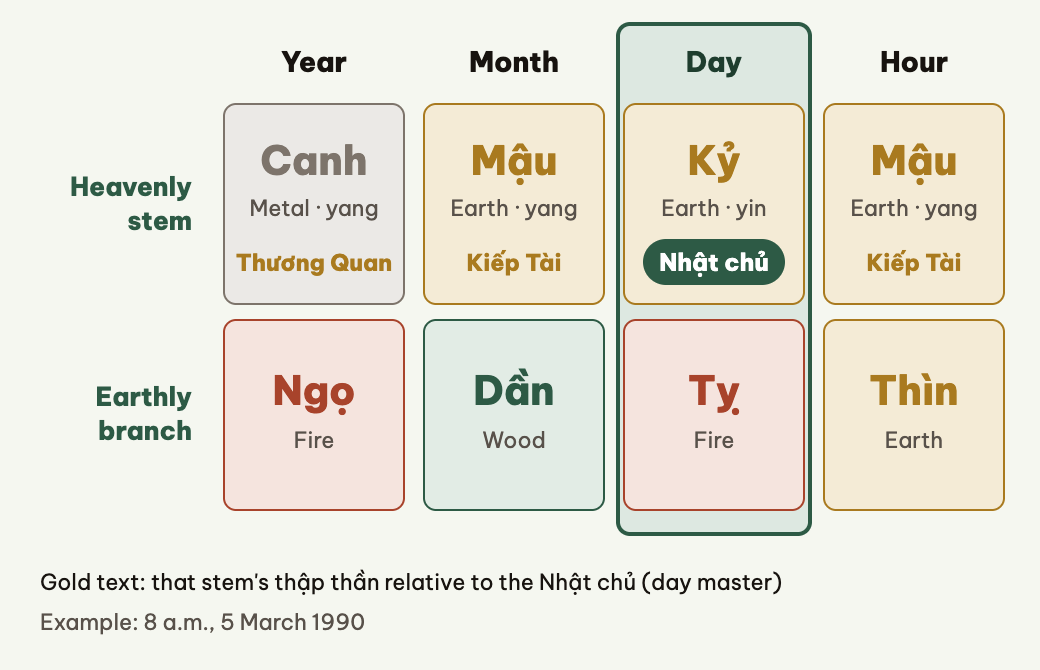
| Pillar | Number of characters | Components | Role |
|---|---|---|---|
| Year | 2 | 1 Heavenly Can, 1 Earthly Chi | Analyse the generating and controlling relationship with the Day Master |
| Month | 2 | 1 Heavenly Can, 1 Earthly Chi | Analyse the generating and controlling relationship with the Day Master; the Chi of this pillar is the month command |
| Day | 2 | 1 Heavenly Can, 1 Earthly Chi | Most important; the Can is the Day Master |
| Hour | 2 | 1 Heavenly Can, 1 Earthly Chi | Analyse the generating and controlling relationship with the Day Master |
When did Bát Tự originate?
Bát Tự did not appear all at once but evolved over many generations. In the Tang dynasty, Li Xuzhong used the Can and Chi of the year, month and day of birth to analyse fate, that is, three pillars with six characters. In the Song dynasty, Xu Ziping added the hour pillar and took the Can of the Day pillar as master, which is why this method is also called the Ziping method. The book Yuanhai Ziping, in the section "On the Day as Master", records exactly this shift: Tang dynasty books used the year to speak of nobility, lowliness, longevity and early death, and only in the Song dynasty did the Ziping theory of taking the day can as master appear.
There is one point on which the sources do not agree. Wikipedia (citing Ho 2003) says Li Xuzhong used three pillars, while the preface of Yuanhai Ziping writes "year, month, day, hour", that is, four pillars. As for the milestone of the shift from taking the year as master to taking the day as master, Yuanhai Ziping and Wikipedia both place it in the Song dynasty, but Xu Yuewu in the commentary to chapter 21 of Ziping Zhenquan says the method "underwent a change" only as late as the Ming dynasty Sanming Tonghui. Therefore, the safe statement is that this method took shape from the Song dynasty and gradually spread afterwards.
What are the four foundational books of Bát Tự?
Four books are usually regarded as the foundation of this method, each placing its emphasis in a different place:
- Yuanhai Ziping: compiled by Xu Dasheng in the Song dynasty, Ming dynasty woodblock edition.
- Sanming Tonghui: by Wan Minying in the Ming dynasty.
- Ziping Zhenquan: by Shen Xiaozhan in the Qing dynasty, with commentary by Xu Yuewu, taking the month command and the structure as its axis.
- Qiongtong Baojian (Dixitian Sui): with commentary by Ren Tieqiao, weighted towards momentum and rootedness.
Knowing this helps explain why the same chart can be read differently by different masters: each book stresses a different axis, so when reading a chart, where the emphasis is placed will produce a different reading.
What are the 10 Heavenly Cans and 12 Earthly Chis?
The Heavenly Cans consist of 10 elements: Giáp, Ất, Bính, Đinh, Mậu, Kỷ, Canh, Tân, Nhâm, Quý. Each Can is tied to one element in the Five Elements (Metal, Wood, Water, Fire, Earth) and to a Yin or Yang nature. The Earthly Chis consist of 12 elements corresponding to the 12 zodiac animals: Tý, Sửu, Dần, Mão, Thìn, Tỵ, Ngọ, Mùi, Thân, Dậu, Tuất, Hợi.
The table below records the element and yin-yang of each Can and each Chi. This yin-yang column is what you need to have ready before reading the Ten Gods section below, because the Ten Gods divide into Direct and Indirect precisely on the basis of whether this Can meets that Can with the same yin-yang sign or a different one.
| Can | Element | Yin-yang |
|---|---|---|
| Giáp | Wood | Yang |
| Ất | Wood | Yin |
| Bính | Fire | Yang |
| Đinh | Fire | Yin |
| Mậu | Earth | Yang |
| Kỷ | Earth | Yin |
| Canh | Metal | Yang |
| Tân | Metal | Yin |
| Nhâm | Water | Yang |
| Quý | Water | Yin |
| Chi | Element | Yin-yang |
|---|---|---|
| Tý | Water | Yang |
| Sửu | Earth | Yin |
| Dần | Wood | Yang |
| Mão | Wood | Yin |
| Thìn | Earth | Yang |
| Tỵ | Fire | Yin |
| Ngọ | Fire | Yang |
| Mùi | Earth | Yin |
| Thân | Metal | Yang |
| Dậu | Metal | Yin |
| Tuất | Earth | Yang |
| Hợi | Water | Yin |
Can and Chi combine in a cycle of 60 combinations called the Sixty Jiazi. This is the foundation for the way of calculating Can and Chi years and days still widely used in Vietnam today, for example "năm Giáp Thìn", "năm Ất Tỵ".
One point to remember right from here: each Earthly Chi is not purely one element. Inside it contains one or several Cans called hidden cans, with a main Can and secondary Cans. In later steps of analysis, especially the step of determining the structure, you must open the hidden cans of the month command before you can read which element truly holds power.
What tool is used to read the eight characters?
The tool for reading the eight characters is the Ten Gods, and it arises from the method of comparing each character with the Day Master. According to Yuanhai Ziping, there are five relationships, each relationship multiplied by the two yin-yang poles becomes ten gods: the element that controls me is Officer and Seven Killings, the element I control is Wealth, the element that generates me is Resource, the element I generate is Output and Hurt, the element of the same kind as me is Peer and Rob Wealth. Within each pair, yang meeting yin is Direct, yang meeting yang is Indirect. For details of each god, see the article The Ten Gods in Bát Tự: Meaning of the Ten Deity Stars in Four Pillars Astrology.
What is the Day Pillar, the Day Master?
In Bát Tự, the Day pillar is regarded as the most important. The Can of the Day pillar is called the Day Master, representing the person being read. The remaining pillars (Year, Month, Hour) are analysed in their generating and controlling relationships with the Day Master according to the Five Elements.
But analysing generation and control is only the opening step. To know whether this chart is strong or weak, you must pass through three gates of checking, and the first gate is not at the Day pillar.
Which life stages and relatives do the four pillars correspond to?
According to Yuanhai Ziping, the four pillars are likened to a tree: the year is the root, the month is the sprout (the outline), the day is the flower, the hour is the fruit. Also according to this book, each Can and Chi in a pillar corresponds to a palace position of the six relations: the year Can is the grandfather, the year Chi is the grandmother, the month Can is the father, the month Chi is the mother and siblings, the day Can is oneself, the day Chi is the wife (the book was written for male charts), the hour Can is the son, the hour Chi is the daughter.
The commentary edition of Ziping Zhenquan adds another way of looking at it, borrowing the four characters "yuan, heng, li, zhen" to assign to the four pillars: the year is yuan, the month is heng, the day is li, the hour is zhen. In this way, a good year and month means a good early period, a good day and hour means a good later period.
Why is the month in Bát Tự not counted from the first day of the lunar month?
Bát Tự changes months according to solar terms and not according to the first day of the lunar month, so this is a solar calculation even though it still uses Can and Chi (Wikipedia, entry Four Pillars of Destiny). The notes in Yuanhai Ziping also state clearly that the month begins from a term such as Lập Xuân (Start of Spring) or Kinh Trập (Awakening of Insects), not from the first day of the month. Therefore people born near a solar term boundary are very easily shifted in the month pillar if they look it up by an ordinary calendar.
Xu Yuewu, in chapter 3 of Ziping Zhenquan, also divides a year of 360 days among the five elements, 72 days for each element, with Earth alone flourishing for the last 18 days of each season, corresponding to Thìn, Tuất, Sửu, Mùi. This is a different way of looking at the distribution of elements in the year compared with a reading purely by solar terms.
Do the gods and stars and nayin decide the chart?
No. Ziping Zhenquan, chapter 21, titled "On gods and stars having no bearing on the structure", writes that once the structure is formed, even a pillar full of the Lonely Star does no harm, while once the structure is broken, even a pillar full of the Heavenly Virtue noble does not save it. Xu Yuewu adds in commentary that the gods and stars and nayin are an inheritance from the era of fate analysis that took the year as master.
This is worth noting because many lookup tools still print the gods and stars right next to the eight characters, making beginners easily think that this is the core part of the chart. In fact the main axis is still the month command, the structure, and the relationship with the Day Master.
How is a chart read from the eight characters to the final reading?
Qiongtong Baojian, chapter "Knowing Fate", cites a chart of Tân Mão, Đinh Dậu, Canh Ngọ, Bính Tý (the book says it is the fate of the Qianlong emperor) to illustrate the steps. The Day Master is Canh born in the month of Dậu, the four chis Tý, Ngọ, Mão, Dậu include all four cardinal positions, and the five elements lack Earth. Ren Tieqiao reads the two clash pairs Tý Ngọ and Mão Dậu as control and submission achieving the structure rather than as damage.
This example shows that the path from the eight characters to the reading must pass through several steps: determine the Day Master, examine the month command, look at the distribution of elements in the four chis, and only then read the clash and combination pairs. The same clash pair, placed in this structure, is control and submission; placed in another structure, it may break the structure.
What is Bát Tự (Four Pillars)? How to read destiny through the 8 Can and Chi characters, favourable or unfavourable when the self is strong or weak?
With Bát Tự (Four Pillars) and how to read destiny through the 8 Can and Chi characters, the month command is the starting point for measuring strength and decline, from which the structure is determined and the useful god chosen. When the self is strong, it is usually favourable if it plays the role of balancing, bridging, regulating temperature, or curing illness; when the self is weak, it becomes unfavourable if it is further suppressed. It only becomes the useful god when it correctly unties the knot of the chart. The case of a following structure is an exception, and is not read in this direction.
To understand fully, see What is the 'Useful God' (Yong Shen) in BaZi (Four Pillars)? and Strong self, weak self.
How do Bát Tự and Tử Vi differ?
Bát Tự reads the eight Can and Chi characters of the year, month, day and hour of birth and then analyses by generation and control, clash and combination around the Day Master. Tử Vi (Vietnamese astrology) places stars into 12 palaces and then reads by the combinations of stars and palaces. The two methods use two different frames of reference, so for the same person the two charts speak in two different ways.
A detailed comparison table between the two methods is in the Tử Vi pillar article: What Is Vietnamese Astrology? An Overview of Reading Methods and Foundational Concepts.
Can Bát Tự be read without knowing the birth hour?
Without a birth hour, only six characters of the three pillars of year, month and day remain, and the hour pillar is entirely missing. The hour pillar is the palace of children and of the later period, so without it the part about children and the final stage of life is left blank.
The method of "fixing the hour by events", that is, inferring the hour backwards from events that have already happened in life, is only an estimate. It can help narrow the range of hours, but it cannot replace the real birth hour, so the result should only be taken as a reference.
How is Bát Tự applied to choosing names, colours and directions?
From the chosen useful god, applications are drawn out in a fixed chain: which element the useful god is, which element the favourable god is, then choosing a name (using characters that carry the element of the useful god or the favourable god), choosing the colours of clothing and objects, choosing the direction of the house and the direction of the desk.
Two things need noting. First, because the useful god depends on how it is chosen, the applications also depend on that choice: change the method and you change the name, the colour and the direction too. The case of a following structure shows this even more clearly, because the useful god there is the element that is dominating, not the element that supports the Day Master. Second, these applications are derived from theory, not from verification, so they should be seen as a frame of reference for consultation, not as mandatory instructions.
Notes when looking things up
Establishing an accurate Bát Tự chart requires correctly converting the Can and Chi of the year, month, day and hour of birth, in which the day Can and Chi is the most complex part in terms of calculation (it involves the Julian day number). Users of lookup tools should prefer sources that have been cross-checked against a reputable perpetual calendar.
As for how to look it up, only the year pillar and the day pillar are looked up directly along the 60 Jiazi cycle. The Can of the month pillar must be inferred from the year can: according to the Five Tigers Escaping method, in a Canh year the Dần month is Mậu Dần, and the following months are counted forward. The Can of the hour pillar must be inferred from the day can: according to the Five Rats Escaping method, on a Bính or Tân day the Tý hour is Mậu Tý, and therefore the Thìn hour is Nhâm Thìn. The full step-by-step method is in the article Building the Four Pillars of BaZi from birth date and time: the year pillar changes at Lập Xuân, the month pillar changes at the solar term, the day pillar follows the 60-cycle, and the hour stem is derived from the day stem.
One more point: most tools return only the 8 characters, not strength and decline, structure and useful god. Those three steps are the analytical part, which must be done by hand, and that is precisely where the schools diverge as said above.
Articles in the Bát Tự topic
- Direct Wealth in BaZi Ten Gods: Meaning and Application in Destiny Analysis
- Direct Resource (Zheng Yin) in the Ten Gods of BaZi: Meaning and Application in Destiny Analysis
- Rob Wealth (Jie Cai) in the Ten Gods of BaZi - Meaning and Application in Fortune Telling
- Heavenly Talent (Thiên Tài) in BaZi Ten Gods: Meaning and Application in Destiny Analysis
- Heavenly Seal (Indirect Resource) in the Ten Gods of BaZi - Meaning and Application in Destiny Analysis
- Hurting Officer in BaZi Ten Gods - Meaning and Application in Destiny Analysis
- Seven Killings in BaZi Ten Gods - Meaning and Application in Destiny Analysis
- The Ten Gods in Bát Tự: Meaning of the Ten Deity Stars in Four Pillars Astrology
- Eating God in the Ten Gods of BaZi: Meaning and Application in Destiny Analysis
- Bi Jian in the Ten Gods of BaZi - Meaning and Application in Fortune Telling
- The Twelve Stages of Growth in Bát Tự: A Life-Cycle Model of Rise and Decline
Topic overview article: Bát Tự


