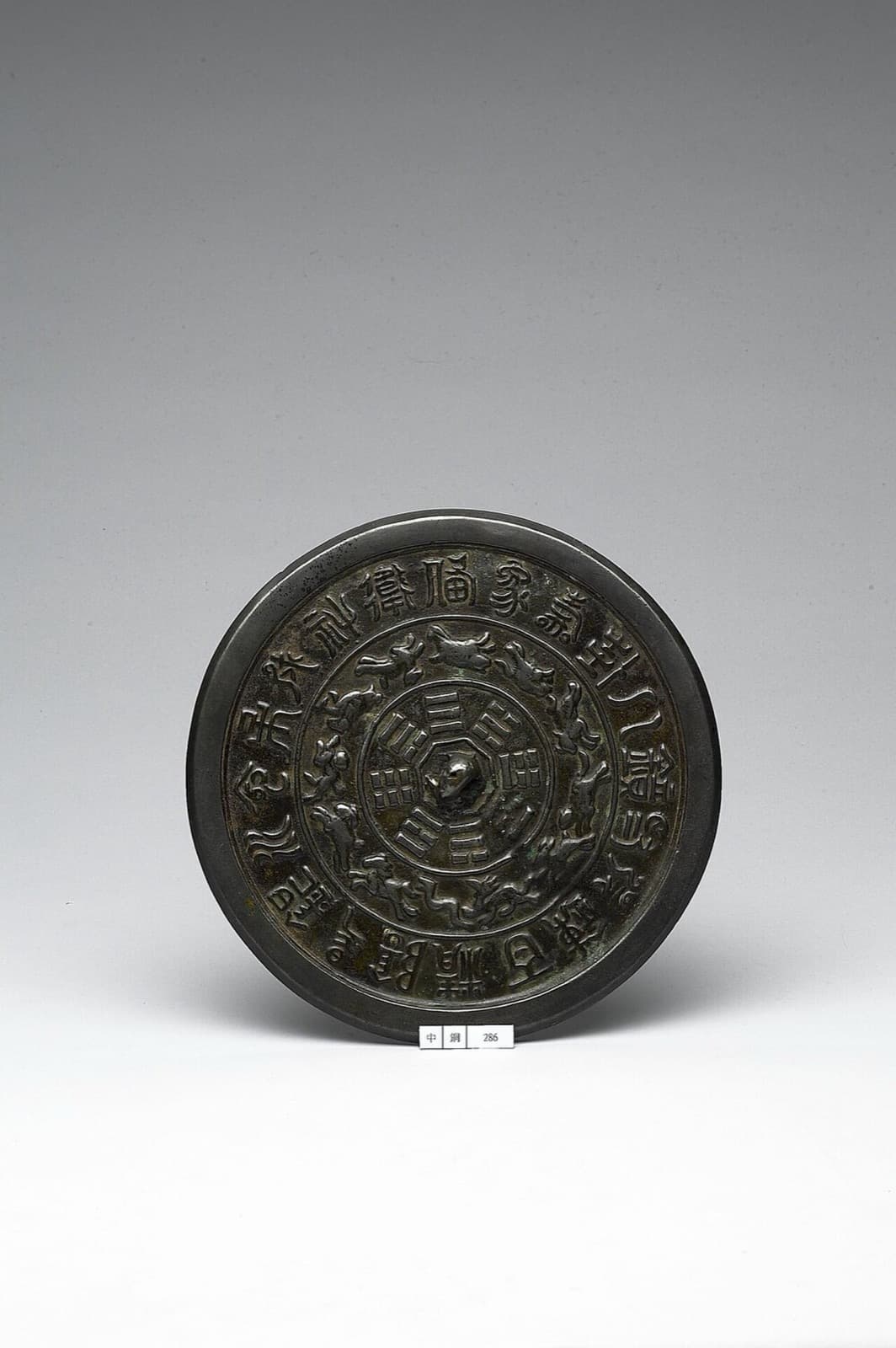
What are the Four Symbols and why are there four?
The Four Symbols, also called Tu Tuong or Four Sacred Beasts, are Thanh Long, Bach Ho, Chu Tuoc and Huyen Vu. In ancient astronomy they are four groups of constellations guarding the four directions: Thanh Long the East, Chu Tuoc the South, Bach Ho the West, Huyen Vu the North. Each is tied to a season, a colour and an element in Ngu Hanh: Thanh Long to Wood, Chu Tuoc to Fire, Bach Ho to Metal, Huyen Vu to Water, while the centre belongs to Earth and is usually assigned to Hoang Long.
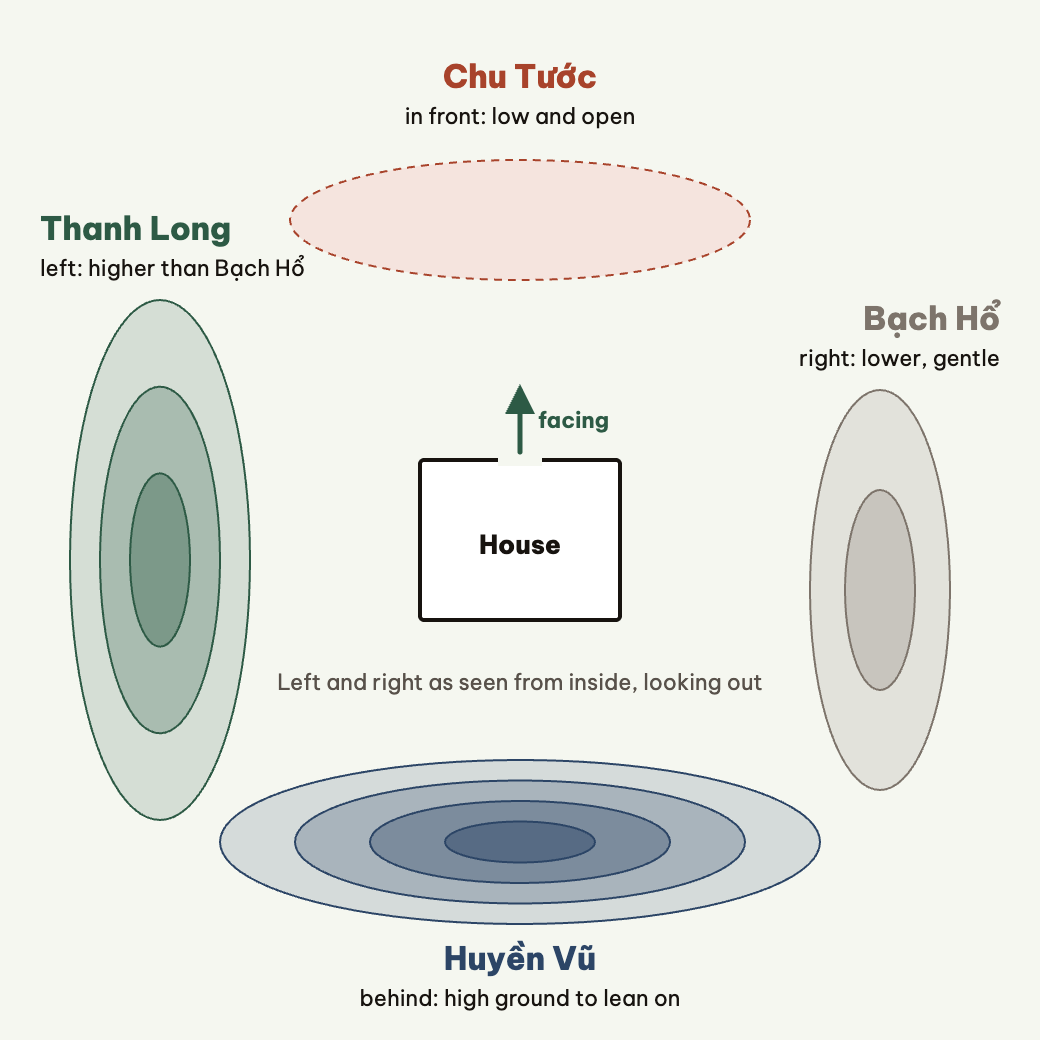
In feng shui geography the four are borrowed as names for the four land forms around the huye. According to Nhap mon loan dau: tam long diem huye, the East matches Thanh Long, the West Bach Ho, the South Chu Tuoc and the North Huyen Vu. But applied to a specific house the common naming follows the position relative to a person standing and looking out, not the compass. This is the easiest point to confuse and the most debated.
Is Thanh Long always on the left or always in the East?
Thanh Long is the land form on the left of the huye, and the left is defined by a person standing at the main door looking out. That means if you stand inside looking out, the ridge, watercourse or block of buildings on your left hand is Thanh Long, whatever compass direction it lies in. This reading matches Nhap mon loan dau, where long and ho are named by the left and right of the huye, while East and West are only astronomical assignments.
Yet one school reads the four by fixed direction, tying Thanh Long to true East, Bach Ho to true West, Chu Tuoc to true South and Huyen Vu to true North, based on the sitting and facing of the house. That school usually belongs to lineages influenced by Duong Trach Tam Yeu and old loan dau texts, where long and ho are judged by where the long mach comes from. The sitting facing school holds that long and ho must be set by the rear front axis of the house, so Huyen Vu sits behind by the sitting, Chu Tuoc in front by the facing, and Thanh Long and Bach Ho are the two sides of that axis. The two readings give different results when the house does not face true South.
What both schools share is that no one treats the four as real animals. They are figurative names for four kinds of terrain: a raised ridge, a winding watercourse, a high mound, a hollow. According to Tuyen tap bai viet Phong Thuy chon loc so 2, the left usually holds Thanh Long as low hills or a winding stream, the right holds Bach Ho with similar terrain, behind is Huyen Vu as a mountain or high mound, and in front is Chu Tuoc as flat low ground or a watercourse.
Table of the four: position, good shape, bad shape and urban substitutes
| Symbol | Position relative to one looking out | Good shape | Bad shape | Substitute in townhouses and flats |
|---|---|---|---|---|
| Thanh Long | Left | Winding, embracing, moderate height, with flowing water or trees | Too long, too short, a well or stagnant pond, bare ground | Row of houses on the left lower than yours, tree line, green balcony, landscape pond |
| Bach Ho | Right | Full, firm, embracing the huye like an arm | Squatting, turning its back, sharp mountain pointing at the huye | Row of houses on the right, fence, low structures, no power pole or antenna pointing in |
| Huyen Vu | Behind | High, thick, firm, slightly bowing, with small mounds sheltering | Deep abyss, cave, water flowing outward, too towering and causing instability | Solid rear wall, tall building behind, wooded hill, no back door opening straight onto a large void |
| Chu Tuoc | In front | Flat, spacious, slightly raised, with gathered water, with people passing | Too high blocking the front, no court, deep hollow, water flowing straight away | Front yard, park, landscape lake, road with moderate foot traffic |
How are Huyen Vu and Chu Tuoc judged?
Huyen Vu is the backrest, so the general rule is stillness not movement, high and thick not open. Nhap mon loan dau quotes an old saying: Huyen Vu needs to bow its head, if it does not bow it is hard to bury, and explains that Huyen Vu should be still, for if it moves the mach has not stopped and the huye is not formed. Tuyen tap bai viet Phong Thuy chon loc so 2 also cites Chinh tong Duong Cong phong thuy hoc giang nghia with the same sense: Huyen Vu must bow low, meaning the terrain behind should descend or have small sheltering mounds, and one should not raise a wall too high and create a sense of instability. The same book warns that a deep abyss behind the huye is considered unfavourable, and if Huyen Vu lets water flow outward the khi is drained, often tied to decline.
Chu Tuoc is the space in front, so the rule is the reverse: it should move, with living khi circulating. Nhap mon loan dau records an old comment that Chu Tuoc, though far, still faces the huye, and being slightly higher is no offence as long as it is not disrespectful; Chu Tuoc should move and not be still, able to come from afar to wrap and hold feeling for the huye. The same book says that if Chu Tuoc has a high mountain beside it, wrapping like the character pham, or courting toward the huye, it is a good formation; but if Chu Tuoc does not court or guard, it is useless. In other words the front needs openness, gathered khi and passing people, not mere emptiness.
How are Long and Ho judged when high or low, embracing or leaving?
Long and Ho are the two arms of the land formation, so the common question is which side should be higher. According to the old view cited in Tuyen tap bai viet Phong Thuy chon loc so 1, the right is yin and the left is yang; the yin side is good when plump and not too short, the yang side is good when curving back and not too long. The book also cites the line Long bao ho toi quy, ho bao long vi toan, meaning the finest terrain is reached when Thanh Long wraps Bach Ho into an arc of shelter; conversely, if Bach Ho turns back to embrace Thanh Long, the terrain is not complete. The book also notes the reversed case: if long comes from the left but runs too far to the left it is a reversed long, and if ho comes from the right but runs too far to the right it is a reversed ho, and then khi scatters and does not gather at the huye.
On the shape of Bach Ho, Tuyen tap bai viet Phong Thuy chon loc so 2 records that Bach Ho is called ham thi if it squats, or cu vi chi tat chu if it turns its back, both bad omens. But if Bach Ho has the hoan bao form, embracing the huye like an arm or a bent elbow, it means protection and shelter, making the long mach firm. For Thanh Long the same book gives a strong warning: Thanh Long with a well means the second son dies, Thanh Long with a pond means the second son is poor, meaning stagnant water on the left is unfavourable. These are old sayings, so they should be read as warnings about terrain, not hard predictions.
The debate over whether Long should be higher than Ho is still unsettled. Some books lean toward Long higher than Ho, seeing it as yang overcoming yin, governing living khi and benefactors. Others stress balance: Nhap mon loan dau notes that Huyen Vu, Chu Tuoc, Thanh Long and Bach Ho must harmonise for good fortune, and that leaving one side high and one low, unable to go together, must breed misfortune, citing the line that Huyen Vu high and Chu Tuoc low is unfavourable. So there are at least two parallel readings: one leaning to a hierarchy of Long over Ho, one leaning to balance among the four. Readers should know which convention they follow rather than mixing the two.
Where does the minh duong sit among the four?
The minh duong is the open ground in front of the huye, inside the embrace of long and ho and right below the sightline of Chu Tuoc. In other words, if the four are four guarding doors, the minh duong is the courtyard in the middle, in front, where khi gathers before entering the huye. Tuyen tap bai viet Phong Thuy chon loc so 1 defines the minh duong not only as a water holder but as a wide, open space where khi circulates and spreads; it acts as a mirror that draws good khi and pushes back bad khi. The book cites an old image: a flat, square minh duong is likened to an open palm receiving wealth, or a bag full of jewels, with the line hinh nhu an chuong, tat chu mai dien; the nhuoc tu nang, dinh gia tich ngoc.
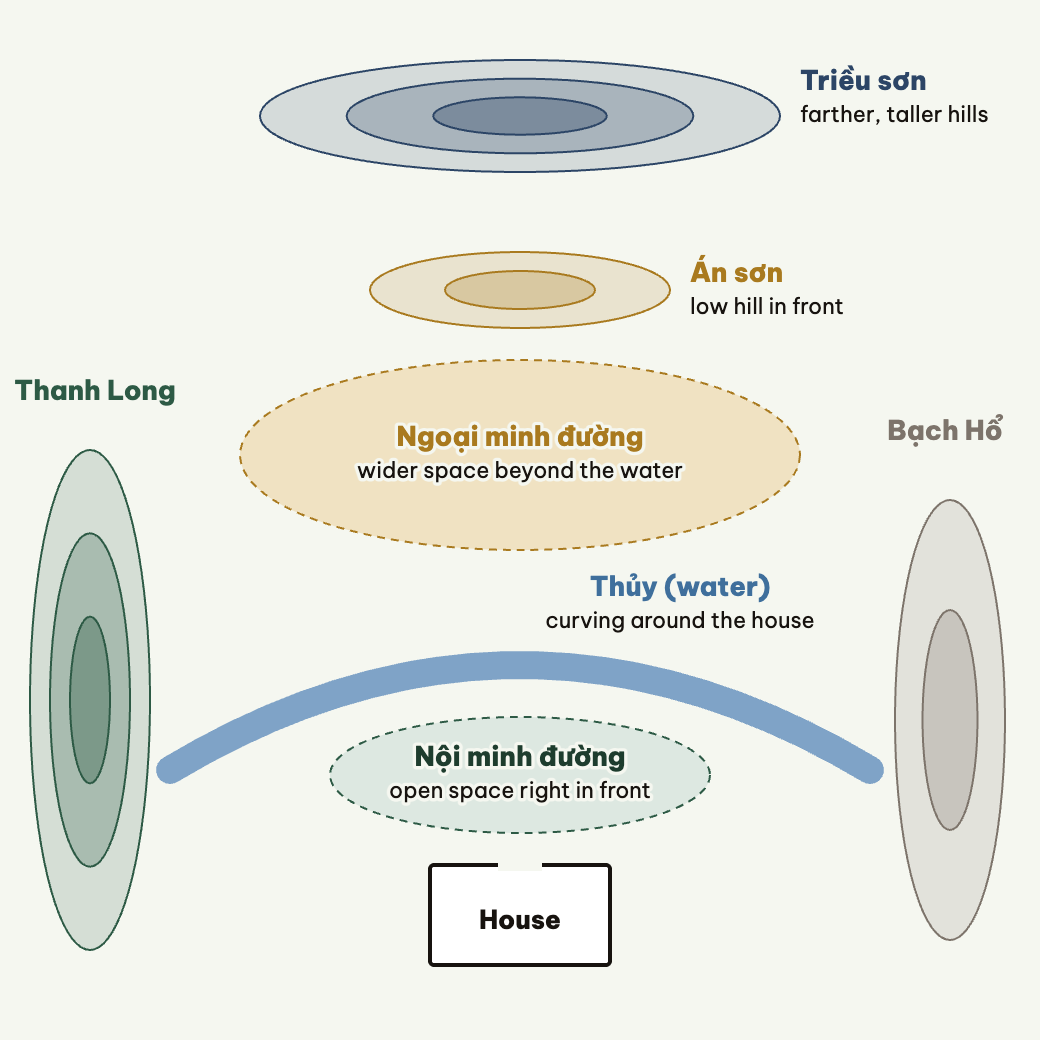
On distance, Tuyen tap bai viet Phong Thuy chon loc so 1 cites duong can toc phat, duong vien tri phat: a minh duong near the huye brings early prosperity, far brings late prosperity. This speaks of pace, not a fixed timing.
Three layers of minh duong: inner, middle and outer
| Layer | Position | Role |
|---|---|---|
| Inner minh duong | Ground inside the embrace of long, ho and sa, closest to the huye | Where khi gathers directly before the huye, nearest to the focal point |
| Middle minh duong | A wider area between the outer long, outer ho and the inner thanh long, bach ho | Where khi is balanced between layers, deciding the breadth and depth of the land formation |
| Outer minh duong | Land beyond the middle minh duong, wrapped by outer long and outer ho in a large ring | Where khi is received from afar, giving an overall frame to the whole formation |
This three layer division is recorded in Tuyen tap bai viet Phong Thuy chon loc so 1 and so 4, based on a multi tiered long ho structure. The inner minh duong is nearest the huye, inside the first long ho layer. The middle minh duong is the main area, between the outer long and outer ho and the inner thanh long and bach ho. The outer minh duong is wider, embraced by the outer long and outer ho in a large ring. Each layer has its own role yet all help harmonise the whole terrain. When reading a land formation people usually go from outer to inner to see whether khi is led to the huye, not just look at one empty patch in front of the house.
How do you read the four in townhouses and flats?
In townhouses and flats the four are no longer real mountains, hills and rivers but are mapped onto surrounding structures. The row on the left plays Thanh Long, the row on the right Bach Ho, a tall building or rear wall behind plays Huyen Vu, and the front yard, road, park or landscape lake plays Chu Tuoc. The table above lists the corresponding substitute for each.
The reading rules still hold: Thanh Long should curve, be lower than or level with your house, and avoid power poles, antennas or sharp objects pointing in. Bach Ho should be full and firm, avoiding a much taller building pressing down or a sharp corner aimed straight at it. Huyen Vu should have a backing, avoiding a back door opening straight onto a large void or a lift opposite. Chu Tuoc should be open with passing people, avoiding a high wall right in front or a main door facing the opposite main door. In flats, the corridor and balcony are usually seen as the inner minh duong, the shared yard and internal road as the middle minh duong, and the big road outside as the outer minh duong.
It should be said plainly: this is figurative mapping, not measurement. Tuyen tap bai viet Phong Thuy chon loc so 4 notes that applying feng shui knowledge needs calm and realism, based on observing nature and the laws of operation, and should not become a rigid formula. The Hue citadel is a classic example of a land formation planned by the four, with the Huong river as Chu Tuoc, Ngu Binh mount as the front an, the ranges behind as Huyen Vu and long and ho on the two sides; the article on the capital will analyse it in more detail.
Points still debated between schools
At least three points are unsettled. The first is whether the four are fixed by direction or by sitting and facing, as above. The second is the hierarchy of Long and Ho: one school leans to Long higher than Ho, another to balance among the four. The third is the weight of Chu Tuoc: Nhap mon loan dau stresses that Chu Tuoc should move and have a court, while some other books treat Chu Tuoc as only an outer layer, not as decisive as Huyen Vu and long ho. Readers should treat these as different conventions, not a single truth, and should not use the four to assert with certainty about a family's wealth or health.