


What is Nguyệt Lệnh?
Nguyệt Lệnh (月令) is the Can Chi of the Month Pillar in Bát Tự Tứ Trụ, representing the seasonal climate of the birth month and playing a primary role when assessing the strength or weakness of the Nhật Chủ. The Month Pillar changes according to solar terms (Lập Xuân, Kinh Trập, Thanh Minh, and so on), not according to the first day of the lunar month.
Also called: syllabus · month order · monthly command
What is Nguyệt Lệnh?
Nguyệt Lệnh (月令) combines "nguyệt" (month) and "lệnh" (command, decree), and refers to the Can Chi (Heavenly Stem and Earthly Branch) of the Month Pillar in a Bát Tự (BaZi) chart. The Month Pillar is determined by solar terms, not by the first day of the lunar month: the Can Chi month changes on the day of the solar term transition (Lập Xuân, Kinh Trập, Thanh Minh, and so on), so anyone born close to a solar term transition needs to check the exact transition time for that year. The Stem of the Month Pillar is derived from the Stem of the Year by the Ngũ Hổ Độn rule, and combines with the month Branch to form its own Stem-Branch pair. The Branch of the Month Pillar is Nguyệt Lệnh in the narrow sense, while the broader usage includes the month Stem as well.
According to the division used in some modern books, the Month Pillar is often associated with roughly the period from age 16 to 30, and it also reflects social environment, career and parents. Note that books do not divide the age periods for the pillars in exactly the same way, so this is only one reference reading. Nguyệt Lệnh therefore carries both a temporal meaning and the meaning of the social space of the person being read.
Why is Nguyệt Lệnh valued?
In many Bát Tự schools, Nguyệt Lệnh is regarded as the most important factor when assessing the strength or weakness of the Day Master. The reason is that the month Branch reflects the solar term, meaning the climate and the agricultural season at the time of birth. Each month Earthly Branch is tied to a specific seasonal command, determining which of the five phases holds power in that month.
Trích Thiên Tủy (traditionally attributed to Liu Ji), in the chapter on the month command, says: "the month command is the framework, like a house; the spirit and the original qi that are in operation are the orientation of the house, and cannot be left unexamined." The commentary in the book gives the example of the Dần month: for the first seven days after Lập Xuân, Mậu earth is in operation; from the eighth to the fourteenth day, Bính fire is in operation; from the fifteenth day onward, Giáp wood is in operation. Uyên Hải Tử Bình (edited by Dương Tông, Ming dynasty), in the section Discussing the Month Command, also concludes: "take the day as master, the year as root, the month as framework, the hour as assistant."
When the Day Master shares the phase that is prosperous in the month, it is said to "obtain the command," and is usually judged to have a solid foundation. Conversely, if the Day Master is controlled or drained by Nguyệt Lệnh, the reading pays closer attention to the remaining pillars to compensate.
How is Nguyệt Lệnh used in reading a chart?
When constructing a chart, the Month Pillar is determined first, and only then are the relations between Nguyệt Lệnh and the Day Master and the other pillars examined. Nguyệt Lệnh is usually used to:
- Assess the degree of strength or weakness of the Day Master.
- Determine the Useful God and the Favorable God according to the birth season.
- Examine interactions with other Branches through combination, clash, punishment and harm.
- Suggest social context, occupation and the coming-of-age period.
Note that this is traditional knowledge of a reference nature, not verified by science. Readers should approach it as a cultural symbol system, and should not use it in place of making important decisions in life.
Distinguishing it from easily confused terms
Nguyệt Lệnh is easily confused with "monthly luck" and "fleeting month." Monthly luck is the month-by-month fortune within the major luck system, while the fleeting month is the current year's month under examination. Nguyệt Lệnh, by contrast, is fixed in the natal chart and does not change over time.
Nguyệt Lệnh is also different from "solar terms" in general. Solar terms are the time markers of the year, whereas Nguyệt Lệnh is the specific month Branch tied to a solar term in a person's chart.
How do the schools understand it differently?
- The reading that emphasizes the month Branch: Stresses that the Branch of the Month Pillar is the factor deciding the strength or weakness of the Day Master, and treats the month Stem as merely supportive or supplementary information.
- The reading that emphasizes both the month Stem and Branch: Treats Nguyệt Lệnh as including both the Stem and the Branch of the Month Pillar, with both factors taking part in the reading and able to interact with each other through combination and clash.
- The reading that combines solar terms and social context: Uses Nguyệt Lệnh both to examine the climate of the birth season and to read family background, occupation and the coming-of-age period.
Related articles
Table of the twelve month commands by solar term
| Lunar month usually falls in | Month Branch | Solar term opening the month | Solar longitude | Phase of the month Branch |
|---|---|---|---|---|
| 1 | Dần | Lập Xuân | 315° | Wood |
| 2 | Mão | Kinh Trập | 345° | Wood |
| 3 | Thìn | Thanh Minh | 15° | Earth |
| 4 | Tỵ | Lập Hạ | 45° | Fire |
| 5 | Ngọ | Mang Chủng | 75° | Fire |
| 6 | Mùi | Tiểu Thử | 105° | Earth |
| 7 | Thân | Lập Thu | 135° | Metal |
| 8 | Dậu | Bạch Lộ | 165° | Metal |
| 9 | Tuất | Hàn Lộ | 195° | Earth |
| 10 | Hợi | Lập Đông | 225° | Water |
| 11 | Tý | Đại Tuyết | 255° | Water |
| 12 | Sửu | Tiểu Hàn | 285° | Earth |
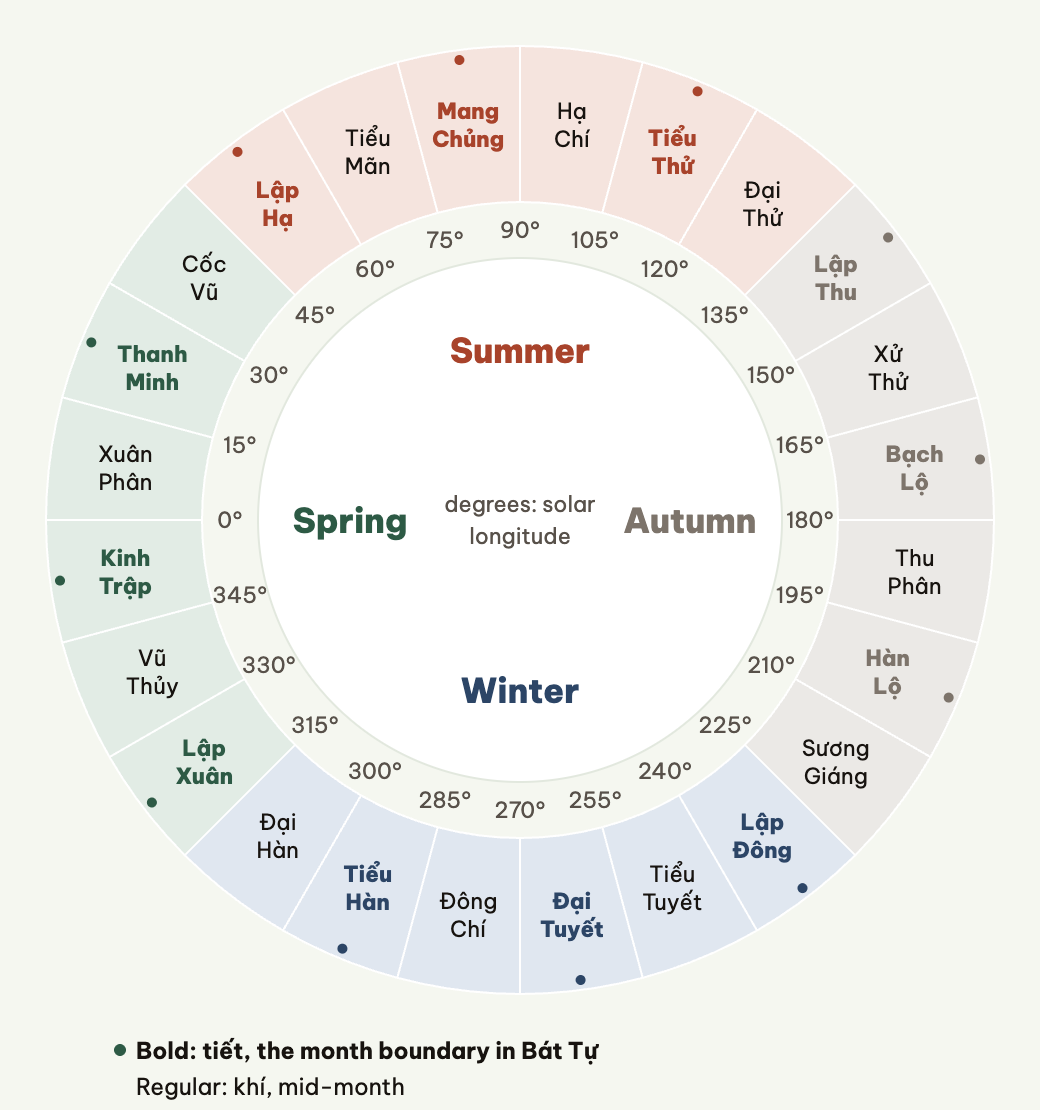
The month in Bát Tự changes on the day of the solar term transition, not on the first day of the lunar month, so the lunar month column is only the month that usually coincides, not the boundary. Anyone born close to a solar term transition needs to check the exact transition time for that year.
The figures in the table match the results of the lookup tools on Nhật Nguyệt.


