



Image: Suzuki Harunobu, Art Institute of Chicago (CC0/Public Domain)
TL;DR: The Month Pillar is one of the four pillars in BaZi, representing ages 16-30 and social environment, career. It is determined by the lunar birth month and the Year Stem, following the Can Chi calendar rules. It is also called 'Moon Order' - holding the climate of the season, the strongest energy source in the Four Pillars.
What is the Month Pillar in Bát Tự (Four Pillars)?
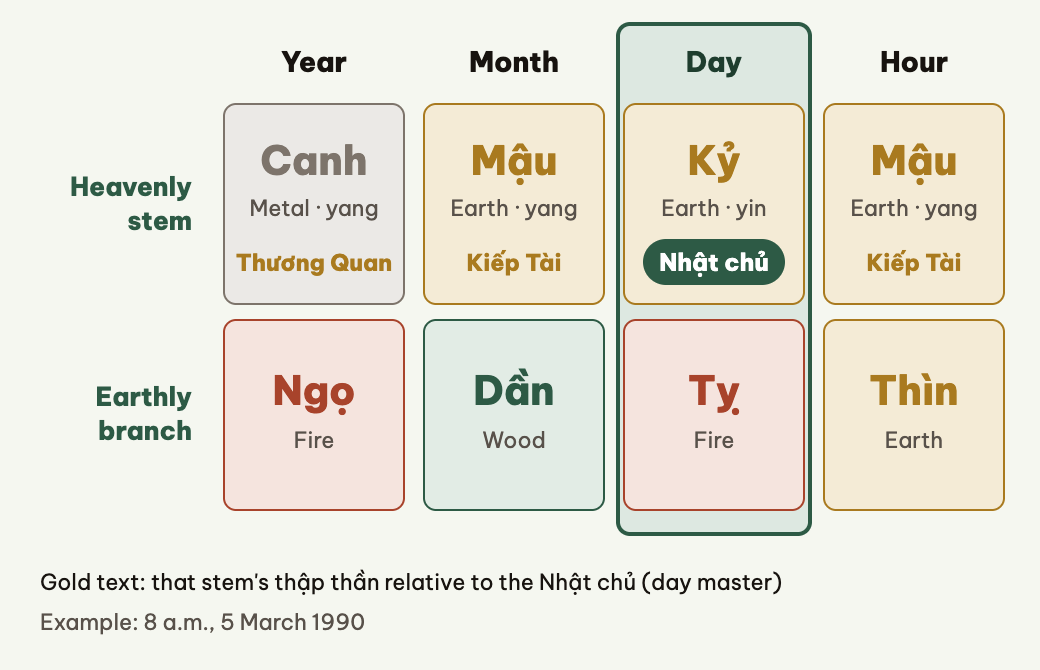
The Month Pillar is the second of the four pillars, Year, Month, Day and Hour, each pillar made up of one Heavenly Stem and one Earthly Branch. What sets it apart from the other pillars is its Branch, the month command (nguyệt lệnh), which is regarded as the first measure when reading a chart. This article follows this order: identifying the Month Pillar, assessing strength or weakness, taking the structure (cách cục), choosing the useful god (dụng thần), recognising two special cases, the following structure (tòng cách) and kiến lộc, dương nhận, then stopping at the point where the schools disagree.
How does the Month Pillar determine strength or weakness and the useful god?
The Month Pillar is the pillar that holds the month command, so it is the first place that decides whether the Day Master is strong or weak. When the self is strong, the Month Pillar usually plays the role of a taboo if it adds more energy to the Day Master, but it becomes favourable if it carries an element that drains or controls. When the self is weak, the Month Pillar is favourable if it supports the Day Master, and a taboo if it drains the Day Master further. The Month Pillar becomes the useful god when its element is exactly the element needed to rebalance the chart, not merely because it holds the structure. The choice between supporting and restraining, smoothing the flow, regulating the climate or treating the illness must all be checked against the Month Pillar first, while the following structure is the exception when the Day Master has no support left. To grasp this fully, see What is the 'Useful God' (Yong Shen) in BaZi (Four Pillars)? and Strong self, weak self.
How is the Month Pillar determined?
It is based on the solar terms (tiết khí) and the Heavenly Stem of the birth year, not on the first day of the lunar month.
Each year has 12 months, and each month corresponds to a fixed Earthly Branch. The boundaries between months are the solar terms: Lập Xuân, Kinh Trập, Thanh Minh, Lập Hạ, Mang Chủng, Tiểu Thử, Lập Thu, Bạch Lộ, Hàn Lộ, Lập Đông, Đại Tuyết, Tiểu Hàn. So a person born before a solar term still belongs to the previous month, even if the lunar calendar has already turned to the new month.
To determine the Stem of the Month Pillar, we use the five tigers table (ngũ hổ độn) based on the Stem of the Year:
| Year stem | Stem of the Dần month |
|---|---|
| Giáp or Kỷ | Bính |
| Ất or Canh | Mậu |
| Bính or Tân | Canh |
| Đinh or Nhâm | Nhâm |
| Mậu or Quý | Giáp |
Once the Stem of the Dần month is known, the following months go in ascending order of the Stem cycle. For example, someone born in the Thân month of 2024, the year of Giáp Thìn: the year is Giáp so the Dần month has the Stem Bính, counting on to the Thân month as the seventh month gives the Stem Nhâm, so the Month Pillar is Nhâm Thân.
How does the Month Pillar differ from an ordinary birth month?
It differs in that it is cut by solar terms, not by the first day of the lunar month. A person born on 5 February 2024 in the solar calendar is, by the lunar calendar, the 26th day of the twelfth month of the year Quý Mão, but because Lập Xuân has already passed, the Month Pillar is counted as the Dần month of the year Giáp Thìn. If we look only at the lunar calendar, we will assign both the month Branch and the month Stem wrongly, and go wrong from the month command step onward.
What is the commanding human element (nhân nguyên tư lệnh) and why can the same Month Pillar differ?
The commanding human element is the stem actually holding power within the month Branch on the exact day of birth, not the month stem written on the pillar. The month Branch usually stores several stems, and each stem holds command for a number of days counted from the solar term that opens that month. So two people with the same Month Pillar can still have a different stem holding command, and the conclusions can differ.
According to Trích Thiên Tủy, chapter on the month command, for the Dần month: the first 7 days after Lập Xuân are commanded by Mậu earth, the next 8 days by Bính fire, and the last 15 days by Giáp wood. Uyên Hải Tử Bình gives the example of the Tý month: born from the 1st to the 10th day, take Nhâm; from the 11th day onward, take Quý.
Trích Thiên Tủy also gives examples showing that merely changing the day of birth within the month changes the whole conclusion. One case is Giáp Tuất, Bính Dần, Mậu Dần, Bính Thìn, born 15 days after Lập Xuân, when Giáp holds command, Bính transforms the Officer into support for the self, read as both fame and profit. Another case is Giáp Tuất, Bính Dần, Mậu Thìn, Canh Thân, born 6 days after Lập Xuân, when Mậu holds command, the wood is still young, the earth is cold and needs fire, and the Thân hour both drains the self's energy and places Bính on the ground of extinction, read as a lifetime of hardship. The year and month stems and branches are the same, yet the outcomes are opposite.
Also in Trích Thiên Tủy, the month command is likened to a house while the human element is like the house's orientation. When comparing the month stem that surfaces with the human element currently holding command: if the stem is weak and the branch is strong, or the stem is strong and the branch is weak, the fortune and misfortune are equal; if both are strong, for example the Dần month with Bính holding command and no water, then the blessing is great; if both are weak, for example the Dần month with Mậu holding command while the stem surfaces wood and the branch stores water, then disaster arises.
How should the Thìn, Tuất, Sửu, Mùi months (mixed qi) be read?
The four months Thìn, Tuất, Sửu, Mùi are called mixed qi because the month Branch stores several stems of different elements, not one pure qi. Tử Bình Chân Thuyên chapter 16 teaches taking whichever stem surfaces in the heavenly stems or forms a combination as the useful one. For example, Giáp born in the Thìn month: if Mậu surfaces, use Indirect Wealth; if Quý surfaces, use Direct Resource; if Ất surfaces, it is the Month Robbery, and meeting Thân and Tý, use water Resource; if nothing surfaces and nothing combines, read according to earth. Chapter 17 of the same book refutes the theory that Wealth and Officer entering the store must be clashed to emerge, because clashing the Branch of a four-store month easily uproots the very stem that has surfaced.
How severe is a clash on the Month Pillar?
A clash on the Month Pillar is not equally severe in every case. Từ Nhạc Ngô in the commentary on chapter 25 writes that clashing the key point is more important than clashing the other pillars, among which Dần Thân Tị Hợi clashes are severe because the qi is still young, Tý Ngọ Mão Dậu clashes succeed or fail depending on the chart, while Thìn Tuất Sửu Mùi clashes are light. This point cites the sense of Trích Thiên Tủy: the birthplace stirs, the store should be opened, meeting a clash in a defeated position requires careful weighing.
Which palace position and age markers is the Month Pillar tied to?
Tying palace positions and age markers to the Month Pillar has a basis in the books, but it is not consistent between them. Uyên Hải Tử Bình records that the month stem is the father, the month branch is the mother and siblings, and the month is the key point; if the Month Pillar carries an Officer star or a Resource, the person is upright and intelligent, and if the month command holds the useful god, one receives the strength of one's parents. Tử Bình Chân Thuyên chapter 23 calls the month branch the palace of the parents. Từ Nhạc Ngô in the commentary on chapter 21 divides the year as origin, the month as prosperity, the day as advantage, the hour as firmness, each part 15 years, and this is the root of assigning the Month Pillar to roughly ages 16 to 30.
It should be said clearly: the 16 to 30 marker is a convention of dividing into 15-year parts, not a calculation derived from the month command.
What does the Month Pillar have to do with the Major Cycles?
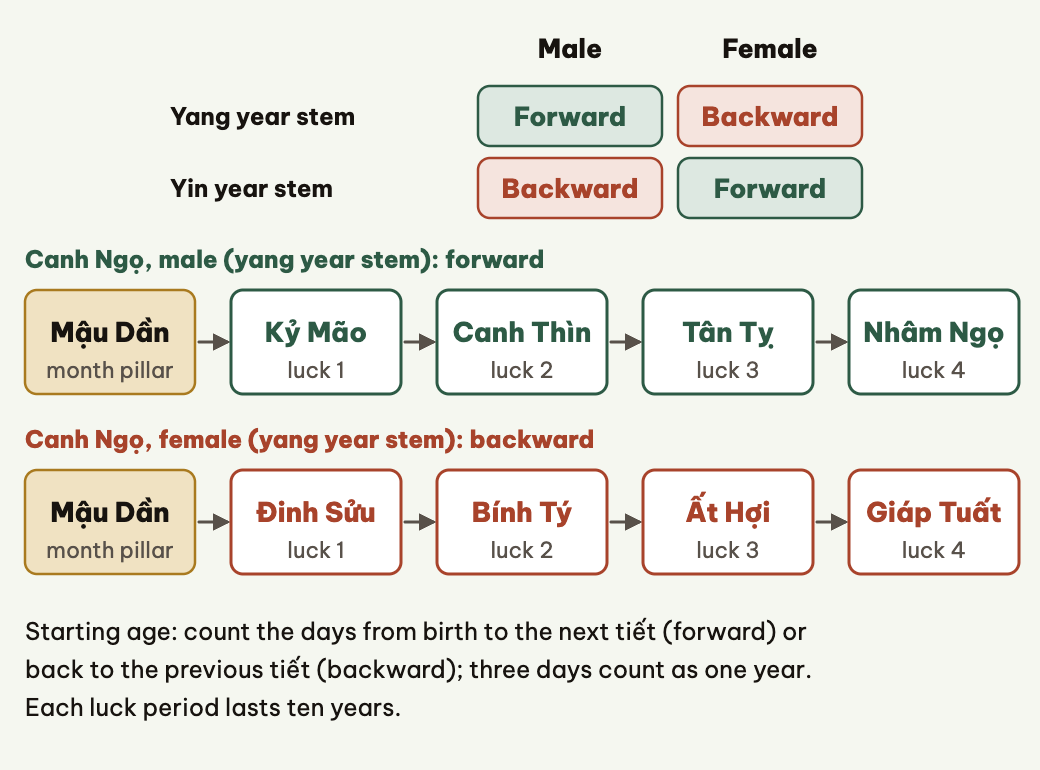
Uyên Hải Tử Bình, in the section On the Major Cycles, writes that the month command is also a heavenly origin, and the cycles begin from the month pillar; the book likens the Month Pillar to a seedling and each change of cycle to grafting a tree. Where the cycle changes direction, that is Sửu to Dần, Thìn to Tị, Mùi to Thân, Tuất to Hợi, it is called turning the corner and is the moment to look closely, while Dần Mão Thìn as one continuous qi is not counted as a change.
What meaning does the Month Pillar carry in interpretation?
The Month Pillar is usually assigned to the social environment and career, to the palace of the parents in some schools, and to the period of roughly 16 to 30 years of age. Assigning palaces by age is a convention of each school, not a fact derived from the month command, so these two layers should be kept separate when reading.
Technically, the Month Pillar is also the anchor point for calculating the Major Cycles, the ten-year cycles of fortune. The Stem of the Month Pillar is used as the starting point, combined with gender and whether the year is Yang or Yin to work out the forward or reverse direction. This is why getting the Month Pillar wrong means going wrong not only in the reading of character, but in the entire timeline of the chart.
In what order should it be applied in practice?
Following the order set out above: determine the Month Pillar first, because it gives the month command. From the month command, measure strength or weakness by obtaining command, obtaining ground, obtaining force. From strength or weakness and the month command, take the structure, and at the same time check whether the month Branch falls on kiến lộc or dương nhận of the Day Stem. Before choosing the useful god, check whether the chart falls into a following structure, because if it does, the rule of choice changes entirely. If it does not fall into a following structure, choose the useful god by one of the four methods, stating clearly which method is being used. Only then consider factors such as clash or combination of the Month Pillar with the other pillars.
One point to note: if the Month Pillar is clashed by the Branch of the Year pillar or the Day pillar, the month command is shaken, and every conclusion drawn from it is weakened. If the Stem and Branch of the Month Pillar combine with each other, the month's qi is considered more harmonious. This is the final layer of checking, not a layer that replaces the main steps.
Where the books disagree about the Month Pillar
There are a few points where both sides should be stated rather than quietly choosing one. First, the number of days of the commanding human element is not consistent: Trích Thiên Tủy gives the Dần month as having 7 days of Mậu earth at the start of the month, while the hidden verse in Uyên Hải Tử Bình mentions only Bính then Giáp. Even within the commentary on Tử Bình Chân Thuyên, the residual qi of Ất in the Thìn month is recorded as 20 days after Thanh Minh in chapter 3, 18 days in chapter 16 and 10 days in chapter 17.
Second, the palace position of the Month Pillar: Uyên Hải Tử Bình gives the month branch as mother and siblings, Tử Bình Chân Thuyên calls it the palace of the parents, while some later anthologies assign the month pillar to brothers and sisters.
Third, the age marker of 16 to 30 is a convention of dividing into 15-year parts according to Từ Nhạc Ngô, not a mandatory calculation.
Overview article on the topic: What Is Vietnamese Astrology? An Overview of Reading Methods and Foundational Concepts


