What is a spread?
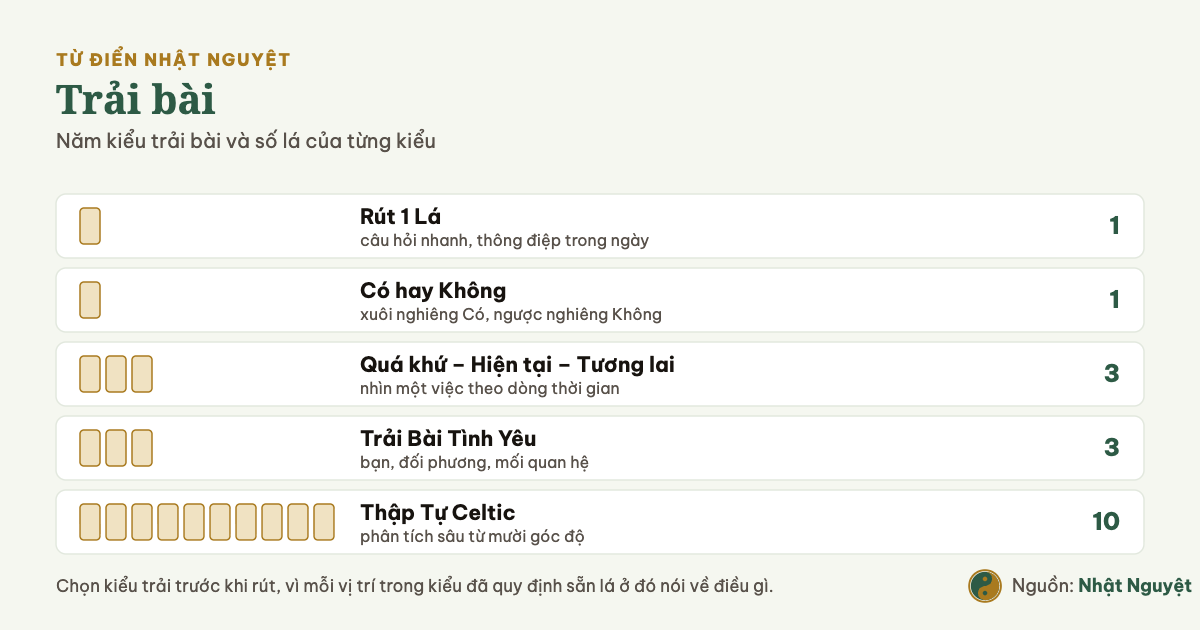
A spread is a predefined layout in which Tarot cards are placed so that each position corresponds to an aspect of the question, such as past, present, future, the querent, or a potential outcome. The number of cards and the shape of the layout vary by purpose: a one-card spread for a daily message, a three-card spread for a timeline, the ten-card Celtic Cross for comprehensive analysis, a V-shaped spread for relationship questions, or a twelve-month spread for a yearly forecast.
Origin and usage
Tarot originated from European playing cards in the Renaissance and was later used as a tool for reflection and inner exploration. Spreads developed alongside the need to ask structured questions: instead of drawing cards at random, the reader chooses a layout that suits the layers of the issue. The standard Rider-Waite deck has 78 cards, comprising 22 Major Arcana and 56 Minor Arcana in four suits, and most spreads can be used with this deck.
In practice, the reader defines the question, chooses a spread, shuffles, then turns each card according to its position. The final meaning combines the card's meaning, the position's meaning, and the relationships among the cards.
Distinguishing from easily confused terms
A spread differs from a free draw in that it has positional structure. Drawing a single card without a layout is still a Tarot act, but it does not form a full spread. A spread should also be distinguished from the deck: the deck is the tool, while the spread is the method of using it. Some people use "spread" to mean both the layout and the reading session, but in Vietnamese, "trải bài" usually emphasizes the act of laying out and interpreting by layout.
Notes on use
Tarot is traditional knowledge for reference and has not been scientifically verified. A spread does not replace professional medical, legal, or financial advice. Practitioners should treat results as prompts for reflection rather than certain predictions.