What is Am Trach and why is it a separate branch of feng shui?
Am Trach is the branch of feng shui concerned with burial places for the dead, meaning graves, huyen dia and burial grounds. It stands opposite and complements Duong Trach, which covers houses, temples and businesses of the living. Both rest on yin yang and the five elements, and both examine long mach, orientation, and the flow of khi and water, but their aims and methods of assessment differ.
The theoretical origin of Am Trach is often linked to the Tang Thu (Book of Burial), attributed to Quach Phac of the Eastern Jin, who lived around the 4th to 5th century. The book comments on a lost work, the Tang Kinh, and through its transmission the principles linking the flow of khi to the proper position of a grave deeply influenced the development of feng shui in general.
It should be said from the outset: this is a system of belief, not an experimental science in the modern sense. Classical books present it as a law of the khi field, and different schools interpret that law in ways that are not entirely the same.
How does grave feng shui differ from Duong Trach?
The fundamental difference lies in who is affected and in the time frame. Duong Trach acts directly on the people living in that house, while Am Trach, in traditional belief, acts indirectly through descendants and is usually said to have a longer-term influence.
| Criterion | Am Trach (grave) | Duong Trach (dwelling) |
|---|---|---|
| Subject affected in belief | Descendants, clan over many generations | People living in the house |
| Focus of assessment | Long mach, huyen vi, minh duong, thuy khau | House orientation, main door, kitchen, bedroom, interior layout |
| Dominant natural factors | Mountain forms, mounds, water flow, distant view | Wind, sun, traffic, neighbours, nearby works |
| Room for adjustment | Very limited, essentially only cai tang or renovation | Can be corrected, rotated, blocked, remedied |
| Time frame discussed | Many generations, sometimes by van | Each period, by years of use |
| Degree of verification | Mainly based on transmission and records | Partly observable through direct experience |
The table reflects how traditional feng shui books divide the field. Note that this is belief within the system, not a scientifically verified conclusion.
Some feng shui materials also link Am Trach to the Phu Mau palace and to stars such as Thien Luong, Thai Am and Cu Mon in tu vi, arguing that when ancestral graves have problems, repairing Duong Trach only brings short-term effect. This link is interpretive, not a mandatory rule, and schools do not fully agree.
Choosing huyen, minh duong, thuy khau: what do the books say?
What is a huyen and what are the criteria for choosing one?
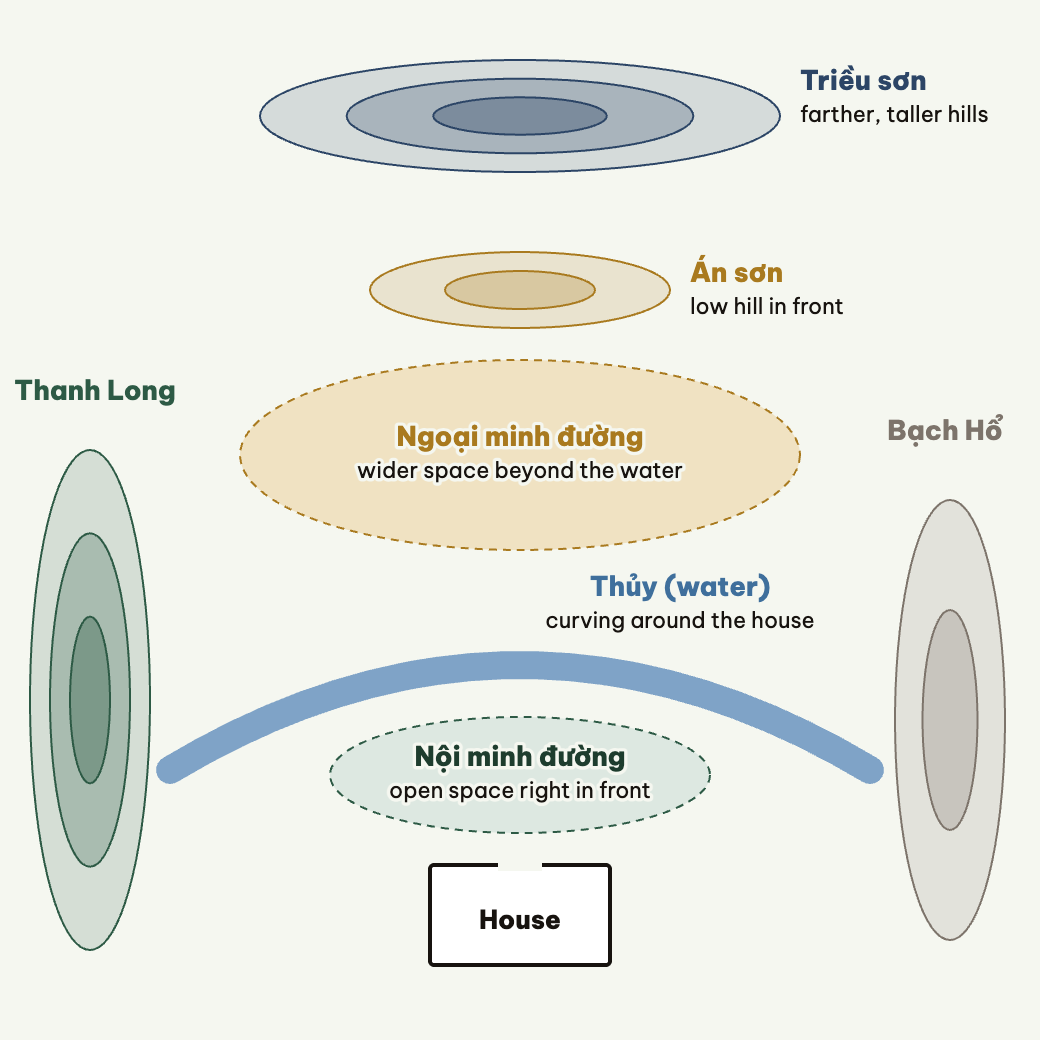
According to classical geography books, a huyen is the point where khi gathers, where the essence of heaven and earth converges, and it is the centre of the whole land plot. Choosing a huyen is not merely picking a point on a map but assessing a whole system of long mach, thuy khi, minh duong and nearby factors. The Tang Kinh stresses that a auspicious huyen buried in an inauspicious way is like casting away a corpse, meaning that finding good land is not enough; burial must also be done correctly.
Long mach and thuy khi
Two key factors determining the fortune of a grave huyen, according to old feng shui masters, are long mach, the khi vein of mountains, and thuy khi, the khi of water flow. A well-placed huyen in this view sits on a firm long mach and is enclosed by surrounding slopes forming a configuration.
Feng shui materials also list unfavourable cases, for instance a mountain blocking behind the huyen with an inauspicious shape and placed too close, said to cause disaster. Notably, the direct clash here need not be a sharp peak; it may simply be a destructive shape affecting the stability of the huyen.
Water is also assessed by flow direction. If the current is rapid and rushes straight at the huyen, the books hold that the negative effect is similar to a mountain rushing straight in. This is why thuy khau, where water gathers or exits, becomes one of the most important points of assessment.
Thuy khau and calculation by orientation
In Dia Ly Nguyen Khong Phap Giam by Lien Tri tien sinh, thuy khau is assessed by specific pairs of mountain and orientation, distinguishing ban nguyen thuy khau and ngoai nguyen thuy khau, tied to different hao and cung. For example, with Canh mountain and Giap orientation, the book places ban nguyen thuy khau at Mui and Thin, and ngoai nguyen thuy khau at Suu and Tuat; with Dau mountain and Mao orientation, the method differs; with Tan mountain and At orientation, the book records ban nguyen thuy khau at Than and Ti, and ngoai nguyen thuy khau at Hoi and Dan.
These are highly technical rules, and different geography schools may use different frames of reference. General readers need not memorise these figures, but should know that traditional Am Trach feng shui does not speak vaguely of good land; it operates by very specific sets of rules, sometimes differing between books.
Influence of neighbouring graves and surrounding works
A grave does not exist in isolation. Classical materials point out that adjacent graves, paths, trees or nearby structures can all affect the feng shui of the main grave. One view holds that if a larger grave or one with worse feng shui stands to the right, it may steal part of the good energy. A small road in front of or beside the grave is also seen as affecting the flow of energy.
The books also distinguish single graves from double-headed graves, meaning joint burials of husband and wife, holding that the degree of influence on descendants differs, and that if the feng shui is good the blessing is enjoyed for many generations. These statements are transmitted belief without independent verification.
Auspicious huyen buried inauspiciously and the question of timing
A point stressed by many books is the phenomenon of an auspicious huyen buried inauspiciously: good land but wrong burial is still unfavourable. The Tuyet Tam Phu says that even an auspicious huyen avoids inauspicious burial, and the Tang Kinh likens such a case to casting away a corpse. The usual cause given is failure to grasp the method of resolving ly khi when placing the grave, or choosing the wrong hour, day, month or year to lower the huyen.
A classical document records that placing a grave at Nham orientation with Binh, or Binh orientation with Nham, within the first twenty years of thuong nguyen may offend phan ngam phuc ngam, bringing disaster that harms the living. This is reasoning by van and orientation, and should be understood as belief within the system rather than a natural law.
Did the ancients bury according to feng shui or not?
This is where sources disagree, and both sides should be presented.
In Vu Trung Tuy But, Pham Dinh Ho holds that in ancient times burying the dead did not involve choosing auspicious land or consulting feng shui to place graves, even for the sages of old. He argues that before the reign of King Cheng of Zhou there was no custom of seeking geography for graves; a filial son burying his parents simply chose a spot north of the village, a high dry place, for a peaceful burial. If divination was used when placing a grave, whether by tortoise shell or by the I Ching, the aim was only to avoid places that would later become walls or roads, to avoid floods, fire and robbery, not to seek land that produces fortune.
Pham Dinh Ho cites the case of Confucius burying his father on the Ngu Phu road, later moving him for joint burial at Phong, with no search for land; Confucius's grave at Khong Lam was also not chosen in advance as a living tomb. He also mentions that the ancients placed epitaphs beneath graves and steles before them, citing the story of Nghiem Ba Nguu's grave sinking into a pond until later people recovered the epitaph and corrected the confusion, or the story of Tang Tu's grave whose location was forgotten until an ancient inscribed stone was found in Gia Thien mountain. He also recounts that Hung Dao Vuong told his sons to cremate him and place the bones in a round vessel buried in An Lac garden, and says this is recorded in Tran history.
On the other side, many hold that the above view reflects only Pham Dinh Ho's personal outlook, while reality was different. History records that nearly a thousand years before Pham Dinh Ho, the burial of emperors already involved very careful choice of terrain. Dinh Tien Hoang's tomb was placed on the summit of Ma Yen mountain in the Hoa Lu area of Ninh Binh, regarded as having good feng shui. Folk tradition also tells of making many coffins and sending them in many directions to keep the burial place secret.
Similarly, the actual resting place of Hung Dao Dai Vuong Tran Quoc Tuan remains an enigma debated for nearly a thousand years. The folk saying born at Kiep Bac, died at Tran Thuong, homeland Bao Loc is used to support the hypothesis of a grave at Tran Thuong, Ha Nam, but many argue that this place name is not closely tied to his person and life, and that by the principle of leaves returning to the root the burial place should be at Bao Loc, Nam Dinh. Today the Bao Loc temple complex has a tomb of Duc Thanh Tran, but the question of where the real grave lies remains unsettled.
Notably, both sides have their grounds. Pham Dinh Ho speaks of ancient belief and of divination aimed only at avoiding practical harm; the other side cites tombs chosen with careful terrain. A reasonable reading is that land selection was not a uniform phenomenon in all periods, but varied by class, era and purpose.
How does Buddhism view boc mo and cai tang?
According to the Buddhist view presented in a lecture by Thay Thich Truc Thai Minh, a person consists of two parts, body and spirit. The corpse after death belongs to the body, a combination of the four elements earth, water, wind and fire, and at death the four great elements return to the four great elements, which is the ordinary law, so the body has nothing sacred. The sacred lies in the mind.
From this, the Buddhist view holds that if the mind of the deceased still clings to bones, flesh, graves and regards them as its home, then boc mo may cause trouble. Conversely, when the mind no longer clings, all is peaceful. Therefore, examining hours, months and directions for boc mo need not be emphasised. Families may boc mo on days off or at weekends so that descendants can gather in full.
Also in this view, taboos such as not boc mo on the 3rd or 7th day of the month, having to boc mo at night because it is the time of flourishing yin, not boc mo in daytime for fear bones turn black or spirits fear light, are all considered mistaken notions, not in line with Buddhist right view. What should be done before boc mo is to go to the pagoda for a cau sieu ceremony, to make offerings to the Three Jewels and transfer merit to the spirit, so that the deceased has the conditions to hear the sutras and the Dharma and let go of clinging.
On the number of graves boc mo at once, the Buddhist view rejects the ideas that boc mo four graves offends the word tu or boc mo three graves falls into kim lau, and holds that families with several graves reaching the time for sang cat may boc mo them at once. Similarly, the idea that a child who dies early may not be boc mo before the parents, and must wait until the parents pass away, is regarded as a backward custom, not in line with right view on karma.
It should be stressed that this is the Buddhist perspective, coexisting with other folk and feng shui beliefs. Readers may choose the approach suited to their own faith and family circumstances.
Vietnam's cai tang, boc mo, sang cat custom
Boc mo is also called by many other names such as sang cat, cai tang, doi tieu, thay ao, thay nha, tam cho nguoi mat, depending on the locality. This is a folk custom of the Vietnamese, expressing the respect and filial devotion of descendants to deceased grandparents and ancestors.
As for origin, according to history the boc mo custom appeared in the Chinese occupation period, starting from Chinese traders who came to Vietnam for business, and after dying were buried here, then their relatives boc mo the remains to take home, and from that the custom formed. Besides, because our rainy season often causes flooding and waterlogging, graves buried in fields, mounds and hills easily subside and flood. Therefore after about three to five years, usually coinciding with the end of mourning, descendants carry out boc mo to wash and clean the remains.
Thus the driving force of the cai tang custom is largely practical and cultural, tied to climate and terrain, not purely a feng shui requirement. The feng shui element appears at the step of choosing the new burial place, orientation and timing, depending on the degree and the family.
As for regional differences, press sources record that prevalence and practice vary between the North, Central and South. However, the reference sources in this article do not provide survey data reliable enough to build a detailed regional comparison table. Therefore the writer does not give a specific regional table, avoiding fabricated figures. What can be said for certain is that this custom exists in all three regions with different names and degrees of intensity, and is influenced by geological conditions, clan habits and local regulations.
An important point to note: there is no guide to self-performing boc mo in this article. Cai tang involves remains, hygiene and legal regulations on burial, so if a family has the need they should learn the local regulations and consult responsible people, not act on their own following online articles.
Local regulations on cemeteries and the cremation trend
From a management angle, burial in Vietnam is governed by regulations on cemeteries, on land for burial and on environmental hygiene. Localities may have their own rules on cemetery location, distance to residential areas, and cai tang within centralised cemeteries. This is a practical factor families need to check before considering land selection by feng shui.
Cremation is increasingly chosen by many families because it saves land, is convenient for transport and worship, and reduces pressure on cemetery land funds. Notably, Hung Dao Vuong himself, according to the record Pham Dinh Ho cites, told his sons to cremate him and place the bones in a round vessel for burial, showing that cremation was not entirely foreign to tradition.
This change also alters the approach to Am Trach feng shui. When cremation and keeping ashes in a clan church or memorial area are used, many elements of traditional Am Trach such as long mach and thuy khau no longer apply in the old way, shifting instead to the arrangement of the worship place, the orientation of the altar and the memorial space.
So how should Am Trach and the cai tang custom be understood reasonably?
Three layers of belief can be seen overlapping in Vietnamese reality. The first is Am Trach feng shui with its complex theoretical system of huyen, long mach, minh duong and thuy khau, operating by different books and schools. The second is folk belief about filial duty and about graves affecting descendants. The third is the Buddhist perspective, which does not emphasise dates and hours and stresses cau sieu and merit transfer.
These layers do not entirely exclude one another. A family may hold a Buddhist cau sieu ceremony, choose a cai tang site by feng shui, and comply with local cemetery rules. What matters is not turning any layer into an absolute claim about fortune or misfortune, and not using it to pressure or blame others.
With classical feng shui books, they should be read in a spirit of reference. These books do not agree with one another on many technical details, and each school has its own frame of reference. With folk beliefs, one should distinguish cultural value and family feeling from claims of karma without verifiable basis. With legal regulations and the cremation trend, these are practical factors that should come first before discussing land and soil.