


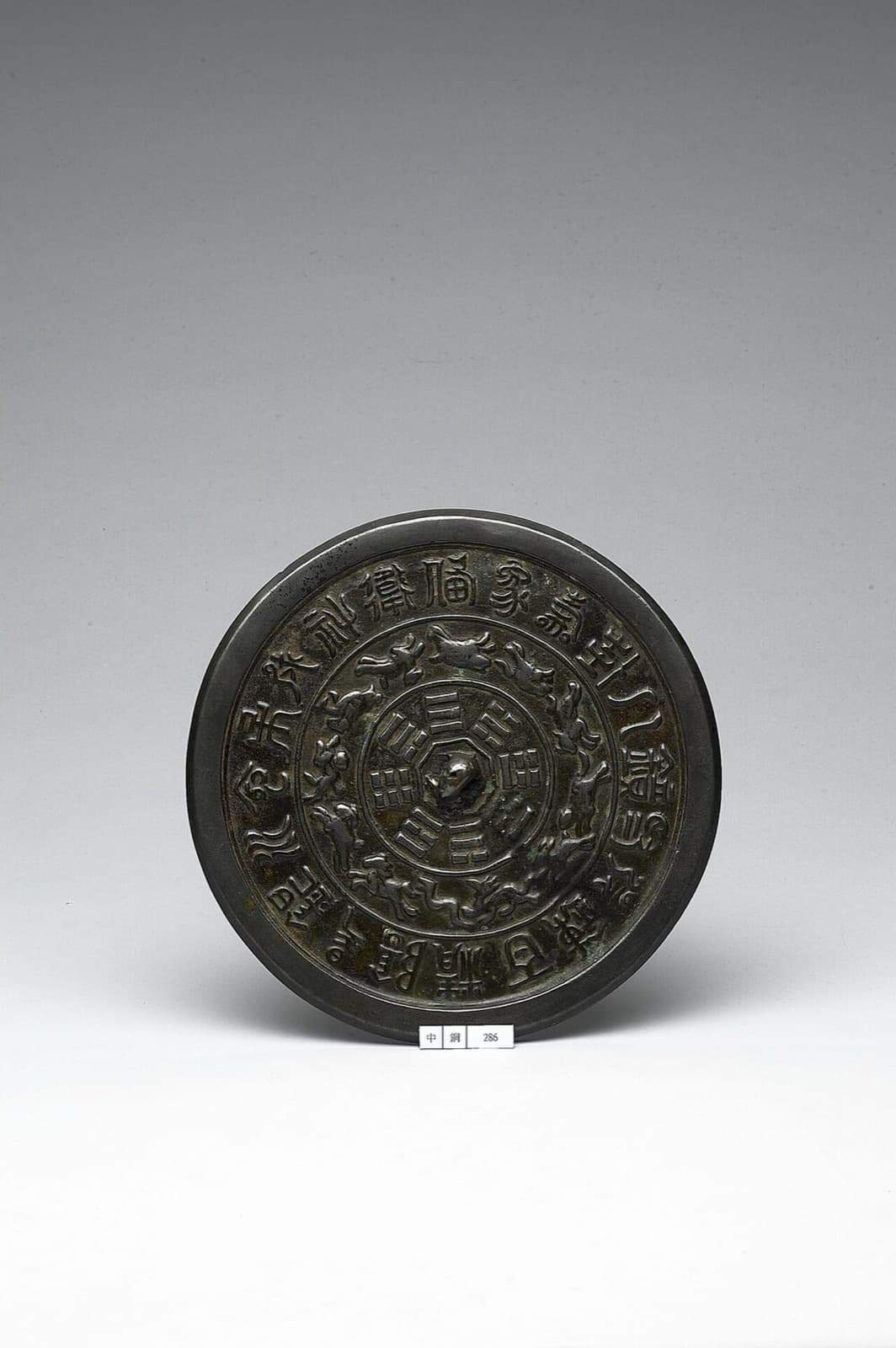
Image: Wikimedia Commons (Public Domain / CC0)
TL;DR: Geng mountain belongs to the Metal element and is located in the West, being one of the 24 mountain directions used to determine the orientation of houses and graves. This article explains its meaning, interpretation methods, and practical considerations when encountering Geng mountain.
The Canh mount in the 24 feng shui mounts: meaning and how to interpret it
Where does the Canh mount sit on the compass, and why is its position derivable rather than memorised?
The Canh mount sits at roughly 247.5° to 262.5° on the compass, measured clockwise from true North. It is the 18th mount in the ring of 24 mounts.
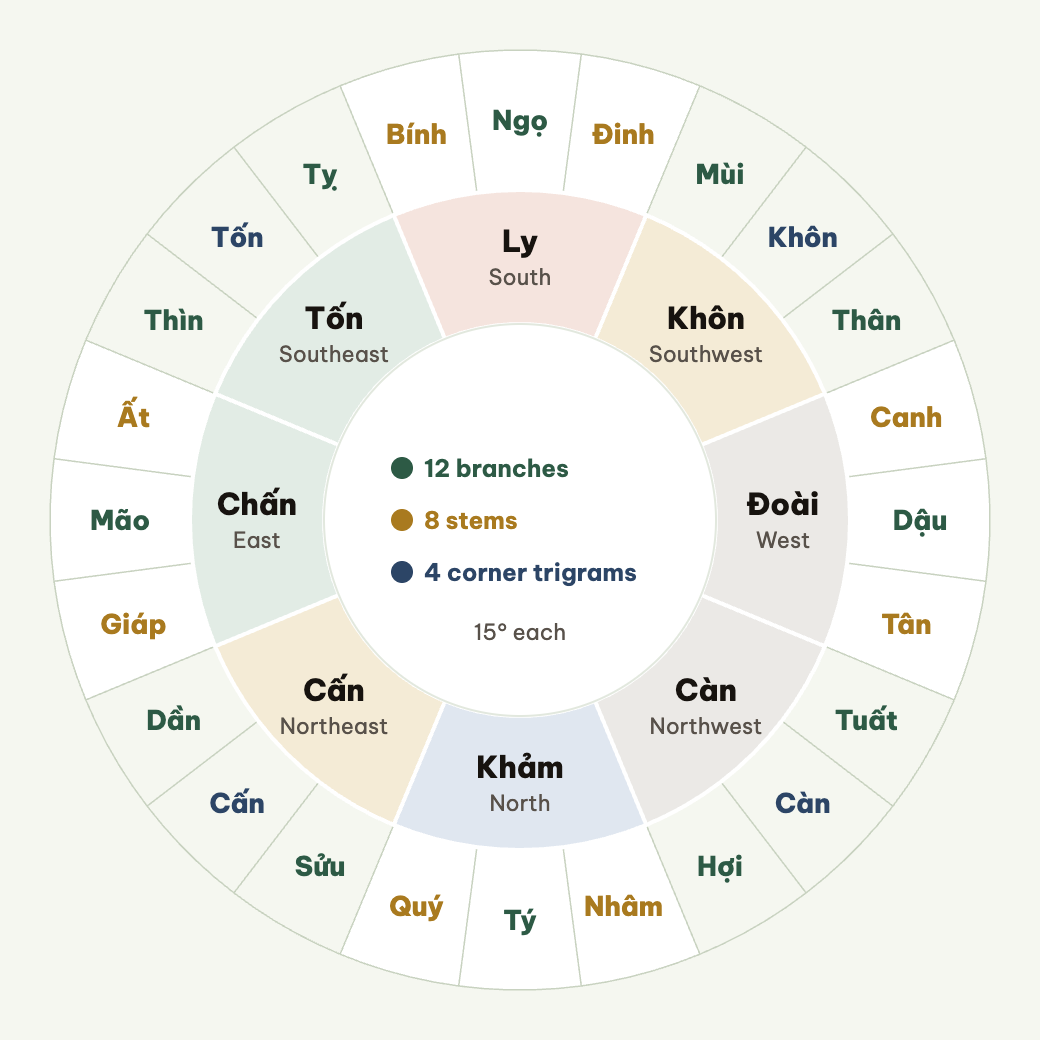
This position does not need to be memorised, because it can be derived from two simple rules. First, the 360° compass ring is divided evenly among 24 mounts, so each mount is exactly 15° wide. Second, the mount at the centre of each of the eight cardinal and ordinal directions carries the name of that direction. The West direction has its centre at 270°, so the central mount of the West is Dậu, occupying roughly 262.5° to 277.5°. Stepping back 15° from Dậu toward the Southwest gives the Canh mount, from 247.5° to 262.5°. Stepping forward another 15° toward the Northwest gives the Tân mount, from 277.5° to 292.5°.
The three mounts Canh, Dậu and Tân together span exactly 45°, which is the entire West sector. The Canh mount is the first mount of the West when counted clockwise, sitting in the southern half of the West. In practice, therefore, the Canh mount is often described as West slightly tilted toward the Southwest.
Two ways of speaking that are easily confused need to be distinguished. When people say "Canh direction", they mean the facing direction of the house falls within roughly 247.5° to 262.5°. When people say "Canh sitting", they mean the rear of the house falls within that range, while the facing direction is the opposite mount. The mount opposite Canh through the compass centre is Giáp, located in the East, in the Chấn palace, roughly 67.5° to 82.5°. A house sitting Canh facing Giáp and a house sitting Giáp facing Canh are two entirely different configurations, and the two must not be called by each other's names.
Which palace does the Canh mount belong to in the Later Heaven bagua, and which three mounts share that palace?
The Canh mount belongs to the Đoài palace in the Later Heaven bagua. The three mounts sharing the Đoài palace are Canh, Dậu and Tân, which are exactly the three mounts of the West direction.
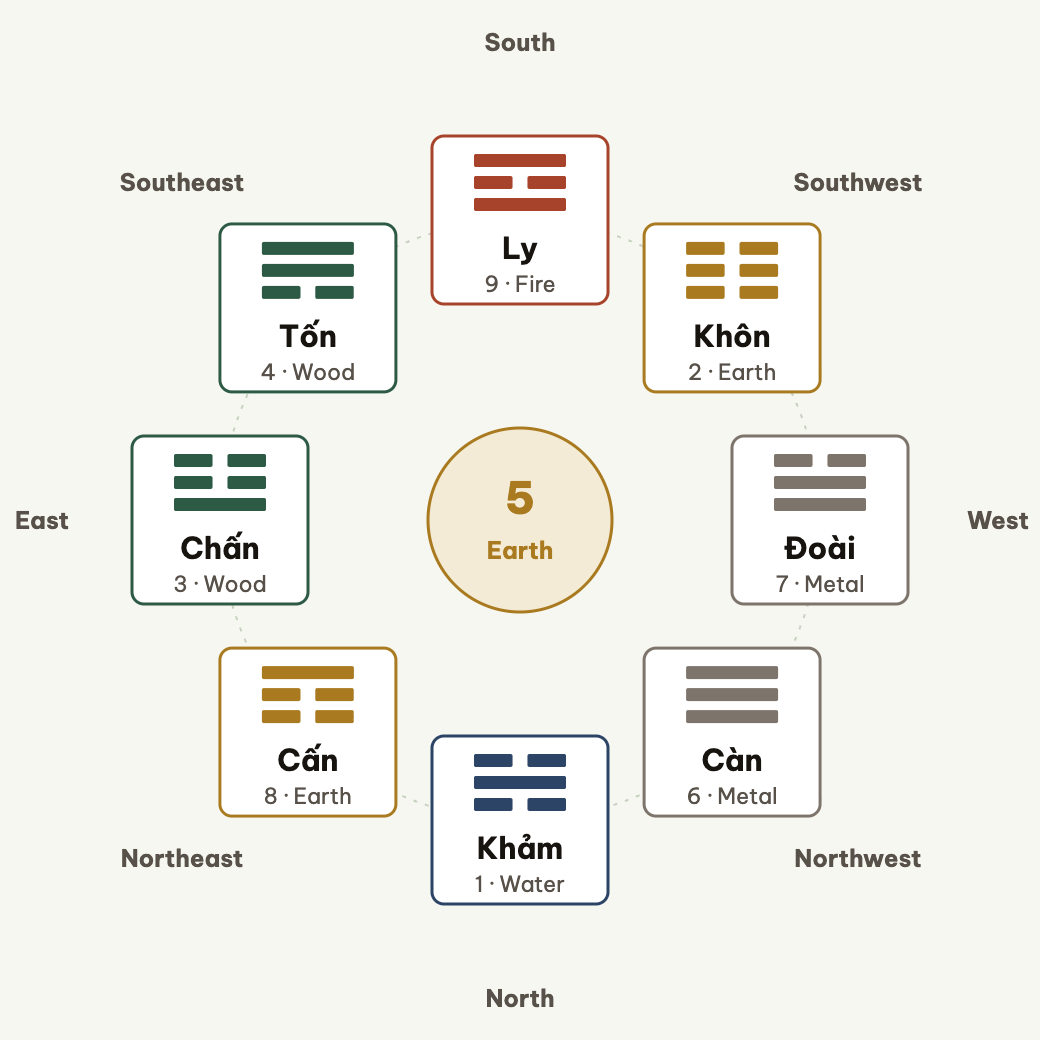
Here two concepts that are often lumped together must be clearly separated: palace and direction. A palace is one of the eight trigrams of the Later Heaven bagua, each trigram governing a 45° zone on the compass and carrying its own trigram name. A direction is the everyday name for a bearing, that is East, West, South, North and the four intermediate directions. The Đoài palace coincides with the West direction, but the two words are not synonymous. Đoài palace is a trigram name, West direction is a bearing name. When interpreting by the Later Heaven bagua, the word palace is used; when describing a geographical position, the word direction is used.
One point that easily causes confusion: the four principal trigrams Khảm, Ly, Chấn and Đoài have no mount bearing their name. The four positions true North, true South, true East and true West have already been taken by the four earthly branches Tý, Ngọ, Mão and Dậu. So there is no such thing as a "Đoài mount" on the compass. The Đoài palace exists, but a mount named Đoài does not. Anyone who writes "Đoài mount" is writing outside the 24-mount system.
What is the Five Elements nature of the Canh mount, and why are there two answers that do not contradict each other?
There are two answers, and both are correct, because they speak about two different things.
Considering the Five Elements of the heavenly stem that gives the mount its name: Canh is the seventh heavenly stem among the ten heavenly stems, belongs to the Metal element, and is Yang Metal. This is the Five Elements nature attached to the character Canh itself, coming from the stem-branch system, and it does not depend on position on the compass.
Considering the Five Elements of the palace that contains it on the Later Heaven compass: Canh sits in the Đoài palace, and the Đoài palace belongs to the Metal element according to the Later Heaven bagua. This is the Five Elements nature attached to the directional zone, coming from the bagua system.
These two statements do not contradict each other because they answer two different questions. The first asks "what element does the character Canh belong to", the second asks "what element does the compass zone containing Canh belong to". In the case of the Canh mount, the two questions happen to give the same result, Metal, so readers rarely notice a discrepancy. But with many other mounts, the two questions give different results, and that is precisely where confusion arises.
Take an example to make the mechanism clear. The Dần mount carries the name of the earthly branch Dần, and Dần belongs to the Wood element; but Dần sits in the Cấn palace, and the Cấn palace belongs to the Earth element. By earthly branch Five Elements, Dần is Wood; by palace Five Elements, Dần is Earth. The two statements do not contradict each other because they speak about two different things. Any article that writes "the Dần mount belongs to Wood" and a few lines later writes "the Dần mount belongs to Earth" without stating the frame of reference will make readers think the author is contradicting himself, when in fact the author is only mixing two systems.
Returning to the Canh mount: when interpreting by stem and branch, Canh is Yang Metal, carrying a strong, decisive, outward-facing character. When interpreting by palace, Canh sits in the Metal zone of the Đoài palace, in the same zone as Dậu and Tân. Both layers of meaning are used, but the system must be named each time it is used.
What is the Tam Nguyên long of the Canh mount, and what does that mean when choosing a mount and direction?
The Canh mount belongs to the Địa nguyên long.
The Tam Nguyên long system divides the 24 mounts into three groups of eight mounts each, based on the origin of the mount names. The Thiên nguyên long group consists of mounts named after heavenly stems and the four trigrams Càn, Khôn, Cấn, Tốn. The Địa nguyên long group consists of mounts named after earthly branches, except the four branches Tý, Ngọ, Mão and Dậu, which are separated out. The Nhân nguyên long group consists of the four branches Tý, Ngọ, Mão and Dậu.
In the West direction, the three mounts are arranged in the order Địa, Thiên, Nhân nguyên long as follows: Canh is Địa nguyên long, Dậu is Thiên nguyên long, Tân is Nhân nguyên long. The central mount of a direction, that is the mount carrying the name of the direction itself, is always Thiên nguyên long, here Dậu. This rule holds for all eight directions.
The three mounts within one palace cannot be substituted for one another, because each mount belongs to a different nguyên long and each nguyên long has its own rules when establishing a facing. When choosing a facing for a plot of land, one must consider which nguyên long that facing belongs to, and only then apply the rules of that nguyên long. Applying the rules of Thiên nguyên long to a Địa nguyên long mount is a mistake of system, even though the two mounts are only 15° apart. This is why in Tam Nguyên, a mount half a degree off can completely change the method of interpretation, not merely change a number.
Where does Bát Trạch place the Canh mount, and what are the limits of that placement?
According to Bát Trạch, the Đoài palace belongs to the Tây tứ trạch (West four houses). Since the Canh mount sits in the Đoài palace, when considered by Bát Trạch it belongs to the Tây tứ trạch group, which comprises Đoài, Càn, Cấn and Khôn.
The limit of this placement needs to be stated clearly. Bát Trạch does not classify individual mounts, it classifies individual palaces. It divides the eight palaces into two groups: Đông tứ trạch (East four houses) comprising Khảm, Ly, Chấn and Tốn, and Tây tứ trạch comprising Đoài, Càn, Cấn and Khôn. So Canh, Dậu and Tân all belong to Tây tứ trạch, and no mount in the Đoài palace belongs to Đông tứ trạch. Saying "the Canh mount belongs to Tây tứ trạch" is shorthand for "the palace containing the Canh mount belongs to Tây tứ trạch".
Bát Trạch uses this grouping to match with the householder's mệnh quái (personal trigram), not to interpret each mount in detail. For a person of Đông tứ mệnh (East four destinies), Bát Trạch advises choosing a house in Đông tứ trạch, and vice versa. But Bát Trạch cannot distinguish Canh from Dậu or Tân, because all three sit in the same palace. To distinguish those three mounts one must move to another system, such as Tam Nguyên long or Huyền Không phi tinh (Flying Star). This is an inherent limit of Bát Trạch, not a defect.
How does Huyền Không phi tinh use the Canh mount, and where do the schools not yet agree?
Huyền Không phi tinh uses the Canh mount at the mount-and-facing layer of the star chart. When constructing a star chart for a house, one determines the sitting and facing, then places the two mountain and facing stars into the central palace, and then flies those two stars along the flying star path. The Canh mount, as one of the 24 mounts, determines which star is placed into the central palace at the mountain layer. Change the mount and the star changes; change the star and the whole star chart changes.
One point on which the branches of Huyền Không do not yet agree is how to assign yin and yang to each mount, used to decide forward flying or reverse flying. Different branches may assign yin and yang to the same mount in different ways, and because forward or reverse flying produces different star charts, the interpretive results also differ. This is a real disagreement between branches, not something invented to make an article look profound.
One thing must be said plainly to avoid misunderstanding: that disagreement lies in how the flying stars operate, not in the position or palace of the mount. No branch of Huyền Không places the Canh mount outside the range 247.5° to 262.5°, and no branch places it outside the Đoài palace. The division of the 24 mounts is common to all schools, and there is no dispute about it. Disputes arise only once calculation begins on that common foundation.
Measurement error: how many degrees wide is the Canh mount, and which mounts border it on either side?
The Canh mount is exactly 15° wide, from 247.5° to 262.5°. The adjacent mount below is Thân, from 232.5° to 247.5°, belonging to the Khôn palace. The adjacent mount above is Dậu, from 262.5° to 277.5°, also belonging to the Đoài palace.
Because each mount is only 15°, a slight deviation crosses into another mount, and crossing into another mount may mean crossing into another palace. Specifically here, going below the 247.5° mark leaves the Đoài palace for the Khôn palace, that is, leaves Tây tứ trạch for Đông tứ trạch under the Bát Trạch classification. A small error at the lower mark already changes the entire house group. Going above the 262.5° mark stays in the Đoài palace, but changes from Canh to Dậu, that is, changes from Địa nguyên long to Thiên nguyên long. A small error at the upper mark changes the entire nguyên long.
The two marks to remember are 247.5° and 262.5°. When measuring, one should measure several times at several points and take a stable reading, because a magnetic compass is affected by steel in the structure, by phones, by metal objects nearby. An error of a few degrees caused by the environment is common, and those few degrees are enough to push the result across a mark. In the case of a house direction falling exactly in the border zone between two mounts, the cautious approach is to record both possibilities, rather than forcing it into one mount for convenience.
Which part of this article is cultural knowledge, not prediction?
This entire article is cultural knowledge. The position 247.5° to 262.5°, the Đoài palace, Địa nguyên long, the Tây tứ trạch group: these are conventions of a long-standing system of symbols, readable and verifiable within that system. They are not predictions about anyone's wealth, health or destiny.
Two things need to be clearly separated. The first is describing the system: where the Canh mount sits, which palace it belongs to, which nguyên long it belongs to. This has a definite, verifiable answer. The second is inferring what will happen to the people living in that house. This has no basis for assertion, and this article does not do it.
Readers should approach the above as they would a glossary of a tradition, not as a forecast. Understanding the Canh mount means understanding one mesh in the 24-mount system, which helps one read feng shui documents and understand what others are saying. It should not be turned into a basis for deciding major matters in life, and still less should it replace decisions based on science and practical reality.
Overview article on the topic: What is feng shui? Foundational principles and how to apply them
Quick-Reference Table: the Canh mountain
| Aspect | Content |
|---|---|
| Position among the 24 mountains | 18 |
| Type | Heavenly Stem |
| Direction | West |
| Governing trigram | Đoài |
| Compass range | 247.5° to 262.5° |
| Dragon cycle | Earth |
Figures in this table match the results of the lookup tools on Nhật Nguyệt.


