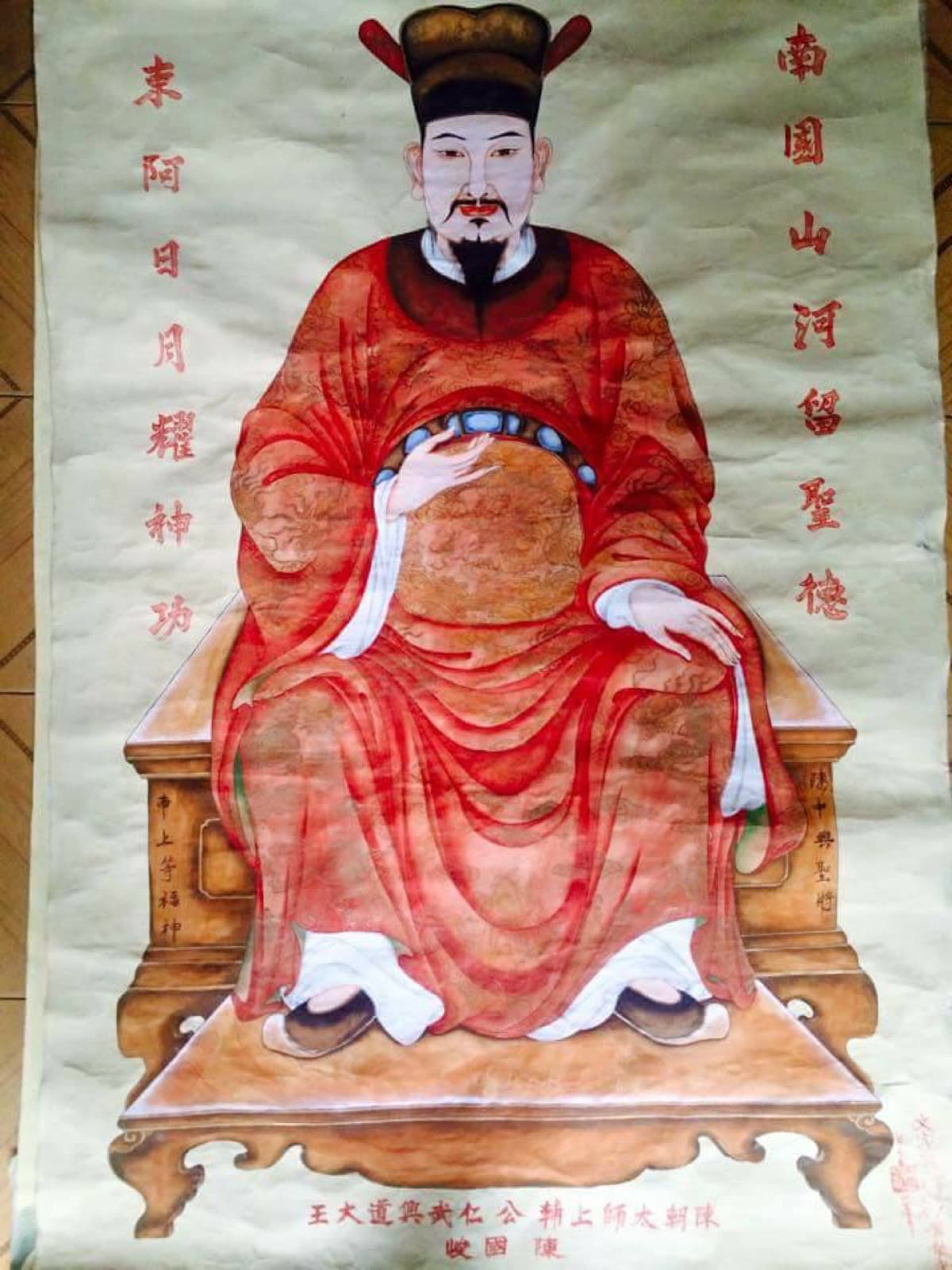
From Quoc Cong Tiet Che to a Saint in Folk Belief
Tran Hung Dao, real name Tran Quoc Tuan (1228-1300), is one of the greatest generals in Vietnamese history. He was the son of An Sinh Vuong Tran Lieu, nephew of King Tran Thai Tong, and was entrusted with the position of Quoc Cong Tiet Che, commanding the entire Dai Viet army during the second and third resistance wars against the Mongol Empire. With exceptional military strategy, he led the people of Dai Viet to defeat the two most powerful empires of the time, achieving glorious victories at Van Don, Chuong Duong, Ham Tu, Tay Ket, and especially the historic Battle of Bach Dang in 1288.
Not only a military genius, Tran Quoc Tuan was also a cultural figure and a master of military strategy, authoring the famous "Binh Thu Yeu Luoc" (Essential Military Manual) and the immortal proclamation "Hich Tuong Si" (Call to the Soldiers). After his death, the Tran court posthumously awarded him the title Thai Su Thuong Phu Quoc Cong Nhan Vu Hung Dao Dai Vuong, the highest honor. However, remarkably, he transcended the framework of a historical figure to enter the spiritual life of the Vietnamese as a saint.
The transformation from a mortal man into a saint in folk belief was not accidental. It originated from the people's deep gratitude and admiration for his immense contributions to protecting the country. People believed that a person of such great talent and virtue would, upon death, become a deity to continue protecting the nation and sentient beings. Thus, the image of Tran Hung Dao was gradually idealized and deified, becoming "Duc Thanh Tran" with the power to save people, eliminate evil spirits, and exert profound influence in the spiritual culture of Vietnamese people across many regions.
Kiep Bac Temple and the Center of Duc Thanh Tran Worship
If Thang Long was the capital of the Tran Dynasty, then Kiep Bac Temple in Tran Hung Dao Ward, Hai Phong City, is one of the most important spiritual centers associated with the life and career of Duc Thanh Tran. Located within the special national relic site Con Son-Kiep Bac, Kiep Bac Temple is not only the main place of worship but also the site of the largest autumn festival of the year to commemorate this national hero. According to historical records, this is where Tran Quoc Tuan established his headquarters during the two resistance wars against the Mongols, where he commanded his troops, and where he passed away on the 20th day of the eighth lunar month in the year of the Rat (1300).
Because of this special historical and spiritual significance, Kiep Bac Temple has become an indispensable destination for people nationwide during the eighth lunar month each year. The Con Son-Kiep Bac Autumn Festival is held solemnly to commemorate the death anniversary of national hero Tran Hung Dao and world cultural celebrity Nguyen Trai. According to the relic management board, during this sacred festival, tens of thousands of people and pilgrims flock to Kiep Bac Temple to pay tribute and participate in traditional rituals.
The most distinctive and unique highlight of Duc Thanh Tran worship at Kiep Bac Temple is the seal opening and distribution ceremony. This is a famous spiritual ritual that has become a long-standing tradition, successfully restored since 2006. The seal opening ceremony usually takes place on the evening of the 21st day of the eighth lunar month, right after the main commemoration. According to folk belief, receiving a seal talisman from Duc Thanh Tran brings luck, peace, health, and prosperity to the recipient.
The Four Sacred Seal Talismans and Their Symbolic Meanings
According to the management board of the Con Son-Kiep Bac special national relic site, Kiep Bac Temple currently preserves four important seal talismans of Duc Thanh Tran, each bearing a distinct symbolic meaning and power:
| Seal Name | Symbolic Meaning |
|---|---|
| Tran Trieu Hung Dao Vuong chi an | The most important seal, representing the supreme authority and power that Duc Thanh Tran bestows upon the recipient. |
| Quoc Phap Dai Vuong | Seeking strength and authority so that all forces submit to rules and laws, bringing justice and order. |
| Van Duoc Linh Phu | A sacred talisman that helps people achieve longevity, prosperity, and growth, praying for abundant health. |
| Phi Thien Than Kiem Linh Phu | Praying for peace, warding off ghosts and evil spirits, protecting people from misfortune and negativity. |
Among these, the "Tran Trieu Hung Dao Vuong chi an" is considered the most important and sacred. The seal opening ceremony is performed by monks and festival organizing committee representatives, with traditional rituals honoring Duc Thanh Tran. Following ancient custom, temple custodians first perform a ceremony to stamp the seal on a piece of yellow silk, then ask permission from Duc Thanh Tran before distributing the seals to pilgrims. In 2025, the organizers prepared up to 30,000 seals for the public, reflecting the great spiritual demand for this saint.
The Spread of Duc Thanh Tran Worship
The worship of Duc Thanh Tran is not limited to Kiep Bac Temple but has spread widely across the country. Many temples, communal houses, and shrines dedicated to Tran Hung Dao or co-worshipping him as a protective deity have been built in various localities. His presence in Vietnamese spiritual life is diverse, from a general protecting the homeland to a saint capable of relieving suffering and bestowing blessings. In temples, one often sees the majestic image of Duc Thanh Tran in military attire or sometimes as a high-ranking official with a benevolent face.
The popularity of this belief reflects a beautiful cultural trait of the Vietnamese: the principle of "remembering the source when drinking water," honoring and being grateful to those who served the country. The worship of Tran Hung Dao as a saint has transcended ordinary historical reverence to become a profound spiritual-cultural phenomenon. It expresses human aspirations for a peaceful, healthy, and happy life, and the desire for protection against life's difficulties and misfortunes. The Kiep Bac Temple festival and the tradition of receiving seals are not only religious activities but also occasions for community bonding and recalling the nation's glorious history.
The worship of Duc Thanh Tran and related rituals, such as the seal opening and distribution, clearly demonstrate the intersection of history and spirituality, of a glorious past and the present. The image of Duc Thanh Tran appearing to help sentient beings has become a powerful spiritual-cultural symbol, enriching Vietnam's national cultural identity.