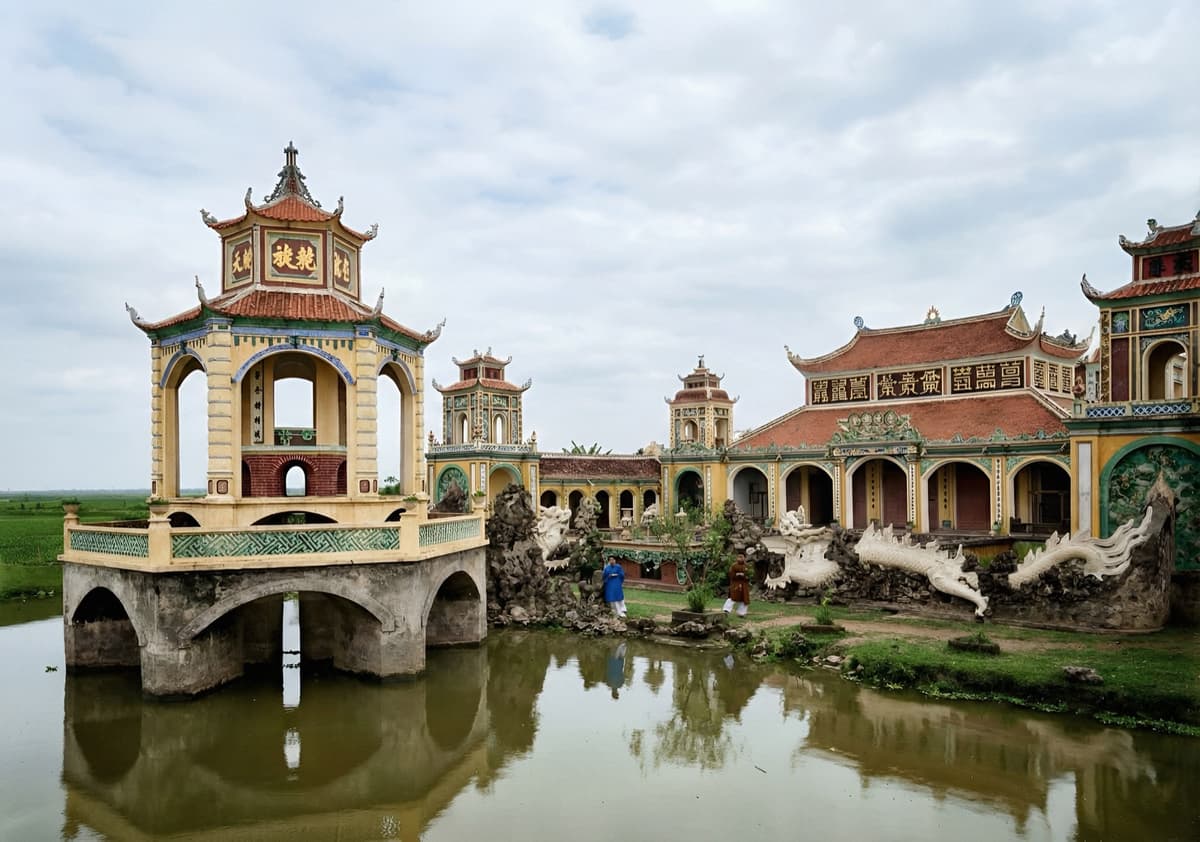
Quan Cong Temples: A Religious Imprint of the Chinese Community in Vietnam
The worship of Quan Cong, also known as Quan Thanh De Quan, has been present in Vietnam for centuries, accompanying the migration waves of the Chinese community. Beyond being a historical general, Quan Cong has been deified in folk beliefs as a symbol of loyalty, martial prowess, and protection. Temples dedicated to him, often called Chua Ong or Quan De Mieu, have become indispensable spiritual anchors, vividly reflecting the cultural and religious life of the Chinese community in Vietnam.
The Role of Quan Cong in Chinese Beliefs
In the folk beliefs of the Chinese in Southern Vietnam, Quan De holds a crucial role as a protective deity for people's lives. The enduring nature of this belief over time is a testament to the community's deep reverence. Quan Cong is not only a martial god symbolizing loyalty and righteousness but also a god of wealth and commerce, guarding fairness and protecting business endeavors. Consequently, most Chinese guildhalls and neighborhoods have temples dedicated to him to seek his blessings.
Architecture and Distinctive Worship Spaces
Quan Cong temples in Vietnam typically feature traditional Chinese architecture with yin-yang tiled roofs, intricate carvings, and vibrant colors. A prime example is Quan De Mieu on Tran Hung Dao Street in Chau Doc City, An Giang Province, a major religious center for the local Chinese community. The worship space is meticulously arranged. The main hall houses the primary statue of Quan Thanh De Quan, flanked by his loyal attendants Quan Binh and Chau Xuong. Depending on the locality, other deities like Na Tra Thai Tu or Phuc Duc Chinh Than may also be venerated, reflecting cultural exchange and adaptation.
The Via of Quan Thanh De Quan: A Cultural Highlight
One of the most significant religious activities is the Via (death anniversary) of Quan Thanh De Quan, held annually on the 23rd and 24th days of the sixth lunar month. This occasion allows the community to express reverence and maintain traditions. The festival includes solemn rituals such as the procession of Quan Thanh De Quan, the bathing ceremony for the statue, and incense offerings. On the main day, after a long drum roll, the temple's management board and representatives, dressed in formal attire, kneel before the main altar to present offerings. A respected elder then reads a eulogy praising the merits of Quan Thanh De Quan and other deities, praying for peace and prosperity. The Via is also a time for communal meals, social visits, and business discussions, strengthening community bonds.
From Chau Doc to Ca Mau: The Spread of the Belief
The worship of Quan Cong is widespread across provinces with significant Chinese populations. In Ca Mau, Chua Quan De, also known as Chua Ong, located in Ward 2, Ca Mau City, serves as a clear example. Built 50 years ago, the temple is linked with the Ngu Nghia Duong guildhall. Over the past half-century, it has been a vital cultural and religious center not only for the Chinese but also for other ethnic groups in the southernmost region. Elders note that the temple has retained its pristine, solemn, and ancient character, showing the community's respect for their heritage. The Via of Quan Thanh De Quan, along with those of Thien Hau Thanh Mau and Thien Ton To Su, are considered the three most distinctive religious festivals of the local Chinese community.
Community Values and Social Cohesion
For the Chinese community, religious culture is a great spiritual anchor, a guiding principle in all activities. Maintaining Quan Cong temples and organizing festivals goes beyond mere worship. It is an opportunity to educate younger generations about traditions and virtues like loyalty, righteousness, and compassion. Temple activities also serve as a bridge for the community to engage in social welfare, support the poor, and contribute to a cohesive and developing society. The worship of Quan Cong in Vietnam is a vibrant example of cultural exchange and integration, enriching the diverse cultural landscape of the nation.