
What are these three spirits in a Lục Hào chart?
Đằng Xà, Bạch Hổ and Huyền Vũ are three of the six beasts (lục thú, also called lục thần) of Lục Hào: Thanh Long, Chu Tước, Câu Trần, Đằng Xà, Bạch Hổ, Huyền Vũ. The book Tăng San Bốc Dịch by Dã Hạc lão nhân discusses the six spirits in chapter 18, placing them right after the chapters on the month general and day spirit, that is, after the prosperous or weak foundation of the hexagram has been established. This shows that the six beasts are not the layer that decides fortune, but the layer that colors a line already positioned.
Three systems are often confused because they share names. First, the six beasts of Lục Hào, started by the day stem and placed from the first line. Second, the heavenly generals of Lục Nhâm, where Đằng Xà, Bạch Hổ and Huyền Vũ are seen as deities owning their own seat, element, direction and ruling season; the Lục Nhâm, volume 1 describes them concretely: Đằng Xà's seat is at Đinh Tị, its nature is yin fire, it sits in the southeast and prospers in summer; Bạch Hổ's seat is at Canh Thân, its nature is yang metal, it sits in the southwest and prospers in autumn; Huyền Vũ has its seat at Hợi and is called the star of robbers, and when it meets Thiên Không it carries the name of the star of lies. Third, the four symbols in loan dau feng shui, where Thanh Long, Bạch Hổ, Chu Tước and Huyền Vũ are the four landforms around the grave site, described in the book Nhập môn loan đầu: tầm long điểm huyệt. The three systems share ancient names but operate by completely different rules. This article discusses only the first.
How are the six beasts started by the day stem?
The rule for starting the six beasts by the day stem is recorded by Tăng San Bốc Dịch in one sentence in chapter 18: Giáp and Ất start Thanh Long, Bính and Đinh start Chu Tước, Mậu starts Câu Trần, Kỷ starts Đằng Xà, Canh and Tân start Bạch Hổ, Nhâm and Quý start Huyền Vũ. The starting spirit is placed on the first line, then in the fixed order Thanh Long, Chu Tước, Câu Trần, Đằng Xà, Bạch Hổ, Huyền Vũ it moves up to the second, third, fourth, fifth and top lines. Thus a six-line hexagram always has exactly six beasts, one per line, no more and no less.
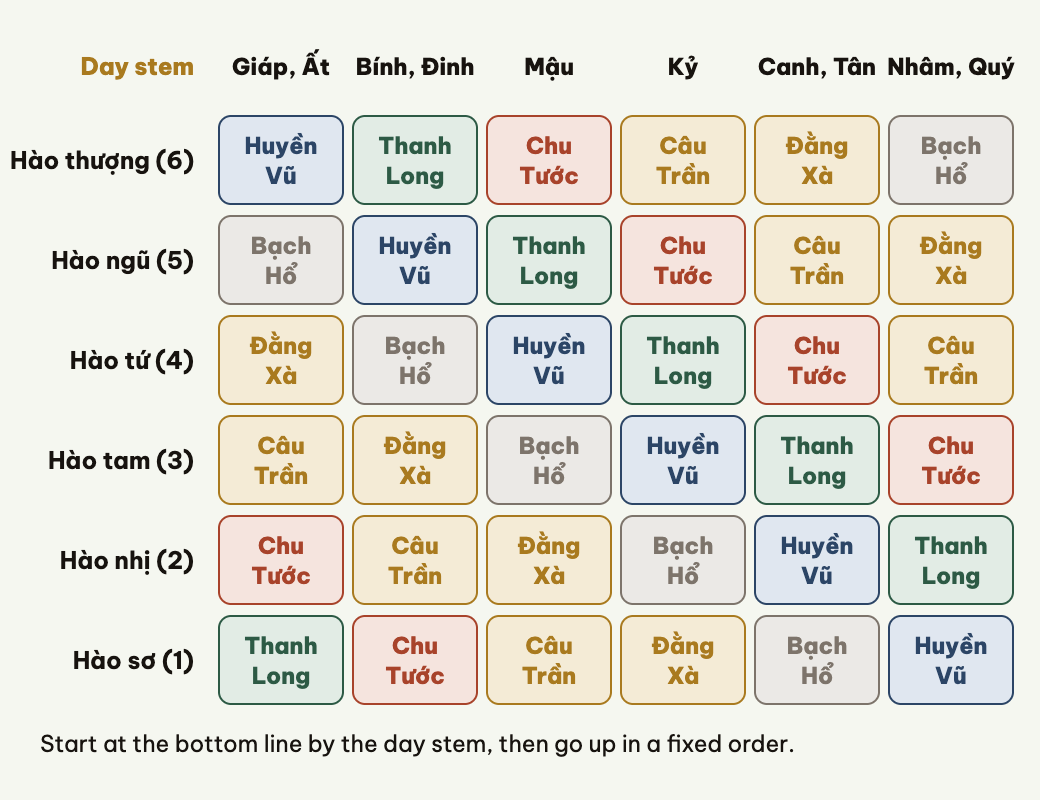
The table below follows the core of the khoiLucThu function in luchao_data.go, checked against the mnemonic above, and shows which spirit sits on which line for a given day stem:
| Day stem | First line | Second line | Third line | Fourth line | Fifth line | Top line |
|---|---|---|---|---|---|---|
| Giáp | Thanh Long | Chu Tước | Câu Trần | Đằng Xà | Bạch Hổ | Huyền Vũ |
| Ất | Thanh Long | Chu Tước | Câu Trần | Đằng Xà | Bạch Hổ | Huyền Vũ |
| Bính | Chu Tước | Câu Trần | Đằng Xà | Bạch Hổ | Huyền Vũ | Thanh Long |
| Đinh | Chu Tước | Câu Trần | Đằng Xà | Bạch Hổ | Huyền Vũ | Thanh Long |
| Mậu | Câu Trần | Đằng Xà | Bạch Hổ | Huyền Vũ | Thanh Long | Chu Tước |
| Kỷ | Đằng Xà | Bạch Hổ | Huyền Vũ | Thanh Long | Chu Tước | Câu Trần |
| Canh | Bạch Hổ | Huyền Vũ | Thanh Long | Chu Tước | Câu Trần | Đằng Xà |
| Tân | Bạch Hổ | Huyền Vũ | Thanh Long | Chu Tước | Câu Trần | Đằng Xà |
| Nhâm | Huyền Vũ | Thanh Long | Chu Tước | Câu Trần | Đằng Xà | Bạch Hổ |
| Quý | Huyền Vũ | Thanh Long | Chu Tước | Câu Trần | Đằng Xà | Bạch Hổ |
One point where printed editions disagree should be noted: the starting sentence for the two stems Mậu and Kỷ. Many editions of Tăng San Bốc Dịch copy "Mậu starts Câu Trần, Kỷ starts Đằng Xà" as in the table above, but some copy the reverse, Mậu starting Đằng Xà and Kỷ starting Câu Trần. This discrepancy directly affects the position of Bạch Hổ and Huyền Vũ in the hexagram. Learners should know it in order to cross-check when meeting other printed books, rather than assuming their own edition is the only standard.
What nuance does Đằng Xà carry when landing on a line?
Đằng Xà is the spirit of the strange, of fear, of entanglement and of dreams. When it lands on a line, it does not turn that line into misfortune, but makes the matter corresponding to that line take on a bizarre, hard-to-explain color, or carry an element of repeated obsession. The Lục Nhâm, volume 1 records Đằng Xà as a great inauspicious general, often causing war, wind and fire, robbery, illness, epidemics and fear; the matters it responds to often have something shady, hidden or concealed. On the other hand, when meeting a prosperous time, Đằng Xà also responds to documents, news, public affairs, small money and false reputation. This is a description from the Lục Nhâm system, but its spirit is in tune with Lục Hào: Đằng Xà is the spirit of something not transparent, not straightforward, somewhat strange.
In Lục Hào, whichever line Đằng Xà lands on is usually read with the sense of fear, groundless worry, strange dreams, persistent entanglement, or events happening in a way nobody expected. If Đằng Xà lands on the Thế line, the querent may be in an unsettled mental state, afraid of things that have not happened. If it lands on the Dụng Thần, the matter asked about has a bizarre element or something concealed. But this nuance is only a coating: if the Dụng Thần is prosperous and supported, Đằng Xà only makes the story a little strange, not strong enough to reverse the outcome.
Does Bạch Hổ landing on a line always mean mourning?
No. This is where Tăng San Bốc Dịch refutes the reading that sees Bạch Hổ and assigns mourning. Bạch Hổ carries the nuance of authority, the power to kill, blood, injury and mourning, but when it lands on the Dụng Thần it becomes the strength that helps the matter succeed. This spirit also matches the general warning in old texts about the six beasts: do not elevate the six beasts, meeting many auspicious spirits is good, meeting many inauspicious spirits is bad. In other words, Bạch Hổ by itself does not pronounce mourning, it only deepens the decisiveness of the line it lands on.
In the Lục Nhâm system, Bạch Hổ is described as an inauspicious general specializing in mourning, harm and inauspicious matters, belonging to yang metal, specializing in the power to kill, and also responding to pregnancy. Compared with Lục Hào, we see a similar reading: Bạch Hổ landing on a Quan Quỷ line may be tension, confrontation, being suppressed, or matters related to blood and injury. But if Bạch Hổ lands on a prosperous Dụng Thần, it is power: the querent may hold the upper hand, be in a deciding position, or the matter will be resolved decisively. Conversely, Bạch Hổ controlling the Dụng Thần, with other inauspicious spirits supporting it, is what deserves attention.
One notable point: Lục Hào editions also use Bạch Hổ to judge a person's temperament. When Bạch Hổ lands on a Tử Tôn line, it is often read as a stubborn, hard-to-control child, or one with reckless actions, requiring adults to correct skillfully. When Bạch Hổ lands on the Thế line, it may be great ambition, a wish to rise. This reading shows that Bạch Hổ does not equal death, but is a spectrum of nuances from authority to conflict.
Does Huyền Vũ landing on a line mean theft?
Not necessarily. Huyền Vũ is the spirit of shady matters, theft, secret love, loss and concealment. When it lands on a line, it signals that the matter corresponding to that line has an unclear element: it may be a loss, a private matter not wanting to be exposed, or an unfair transaction. The Lục Nhâm, volume 1 records that Huyền Vũ carrying a spirit that controls the Can is very taboo: a sign that a trader or a thief is plotting harm against oneself, and also a sign of wealth being damaged, involvement in lawsuits, evasion and shortcomings. Yet the same book records that if Huyền Vũ carries a spirit that generates the Can, even with evil stars, within the inauspicious there is still good achieved and part of the harm is reduced, responding to secret plotting of private matters and seeking gain. That is, Huyền Vũ is not a fixed label.
In Lục Hào, whichever line Huyền Vũ lands on may carry the meaning of shady, unclear, or related to private matters. If Huyền Vũ lands on a Huynh Đệ line, one often thinks of loss of wealth, being used, or someone in the close group plotting something unspoken. If it lands on a Thê Tài line, it may be unclear money matters, or a love matter with an element of concealment. If it lands on a Quan Quỷ line, be careful with papers, contracts, or being misunderstood. But once again, this nuance only has meaning when placed beside the state of the Dụng Thần.
Why do these three spirits, though reputed inauspicious, only color and not decide fortune?
Because in Lục Hào, fortune and misfortune are decided by the Dụng Thần and the generating or controlling relations of the spirits, not by the six beasts. Tăng San Bốc Dịch places the six spirits in chapter 18, that is, after teaching how to take the Dụng Thần and examine the month general, day spirit, void, month break, generation, control, clash and punishment. Old texts also remind of the principle: the six beasts are on the Dụng Thần, do not elevate the six beasts, meeting many auspicious spirits is good, meeting many inauspicious spirits is bad. That is, the six beasts are only an extra layer of information, helping refine the reading.
An easy comparison: the prosperity or weakness of the Dụng Thần is like the weather, and the six beasts are like the color of the sky. An overcast sky does not mean it will rain, but if it rains, it rains in an overcast scene. Likewise, Bạch Hổ on a prosperous Dụng Thần does not ruin the matter, but makes it succeed decisively, somewhat tensely. Huyền Vũ on a prosperous Dụng Thần does not automatically mean losing wealth, but may be achieving the matter through a non-public route, or with a private element. Đằng Xà on a prosperous Dụng Thần does not automatically mean disaster, but means the story is somewhat strange, hard to explain by ordinary logic.
Where do the schools differ?
There are at least three notable disagreements. First, Tăng San Bốc Dịch refutes the reading that Bạch Hổ always means mourning, while some books and some masters still keep the old reading, seeing Bạch Hổ and thinking of mourning, filial dress or death. Both readings coexist, and learners should know both and weigh them by context.
Second, the starting sentence for the two stems Mậu and Kỷ has different recorded versions as noted in the table section. The copy reading Mậu starts Câu Trần, Kỷ starts Đằng Xà is common, but the reverse copy still circulates. This is a point to cross-check when comparing hexagrams between software or between masters.
Third, the names are the same but the systems differ. Đằng Xà, Bạch Hổ and Huyền Vũ in Lục Hào differ from the heavenly generals of Lục Nhâm, and differ from the four symbols of feng shui. In Lục Nhâm they have their own seat, element, direction and ruling season, and there are configurations such as Đằng Xà lying down, Đằng Xà in battle, Huyền Vũ across extinction. In loan dau feng shui they are landforms around the grave site, for example Bạch Hổ should be still and not moving, Huyền Vũ should bow its head, and Huyền Vũ high with Chu Tước low is unfavorable. One should not apply the meaning of one system directly to another.
An example illustrating the reading
Suppose a Lục Hào hexagram is cast for a question about a business deal, with day stem Canh, the Thê Tài line on the fourth line, and the Thế line on the second line. According to the six-beast starting table, the stem Canh starts Bạch Hổ on the first line, so the second line is Huyền Vũ, the third line is Thanh Long, the fourth line is Chu Tước, the fifth line is Câu Trần, and the top line is Đằng Xà. In this case, the Thế line on the second line has Huyền Vũ, and the Thê Tài line on the fourth line has Chu Tước.
The reading would be: Huyền Vũ on the Thế line shows the querent has something unspoken, or is considering a non-public route. Chu Tước on the Thê Tài line suggests papers, speech, or news related to money. But the fortune of the deal must still be judged by the Dụng Thần, which is the Thê Tài line: if Thê Tài is prosperous and supported, the two nuances above are only secondary details, perhaps the deal is negotiated privately and one should be careful with words. If Thê Tài is weak and controlled, then Huyền Vũ and Chu Tước are more worrying, suggesting the possibility of being deceived through words or losing money through an unclear route. Note that the example hexagram here is set up to illustrate the six-beast starting rule, not copied from any source.
Key points to remember
Đằng Xà, Bạch Hổ and Huyền Vũ are three spirits with an inauspicious reputation, but in Lục Hào they only color the line, they do not decide fortune. Fortune is decided by the Dụng Thần and the generating or controlling relations of the spirits. The way to start the six beasts by day stem is fixed: Giáp and Ất start Thanh Long, Bính and Đinh start Chu Tước, Mậu starts Câu Trần, Kỷ starts Đằng Xà, Canh and Tân start Bạch Hổ, Nhâm and Quý start Huyền Vũ, placed from the first line upward. There is disagreement among schools about the two stems Mậu and Kỷ and about how to read Bạch Hổ, so learners should know both sides rather than imposing a single way.


