
What are the six beasts, and why are they only a color layer over a line?
The six beasts (also called the six spirits) are Thanh Long, Chu Tuoc, Cau Tran, Dang Xa, Bach Ho, and Huyen Vu. They are not lines, not the five elements, not the six relations, but a layer of symbols placed on the six lines of a hexagram after the hexagram, the day stem, the month order, and the day spirit are already in place. This article does not repeat the general overview of the six beasts given in the article kb2-luc-than-luc-thu; here it goes only into the shade of each spirit when it lands on a line, the way of starting them by day stem, and the points where the books disagree.
The core point to grasp first: according to Tang San Boc Dich, the six beasts are an auxiliary layer, not a deciding factor. Boc Phe Chinh Tong, in its section on the six beasts, says the same in spirit: one must see whether that line is prosperous or declining, generated or overcome, whether it is the Dung than (useful spirit) or a Ky than (adverse spirit), and only then read the shade the spirit brings. If the line is already inauspicious, Thanh Long cannot save it; if the line is already auspicious, Bach Ho cannot break it.
Is there a table for starting the six beasts by day stem?
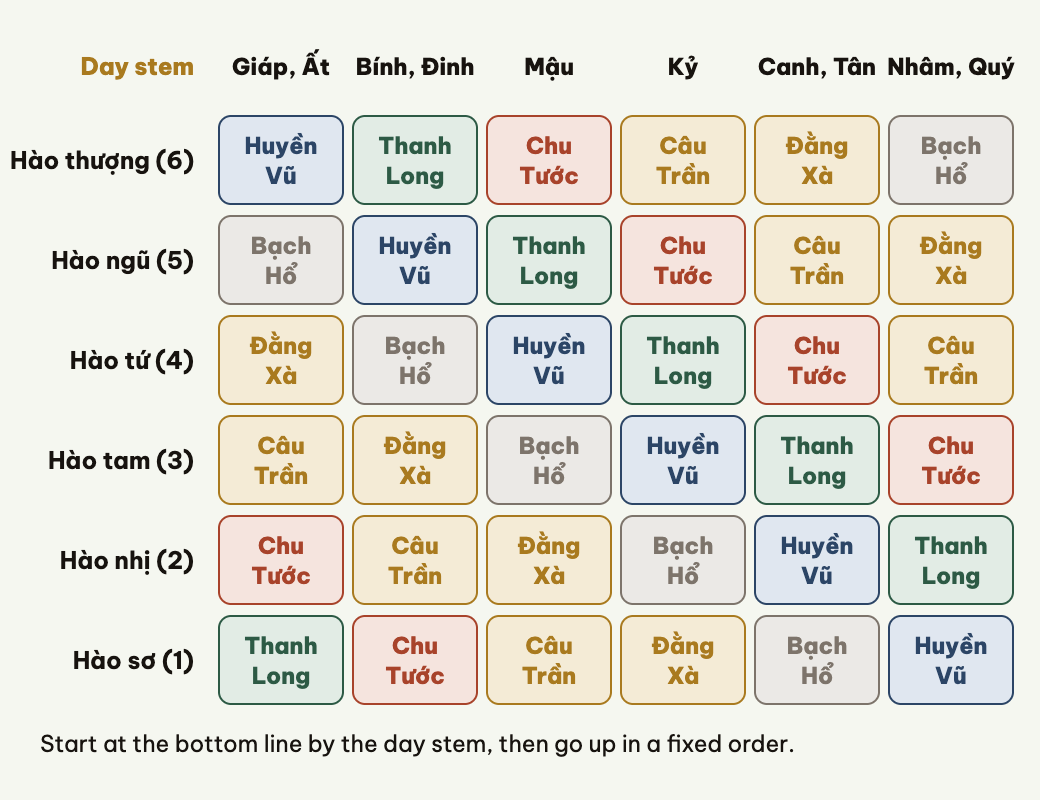
Yes. The most common way of starting them, recorded in Tang San Boc Dich chapter 18 (Six Spirits), takes the day stem as the anchor and places them upward from the first line:
| Day stem | Spirit at line 1 | Line 2 | Line 3 | Line 4 | Line 5 | Top line |
|---|---|---|---|---|---|---|
| Giap, At | Thanh Long | Chu Tuoc | Cau Tran | Dang Xa | Bach Ho | Huyen Vu |
| Binh, Dinh | Chu Tuoc | Cau Tran | Dang Xa | Bach Ho | Huyen Vu | Thanh Long |
| Mau | Cau Tran | Dang Xa | Bach Ho | Huyen Vu | Thanh Long | Chu Tuoc |
| Ky | Dang Xa | Bach Ho | Huyen Vu | Thanh Long | Chu Tuoc | Cau Tran |
| Canh, Tan | Bach Ho | Huyen Vu | Thanh Long | Chu Tuoc | Cau Tran | Dang Xa |
| Nham, Quy | Huyen Vu | Thanh Long | Chu Tuoc | Cau Tran | Dang Xa | Bach Ho |
The rule for reading the table is simple: identify the day stem, find the spirit starting at the first line, then count upward in the circular order Thanh Long, Chu Tuoc, Cau Tran, Dang Xa, Bach Ho, Huyen Vu. For example, on a Giap or At day the first line is Thanh Long, the second is Chu Tuoc, the third is Cau Tran, the fourth is Dang Xa, the fifth is Bach Ho, and the top line is Huyen Vu. On a Canh or Tan day the first line is Bach Ho, and so on upward.
One technical point to note: this way of starting them counts by day stem, not by day branch, not by the stem of the line. This is what distinguishes it from many other systems such as Luc Nham or Ky Mon, where the generals are placed by board and by session rather than by the day stem of a Luc Hao hexagram.
What shade does Thanh Long carry when it lands on a line?
Thanh Long belongs to Wood, tied to the East, to spring, to growth. When it lands on a line, it covers that line with the shade of joy, wine and money, benevolence, and cheerfulness. Tang San Boc Dich in its section of eighteen discussions says in substance that Thanh Long is by nature very cheerful and benevolent, but if it attaches to a Ky than then plans bring no gain. That is, the nature of the spirit is one thing, the position it occupies is another.
When Thanh Long lands on a Dung than that is prosperous, the shade of joy, wine and money, and good news is clearer. When Thanh Long lands on a Ky than, that shade is bent in another direction: cheerfulness becomes excessive eating and drinking, benevolence becomes weakness, joy becomes hollow celebration. So Thanh Long should not be read as "auspicious" mechanically.
What shade does Chu Tuoc carry when it lands on a line?
Chu Tuoc belongs to Fire, tied to the South, to summer, to flame and speech. When it lands on a line, it covers that line with the shade of speech, documents, news, and disputes. The book Luc Nham (volume 1, introductory section), in its discussion of Chu Tuoc, states: Chu Tuoc governs feathers and wings, news, and writing; in old times feathers were used as pens and pigeons carried messages, so Chu Tuoc is tied to correspondence and official papers. The same book also says Chu Tuoc corresponds to the exchange of files and documents, and that when divining official matters and Chu Tuoc moves counter to the stem, reprimand from a superior is likely.
In Luc Hao, Chu Tuoc is read in the same spirit: on whichever line it lands, that line carries the added shade of speech, papers, news, or disputes. If the line is prosperous and generated, Chu Tuoc leans toward good news, smooth documents, and words with weight. If the line is declining and overcome, Chu Tuoc leans toward disputes, quarrels, arguments, and troublesome papers.
What shade does Cau Tran carry when it lands on a line?
Cau Tran belongs to Earth, tied to ground, to stillness, to slowness. When it lands on a line, it covers that line with the shade of land, houses, stagnation, and official errands. In comparative Kinh Dich writings, Cau Tran is also used to denote land, architecture, and also tumors, stones, and things that accumulate over a long time. Source 11 (a rewritten version, for comparison only) states that Cau Tran symbolizes land and architecture, and when activated it carries information about shifts in the ground layer; this matches the common understanding in old books so it can be used for reference, but should not be cited as a line from a book.
The point to remember: Cau Tran is neither bad nor good in itself. It only says that the matter tied to that line has the quality of slowness, of land, of administrative paperwork. If the Dung than is prosperous, Cau Tran is good land, a peaceful house. If the Dung than is declining, Cau Tran is stagnation, blockage, a matter that drags on without end.
Table of shades for the three spirits and the source of each row
| Spirit | Five elements, direction | Main shade | Shade when attached to a Ky than or declining | Source |
|---|---|---|---|---|
| Thanh Long | Wood, East | Joy, wine and money, benevolence, cheerfulness | Plans bring no gain, excess joy turns harmful | Tang San Boc Dich, Eighteen Discussions; Boc Phe Chinh Tong, section on the six beasts |
| Chu Tuoc | Fire, South | Speech, documents, news, disputes | Quarrels, arguments, troublesome papers | Tang San Boc Dich chapter 18; Luc Nham volume 1, section on Chu Tuoc |
| Cau Tran | Earth, Center | Land, houses, stagnation, official errands | Blockage, dragging on, accumulation | Tang San Boc Dich; Boc Phe Chinh Tong, section on the six beasts |
Why do the six beasts only color, and never decide fortune or misfortune on their own?
The answer lies in the structure of Luc Hao hexagram reading. A Luc Hao hexagram has many layers: the hexagram and the lines, the five elements of the lines, the six relations of the lines, the month order and the day spirit, the moving line and the changed line, void in the cycle and month destruction, and only then the six beasts. Among these layers, the month order and the day spirit are the two strongest, because they decide the prosperity or decline of every line. The six beasts stand in the outermost layer, only adding shade, never changing prosperity or decline.
Tang San Boc Dich stresses this spirit many times. The book criticizes books that treat Thanh Long as always auspicious and Bach Ho as always inauspicious as a mechanical reading that ignores prosperity, decline, generation, and overcoming. In the same spirit, Boc Phe Chinh Tong in its section on the six beasts also says the line must be examined first and only then the spirit read. In other words, the six beasts are seasoning, not the main dish.
An example for clarity: suppose one needs to divine a matter of seeking wealth, casts a hexagram with LapQueLucHao, and gets the Wealth line holding the World position, generated by the month order and supported by the day spirit; then even if that line attaches to Bach Ho it cannot be called inauspicious. The shade of Bach Ho only adds that the matter is forceful, decisive, and may involve a small dispute, but it cannot break the prosperity of Wealth. Conversely, if the Wealth line is already destroyed by the month and overcome by the day, and also attaches to Thanh Long, then Thanh Long cannot save it either, it only makes the reader more prone to complacency.
Where do the schools differ?
First, Tang San Boc Dich criticizes books that treat Thanh Long as always auspicious and Bach Ho as always inauspicious. This is the clearest point of disagreement between the Da Hac school and some earlier books. Da Hac holds that the six beasts must be placed in relation to the Dung than, the month order, and the day spirit.
Second, some schools drop the six beasts entirely, using only the five elements, the six relations, and the month and day. This approach appears in some modern Luc Hao schools, which hold that the six beasts only add noise rather than information.
Third, the way of starting the six beasts for Mau and Ky has differing records. The common version according to Tang San Boc Dich chapter 18 is that Mau starts with Cau Tran and Ky starts with Dang Xa. Some other versions record Mau starting with Dang Xa and Ky starting with Cau Tran. This is where clarity is needed: this article follows the convention of Tang San Boc Dich chapter 18, that is, Mau starts with Cau Tran, Ky starts with Dang Xa, and they are placed upward from the first line.
Fourth, the six spirits Thanh Long, Chu Tuoc, Cau Tran, Dang Xa, Bach Ho, and Huyen Vu share names but belong to a different system from the twelve heavenly generals of Luc Nham. Luc Nham has Quy Nhan, Dang Xa, Chu Tuoc, Luc Hop, Cau Tran, Thanh Long, Thien Khong, Bach Ho, Thai Thuong, Huyen Vu, Thai Am, and Thien Hau. Six names overlap, but the way of placing them, the way of reading them, and the context of use are entirely different. One should not take the reading of Chu Tuoc in Luc Nham and apply it directly to Luc Hao without noting the difference in system.
In what order should the six beasts be read?
The reading order should be as follows: identify the question and the Dung than; look at the month order and the day spirit; look at the moving line, the changed line, void in the cycle, and month destruction; look at the six relations and the five elements of the line; and only at the end read the six beasts to add shade. If the order is reversed, reading the six beasts first and then looking at prosperity and decline, one easily falls into the mechanical reading that Tang San Boc Dich criticized.
One more point to remember: the six beasts do not create fortune or misfortune on their own, but they help distinguish two situations with the same five element structure. For example, two hexagrams both have a prosperous Wealth line, one with Wealth attached to Thanh Long, one with Wealth attached to Bach Ho. Both are prosperous Wealth, but the shades differ: one leans toward joy, one toward force, decisiveness, and possible dispute. This is the true value of the six beasts: distinguishing shades, not deciding fortune or misfortune.
Should the six beasts be used to discuss illness?
No, within the scope of this article and the orientation of the site. Boc Dich books and some sources contain passages discussing illness by the six spirits (Thanh Long tied to aches, itching, postpartum matters; Chu Tuoc tied to delirious speech, inflammation, fever; Cau Tran tied to tumors, stones; Dang Xa tied to intestines, strange diseases, fright). Those passages belong to the domain of traditional medicine and illness divination, not to the scope of this article. The site does not write a section on asking about illness with Luc Hao. Readers with health problems should seek a medical facility, not rely on a hexagram.
A compact way to remember
Thanh Long is joy, wine and money, benevolence. Chu Tuoc is speech, documents, news, disputes. Cau Tran is land, stagnation, official errands. All three, together with Dang Xa, Bach Ho, and Huyen Vu, only color a line already assessed for prosperity or decline. The way of starting them is by day stem, placed upward from the first line, according to the convention of Tang San Boc Dich chapter 18. Where Mau and Ky start with which spirit has differing records, and some schools drop the six beasts entirely. These six spirits share names but belong to a different system from the twelve heavenly generals of Luc Nham. Read the six beasts last, never first.


