
What is Mệnh vô chính diệu?
Mệnh vô chính diệu is the condition in which the Mệnh palace on a Tử Vi chart holds no major star (chính tinh) at all. Major stars here comprise two systems: the Tử Vi system (Tử Vi, Thiên Cơ, Thái Dương, Vũ Khúc, Thiên Đồng, Liêm Trinh) and the Thiên Phủ system (Thiên Phủ, Thái Âm, Tham Lang, Cự Môn, Thiên Tướng, Thiên Lương, Thất Sát, Phá Quân), fourteen stars in total. A palace with none of these is called a vô chính diệu palace, and when the Mệnh palace falls into that case it is called Mệnh vô chính diệu, abbreviated Mệnh VCD.
This label contrasts with "hữu chính diệu", meaning a ruling star is present. The ancients likened a palace with a major star to a house with an owner, and a vô chính diệu palace to a house without one. From that came the reasoning: a house without an owner lets bandits (malefic stars) do as they please, so a vô chính diệu palace is considered weak. Horos notes this metaphor has a flip side, because if auspicious stars occupy a vô chính diệu palace, then by that logic the auspicious stars would be stronger than usual, and the saying "phi yểu tắc bần" becomes arbitrary.
Why does an empty Mệnh palace happen?
An empty Mệnh palace is not rare; it is a necessary result of how stars are placed. The fourteen major stars are positioned according to the location of Tử Vi, and Tử Vi travels a fixed circuit through the twelve palaces. Since each palace holds only certain major stars, there are always palaces that receive none. When the native's Mệnh palace lands on one of those empty palaces, we have Mệnh vô chính diệu.
The table below shows which palaces are left empty by the twelve positions of Tử Vi. This is the core arithmetic of star placement, not a convention of any single school.
| Tử Vi position | Palaces with major stars | Vô chính diệu palaces |
|---|---|---|
| Tý | Tý, Sửu, Dần, Mão, Thìn, Tỵ, Ngọ, Mùi, Thân, Dậu, Tuất, Hợi all hold at least one major star | None |
| Sửu | Tý (Thiên Đồng), Sửu (Tử Vi, Phá Quân), Dần (Vũ Khúc), Mão (Thái Dương), Thìn (Thiên Cơ), Tỵ (Thất Sát), Ngọ (Thiên Lương), Mùi (Liêm Trinh), Thân (Tham Lang), Dậu (Cự Môn), Tuất (Thiên Tướng), Hợi (Thái Âm) | None |
| Dần | Dần (Tử Vi), Mão (Thiên Cơ), Thìn (Thái Dương), Tỵ (Vũ Khúc), Ngọ (Thiên Đồng), Mùi (Liêm Trinh), Thân (Tham Lang), Dậu (Cự Môn), Tuất (Thiên Tướng), Hợi (Thái Âm), Tý (Thiên Phủ), Sửu (Phá Quân) | None |
| Mão | Mão (Tử Vi), Thìn (Thiên Cơ), Tỵ (Thái Dương), Ngọ (Vũ Khúc), Mùi (Thiên Đồng), Thân (Liêm Trinh), Dậu (Tham Lang), Tuất (Cự Môn), Hợi (Thiên Tướng), Tý (Thiên Phủ), Sửu (Thái Âm), Dần (Phá Quân) | None |
| Thìn | Thìn (Tử Vi), Tỵ (Thiên Cơ), Ngọ (Thái Dương), Mùi (Vũ Khúc), Thân (Thiên Đồng), Dậu (Liêm Trinh), Tuất (Tham Lang), Hợi (Cự Môn), Tý (Thiên Tướng), Sửu (Thiên Phủ), Dần (Thái Âm), Mão (Phá Quân) | None |
| Tỵ | Tỵ (Tử Vi), Ngọ (Thiên Cơ), Mùi (Thái Dương), Thân (Vũ Khúc), Dậu (Thiên Đồng), Tuất (Liêm Trinh), Hợi (Tham Lang), Tý (Cự Môn), Sửu (Thiên Tướng), Dần (Thiên Phủ), Mão (Thái Âm), Thìn (Phá Quân) | None |
| Ngọ | Ngọ (Tử Vi), Mùi (Thiên Cơ), Thân (Thái Dương), Dậu (Vũ Khúc), Tuất (Thiên Đồng), Hợi (Liêm Trinh), Tý (Tham Lang), Sửu (Cự Môn), Dần (Thiên Tướng), Mão (Thiên Phủ), Thìn (Thái Âm), Tỵ (Phá Quân) | None |
| Mùi | Mùi (Tử Vi), Thân (Thiên Cơ), Dậu (Thái Dương), Tuất (Vũ Khúc), Hợi (Thiên Đồng), Tý (Liêm Trinh), Sửu (Tham Lang), Dần (Cự Môn), Mão (Thiên Tướng), Thìn (Thiên Phủ), Tỵ (Thái Âm), Ngọ (Phá Quân) | None |
| Thân | Thân (Tử Vi), Dậu (Thiên Cơ), Tuất (Thái Dương), Hợi (Vũ Khúc), Tý (Thiên Đồng), Sửu (Liêm Trinh), Dần (Tham Lang), Mão (Cự Môn), Thìn (Thiên Tướng), Tỵ (Thiên Phủ), Ngọ (Thái Âm), Mùi (Phá Quân) | None |
| Dậu | Dậu (Tử Vi), Tuất (Thiên Cơ), Hợi (Thái Dương), Tý (Vũ Khúc), Sửu (Thiên Đồng), Dần (Liêm Trinh), Mão (Tham Lang), Thìn (Cự Môn), Tỵ (Thiên Tướng), Ngọ (Thiên Phủ), Mùi (Thái Âm), Thân (Phá Quân) | None |
| Tuất | Tuất (Tử Vi), Hợi (Thiên Cơ), Tý (Thái Dương), Sửu (Vũ Khúc), Dần (Thiên Đồng), Mão (Liêm Trinh), Thìn (Tham Lang), Tỵ (Cự Môn), Ngọ (Thiên Tướng), Mùi (Thiên Phủ), Thân (Thái Âm), Dậu (Phá Quân) | None |
| Hợi | Hợi (Tử Vi), Tý (Thiên Cơ), Sửu (Thái Dương), Dần (Vũ Khúc), Mão (Thiên Đồng), Thìn (Liêm Trinh), Tỵ (Tham Lang), Ngọ (Cự Môn), Mùi (Thiên Tướng), Thân (Thiên Phủ), Dậu (Thái Âm), Tuất (Phá Quân) | None |
This table shows something important: with Tử Vi in its twelve positions, every palace on the earthly plate receives exactly one major star, so no palace is entirely empty. In other words, a vô chính diệu palace is not produced by Tử Vi itself, but by the placement of Mệnh according to birth month and birth hour pushing the Mệnh palace into a spot with no major star. This is why the rate of Mệnh VCD is not fixed across all charts, but depends on the distribution of birth months and birth hours among people.
Reading an empty Mệnh palace by borrowing stars from Thiên Di
According to the Tam Hợp school of Trung Châu Tử Vi Đẩu Số, represented by the Tử Vi scholar Vương Đình Chi, a vô chính diệu palace requires the method of "borrowing stars to place the palace": take the star system in the opposite palace to assess the star system of the home palace. The palace opposite Mệnh is Thiên Di, so Mệnh VCD is read through the star system of Thiên Di. Tracuutuvi.com records the influence as roughly 70 to 80 percent, meaning some part and not the whole.
Why only "six or seven parts"? Because a borrowed palace is not the occupying palace. The borrowed star still sits in its home palace, and when it shines onto Mệnh it is already diminished. One example in Tử Vi literature shows this: a male chart has a vô chính diệu Quan Lộc palace, with Tử Vi and Thiên Tướng in miếu vượng opposite. By theory this person should hold a high post, but in fact he only reached department head and never became director. The document concludes that no matter how good the opposite palace is, when it shines into an empty palace it is still diminished, especially in key palaces such as Mệnh, Quan, and Tài.
Minor stars, Tuần Triệt, and Tứ Không in an empty palace
When the Mệnh palace has no major star, the remaining minor and miscellaneous stars play a larger role than usual. Horos argues that vô chính diệu strengthens the stars occupying the palace, in both directions: a malefic star such as Kình Dương in a Mệnh VCD usually causes heavier harm than when a major star accompanies it, but an auspicious star in a Mệnh VCD is also stronger than usual. Because Tử Vi is qualitative rather than quantitative, this increase cannot be measured precisely; it can only be judged on the chart and checked against reality.
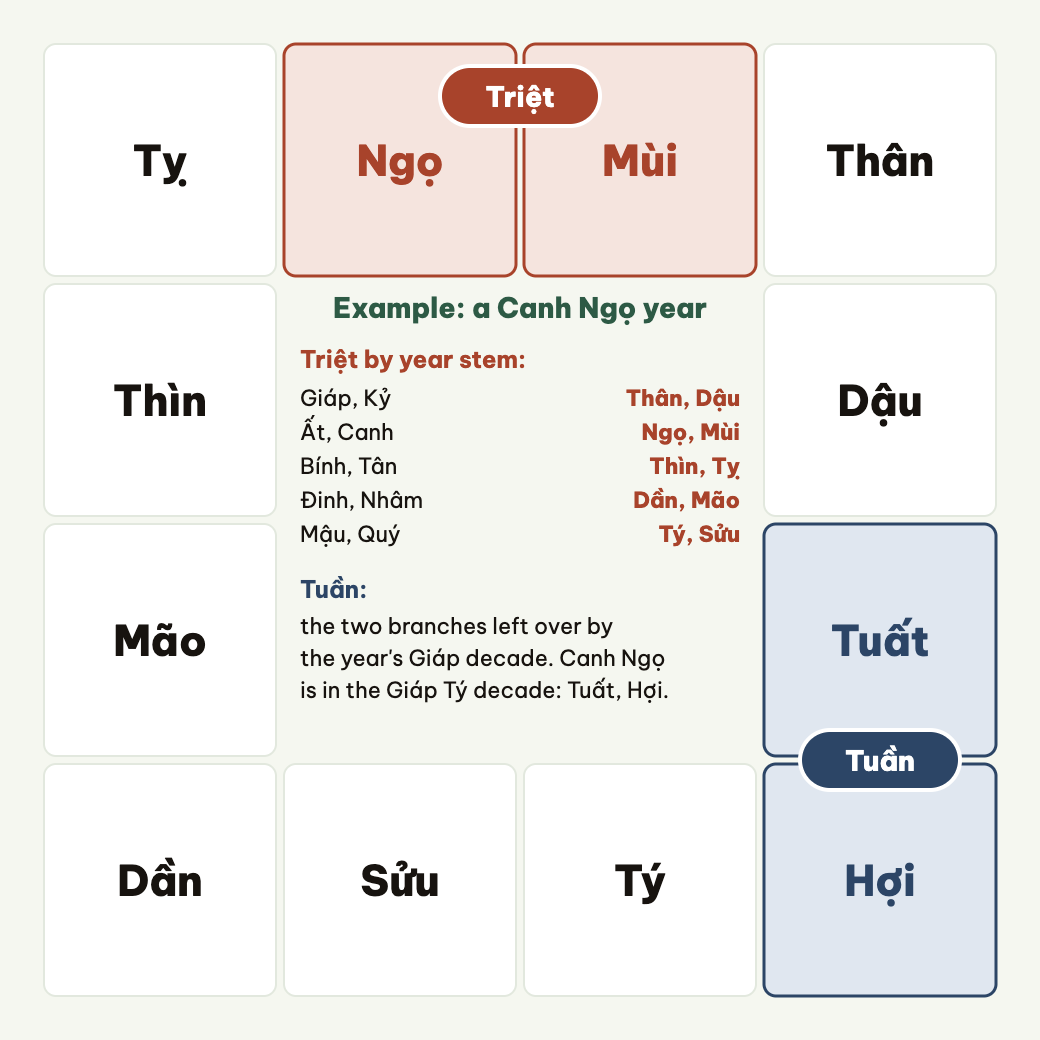
Tuần and Triệt are two stars that often cause concern in a palace with a major star, but in a vô chính diệu palace they are usually seen as beneficial. Tracuutuvi.com explains that Tuần surrounds and restrains, Triệt blocks thoroughly, so when they sit over a Mệnh VCD palace they curb the bad effects of occupying or shining malefic stars. The downside is that they also reduce the good of auspicious stars, so the early period is often hard and only later becomes easier.
The system of four Không stars, comprising Thiên Không, Địa Không, Tuần Không, and Triệt Không, is divided into separate configurations. Đắc Nhị Không is having two of the four Không stars shine onto Mệnh, usually signifying sudden rise and sudden fall. Đắc Tam Không is one Không star holding Mệnh and the other two in the tam hợp palaces, regarded as one of the best forms for a Mệnh palace without a major star. Kiến Tam Không is one Không star in Mệnh, one in Thiên Di, and one in Tài Bạch or Quan Lộc, usually limiting wealth, career, and romance. Ngộ Tam Không is the bad case, when the Mệnh palace has a malefic star in hãm địa occupying it while the three directions add Không stars, making the malefic star act strongly and hard to stop.
The old verse "vô chính diệu yểu chiết" and where the schools disagree
Many books write "Mệnh Vô Chính Diệu phi yểu tắc bần", meaning if not short-lived then poor. Horos counters that this verse no longer suits modern interpretation. When Mệnh VCD meets many bad stars with no auspicious star to balance them, life is indeed likely to drift, struggle to accumulate wealth, and struggle to define itself. But when Mệnh VCD meets many auspicious stars or sits in a favorable configuration, the native still develops well, sometimes even surpassing a chart with an occupying major star. Tử Vi literature also records the case of a woman born in the year Nhâm Tí, whose Mệnh palace placed at Thân is completely empty, yet she was a successful businesswoman, lived to nearly 70, and had 10 children.
The clearest disagreement among schools lies in the scope of star borrowing. The Tam Hợp school follows the method of borrowing the star system of the opposite palace, taking Thiên Di as the main source. Other schools extend further, borrowing from the whole tam hợp, that is, also considering Tài Bạch and Quan Lộc, and even reading other palaces through a flexible "borrowed palace" relationship. One document on fate analysis remarks that life is endlessly varied, the twelve palaces cannot contain it all, so one must apply the borrowed palace relationship flexibly.
The Khâm Thiên Tứ Hóa school takes a completely different direction. One record on Khâm Thiên recounts the case of a person with Mệnh Vô Chính Diệu who, by the Tam Hợp school, must borrow Đồng and Nguyệt from the opposite palace, but the reader following Khâm Thiên only needed to say "borrowing Thái Âm is enough". The understanding here is not that Thái Âm is placed into Mệnh, but that Mệnh VCD "sends its image" into Thái Âm, and Thái Âm becomes "the Tử Vi of the twelfth position" in the chart's configuration. The same record gives another example: instead of borrowing Dương Lương from the opposite palace, the reader takes "the Tử Vi of Điền Trạch" to examine the Mệnh palace, finds Cự Môn, and it again falls into Quan Lộc. That is, Khâm Thiên does not fix on the opposite palace, but reads an empty palace through the Tự Hóa and Phi Hóa of the whole chart.
Why fortune should not be asserted absolutely
Mệnh vô chính diệu is not a sentence. An empty Mệnh palace creates an open space to receive influence from other palaces, especially the tam hợp of Tài, Quan, Di, and the minor stars. This very absence of a major star is the source of versatility, helping the native adapt easily to many environments and fields, provided good stars shine in. People with Mệnh VCD often learn quickly, are curious, love to explore, and succeed more easily once they have accumulated enough experience.
On the other hand, there are points to note. Tracuutuvi.com remarks that people with Mệnh VCD find it hard to hold leadership positions because they lack firm views, are easily influenced from outside, and work by emotion, so success, if any, is easily lost. The influence of a Mệnh VCD palace is clearest in the early period, diminishing in the middle and late periods. These are tendencies, not fixed destiny, and should be checked against the whole chart before concluding.


