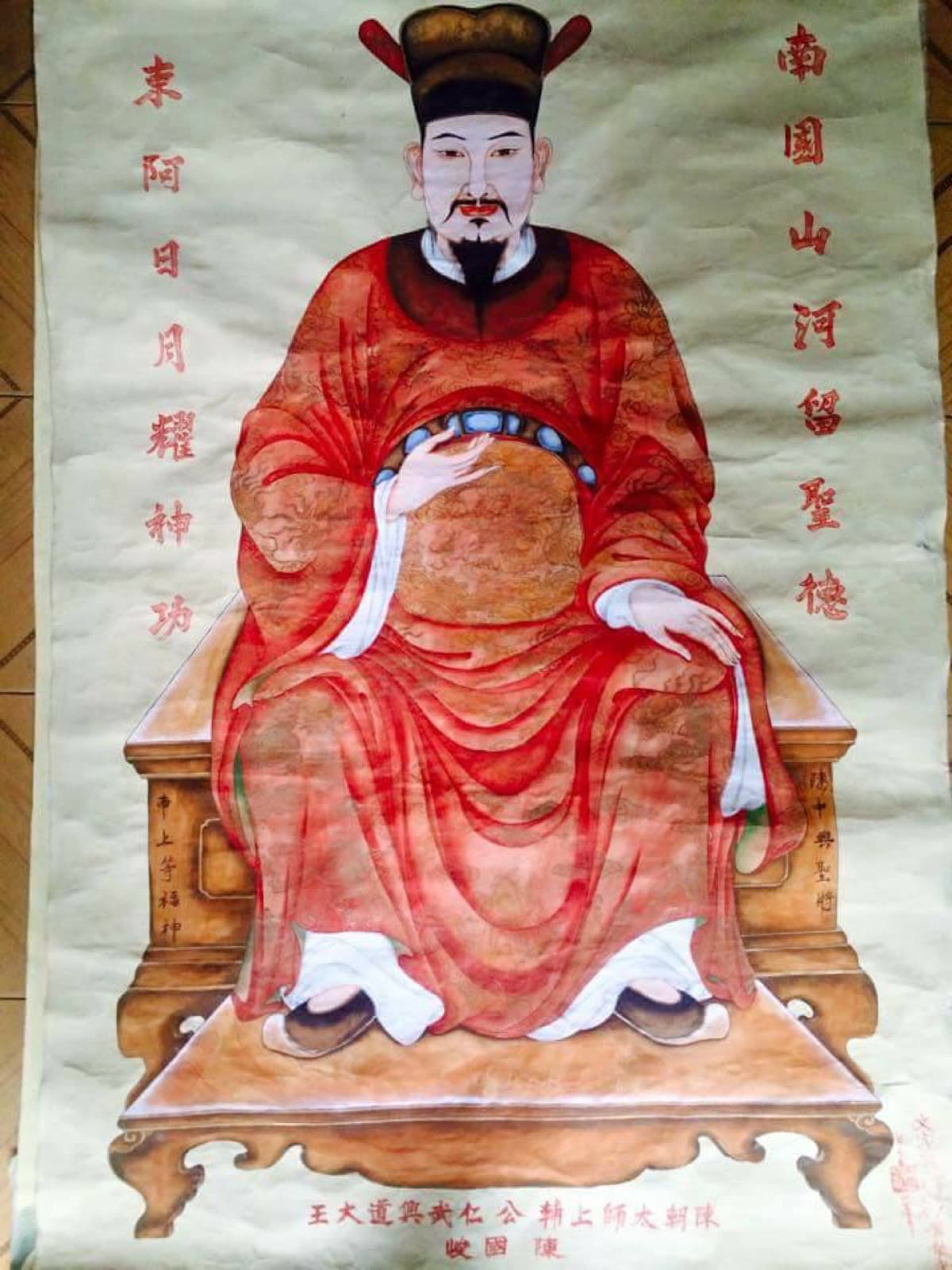
When and where does the Tep Temple festival take place?
The Tep Temple festival, the festival of the temple honoring Trung Tuc Vuong Le Lai, is recorded by Bao Thanh Hoa as taking place twice a year: on the 21st day of the 8th lunar month and the 8th day of the 1st lunar month1. The temple is located in Kien Tho commune, Thanh Hoa province (before July 2025 part of Ngoc Lac district), in the Lam Son area12. The newspaper calls the place Tep village, while the Kien Tho commune portal in 2025 calls it Thanh Son village, so both names exist side by side12.
The temple to Le Lai belongs to the Lam Kinh Special National Relic Site, about 6 km west of the main hall1. It stands on high, flat, airy ground, described in feng shui terms as a "dragon and tiger" terrain1. In front of the temple is a large semicircular lake1.
Why is Le Lai's death anniversary one day before Le Loi's?
After ascending the throne in the first year of Thuan Thien (1428), Le Loi had a temple built to Le Lai in Tep village and ordered his officials to hold Le Lai's commemoration one day before his own1. From this came the folk saying "Twenty-first for Le Lai, twenty-second for Le Loi"1. This was a ritual regulation expressing the gratitude of the founding king of the Later Le dynasty to the man who risked his life to save him in the early days of the uprising12.
According to Bao Van Hoa, Le Loi conferred on Le Lai the title Trung Tuc Vuong, built a temple in his home village of Kien Tho, and set the annual date of the 21st day of the 8th lunar month, one day before his own commemoration, for the people to remember and honor the loyal hero2.
History of the temple and its restorations
The temple to Le Lai was established in 1428 by order of Le Loi1. In 1450, under the reign of King Le Nhan Tong (era name Thai Hoa), the king issued a decree to repair and embellish the temple as a place of worship and incense for the talented general who forgot himself to save his commander1.
In 1939 and 1944 under King Bao Dai, the temple's rear sanctuary was restored for the last time, giving it its present appearance1. The temple was designed and built in the "chong ruong gia chieng" style, a traditional northern Vietnamese house architecture, with curved roofs as commonly seen in communal houses and pagodas1. Inside, the altar is decorated with red lacquer and gold; the rear sanctuary still keeps many valuable ancient artifacts such as horizontal plaques and parallel sentences carved on solid wood panels, praising the merits and heroic example of the founding official of the Later Le dynasty1.
| Time | Event related to the temple and festival |
|---|---|
| 1416 | Le Lai and Le Loi with 17 generals held the Lung Nhai oath, preparing to raise the Lam Son uprising, according to Dai Viet Thong Su1 |
| 1419 | The Lam Son army was besieged on Chi Linh mountain; Le Lai exchanged robes with Le Loi, risking his life to save his lord, and was captured1 |
| 1428 | Le Loi ascended the throne, built a temple to Le Lai in Tep village, and set Le Lai's commemoration one day before his own12 |
| 1450 | King Le Nhan Tong, era Thai Hoa, decreed repairs and embellishment of the temple1 |
| 1939, 1944 | Under King Bao Dai, the rear sanctuary was restored for the last time, giving the temple its present form1 |
| 2025 | A solemn incense-offering ceremony to Trung Tuc Vuong Le Lai was held in Kien Tho commune, marking the 607th anniversary of the Lam Son Uprising (1418-2025)2 |
The two annual festivals and main activities
According to Bao Thanh Hoa, the Tep Temple festival takes place on the 21st day of the 8th lunar month and the 8th day of the 1st lunar month1. The festival usually includes solemn rituals and incense offerings following Le-era worship rites1. There are also palanquin processions, chau van singing, gong performances, sword dances, and archery1.
| Festival | Lunar date | Note |
|---|---|---|
| Main commemoration | 21st day of the 8th lunar month | Same as Le Lai's death anniversary by royal rule, one day before Le Loi's12 |
| Early-year festival | 8th day of the 1st lunar month | The second festival of the year, as recorded by Bao Thanh Hoa1 |
Note that available sources record the two festivals as above. Bao Van Hoa, reporting on the 2025 incense ceremony, mentions only the 21st day of the 8th lunar month, which was October 12 that year, without mentioning the 8th day of the 1st lunar month2. This is where sources do not fully agree on the number of festivals listed, and readers should cross-check with local announcements for each specific year.
Le Lai's sacrifice to save his lord: what is official history and what is legend?
According to Dai Viet Thong Su, in 1416 Le Lai and Le Loi with 17 generals held the Lung Nhai oath to prepare the Lam Son uprising against the invading Ming1. In 1419, when the Lam Son army was besieged on Chi Linh mountain with no retreat, in an urgent situation Le Lai exchanged robes with Le Loi to save his lord and protect the force1. He rode an elephant into battle to break the siege, but because the enemy force was too strong, Le Lai was captured1. His sacrifice contributed significantly to the victory of the Lam Son uprising1.
According to Bao Van Hoa, when the army was surrounded on Chi Linh mountain, Lord Le Lai volunteered to wear the royal robe, impersonating Le Loi, leading suicide troops into battle to open a bloody path to save the commander and the whole army2. That heroic sacrifice not only saved Binh Dinh Vuong Le Loi but also preserved the seed of the anti-Ming resistance, so that from that flame the flag of national independence was raised high2.
Symbolic details such as Le Lai riding an elephant into battle to break the siege, or wearing the royal robe to impersonate Le Loi, are cited by newspapers and historical records as part of the historical story, but the level of detail may vary between accounts. Elements not found in official history but only passed down among the people should be noted as legend, not presented as verified events. The event of Le Lai sacrificing himself to save Le Loi and the army during the difficult period at Chi Linh is recorded in Dai Viet Thong Su1.
How is the Tep Temple festival actually held?
During the 2025 incense ceremony to commemorate Trung Tuc Vuong Le Lai, delegates and people offered incense to remember the merits of the loyal general2. The ceremony was conducted solemnly according to traditional rites, accompanied by resonant gongs and drums, creating a sacred atmosphere rich in Thanh Hoa identity2. Director of the Thanh Hoa Department of Culture, Sports and Tourism Le Van Trung beat the drum to open the festival2.
Also on the 21st day of the 8th lunar month in 2025, in Hac Thanh ward, a ceremony and incense offering to commemorate national hero Le Loi was solemnly held at the Thai Mieu of the Later Le dynasty National Relic and the Le Loi Statue2. Chairman of the Hac Thanh ward People's Committee Nguyen Van Hung struck the gong to begin the ceremony2. Thus, the two commemorations of Le Lai and Le Loi were held on the same day, the 21st of the 8th lunar month, at two different locations in Thanh Hoa2.
Activities at the Tep Temple festival as recorded by Bao Thanh Hoa include rituals, incense offerings, palanquin processions, chau van singing, gong performances, sword dances, and archery1. The Tep Temple festival has long been a major celebration for local people and attracts thousands of visitors to offer incense1.
Points to note when researching this festival
First, the temple has several names: temple of Trung Tuc Vuong Le Lai, Tep Temple, Le Lai Temple1. The village also has two names: Tep village in the press, and Thanh Son village on the Kien Tho commune portal in 202512.
Second, regarding administrative units, Kien Tho commune, Thanh Hoa province is the current unit; before July 2025 this area belonged to Ngoc Lac district2. When researching older documents, readers may encounter the name Ngoc Lac district instead of the commune directly under the province.
Third, available sources do not mention any intangible cultural heritage title specifically for the Tep Temple festival12. Therefore, this festival should not be assigned titles such as national heritage or UNESCO heritage without official recognition documents. The fact that the Le Lai temple is within the Lam Kinh Special National Relic Site is information about the relic, not the festival1.