
What Are Tuần and Triệt on a Tử Vi Chart?
Tuần and Triệt, fully named Tuần Không and Triệt Không, are two stars in the void (không vong) group of Tử Vi Đẩu Số, alongside Địa Không. In the common presentation on Tử Vi reference sites, these two stars are not fixedly inauspicious or auspicious; their effect depends on their position on the chart and their combination with other stars.
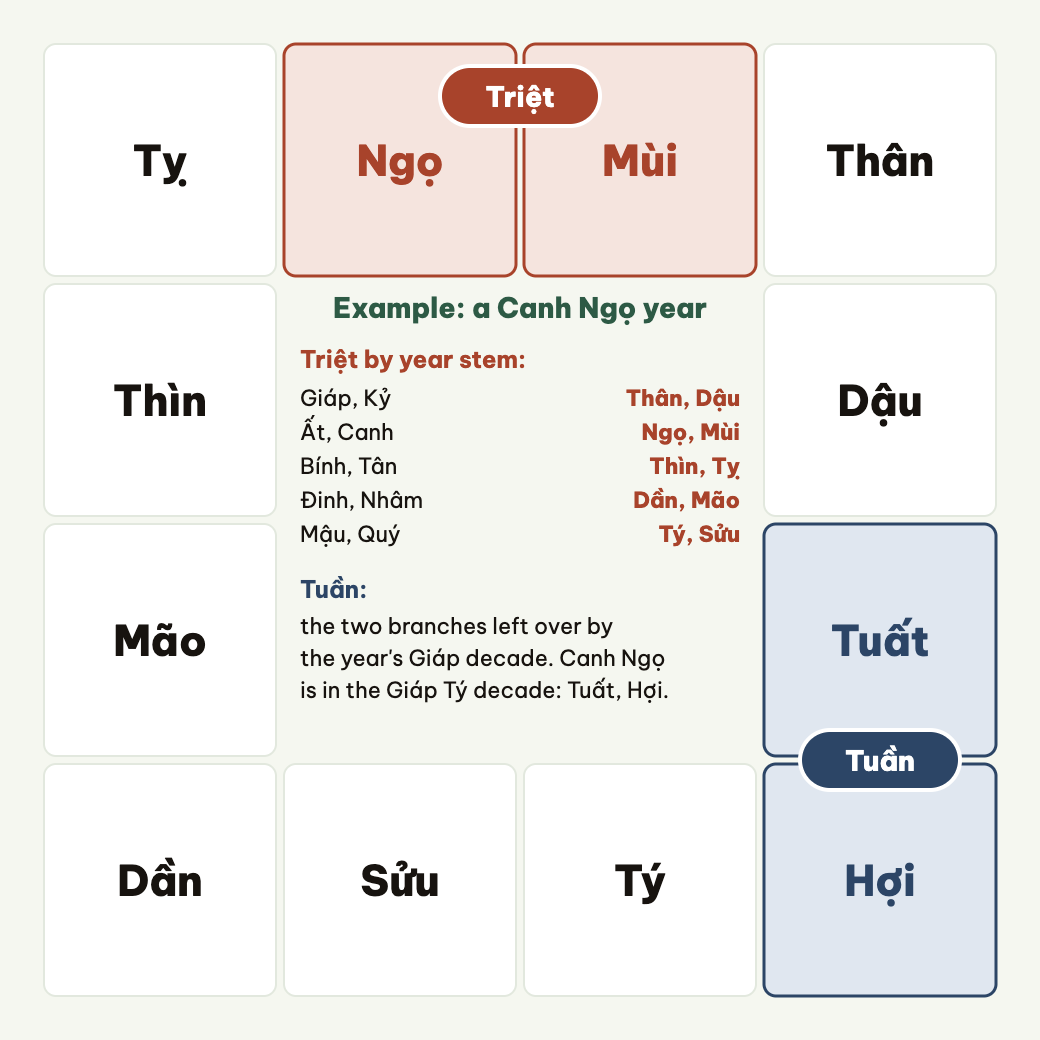
The special point of Tuần and Triệt is that they do not sit neatly in one palace but always block the gap between two adjacent palaces. So when interpreting, both palaces are considered affected. Tuần Không's character is obstruction, hardship, persistence, slow turning, and it is assigned the Metal element. Triệt Không's character is restraint, blocking luck, deadlock, hindrance, destruction, and it is assigned the Fire element. Note that even the element assignment for these two stars is not consistent across schools.
Why Do Tuần and Triệt Always Block Between Two Palaces?
The mechanism of blocking between two palaces comes directly from how the stars are placed. Tuần Không is taken from the tuần Giáp, meaning from the gap in the 60-year cycle (hoa giáp). A tuần Giáp consists of 10 days pairing 10 Heavenly Stems with 10 of the 12 Earthly Branches, so 2 Earthly Branches are always left empty. Those two empty Earthly Branches are the Tuần Không of that tuần. Because they are two adjacent Earthly Branches in the 12 Branches, when placed on the chart Tuần always occupies two adjacent palaces, meaning it sits in the gap between two palaces.
Triệt Không is placed by the heavenly stem of the birth year. Each pair of heavenly stems corresponds to a pair of adjacent palaces, so Triệt also always blocks between two palaces. This is the core reason both Tuần and Triệt never stand neatly in one palace, and when interpreting one must consider both palaces they block.
How Is Tuần Placed by the Birth Year's Tuần Giáp?
To place Tuần, first determine which tuần Giáp the birth year belongs to. A year with the heavenly stem Giáp is a birth year ending in the digit 4, for example 1984, 1994, 2004, 2014. From the birth year, count back to the nearest Giáp year, then consult the table below.
| Tuần Giáp | Palace pair for Tuần |
|---|---|
| Giáp Tý | Tuất, Hợi |
| Giáp Tuất | Thân, Dậu |
| Giáp Thân | Ngọ, Mùi |
| Giáp Ngọ | Thìn, Tỵ |
| Giáp Thìn | Dần, Mão |
| Giáp Dần | Tý, Sửu |
For example, someone born in 2000, counting back to the nearest Giáp year is 1994, that is Giáp Tuất, so Tuần is placed at the two palaces Thân and Dậu. This tuần không table matches the record in the book Kỳ Môn Chỉ Quy, volume 1, in the section on tuần không direction: tuần Giáp Tý voids Tuất Hợi, tuần Giáp Tuất voids Thân Dậu, tuần Giáp Thân voids Ngọ Mùi, tuần Giáp Ngọ voids Thìn Tỵ, tuần Giáp Thìn voids Dần Mão, tuần Giáp Dần voids Tý Sửu. The method of establishing tuần Giáp is also presented in detail in the book Đẩu số tinh thành, volume 1 part 1: after the 10 stems are exhausted, the two empty earthly branches of the previous round are paired first in the next round.
How Is Triệt Placed by the Birth Year's Heavenly Stem?
Triệt is simpler to place, relying only on the heavenly stem of the birth year; each pair of stems corresponds to a pair of adjacent palaces.
| Birth year heavenly stem | Palace pair for Triệt |
|---|---|
| Giáp, Kỷ | Thân, Dậu |
| Ất, Canh | Ngọ, Mùi |
| Bính, Tân | Thìn, Tỵ |
| Đinh, Nhâm | Dần, Mão |
| Mậu, Quý | Tý, Sửu |
It is important to distinguish clearly: Tuần is taken by the birth year's tuần Giáp, while Triệt is taken by the birth year's heavenly stem. The two placement methods differ, so for the same birth year, the palace pair blocked by Tuần and the palace pair blocked by Triệt may or may not coincide. When Tuần and Triệt block the same palace pair, the degree of influence is usually considered stronger than when only one of the two is present.
The General Principle: Good Stars Reduced, Bad Stars Released
The most common principle when interpreting Tuần and Triệt is: meeting a good star reduces its luck, meeting a bad star restrains its harm. Many sources stress that Tuần and Triệt only reduce influence and do not change the basic nature of the star, do not turn inauspicious into auspicious and vice versa.
The book Tử Vi kinh nghiệm quyển hạ records an old view: an inauspicious star in a strong position is originally good, but meeting Tuần Triệt it becomes spoiled; while an inauspicious star in a weak position is originally bad, meeting Tuần Triệt the bad is reduced, but it is not reversed into good. This wording shows Tuần Triệt can harm both the good and the bad, depending on context.
Some specific cases are also recorded in Tử Vi kinh nghiệm quyển hạ. Lộc Tồn is originally a wealth star, but if blocked by Tuần or Triệt then wealth is hard to manifest, and accumulation meets obstacles. Thiên Hình when blocked by Tuần Triệt has its authority reduced, even lost entirely, interpreted as a "broken sword". The same book also records the phrases "Triệt đáo Kim cung" and "Tuần lâm Hỏa địa", holding that Triệt in the Thân Dậu palace (Metal) is not a concern for a Metal fate, and Tuần in the Ngọ Mùi palace (Fire) is not a concern for a Fire fate, but the book also reminds readers to experiment to verify which method is more correct.
What About Tuần and Triệt in a Mệnh Palace with No Main Star?
A Mệnh palace with no main star (Mệnh vô chính diệu) is the most discussed case when speaking of Tuần and Triệt. The book Tử Vi kinh nghiệm quyển hạ cites the old phrase "Mệnh vô chính diệu, đắc tam không, nhi phú quý khả kỳ", in which tam không is understood as Triệt Không, Tuần Không, and Địa Không. But even this phrase has another reading: "phú quý khả kỳ" implies wealth and honor have limits, meaning wealth and honor are not lasting, not necessarily a blessing. The book also notes not to confuse tam không with Thiên Không.
Another view holds that Tuần and Triệt can reduce susceptibility to external circumstances in people with a Mệnh palace with no main star, but do not change the original nature of that configuration. This is a more cautious view than treating tam không as a guarantee of wealth and honor.
Triệt Strong Before 30, Tuần Later: View and Rebuttal
A widely circulated view in folk Tử Vi holds that Triệt has a strong effect in youth, weakening after about age 30, while Tuần is lighter but persistent, affecting the whole life. This wording often comes with the judgment that male charts prefer Triệt over Tuần, and female charts prefer Tuần over Triệt.
However, this is not a view accepted by all schools. The site tracuutuvi.com presents this direction, holding that people with Tuần Triệt in the Mệnh palace face difficulties in youth, and as they grow older Triệt's effect diminishes so things become easier, while Tuần becomes more persistent later. But some other documents hold that Tuần and Triệt can undo each other, or that Tuần Triệt in the same palace has a stronger effect rather than an undoing one. This is where schools disagree, and readers should know so as not to apply it mechanically.
"Triệt đáo kim cung" and Other Old Phrases
"Triệt đáo Kim cung" is shorthand for the view that Triệt in a Metal palace (Thân, Dậu) is less bad, even good for a Metal fate, because Triệt is assigned the Metal element. Similarly, "Tuần lâm Hỏa địa" speaks of Tuần in the Ngọ, Mùi palaces. The book Tử Vi kinh nghiệm quyển hạ records these phrases with examples: a Mệnh in the Thân palace meeting Triệt is considered less bad, while a Mệnh in the Dậu palace bearing the two words Không Vong is considered very bad. It should be stated clearly that this is old interpretation, not an immutable rule, and the book itself encourages readers to verify.
Another view recorded in research circles holds that Triệt in a Metal palace is good, only blocking bad stars; Tuần in a Fire palace also only blocks bad stars. This wording is tied closely to the element assignment for the two stars, and that very assignment is itself a point of dispute.
Origin of Tuần and Triệt: Unresolved Questions
The origin of Tuần and Triệt is a big question without a unified answer. Ancient China did not have the concept of a week as seven days; tuần here is a unit of 10 for counting time. Some opinions hold that the tuần concept in Diễn Cẩm Pháp was transmitted from the Western Regions, originating in the Qing dynasty, and Diễn Cẩm Pháp is a prediction method using 28 stars, unrelated to Tử Vi Đẩu Số.
Some researchers distinguish two branches of Tử Vi: the "Tử Vi chính tông" branch transmitted from court astrologers in the Tang dynasty, and the "Tử Vi dân gian" branch formed when knowledge was lost and then embellished. This is why the star system and methodology lack consistency, including Tuần and Triệt. Some schools hardly use Tuần Triệt, for example the Khâm Thiên Hoa Sơn tứ hóa school, and the Hiện đại school founded by Liễu Vô Cư Sĩ also does not use these two stars.
There is also a view that Tuần and Triệt are not stars but only yin-yang data, representing the opening and closing of two phases. Dr. Hà Hưng Quốc is mentioned with this view. Another view holds that Tuần Triệt express abnormality, not necessarily bad, and only bring reduction rather than changing the nature of the main star.
Common Prejudices to Avoid
In practical interpretation, many prejudices attach to Tuần and Triệt: Tuần Triệt in the Quan Lộc palace means a career broken midway, hard to succeed; in the Tài Bạch palace, hard to accumulate wealth, poverty and hardship; in the Phu Thê palace, emotional breakdown. These prejudices often ignore the wholeness of the chart.
The cautious view holds that the influence of Tuần and Triệt is real but not dominant, because their nature is only qualitative and does not change auspicious or inauspicious quality. A chart experiencing challenges in career or love may be due to a configuration in an inauspicious position, not only because of Tuần and Triệt. Therefore, when interpreting, one should place Tuần and Triệt in the whole chart rather than looking only at their presence to conclude about a whole life.
Summary of Approach
Tuần and Triệt are two void stars with clear placement: Tuần by the birth year's tuần Giáp, Triệt by the birth year's heavenly stem. Both always block between two adjacent palaces, so when interpreting one must consider both palaces. The general principle is to reduce the luck of good stars and restrain the harm of bad stars, without reversing nature. Schools still disagree on intensity, timing of influence, element assignment, and degree of involvement in the chart, so readers should treat Tuần and Triệt as a reference factor in the whole, not a decisive one.


