
What is Tam Phuong Tu Chinh?
Tam Phuong Tu Chinh is the four key palaces used to interpret one palace on a Tu Vi chart: the home palace, the two Tam Hop palaces that share its Earthly Branch group, and the opposite palace. In the common presentation on tracuutuvi.com, every palace on the chart has its own Tam Phuong Tu Chinh, and reading all four gives a fuller result than reading one alone. "Tam Phuong" means the two Tam Hop palaces, "Tu Chinh" means the opposite palace. Home palace plus two Tam Hop palaces plus the opposite palace make four.
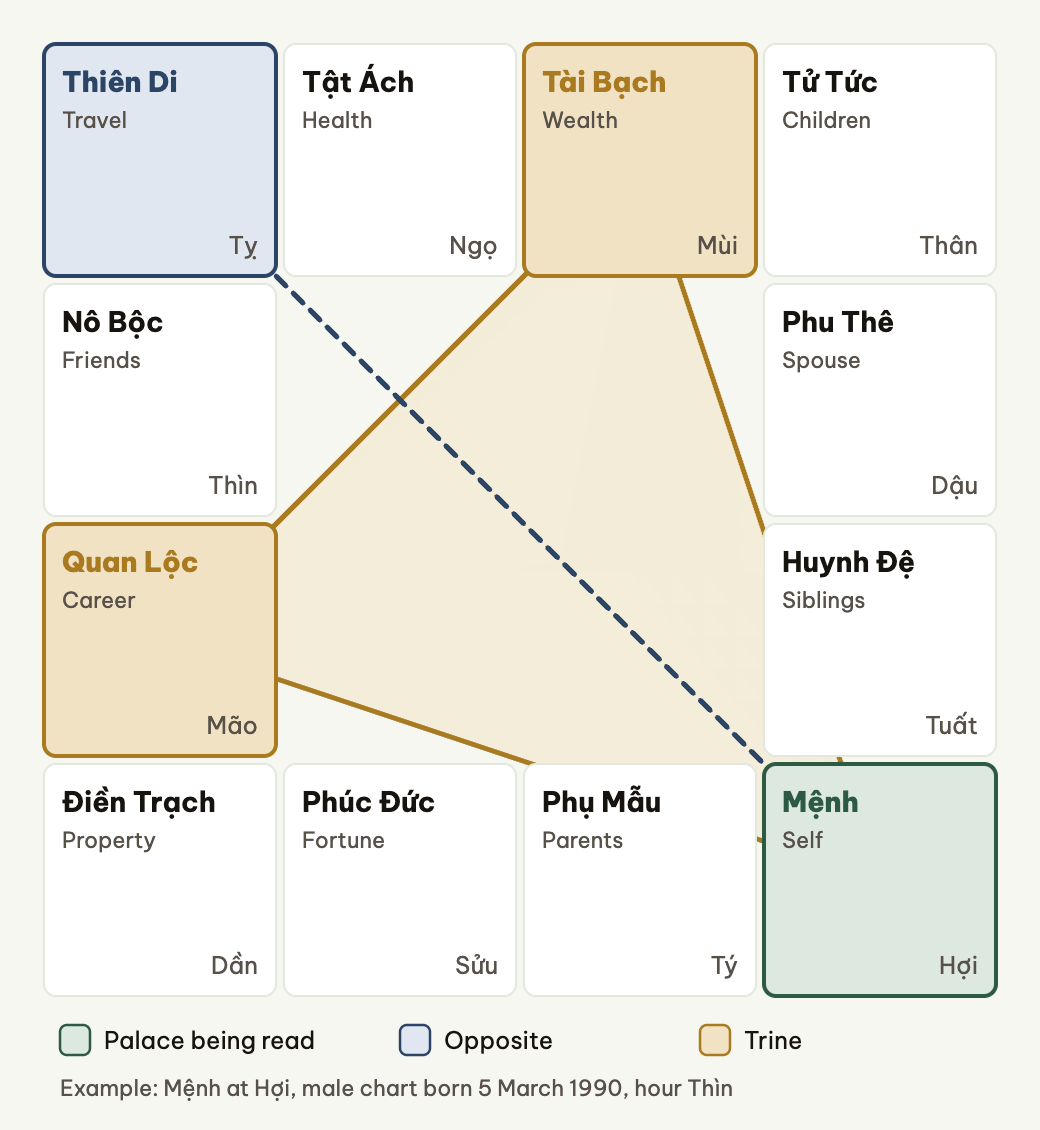
This mechanism comes from how stars are placed by Earthly Branch. Each palace carries one Earthly Branch, and the relations between Earthly Branches decide which palace combines with which, and which opposes which.
How are Tam Hop and the opposite palace determined?
Tam Hop has four fixed groups:
- Than, Ty, Thin
- Ty, Dau, Suu
- Dan, Ngo, Tuat
- Hoi, Mao, Mui
For example, if the Menh palace carries the Earthly Branch Ngo, its two Tam Hop palaces are Dan and Tuat. The opposite palace is the one facing it on the board, in six pairs: Ty with Ngo, Suu with Mui, Dan with Than, Mao with Dau, Thin with Tuat, Ty with Hoi. A Menh palace at Ngo opposes the palace at Ty, usually the Thien Di palace.
Table of 12 palaces: home, Tam Hop, opposite, Giap, Nhi Hop
The table below follows the palace calculation core in tuvi_chieusau.go (functions HoiSao, LienCung): for each palace, take its Earthly Branch and derive the two Tam Hop palaces, the opposite palace, the two flanking palaces before and after, and the Nhi Hop palace. The "Tam Hop" column lists the two Earthly Branches that combine with the home palace, "opposite" lists the facing branch, "Giap" lists the two neighbouring branches, "Nhi Hop" lists the Nhi Hop branch.
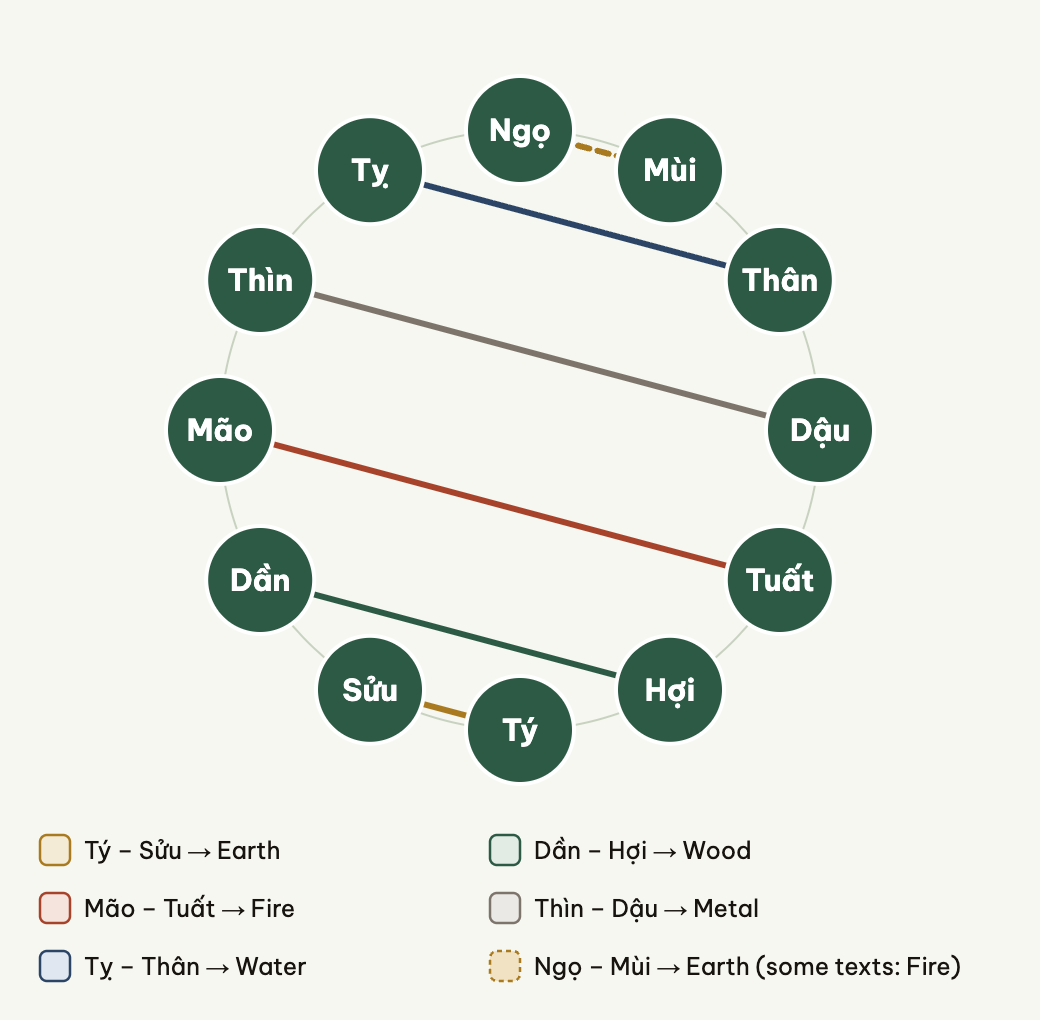
| Home palace (Earthly Branch) | Two Tam Hop palaces | Opposite palace | Two Giap palaces | Nhi Hop palace |
|---|---|---|---|---|
| Ty | Than, Thin | Ngo | Hoi, Suu | Suu |
| Suu | Ty, Dau | Mui | Ty, Dan | Ty |
| Dan | Ngo, Tuat | Than | Suu, Mao | Hoi |
| Mao | Hoi, Mui | Dau | Dan, Thin | Tuat |
| Thin | Ty, Than | Tuat | Mao, Ty | Dau |
| Ty | Dau, Suu | Hoi | Thin, Ngo | Than |
| Ngo | Dan, Tuat | Ty | Ty, Mui | Mui |
| Mui | Hoi, Mao | Suu | Ngo, Than | Ngo |
| Than | Ty, Thin | Dan | Mui, Dau | Ty |
| Dau | Ty, Suu | Mao | Than, Tuat | Thin |
| Tuat | Dan, Ngo | Thin | Dau, Hoi | Mao |
| Hoi | Mao, Mui | Ty | Tuat, Ty | Dan |
One distinction matters: the table is written by the Earthly Branch of the palace, not by palace name (Menh, Tai, Quan and so on). Palace names change with birth hour and birth month, while Earthly Branch relations are fixed. To look up the Tam Phuong Tu Chinh of the Menh palace, you first need to know which Earthly Branch the Menh palace sits in.
How strongly does each type of palace act?
There is no absolute scale, but the common presentation on tracuutuvi.com gives a rough order: the home palace is the root, the two Tam Hop palaces converge into it, the opposite palace stands against it, the two Giap palaces squeeze it from both sides, and the Nhi Hop palace supports it more lightly.
The home palace
The home palace is where the main stars sit, and it is the root of interpretation. Every other palace only means something when placed beside the home palace.
The two Tam Hop palaces
According to tracuutuvi.com, stars in a Tam Hop palace have a strong and long-lasting influence. For example, the Tai Bach palace sits in a fixed Tam Hop position with the Menh palace, so stars in Tai Bach converge on Menh throughout life, and the good or bad of Tai Bach acts directly on Menh, and the reverse as well. The Quan Loc palace is called the "khi so palace" of Menh, speaking of career and rank. The Thien Di palace is the outward expression of Menh.
The opposite palace
The opposite palace is the one facing the home palace, acting face to face. The book Dau So Tinh Thanh (Thien Hoa Dong Nhan) clearly separates two actions: stars in the Tam Phuong of the home palace are said to "hoi", stars in the opposite palace are said to "chieu". So "hoi" and "chieu" are two different mechanisms, not lumped together. This book also names "phu" and "giap": auspicious stars in the two neighbouring palaces are called phu, inauspicious stars in the two neighbouring palaces are called giap. Both auspicious and inauspicious stars in the two adjacent palaces are called giap, for example nhat nguyet giap Menh, khong kiep giap Menh.
The two Giap palaces
The two Giap palaces are the ones immediately before and after the home palace. The book TVDS Menh Van Phan Tich (Tu Tang Sinh) argues that earlier interpreters only noted stars in the same palace or patterns from Tam Phuong and forgot the force of the flanking palaces, but by the author's and colleagues' testing the force of the two flanks cannot be ignored: if auspicious stars flank the palace they lift it, if inauspicious stars flank it the outlook is poor. The book also gives the example of the Huynh De and Phu Mau palaces holding auspicious Phu, Bat, Xuong, Khuc, Duong, Am or the three Hoa Loc, Quyen, Khoa flanking Menh, in which case the original Menh palace or the Menh palace of the major limit is helped, and even a weak Menh can pass the gate.
An extreme example mentioned in the Tu Vi essay collection is "Duong Da giap Ky": when Hoa Ky sits in the Menh palace with Kinh Duong and Da La on either side, it creates double pressure and easily leads to ruin. This reading shows that Giap palaces can amplify or suppress the home palace.
The Nhi Hop palace
The Nhi Hop palace is the one whose Earthly Branch is Nhi Hop with the home palace. In the table above, each palace has its own Nhi Hop palace. This is the lightest layer of relation and also the most disputed, since many schools barely use it when reading Tam Phuong Tu Chinh.
Where the schools disagree
This point needs stating clearly, because the same chart giving different results across schools is mostly due to different ranking of the palace layers.
Some schools rate the opposite palace above Tam Hop
Some schools place the opposite palace ahead of Tam Hop, on the grounds that the opposite palace acts head-on while Tam Hop acts by convergence. This view differs from the common presentation on tracuutuvi.com, where Tam Hop is stressed as strong and lasting throughout life. Vuong Dinh Chi's book on Dau So, discussing Liem Trinh and the Sat Pha Tham group, also says one must consider the rotating major limit, then see what stars converge into the Menh palace through Tam Phuong Tu Chinh, and only then decide whether the change is good or bad. This wording puts Tam Phuong Tu Chinh in the role of a sufficient condition for a conclusion, rather than itself asserting fortune or misfortune.
Some schools drop Nhi Hop almost entirely
Many schools reading Tam Phuong Tu Chinh use only four palaces: home, two Tam Hop, one opposite, plus the two Giap as a secondary layer. The Nhi Hop palace is hardly entered into the reading table, or mentioned only as a pure Earthly Branch relation. The reason is that Nhi Hop creates neither the convergence of Tam Hop nor the opposition of the opposite palace, so its effect is weak and easily overshadowed.
The Kham Thien school reads palace relations through Tu Hoa flight paths
The Kham Thien Tu Hoa school does not stop at star convergence by Tam Phuong Tu Chinh, but reads relations between palaces through the flight paths of Tu Hoa. The method: take the stem of each palace, project Hoa Loc, Hoa Quyen, Hoa Khoa, Hoa Ky onto other palaces, then follow the chain of khi Ky as it spreads. The Kham Thien Tu Hoa essay collection cites a female chart with uterine fibroids: the Phuc Duc palace with stem Mau projects Thien Co Hoa Ky into Phu The, from Phu The the khi moves on so that Thai Duong meets Cung Mon Hoa Ky of the birth year, creating double Ky at Tai Bach, then Tai Bach opposes back to Phuc Duc; adding other Ky flows entering Tat Ach and Tat Ach self-transforming Ky outward, it becomes a four-Ky destructive configuration. This reading rests not on star convergence by Tam Phuong Tu Chinh but on the path of Hoa Ky between palaces.
Vuong Dinh Chi's book on Dau So also stresses the role of Tu Hoa: without the action of Tu Hoa a tendency is only an "an tuong" in the mind and hard to become an acted phenomenon; with Tu Hoa urging it, it becomes a "hinh anh hien lo".
Tam Phuong Tu Chinh of typical palaces
According to the summary table on tracuutuvi.com:
- Menh palace: Thien Di, Quan Loc, Tai Bach. Thien Di is the outward expression, Quan Loc is the career khi so, Tai Bach is the source of nurture.
- Phu Mau palace: Tat Ach, No Boc, Tu Tuc. When reading relations with parents one must also note the Phuc Duc palace, since the fortune or misfortune of Phuc Duc strongly affects harmony or clash with parents.
- Phuc Duc palace: Tai Bach, Phu The, Thien Di. If inauspicious stars land in a Tam Hop palace, Phuc Duc carries part of it too.
- Dien Trach palace: Tu Tuc, Huynh De, Tat Ach.
- Quan Loc palace: Phu The, Tai Bach, Menh.
- No Boc palace: Huynh De, Tu Tuc, Phu Mau.
- Thien Di palace: Menh, Phu The, Phuc Duc.
- Tat Ach palace: Phu Mau, Huynh De, Dien Trach. Constitution is largely inherited from parents, so the opposite Phu Mau palace is read alongside.
- Tai Bach palace: Phuc Duc, Quan Loc, Menh.
- Tu Tuc palace: Dien Trach, No Boc, Phu Mau.
- Phu The palace: Quan Loc, Phuc Duc, Thien Di.
- Huynh De palace: No Boc, Dien Trach, Tat Ach.
Comparing with the Earthly Branch table above shows the two ways of writing match: for example, a Menh palace at Ngo has Tam Phuong Tu Chinh by palace name of Thien Di, Quan Loc, Tai Bach, and by Earthly Branch of Ty, Dan, Tuat. Writing by palace name suits readers, writing by Earthly Branch suits programming.
Why no palace is read alone
The reason lies in how stars are placed: a star does not stay still in one spot but always relates to other palaces through Earthly Branch. The book Dau So Tinh Thanh further distinguishes "phu cung": auspicious stars, whether occupying or shining, are both called phu cung; in the forward direction the earlier palace helping the later is called phu, in the reverse direction the later palace helping the earlier is called cung. So even the direction of support has its own name, showing the system of relations between palaces is built in some detail.
A palace read alone tells only which stars occupy it, not which stars converge, which oppose, which flank. With the same occupying star, if the Tam Hop is all auspicious the meaning differs sharply from when the Tam Hop holds inauspicious stars; if the opposite palace holds Hoa Ky then the home palace is affected too; if the two Giap palaces hold Kinh Duong and Da La then pressure rises. This is why the saying "no palace is read alone" becomes a foundational principle of Tu Vi Dau So.
One further note: the ranking of strength between palace layers is where schools differ most, and no school is accepted as the common standard. Readers should know which convention a text follows before applying it.


