



Image: The Metropolitan Museum of Art (Public Domain)
TL;DR: Đại Khê Thủy is the nạp âm for the year pairs Giáp Dần and Ất Mão, symbolizing a great stream in a ravine, carrying Water element but containing Wood energy of Dần Mão. In five elements, this destiny needs support from Metal (Metal generates Water) and harmonizes with Wood (Water generates Wood), but should avoid conflict from Earth (Earth controls Water).
Introduction to the Sixty Jiazi Cycle and Nayin
The Sixty Jiazi cycle is a system of stems and branches that combines the 10 Heavenly Stems (Jia, Yi, Bing, Ding, Wu, Ji, Geng, Xin, Ren, Gui) with the 12 Earthly Branches (Zi, Chou, Yin, Mao, Chen, Si, Wu, Wei, Shen, You, Xu, Hai) to form 60 different combinations, each representing one year. However, to describe the deeper nature of each year, the ancients also used the concept of Nayin: a classification system based on the sound of the five elements, which helps explain why people with the same destiny element of Metal, Wood, Water, Fire or Earth (according to birth year) can still have different personalities and fates.
There are 30 types of Nayin, each covering 2 consecutive years. For example, the years Jia Zi and Yi Chou belong to the Nayin Hai Zhong Jin (gold in the sea); the years Jia Shen and Yi You belong to Quan Zhong Shui (water in a spring); and the years Jia Yin and Yi Mao belong to Da Xi Shui: a great stream flowing between mountain ravines.
What is Da Xi Shui?
What is the origin of Da Xi Shui?
Da Xi Shui (大溪水) means "water of the great ravine" or "great stream". In the Sixty Jiazi cycle, this Nayin is assigned to the two years Jia Yin (甲寅) and Yi Mao (乙卯).
The formation of this name comes from the field energy of the Earthly Branches:
- Yin and Mao belong to the East, corresponding to spring, the period when all things multiply and plants sprout and grow leaves.
- In the five elements, Yin and Mao both belong to the Wood element, representing growth and expansion.
- Water generates Wood, so when Wood is at its most prosperous state (spring), Water has completed its mission of nourishment and begins to transform. The water is no longer as narrow as Quan Zhong Shui (water in a spring) but has gathered into a large flow in the ravines and channels: hence it is called "Da Xi".
What are the five element characteristics of Da Xi Shui?
Although it carries the Water element, Da Xi Shui has very distinctive features compared with other Water Nayin:
| Characteristic | Explanation |
|---|---|
| Strong flow | Not as still as Chang Liu Shui (long river water), but carrying moving energy, always seeking to break through and overcome obstacles. |
| Containing Wood qi | Because it is located at Yin and Mao (where the Wood element is prosperous), this destiny has a combination of the wisdom of Water and the steadfastness and upward striving of Wood. |
| High flexibility | Ravine water can wind according to the terrain, symbolizing a good ability to adapt to circumstances. |
What is the meaning in the relationships of mutual generation and mutual overcoming?
According to the five element principles mentioned in Eastern feng shui:
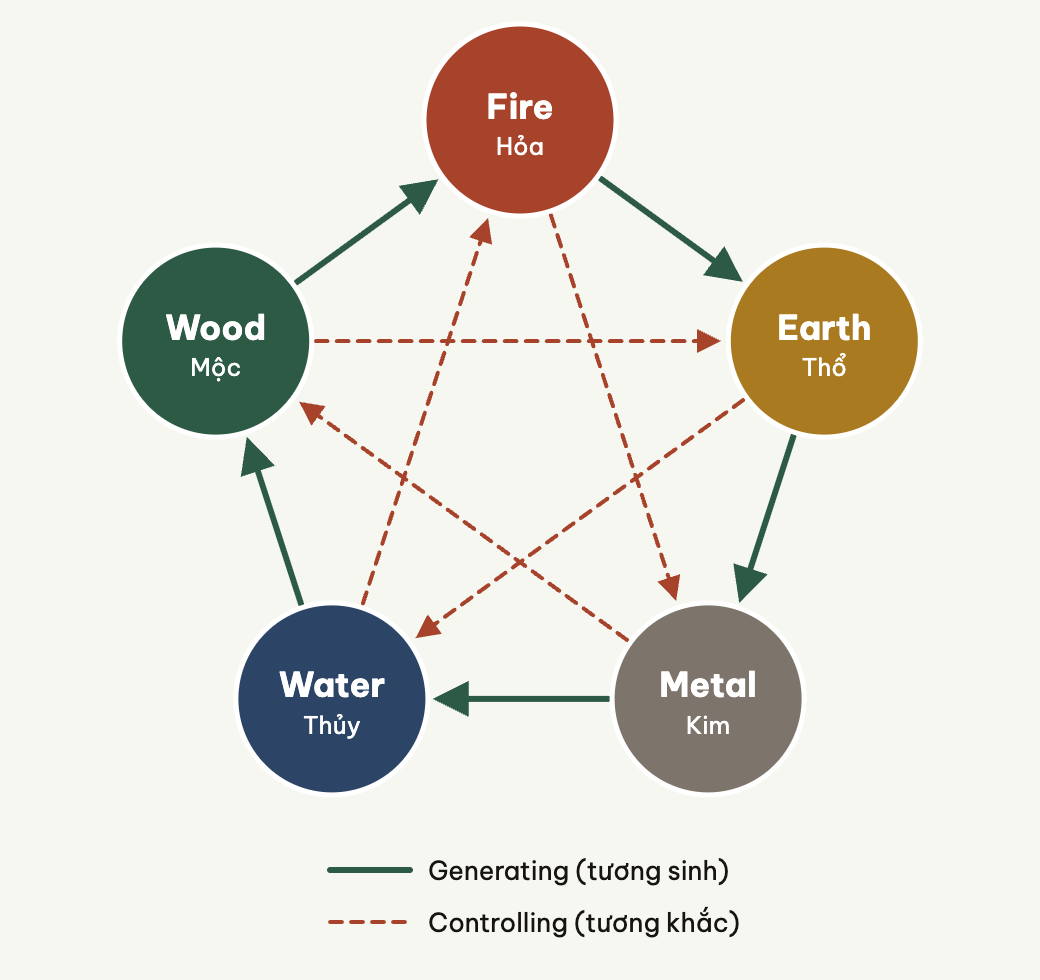
- Mutual generation: Metal generates Water, Water generates Wood.
- Mutual overcoming: Earth overcomes Water, Water overcomes Fire.
Da Xi Shui and the Metal element
Metal is the source that generates Water (Metal generates Water: metal when heated melts into liquid form). Therefore, people carrying the Nayin Da Xi Shui receive strong support from factors belonging to the Metal element. In practice, this is shown through:
- Supporting colors: white, gray, silver (belonging to Metal).
- Feng shui items: metal, gold and silver jewelry, clocks, stainless steel utensils.
- House direction or desk direction belonging to the West (the position of Metal).
Da Xi Shui and the Wood element
Water generates Wood, therefore Da Xi Shui is a source of nourishment for the Wood element. People with this destiny have a mutually supportive relationship with people or objects belonging to the Wood element:
- Suitable colors: green, dark blue.
- East and Southeast (the positions of Wood) are good directions.
- Green plants in the home or workplace help enhance positive energy.
Da Xi Shui and the Earth element
Earth overcomes Water: earth blocks the flow of water. This is a restraining relationship to keep in mind:
- Colors to limit: earth yellow, brown (belonging to Earth).
- Materials such as ceramics, stone and brick should be used with consideration in the living space.
- People carrying this destiny should avoid areas with too much earth and stone, or houses with a structure that is too heavy and enclosed.
Personality traits and fate of Da Xi Shui people
In Tu Vi (Vietnamese astrology) and Eastern physiognomy, people born in the year Jia Yin (for example, 1974) or Yi Mao (for example, 1975) often have the following characteristics:
What are the strengths of Da Xi Shui people?
- Sharp intellect: Water represents intelligence and wisdom. A great stream symbolizes a broad vision.
- Resilient willpower: The Wood qi from Yin and Mao helps them not give up easily and always find a way through difficulties.
- Good communication ability: Water governs language and connection. They easily build social relationships.
- Flexible thinking: Like a winding stream, they know how to adjust strategy when circumstances change.
What weaknesses do Da Xi Shui people need to overcome?
- Easily scattered energy: Overflowing water can lead to spreading oneself thin and difficulty focusing on a single goal.
- Unstable emotions: Like a flow that is sometimes strong and sometimes weak, they may experience clear psychological fluctuations.
- Lack of patience with details: A tendency to look at the big picture while overlooking important small details.
How is it applied in home feng shui?
According to the five element principles in home feng shui, every object and color in the living space symbolizes a certain element. For people belonging to the Nayin Da Xi Shui, balancing the living space needs to be based on the following principles:
Which colors are suitable for Da Xi Shui people?
- Main colors to use: Blue, black (their own Water destiny); white, gray (Metal generates Water); green (Water generates Wood: creating good energy circulation).
- Colors to limit: Earth yellow, earth brown (Earth overcomes Water). If you want to use them, they should only be small accents, avoiding large areas.
Space arrangement
- Good areas: Near water sources (fish tanks, small fountains) to help enhance the energy of their own destiny.
- Note: Do not place too many ceramics or decorative stones in the center of the house (the area belonging to Earth), because it easily creates energy restraint.
- Shapes: Prioritize winding lines, free and asymmetrical shapes: the characteristics of the Water element.
Balancing Yin and Yang
According to feng shui, Yin is dark, still color; Yang is bright, moving color. Da Xi Shui people tend toward a still state (Yin) because of the nature of Water. To balance, they should:
- Increase natural light in the home.
- Use more bright tones such as white and silver to create balance.
- Avoid spaces that are too dark and damp: this will increase the stagnation of Water energy.


