
What is Hexagram Di Huo Ming Yi in the I Ching?
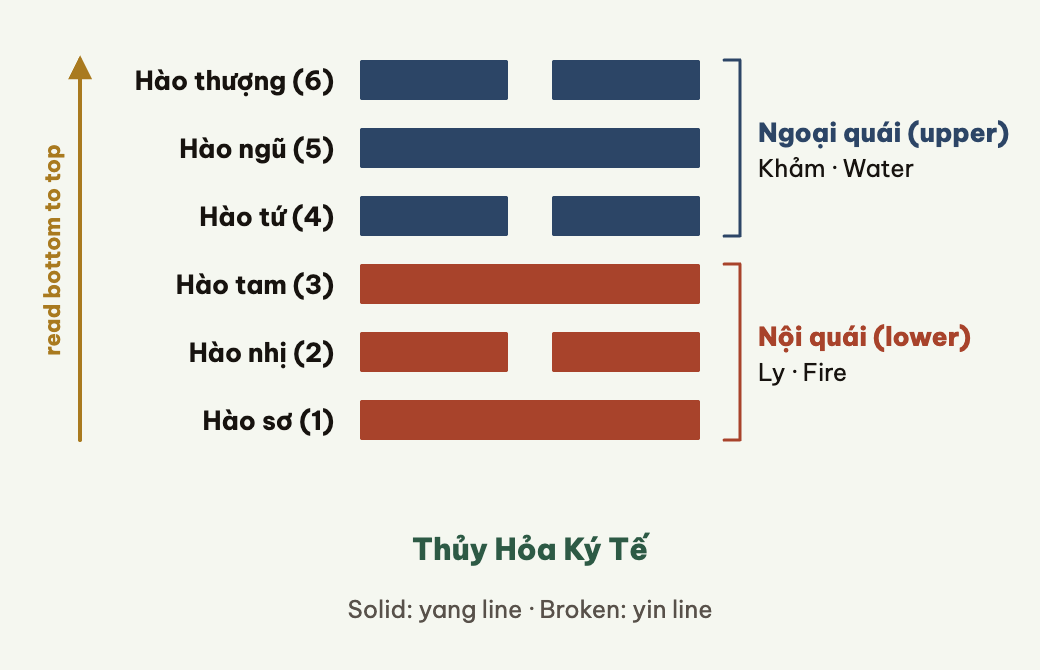
Hexagram Di Huo Ming Yi (地火明夷) is number 36 of the 64 I Ching hexagrams, immediately following Hexagram Huo Di Jin (number 35). It consists of two yang lines beneath four yin lines, with the inner (lower) trigram Li (離), fire and sun, and the outer (upper) trigram Kun (坤), earth. Earth above, fire below, the sun has set beneath the earth, its light obscured. The core spirit of the hexagram is the way of keeping the light within while the outside is dark.
The name has two characters: Ming (明) meaning bright, Di (夷) meaning wounded, obscured, harmed. "Ming Yi" is the light being wounded. In Vietnamese I Ching texts this hexagram is usually called Địa Hỏa Minh Di, or simply Hexagram Minh Di.
According to the presentation in HOROS's article on Hexagram Di Huo Ming Yi, this is one of the clearest hexagrams on conduct in dark times: the text does not advise resistance, does not advise flaring up to keep shining, but only advises knowing the difficulty while still holding the inner path.
Why does Hexagram Ming Yi follow Hexagram Jin?
In the Sequence of Hexagrams (序卦傳), Hexagram Huo Di Jin (number 35) speaks of advancing, the sun rising above the earth, light spreading. Hexagram Di Huo Ming Yi (number 36) is the opposite state: the sun has set, light covered by earth. The two are a pair (opposite hexagrams, or zong gua), Jin is light advancing, Ming Yi is light wounded.
According to the interpretation of the 64-hexagram order on the Ly So Viet Nam forum, Jin followed by Ming Yi is the natural law of movement: whatever advances endlessly will at some point be blocked, whatever shines endlessly will at some point be obscured. This is the general rule of the Sequence, each hexagram a picture of the movement of the cosmos and human life.
What does the Judgment of Hexagram Di Huo Ming Yi say?
Original Han-Viet text:
明夷:利艱貞
Minh Di: Lợi gian trinh.
Meaning: holding firm in hardship is beneficial.
According to the explanation in HOROS's article on Hexagram Di Huo Ming Yi, the Judgment advises one thing only: knowing the difficulty while still holding the inner path, that is beneficial. The text does not advise resistance, does not advise flaring up to keep shining. This is worth noting, because many who read Hexagram Ming Yi immediately think of having to "rise up" or "resist," while the text leans toward holding oneself.
The character "jian" (艱) here means hardship, toil. The character "zhen" (貞) means uprightness, firmness to the end. Together, "lợi gian trinh" is: keeping uprightness and firmness in hardship is beneficial. This is the key sentence of the whole hexagram.
What does the Image of Hexagram Di Huo Ming Yi say?
Original Han-Viet text:
明入地中,明夷;君子以蒞眾,用晦而明
Minh nhập địa trung, Minh Di; quân tử dĩ lỵ chúng, dụng hối nhi minh.
Meaning: light entering into the earth is the image of Hexagram Ming Yi. The junzi follows this in dealing with the crowd, using obscurity to keep clarity.
According to HOROS's article on Hexagram Di Huo Ming Yi, "using obscurity to keep clarity" is one of the finest lines in the I Ching. In unfavorable circumstances, a clear-minded person need not flaunt their clarity. Veil it to avoid harm. But within, still clear enough to see things plainly.
One must distinguish "dụng hối" (用晦) from stupidity or deceit. This is actively veiling one's light, not making oneself dark. Inside still bright, only not displayed outside.
The six line texts of Hexagram Di Huo Ming Yi and their explanations
The six lines describe six situations of a clear-minded person in a time when light is obscured, moving from outside to inside.
Sơ cửu (line 1): A bird in flight droops its wing
Original Han-Viet text:
明夷于飛,垂其翼。君子于行,三日不食。有攸往,主人有言
Minh di vu phi, thuỳ kỳ dực. Quân tử vu hành, tam nhật bất thực. Hữu du vãng, chủ nhân hữu ngôn.
Meaning: Ming Yi in flight, drooping its wings. The junzi sets out, three days without food. There is somewhere to go, the host has words of reproach.
According to HOROS's article on Hexagram Di Huo Ming Yi, this is one who has just sensed the atmosphere has shifted and decides to withdraw early. Flying but drooping the wings, not beating hard, not drawing attention. Enduring three days of hunger on the road is acceptable, enduring the reproach of the old host is acceptable. Leaving early while the situation still allows leaving is the wise choice. Many wait until they can no longer leave, then regret.
Note: the images "three days without food" and "the host has words of reproach" are the social context of ancient times, when leaving a place often brought judgment from those who stayed. This is historical context, not literal advice.
Lục nhị (line 2): Wounded in the left thigh
Original Han-Viet text:
明夷,夷于左股,用拯馬壯,吉
Minh di, di vu tả cổ, dụng chửng mã tráng, cát.
Meaning: Ming Yi, wounded in the left thigh, using a strong horse to rescue, auspicious.
According to HOROS's article on Hexagram Di Huo Ming Yi, this line speaks of a situation where one did not withdraw in time and has been partly harmed. The left thigh wounded is losing part of the ability to walk, but not total ruin. The line says: use a strong horse to rescue, auspicious. That is, once affected, one needs a strong enough means to escape, a trustworthy friend, a new job opportunity, a thick enough reserve, a colleague willing to speak up. Being wounded does not mean it is over. With the right support one can still go on.
Cửu tam (line 3): Hunting in the south, catching the ringleader
Original Han-Viet text:
明夷于南狩,得其大首,不可疾貞
Minh di vu nam thú, đắc kỳ đại thủ, bất khả tật trinh.
Meaning: Ming Yi hunting in the south, catching the ringleader, one cannot be hasty in holding firm.
According to HOROS's article on Hexagram Di Huo Ming Yi, this is the rare situation of the hexagram, one with a chance to reverse the board. The person in this role sees the root of the problem, knows who caused the chaos, and has an occasion to solve it at the root. But the line immediately adds a warning: do not be hasty. Act only at the right moment; at the wrong moment, even the right act fails. Fixing great matters requires a slow rhythm.
Lục tứ (line 4): Entering to the heart, then withdrawing
Original Han-Viet text:
入于左腹,獲明夷之心,于出門庭
Nhập vu tả phúc, hoạch minh di chi tâm, vu xuất môn đình.
Meaning: Entering the left belly, grasping the heart of Ming Yi, then leaving the courtyard gate.
According to HOROS's article on Hexagram Di Huo Ming Yi, this is one who has gone deep inside to truly understand the situation: understanding what the superior is planning, where the company is heading, why things have become as they are. Having understood, one quietly leaves. No longer trying to fix, no longer trying to advise, no longer trying to persuade. Knowing clearly and knowing when to withdraw is rare. Leaving the courtyard gate before everything collapses is a form of maturity.
Lục ngũ (line 5): Ji Zi feigning obscurity to keep clarity
Original Han-Viet text:
箕子之明夷,利貞
Cơ Tử chi minh di, lợi trinh.
Meaning: The Ming Yi of Ji Zi, holding firm is beneficial.
According to HOROS's article on Hexagram Di Huo Ming Yi, this is the most famous line of the hexagram, borrowing the story of Ji Zi of the Shang dynasty. When King Zhou was cruel, Ji Zi could no longer remonstrate, could not leave because he was of the royal clan, so he feigned madness. Outside appeared dark, inside kept a bit of light for later use. Today this is the conduct of one stuck in a position one cannot leave and cannot speak from. Deliberate silence. Hiding one's talents for a time. Waiting for the time.
Note: this line is transcribed from the Han text and Han-Viet reading in HOROS's article. The story of Ji Zi is the historical context of the Shang dynasty, not literal advice for everyone in every situation.
Thượng lục (line 6): Rising to the top then falling to earth
Original Han-Viet text:
不明晦,初登于天,後入于地
Bất minh hối, sơ đăng vu thiên, hậu nhập vu địa.
Meaning: Not bright but dark, at first rising to heaven, later falling to earth.
According to HOROS's article on Hexagram Di Huo Ming Yi, this is the line of the one who causes the darkness, not the one who endures it. Once risen so high as to reach heaven, thinking none could touch them. But the essence is "not bright but dark," the halo only outward, inside already rotten. In the end falling to earth. The I Ching clearly forecasts the end of false brightness: the higher one rises, the harder one falls.
Summary table of the six lines of Hexagram Di Huo Ming Yi
| Line | Name | Han-Viet | Situation |
|---|---|---|---|
| 1 | Sơ cửu | Minh di vu phi, thuỳ kỳ dực | Bird in flight droops its wing, withdraw early |
| 2 | Lục nhị | Minh di, di vu tả cổ | Wounded in the left thigh, use a strong horse to rescue |
| 3 | Cửu tam | Minh di vu nam thú | Hunting in the south, catching the ringleader, not hasty |
| 4 | Lục tứ | Nhập vu tả phúc | Entering to the heart, understanding then withdrawing |
| 5 | Lục ngũ | Cơ Tử chi minh di | Feigning obscurity to keep clarity |
| 6 | Thượng lục | Bất minh hối | Not bright but dark, rising to heaven then falling to earth |
Is Hexagram Di Huo Ming Yi auspicious or inauspicious?
Books and websites are not fully agreed on calling Hexagram Ming Yi auspicious or inauspicious. The site tracuutuvi.com places it in the "inauspicious hexagram" group, holding that the querent will face difficulties and challenges in work and love, and advises restraint, a quiet life, hiding to await opportunity. The label "inauspicious hexagram" here is a classification by degree of favorability of the times, not a fixed sentence on the querent's fate.
Meanwhile, HOROS's article on Hexagram Di Huo Ming Yi does not use the word "inauspicious" but emphasizes the attitude of conduct: in dark times keep the light within, knowing the difficulty while still holding the inner path is beneficial. The Judgment "Lợi gian trinh" also does not say auspicious or inauspicious, only that holding firm in hardship is beneficial.
One line of interpretation also views this hexagram as a strategy of response: though the hexagram carries signs of difficulty and loss, it is not an unbreakable curse, and the core advice is to hold to the right path, not be shaken by outer circumstance. This view matches the spirit of the Judgment "Lợi gian trinh."
The common point of these readings is: Hexagram Ming Yi describes an unfavorable time, and what is needed is to hold oneself, not show off, not resist when the time does not permit. The auspicious/inauspicious classification is only an outer label, not changing the core content of the hexagram.
How is Hexagram Di Huo Ming Yi applied to life?
According to HOROS's article on Hexagram Di Huo Ming Yi, the six lines are six different situations of a capable, well-intentioned, clear-minded person who falls into an unfavorable environment: a chaotic company, a bad team, an unfair boss, family troubles, a society in disorder. Each line suggests a way of handling.
The first way is to be sensitive to the time and withdraw early while the situation still allows (line 1). The second is, once affected, to find strong enough support to escape (line 2). The third is, when there is a chance to solve at the root, to wait for the right moment, not rush (line 3). The fourth is to understand the true situation then quietly withdraw (line 4). The fifth is, when stuck in a position one cannot leave and cannot speak from, to keep deliberate silence, hide one's talents for a time, wait for the time (line 5). The sixth is a warning to the one who causes the darkness: the higher one rises, the harder one falls (line 6).
Note that this is applying the spirit of the hexagram to life, not advice to apply mechanically to every case. Each line describes a situation, and which way to handle depends on the specific circumstances of the querent.
Is the Khổng Minh Thần Toán poem card the same as the line texts of Hexagram Ming Yi?
No. The Khổng Minh Thần Toán poem card in the collection is a card text from another book, not a line text of the Zhou Yi. Hexagram Di Huo Ming Yi in the I Ching has its own Judgment, Image, and six line texts, transcribed from the Han text and Han-Viet reading in HOROS's article. The Khổng Minh Thần Toán poem card is a separate system, with its own way of drawing and interpreting, and should not be mixed into the Zhou Yi line texts.
Hexagram Di Huo Ming Yi in love and work
According to HOROS's article on Hexagram Di Huo Ming Yi, when this hexagram is drawn in matters of love, it often signals a period of hidden instability: the other person is hiding something, or there is something unsaid. The site tracuutuvi.com also holds that this hexagram carries signs of difficulty for both work and love, and advises restraint, a quiet life, hiding to await opportunity.
It must be stressed that this is traditional interpretation, not an absolute statement about the future. Hexagram Ming Yi describes a time, not determining the fate of a specific relationship or job. The querent should see it as a lens for looking again at the situation, not a sentence.
The core lesson of Hexagram Di Huo Ming Yi
Hexagram Di Huo Ming Yi teaches the way of holding oneself in dark times. When the light is obscured, what is needed is not to flare up and keep shining, but to keep the inner light unharmed. "Dụng hối nhi minh," using obscurity to keep clarity, is the guiding principle of the hexagram. Knowing the difficulty while still holding the inner path, that is what the Judgment calls "lợi gian trinh."
The six line texts sketch six degrees of the same principle: being sensitive to the time to withdraw early, finding support once wounded, waiting for the right moment when there is a chance, understanding clearly then withdrawing, feigning obscurity when stuck, and being wary of false brightness. These are specific situations, not general advice for everyone in every circumstance.
The point to remember is that Hexagram Ming Yi does not promise an automatic good outcome. It only says that in dark times, holding the inner path is beneficial. Whether one holds it, and how, is up to the querent.
Structure of Hexagram Di Huo Ming Yi in one table
| Item | Value |
|---|---|
| Order in the Zhou Yi | 36 |
| Chinese name | 明夷 |
| Upper trigram | Kun (Earth) |
| Lower trigram | Li (Fire) |
| Six lines, top to bottom | yin, yin, yin, yang, yin, yang |
| Nuclear hexagram | Lôi Thủy Giải (number 40) |
| Opposite hexagram | Thiên Thủy Tụng (number 6) |
| Reversed hexagram | Hỏa Địa Tấn (number 35) |


