



TL;DR: The Đoài trigram (☱) consists of one yin line above two yang lines. According to the Shuogua commentary, it represents a marsh (澤), a young woman, the mouth, a goat, speech, collapse, and joy. In the Nhật Nguyệt core calculation table, Đoài belongs to the Later Heaven West and the metal element; Zhu Xi's mnemonic calls it 'broken at the top'. Nhật Nguyệt's suggestion: Đoài energy may serve as a support when communication, negotiation, or connection is needed, but one should remain sincere and moderate; this is only a reference suggestion.
What is the single Đoài trigram in the Bát Quái?
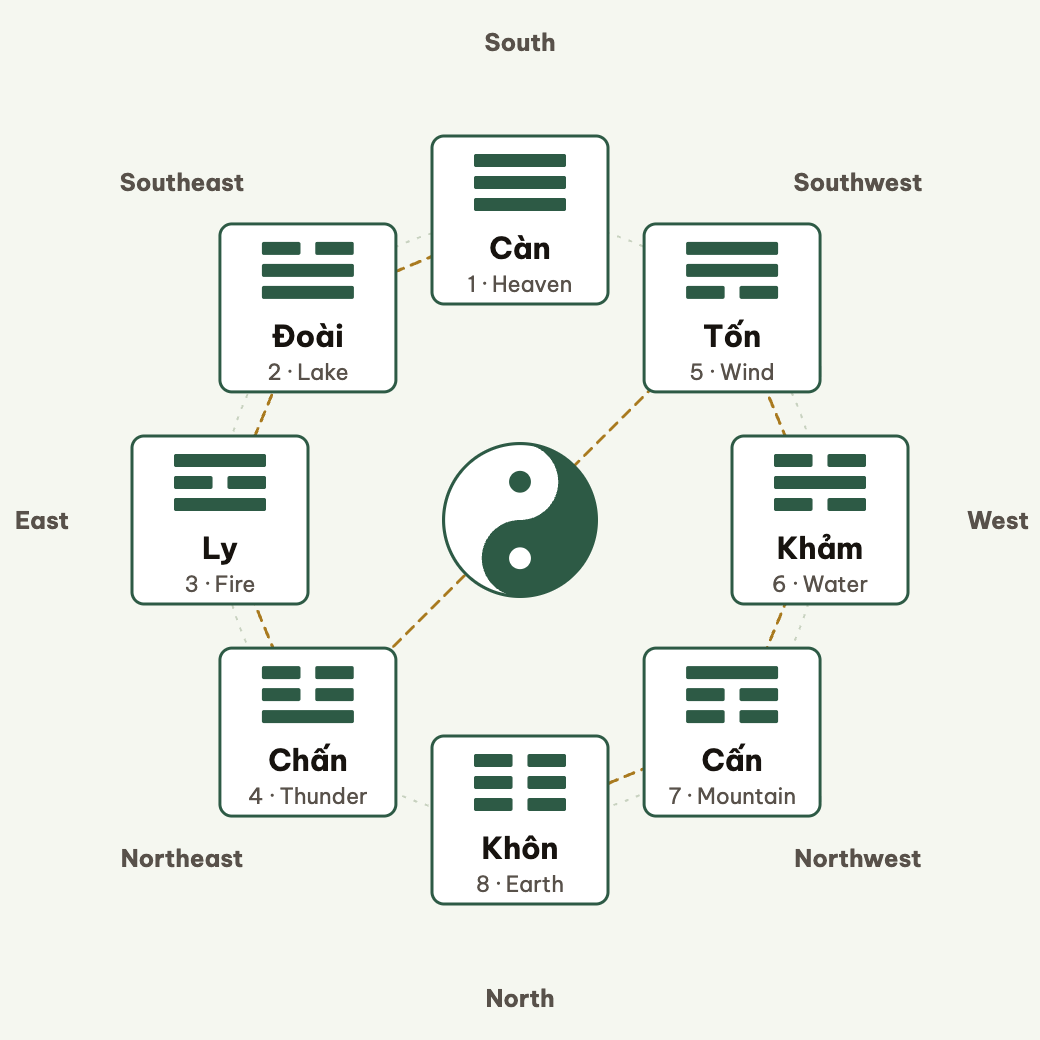
In the Bát Quái (Eight Trigrams) system of the Kinh Dịch (I Ching), the eight single trigrams (kinh quái) are the most basic symbols, formed from combinations of three yin and yang lines. The Đoài trigram (☱) consists of one yin line above two yang lines, symbolizing the Marsh, with the Metal element in the five phases. In the Hậu Thiên Bát Quái (Later Heaven Eight Trigrams) system, Đoài corresponds to due West.
What does the Thuyết Quái say about the Đoài trigram?
The Thuyết Quái truyện is a chapter of the Thập Dực, traditionally attributed to Khổng Tử; modern scholarship does not consider this proven. This chapter contains many statements about the Đoài trigram, and these are the original lines worth citing first.
- 兌以說之 (Đoài dĩ duyệt chi): Đoài brings joy to all things through delight.
- 說言乎兌 (Duyệt ngôn hồ Đoài): Delight is spoken of in the Đoài trigram.
- 兌,正秋也。萬物之所說也。故曰說;言乎兌 (Đoài, chính thu dã. Vạn vật chi sở duyệt dã. Cố viết duyệt; ngôn hồ Đoài): Đoài is the height of autumn. It is where all things rejoice. Therefore it is called delight; it speaks of Đoài.
- 說萬物者,莫說乎澤 (Duyệt vạn vật giả, mạc duyệt hồ trạch): What brings joy to all things, nothing surpasses the marsh.
- 兌,說也 (Đoài, duyệt dã): Đoài is delight (joy).
- 兌為羊 (Đoài vi dương): Đoài is the sheep.
- 兌為口 (Đoài vi khẩu): Đoài is the mouth.
- 兌三索而得女,故謂之少女 (Đoài tam sách nhi đắc nữ, cố vị chi thiếu nữ): Đoài sought three times and obtained a daughter, therefore it is called the youngest daughter.
- 兌為澤、為少女、為巫、為口舌、為毀折、為附決。其於地也,為剛鹵,為妾、為羊 (Đoài vi trạch, vi thiếu nữ, vi vu, vi khẩu thiệt, vi hủy chiết, vi phụ quyết. Kỳ ư địa dã, vi cương lỗ, vi thiếp, vi dương): Đoài is the marsh, is the youngest daughter, is the spirit medium, is the mouth and tongue, is breakage and collapse, is the accompanying decision. As for the earth, it is hard saline soil, is the concubine, is the sheep.
What does Chu Hy's mnemonic for the trigram images say?
Chu Hy, in the Chu Dịch bản nghĩa (first volume, Bát quái thủ tượng ca), provides a mnemonic for the shapes of the eight trigrams. About Đoài, the mnemonic says: 兌上缺 (Đoài thượng khuyết), meaning Đoài is broken above, corresponding to one yin line sitting above two yang lines.
What is the structure and position of the Đoài trigram?
The Đoài trigram has the form of one yin line (broken line) above two yang lines (solid lines). This structure is the basis for Chu Hy's mnemonic calling it "broken above."
As for direction, two systems must be distinguished. The Nhật Nguyệt core calculation records Đoài as belonging to the Later Heaven West. The Tiên Thiên Bát Quái (Earlier Heaven Eight Trigrams), by tradition, places Đoài in the Southeast. The ancient Chinese Feng Shui book, Lý luận và thực tiễn volume 2, presents two layers of direction side by side: the Earlier Heaven layer has Càn South, Khôn North, Ly East, Khảm West, Chấn Northeast, Đoài Southeast, Tốn Southwest, Cấn Northwest; the Later Heaven layer has Ly South, Khảm North, Chấn East, Đoài West, Tốn Southeast, Cấn Northeast, Khôn Southwest, Càn Northwest. Therefore, if one simply says "Đoài is the West," this is correct for the Later Heaven, but insufficient for the Earlier Heaven.
| System | Position of Đoài | Notes |
|---|---|---|
| Tiên Thiên Bát Quái | Southeast | Traditionally attributed to Phục Hy; modern scholarship does not consider this proven |
| Hậu Thiên Bát Quái | Due West | Traditionally attributed to Văn Vương; modern scholarship does not consider this proven. The Nhật Nguyệt core calculation records Đoài as belonging to the Later Heaven West |
Why are the three lines of the Đoài trigram read as marsh water, youngest daughter, and joy?
According to the Thuyết Quái truyện, these names all have original lines. Regarding family, the Thuyết Quái says: 兌三索而得女,故謂之少女 (Đoài tam sách nhi đắc nữ, cố vị chi thiếu nữ). Regarding nature, the Thuyết Quái says: 兌為澤 (Đoài vi trạch), Đoài is the marsh. Regarding mindset, the Thuyết Quái says: 兌,說也 (Đoài, duyệt dã), Đoài is delight (joy); and 說萬物者,莫說乎澤 (Duyệt vạn vật giả, mạc duyệt hồ trạch), what brings joy to all things, nothing surpasses the marsh.
The image of the marsh is the anchor for meaning to extend into joy, harmony, good relationships, and community communication. That is the interpretive part based on the original lines, not what the original lines themselves state.
The Đoài and Cấn pair in the Earlier Heaven: what does "mountain and marsh exchange breath" mean?
The Thuyết Quái truyện has the line: 天地定位,山澤通氣,雷風相薄,水火不相射 (Thiên địa định vị, sơn trạch thông khí, lôi phong tương bạc, thủy hỏa bất tương xạ). This line shows that Heaven and Earth are set in fixed positions, while mountain and marsh have exchange with each other. Heaven and Earth are positioned by Càn above and Khôn below, and the other trigrams are generated from there. The Càn Khôn pair is the positioning pair, while the Cấn Đoài pair is the exchanging-breath pair: mountain and marsh, though one is high and one is low, one dry and one damp, their breath communicates and becomes function.
The book Địa lý Nguyên Không Pháp Giám by Liên Trì tiên sinh delves into this idea when discussing water mouths. The book holds that the water mouth must use Đoài, because Đoài is where the metal dragon emerges and is where heaven and earth are positioned. The book argues that if mountain and marsh do not communicate, then Đoài and Cấn, though bearing the names of man and woman, are not truly husband and wife, and cannot generate to become the function of heaven and earth. When mountain and marsh have communicated, the top lines of Đoài and Cấn exchange, Đoài transforms into pure Càn and Cấn transforms into pure Khôn; similarly, the middle lines of Khảm and Ly exchange, the first lines of Chấn and Tốn exchange. This is how this book interprets "mountain and marsh exchange breath" at the line level, and is also why the book regards Đoài as holding a key role when discussing water mouths.
Symbolic meaning of the Đoài trigram according to the Thuyết Quái truyện
The Thuyết Quái truyện lists a fairly rich system of images for the Đoài trigram. The table below records exactly the images found in this chapter.
| Image group | Images of Đoài according to the Thuyết Quái truyện |
|---|---|
| Nature | Marsh (澤), hard saline soil (剛鹵) |
| Family | Youngest daughter (少女), concubine (妾) |
| Body | Mouth (口) |
| Animal | Sheep (羊) |
| Profession, function | Spirit medium (巫), mouth and tongue (口舌) |
| Qualities | Delight (說, joy), breakage and collapse (毀折), accompanying decision (附決) |
In Nhật Nguyệt's understanding
In Nhật Nguyệt's understanding, the Đoài trigram packs two faces of communication and joy. On one hand, the marsh is where water gathers, gathering people, facilitating exchange and bringing ease. On the other hand, the Thuyết Quái truyện also assigns Đoài the images of "mouth and tongue," "breakage and collapse," and "accompanying decision," showing that words and joy are not always favorable. To read Đoài is to read both faces at once.
Nhật Nguyệt's suggestions:
Nhật Nguyệt's suggestions: when work demands communication, negotiation, presentation, or event organization, Đoài energy can be an anchor for opening up and connecting, but sincerity should be maintained so that words do not slide into "mouth and tongue." In matters of affection, Đoài suggests openness and gentleness, yet also reminds one to keep moderation so that joy does not become indulgence. Regarding health, the "mouth" image suggests attention to eating, drinking, and speech; this is only a reference suggestion, not a substitute for medical advice. Regarding home feng shui, according to the Nhật Nguyệt core calculation, Đoài belongs to the Later Heaven West and the Metal element; if one wishes to honor this direction, the western area can be arranged to be open and elegant, avoiding turning that place into an overly noisy spot.
Conclusion on Đoài energy
The single Đoài trigram is a symbol of harmony between inner strength and outer form. The original lines of the Thuyết Quái truyện give us concrete images: marsh, youngest daughter, mouth, sheep, mouth and tongue, breakage and collapse. Chu Hy's mnemonic gives us the shape "broken above." Understanding these two layers, readers can reflect for themselves on the value of flexibility in conduct, on the importance of words, and on the art of creating joy in life, while staying clear-headed about the downsides that the Thuyết Quái truyện itself has recorded.
Overview article on the topic: What is the Bát Quái


