
What Are the He Tu and Luo Shu?
The two ancient Eastern diagrams called the He Tu and Luo Shu were once regarded as early maps sketching the operating laws of the universe. Many ancient disciplines, feng shui among them, take them as a foundation. The He Tu consists of 55 dots arranged by the generating cycle of the five elements and yin yang, reflecting the operation of heaven and earth. The Luo Shu holds nine numbers laid out as a magic square, expressing the order and balance of the world after heaven and earth had taken shape. From these two diagrams the ancients drew numbers, images, and interactions among basic elements, forming the basis for calculation and prediction in feng shui.
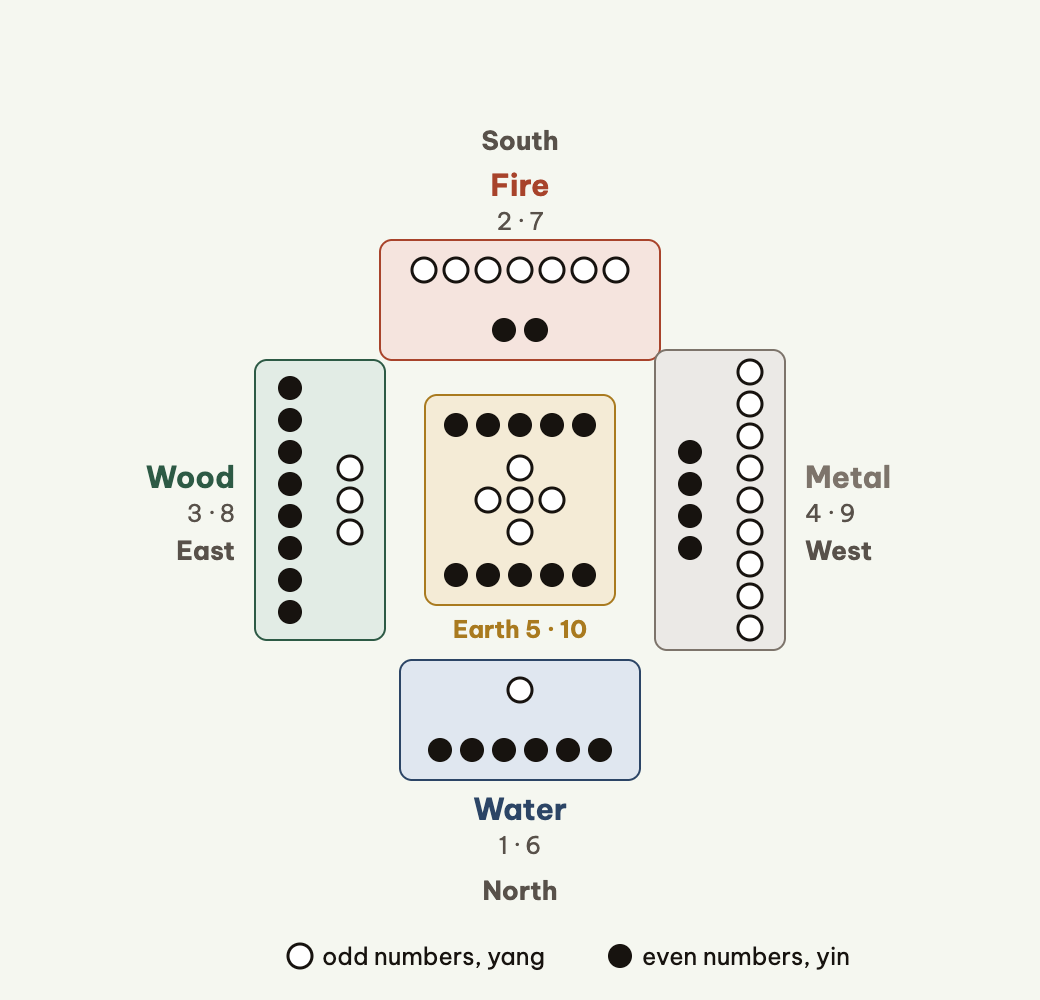
According to Wikipedia, the Luo Shu is also called the Nine Palaces Diagram, and is the only standard third order magic square. It usually goes together with the He Tu, and both are used in the geography arts, numerology, philosophy, and early natural science of ancient China. The name Luo Shu is tied to the Luo River near Luoyang, Henan; the name He Tu is tied to the Yellow River.
Is the Origin of the He Tu and Luo Shu Real History?
No, the origin of both diagrams is legend, not a verifiable historical event. Legend tells that in the time of King Yu of the Xia dynasty, after a great flood, the people prayed to the god of the Luo River. A divine turtle rose up, its shell bearing the Luo Shu pattern with dots representing the numbers one through nine arranged in a three by three grid. The He Tu is likewise tied to the legend of a dragon horse appearing on the Yellow River.
On the textual side, Wikipedia cites records showing that the earliest document, around 650 BCE, is still vague, mentioning only a "river diagram." Only around 80 CE does a magic square begin to be described clearly, and only in 570 CE does a concrete example appear. This shows that the shape we use today is not a primordial image from high antiquity, but the result of a long process of formation.
According to the book ghi chep tu vi 01, before Confucius edited the I Ching, both the He Tu and Luo Shu had been lost. The two diagrams in current use are said to have been redrawn by Kong An, twelfth generation descendant of Confucius, who lived under Emperor Wu of Han, but on what basis is unclear. Note that this is a view recorded in a reference book, and researchers still debate the dating and true origin of the two diagrams.
How Do the Structures of the He Tu and Luo Shu Differ?
The He Tu and Luo Shu differ in how numbers are arranged, in their generating role, and in their purpose. The comparison table below summarizes the main points.
| Criterion | He Tu | Luo Shu |
|---|---|---|
| Number of dots | 55 dots | 9 numbers |
| Arrangement | By generating pairs, five element generating cycle | As a three by three magic square |
| Number positions | 1-6 in the North, 2-7 in the South, 3-8 in the East, 4-9 in the West, 5-10 at the center | 1 in the North, 9 in the South, 3 in the East, 7 in the West, 2 in the Southwest, 4 in the Southeast, 6 in the Northwest, 8 in the Northeast, 5 at the center |
| Sum of rows, columns, diagonals | Does not form a magic square | All equal 15 |
| Role | Shows the earliest operation of heaven and earth, the five element generating cycle | Shows order and balance after heaven and earth took shape |
| Where used | Study of primordial movement, the qi nature of land and buildings | Foundation of the nine palaces, flying stars, qi men dun jia, liu ren |
Why Is the 4-9-2 Magic Square Special?
According to Wikipedia, odd and even numbers alternate on the outer ring of the Luo Shu. The four even numbers sit at the four corners, while the five odd numbers form a cross at the center. The sum of every row, every column, and both diagonals equals 15. Because the number 5 sits in the center cell, the sum of any two cells symmetric through the 5 always equals 10, which is the number of the He Tu. For example, a corner cell opposite another corner cell also adds to 10.
The number 15 is also tied to the number of days in each period of the 24 solar terms of the year, according to a note in Wikipedia. This is one reason the Luo Shu is seen as a model for both time and space. Studies cited by Wikipedia show that the magic square was once used as a basis for city planning, tomb and temple design, and for marking spaces of political and religious significance.
How Do the Nine Luo Shu Numbers Pair with the Later Heaven Ba Gua to Form the Nine Palaces?
According to Wikipedia, the Luo Shu is often connected numerologically with the ba gua, and the eight trigrams are placed in the eight outer cells. Because Chinese maps put North at the bottom, the magic square with 1 at the bottom and 9 at the top is preferred over other rotations or reflections. In the Later Heaven arrangement, 1 and 9 correspond to the Kan trigram (water) and the Li trigram (fire). In the Early Heaven arrangement, they correspond instead to the Kun trigram (earth) and the Qian trigram (heaven).
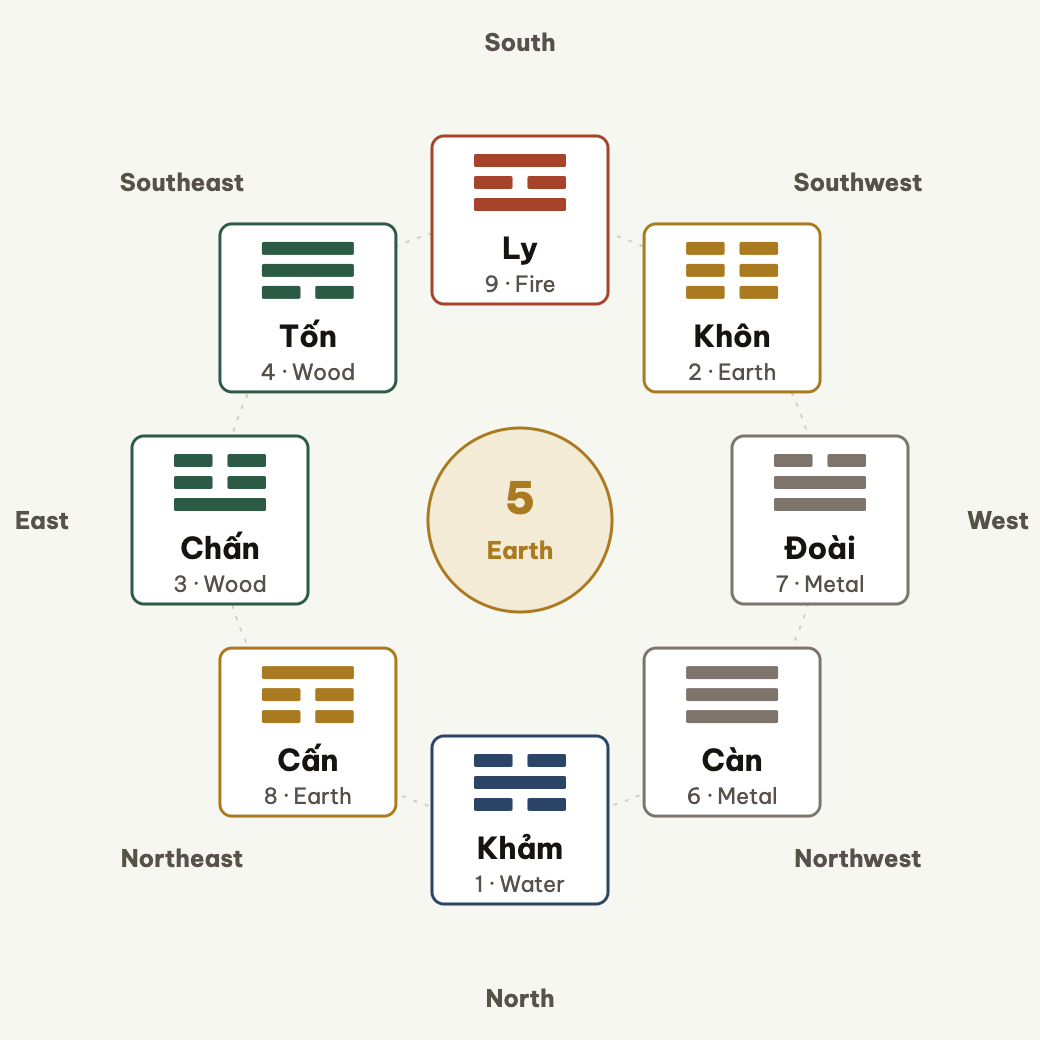
As recorded in Tuyen tap bai viet Phong Thuy chon loc so 3, feng shui and many other ancient disciplines take the He Tu and Luo Shu as their foundation; the Luo Shu in particular, with nine numbers arranged as a magic square, reflects the order and balance of the universe after heaven and earth were divided. Tuyen tap bai viet Phong Thuy chon loc so 4 shows that the Later Heaven ba gua appears most commonly when applied to homes and offices, while the Early Heaven ba gua serves the study of the movement of heaven and earth and the interaction of primordial elements.
The nine palace table below presents the pairing of number, trigram, direction, element, and star name according to the Later Heaven convention.
| Number | Trigram | Direction | Element | Star name |
|---|---|---|---|---|
| 1 | Kan | North | Water | Nhat Bach |
| 2 | Kun | Southwest | Earth | Nhi Hac |
| 3 | Zhen | East | Wood | Tam Bich |
| 4 | Xun | Southeast | Wood | Tu Luc |
| 5 | Center palace | Center | Earth | Ngu Hoang |
| 6 | Qian | Northwest | Metal | Luc Bach |
| 7 | Dui | West | Metal | That Xich |
| 8 | Gen | Northeast | Earth | Bat Bach |
| 9 | Li | South | Fire | Cuu Tu |
What Is the Flying Star Path Through the Center, Qian, Dui, Gen, Li, Kan, Kun, Zhen, and Xun?
The flying star path is the sequence in which stars move through the nine palaces along a fixed route, starting from the center palace and then passing through Qian, Dui, Gen, Li, Kan, Kun, Zhen, and Xun. In Xuan Kong Fei Xing feng shui, each star from Nhat Bach to Cuu Tu has its own five element nature and holds a fixed position in the Luo Shu and the nine palaces; at the same time, they shift position with each yun, a twenty year cycle. It is precisely this interaction among stars in their palaces over time that forms the basis for assessing wealth, health, career, and household members of a family or an area.
According to Tuyen tap bai viet Phong Thuy chon loc so 2, in yun 8 the palaces with flourishing qi under the cheng men jue include the South, Southwest, West, Northwest, North, Northeast, East, and Southeast. To place a stove or arrange water to activate wealth, one must rely on those palace positions. Zheng shen is understood as the high mountain place of the ruling star, the place that receives flourishing qi. For instance, in yun 1, Nhat Bach holds the ruling role, so the Nhat position belonging to Kan is regarded as zheng shen.
Do the Schools Agree on Pairing Trigrams with Numbers?
No, the schools do not agree, and this is a point to state clearly rather than quietly pick one side. Wikipedia records that in the Later Heaven arrangement, 1 and 9 correspond to Kan and Li; in the Early Heaven arrangement, they correspond to Kun and Qian. Thus the same number carries a different trigram depending on whether the Early Heaven or Later Heaven system is used.
Tuyen tap bai viet Phong Thuy chon loc so 4 also clearly distinguishes the two kinds of ba gua. The Early Heaven ba gua places Qian above and Kun below, symbolizing the primal balance of yin and yang, and is often used to examine matters concerning the qi nature of a plot or a building. The Later Heaven ba gua, as this book describes it, has Kan above and Li below, and is widely used in residential and office feng shui applications. This difference directly affects how trigrams are paired with numbers in each specific calculation.
In addition, the book Thuat so Lac Thu (Ky Mon Don Giap nguyen thuy) offers a different view of the origin. According to this book, the Luo Shu table with the nine palace time and the Later Heaven ba gua space belongs to the Lac Viet people, arising before 2357 BCE; the book cites ancient Chinese history recording that in the Mau Than year of King Yao's reign, envoys of the Viet people then in the South brought to the capital Binh Duong a divine turtle with the characters Khao Dau carved on its shell. This book also holds that the term Luo Shu originally means the book of the Lac people. This is the book's own view, not one generally agreed by researchers, so it should be read as an independent interpretation.
Which Calculations Use the Luo Shu?
According to Wikipedia, the Luo Shu is part of the heritage of ancient Chinese mathematics and divination, and is an important symbol in feng shui, the geography art concerned with placing objects in relation to the flow of qi. The Luo Shu together with the ba gua is sometimes used as a mandala like expression in feng shui geography.
The book Ky Mon Chi Quy, volume 1, shows that qi men dun jia is tied to the ba gua for positioning and to the use of numerology to judge fortune. The book Ky Mon Don Giap dieu bi by Khau Kim Han states clearly how to start the nine stars and eight gates: on a Giap Ty day, Thien Bong starts at Gen palace eight, Thien Nhue at Li nine, then flies forward through the nine palaces; on an At Suu day, Thien Bong starts at Li nine, Thien Nhue at Kan one. The book also gives how to start the huu gate by groups of three days, and notes that every three days one palace shifts, without entering the central five. These are concrete examples showing that the Luo Shu nine palaces serve as the calculation frame in qi men.
Ky Mon Chi Quy, part 34, stresses the principle of yin yang two dun dividing the three yuan, the forward and reverse movement of the palaces, and the practice of checking tai sui and yue jian then putting the gan zhi into the center palace to fly forward through the nine palaces in order to examine generating and controlling relations for fortune. The book also states that in the nine palaces, Qian, Kan, Gen, and Li are regarded as ji su, while Kun, Dui, Zhen, and Xun are the four xin, and the center palace belongs to earth. This classification shows that each palace in the nine palaces has a different role depending on the calculation in use.
The book Liu Ren, volume 1: Introduction, presents how to place the twelve heavenly generals into the hexagram, beginning with the Quy Nhan star and then placing the next eleven stars in the order of the Quy Nhan star cycle. The book also records the rule for placing the Quy Nhan star cycle by day gan, distinguishing day and night. This is another example showing that li qi calculations all share one frame of directions and numbers.
Why Is It Said That Every Li Qi Calculation Comes Back to the Nine Cells of the Luo Shu?
This saying should be understood with care. It is true that many li qi calculations in Eastern scholarship share a nine cell frame with the numbers one through nine, tied to eight trigrams and one center palace. Wikipedia records that the Luo Shu is part of the heritage of ancient Chinese mathematics and divination, and an important symbol in feng shui. Tuyen tap bai viet Phong Thuy chon loc so 2 shows that Xuan Kong Fei Xing uses the nine palaces and nine stars as the basis for judgment. Ky Mon Don Giap dieu bi and Ky Mon Chi Quy show that qi men also uses the nine palaces to start stars and place gates. Liu Ren shows that liu ren uses a heavenly plate and a star cycle by direction.
However, one should not understand that every calculation rests only on the Luo Shu and nothing else. Each calculation also has its own system of gan zhi, five elements, shen sha, and its own method of interpretation. The Luo Shu plays the role of a shared frame of directions and numbers, but the specific judgment is set by each school. Note also that views on the origin, on how trigrams pair with numbers, and on how the nine palaces are used are not fully agreed among books and schools.
Points to Note When Researching the He Tu and Luo Shu
First, both diagrams are legend, not verifiable historical events. The earliest documents are vague, and the shape in use today took shape over many centuries.
Second, the drawings of the He Tu and Luo Shu we see today appeared only in the Song dynasty. Before that, documents mention only the names or describe them indirectly, without concrete drawings as now.
Third, the Early Heaven and Later Heaven schools pair trigrams with numbers differently. The same number may attach to different trigrams depending on the system in use, and this affects the result of judgment.
Fourth, no li qi calculation yields an absolute fortune result. The books all stress that fortune also depends on many other factors such as gan zhi, five elements, shen sha, and the specific context. Readers should treat this as a system of symbols and rules for reflection, not as a certain statement about the future.


