
What is Hexagram Hoa Trach Khue and where does it sit among the 64 hexagrams?
Hoa Trach Khue (Chinese characters 火澤睽) is the 38th hexagram of the 64 I Ching hexagrams, coming right after Phong Hoa Gia Nhan (hexagram 37). The name has two parts: Hoa (Ly ☲) above, Trach (Doai ☱) below. The inner trigram is Doai, symbolizing a marsh. The outer trigram is Ly, symbolizing fire. In the palace system of the I Ching, Hoa Trach Khue belongs to the Can palace, grouped with Son Hoa Bi, Son Thien Dai Suc, Son Trach Ton, Thien Trach Ly, Phong Trach Trung Phu, and Phong Son Tiem.
Notably, although it carries the image of Hoa (Fire), this hexagram belongs to the Can palace (Earth). This detail is often overlooked in quick lookups but matters to those using the I Ching in feng shui and mai hoa dich so, because it determines the hexagram's five-element nature in relation to other hexagrams.
The name "Khue" (睽) means opposition, separation, two eyes looking in two directions. The character 睽 is composed of the Muc radical (eye) and the character Quy, evoking the image of two eyes not looking at the same point. This is how the ancients used concrete imagery to describe an abstract state: disagreement, distance, not sharing a path.
Why does Khue follow Gia Nhan?
Phong Hoa Gia Nhan (hexagram 37) speaks of family, of household members keeping to their proper roles. Hoa Trach Khue (hexagram 38) follows immediately. In the traditional Tu Quai sequence, hexagrams are arranged in pairs with causal or opposing relations. Gia Nhan and Khue form such a pair: when each person in the home keeps their proper place, things are harmonious, but when difference arises in the family, when each person looks in a different direction, Khue emerges. In other words, Khue is the reverse side of Gia Nhan. The family is the closest place, but also the place most prone to disagreement, because people cannot avoid each other forever.
The Judgment: "small matters succeed"
The Judgment of Khue is very short:
睽:小事吉
Khue: Tieu su cat.
Meaning: small matters succeed.
This line must be read in context. Khue is a time when two sides do not look in the same direction. In such a time, the text does not advise undertaking great matters. Great matters require unity of heart, and unity is lacking. Small matters, matters of moderate scope, are favorable. This is advice about knowing the limits of one's time.
Note: the Judgment only says "small matters succeed," not "great matters bring misfortune." This is a point that I Ching commentaries often stress when distinguishing degrees. Great matters are not encouraged, but they are not declared disastrous. Readers should distinguish between "should not do" and "doing it will fail."
The Image: "agree in the great, differ in the small"
The Image of Khue:
上火下澤,睽;君子以同而異
Thuong hoa ha trach, Khue; quan tu di dong nhi di.
Meaning: fire above, marsh below is the image of Khue. The noble person follows this by agreeing in the great and differing in the small.
"Dong nhi di" is one of the memorable life lessons of the I Ching. Fire rises, water flows down, two different natures coexisting in one universe. The wise do not demand that others be like them in everything. Agreement at the root is enough; difference in branches and leaves is ordinary.
Note on how "dong nhi di" is read in different commentaries. Some understand "dong" as jointly holding the central and correct way, "di" as each person having their own conduct. Others understand "dong" as sharing a common purpose, "di" as different means. Both readings lead to the same spirit: hold the common at the deep level, allow the individual at the surface level.
The six line texts and plain-language explanations
The six lines of Khue describe six situations when people fall into misunderstanding, disagreement, and division, and how to reconnect step by step.
| Line | Original Han Viet | Meaning |
|---|---|---|
| So cuu (line 1) | 悔亡,喪馬勿逐,自復。見惡人,无咎 / Hoi vong, tang ma vat truc, tu phuc. Kien ac nhan, vo cuu | Rest easy, a lost horse need not be chased, it returns on its own. Meeting a bad person brings no harm |
| Cuu nhi (line 2) | 遇主于巷,无咎 / Ngo chu vu hang, vo cuu | Meeting the lord in a small alley brings no harm |
| Luc tam (line 3) | 見輿曳,其牛掣,其人天且劓。无初有終 / Kien du due, ky nguu xiet, ky nhan thien tha ti. Vo so huu chung | Seeing a cart pulled backward, an ox jerked back, a person with nose cut and hair shaved. No good start but a good end |
| Cuu tu (line 4) | 睽孤,遇元夫,交孚,厲无咎 / Khue co, ngo nguyen phu, giao phu, le vo cuu | Isolated in separation, meeting a good person, exchanging sincerity, dangerous but no harm |
| Luc ngu (line 5) | 悔亡,厥宗噬膚,往何咎 / Hoi vong, quyet tong phe phu, vang ha cuu | Rest easy, kin bite into soft flesh together, advancing brings no fault |
| Thuong cuu (line 6) | 睽孤,見豕負塗,載鬼一車,先張之弧,後說之弧。匪寇婚媾,往遇雨則吉 / Khue co, kien thi phu do, tai quy nhat xa, tien truong chi ho, hau thoat chi ho. Phi khau hon cau, vang ngo vu tac cat | Isolated in separation, seeing a mud-covered pig, a cart full of ghosts, first drawing the bow, then releasing it. Not a bandit, a marriage proposal, going and meeting rain brings good fortune |
Line 1: A lost horse need not be chased
This line is for one beginning a disagreement. There is friction, someone leaves in anger, something breaks. The line says: do not rush to chase and hold on. The lost horse will return on its own. Meeting even someone you dislike is fine. In a time of difference, anxious clinging usually makes things worse. Let it rest a while, and many things resolve themselves.
Line 2: Meeting the lord in a small alley
This is a good line. When apart, when misunderstanding, you happen to meet again in an informal place: a small shop, a street corner, a shared meal. Not a place for big talk, but enough to break the ice. The line says: no harm. Some reconciliations do not happen at the meeting table but in a small alley.
Line 3: Cart pulled backward, person wounded
This is the hardest passage of the hexagram. The person in this role is deeply misunderstood, wounded in reputation, blocked on all sides. Cannot advance, cannot retreat. But the line has a memorable phrase: "no good start but a good end." The middle is hard, but the outcome can still be good. Enduring this phase, knowing how to wait, knowing not to retaliate, is the condition for reaching the goal.
Note on historical context: the image of "nose cut and hair shaved" (thien tha ti) is an ancient punishment, not advice for today's reader. It is how the ancients described the degree of severe reputational wounding, not a standard to apply.
Line 4: Isolated yet meeting someone trustworthy
This is one who has fallen into isolation within a group or relationship, with no one who understands them. Fortunately, they meet a good person, a trustworthy person. The two exchange sincerity and lean on each other through the hard passage. Though danger remains, no harm comes. In a time of division, one right friend is worth a whole team.
Line 5: Biting into soft flesh with kin
This line uses a folk image: kin bite into the soft part of the meat together, sharing the tasty, easy portion. Disagreement is untied when parties sit down together at a meal, a reunion, a simple shared task. No need to decide who is right or wrong; just doing a good thing together reconnects the relationship. Advancing this step has nothing to fear.
Line 6: Seeing a pig as a ghost, then releasing the bow
This is the classic line on deep misunderstanding. The person in this role has been isolated too long, seeing suspicion in everything. A mud-covered pig looks like a monster, a cart of people looks like a cart of ghosts, the bow is drawn to shoot. Then they realize: not bandits coming, a marriage proposal. The bow is lowered, rain falls, everything turns well.
The image of "a cart full of ghosts" (tai quy nhat xa) is one of the most famous in the I Ching on the power of misperception. When the mind is preset to suspicion, threats appear everywhere. The line does not say the fear is baseless, it says the moment the bow is lowered is the moment everything turns.
Is Khue auspicious or inauspicious?
This question is searched most often, and the answer needs qualification. I Ching commentaries and modern lookup sites usually place Khue in the group of hexagrams unfavorable for great matters. A popular lookup site describes Khue as a "bad" hexagram, full of conflict and clash, indicating a time when career success is hard and wealth is difficult. But that same site notes that in hardship people gain lessons and greater clarity.
This reading has a basis in the Judgment: "small matters succeed." That is, Khue is not a "greatly inauspicious" hexagram, but a hexagram of a limited time. In a limited time, doing small matters, matters within one's strength, matters not requiring high unity, is still favorable. This is the point readers should grasp to avoid two extremes: absolute panic or complete dismissal.
Applying Khue in life
In family and friendship
Khue is the hexagram of disagreement. When family troubles arise, when friends drift apart, line 2 suggests an approach: find an informal occasion to meet, do not weight the issue, let the meeting break the ice naturally. Line 5 suggests another way: do a shared task, share a meal, without first deciding right and wrong.
In work and cooperation
The Judgment "small matters succeed" applies directly: in a period of disagreement with a partner, focus on small, concrete matters, matters not requiring long-term commitment. Great matters need unity of heart, and unity is lacking. This is advice on pace, not on whether to cooperate at all.
In self-cultivation
The Image "dong nhi di" is a teaching on embracing difference. The noble person does not demand that others be like them in everything. Holding the common at the root and allowing the individual at the branch is how to live with those who differ without losing oneself.
Khue in relation to other hexagrams
Khue sits in the Can palace, grouped with Son Hoa Bi, Son Thien Dai Suc, Son Trach Ton, Thien Trach Ly, Phong Trach Trung Phu, and Phong Son Tiem. Knowing which palace a hexagram belongs to helps I Ching users in systems such as mai hoa dich so or feng shui determine the hexagram's five-element nature, then judge generation and overcoming.
Some books also group Khue with Tung (hexagram 6) and Bi (hexagram 12) because all speak of a state of non-flow. However, this grouping is less common than palace grouping. Readers should know there are multiple classification systems, each serving its own purpose.
Notes when looking up Khue
First, distinguish the Judgment, the Image, and the line texts. The Judgment is the words of King Wen, the Image is the words of Confucius, the line texts are for each line. Different books may number lines differently, but bottom-to-top order is the common standard.
Second, distinguish the I Ching from other systems. The poem cards in Khong Minh Than Toan are card texts from another book, not Zhou Yi line texts. When looking up, if you see a four-line poem attached to Khue, that is a card from a separate system and should not be mixed with line texts.
Third, distinguish historical context from advice. Images such as "nose cut and hair shaved" or "a cart full of ghosts" are how the ancients described situations, not standards to apply. Reading the I Ching requires keeping distance from the social context that produced it.
Fourth, do not assert absolute fortune or misfortune. Different I Ching schools interpret differently. Some stress the Judgment, some stress the line texts, some stress the hexagram image. Readers should know which convention the text follows and may consult other readings.
Structure of Hoa Trach Khue in a table
| Item | Value |
|---|---|
| Order in Zhou Yi | 38 |
| Chinese character name | 睽 |
| Upper trigram | Ly (Fire) |
| Lower trigram | Doai (Marsh) |
| Six lines, top to bottom | yang, yin, yang, yin, yang, yang |
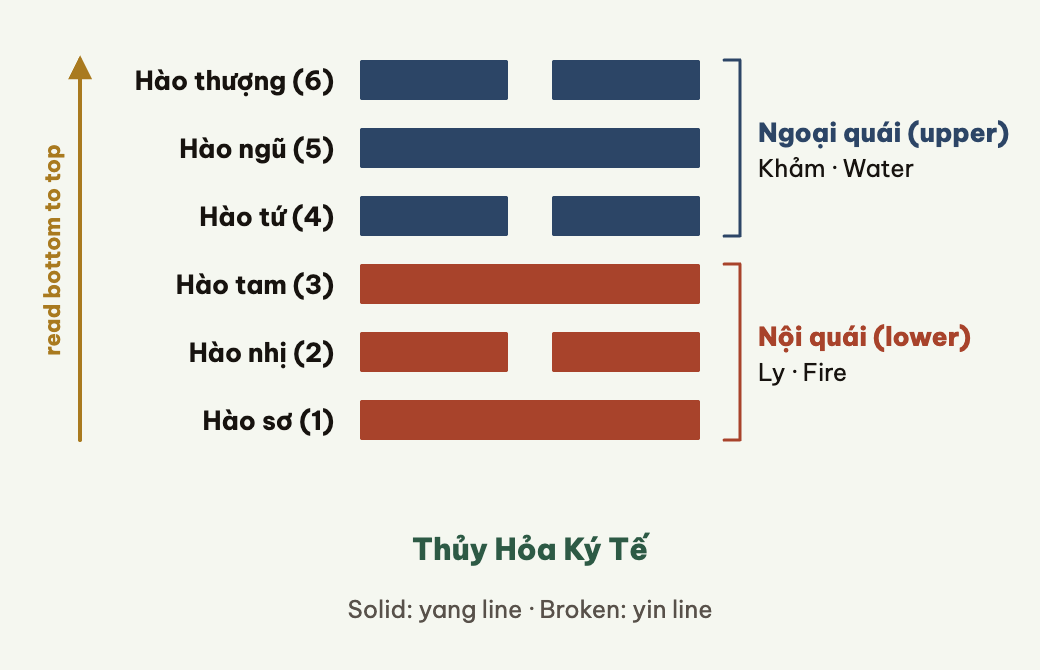
| Nuclear hexagram | Thuy Hoa Ky Te (hexagram 63) |
| Opposite hexagram | Thuy Son Kien (hexagram 39) |
| Reverse hexagram | Phong Hoa Gia Nhan (hexagram 37) |


