
What is the Phong Hoa Gia Nhan hexagram and where does it sit among the 64?
Phong Hoa Gia Nhan (風火家人), also called Gia Nhan (家人) for short, is the 37th hexagram of the 64 I Ching hexagrams. It is composed of the inner (lower) trigram Ly ☲, the image of fire, and the outer (upper) trigram Ton ☴, the image of wind. The six lines include four yang lines and two yin lines. The core image is fire burning within, generating wind that spreads outward, so the hexagram speaks of family and of how each person keeps to their proper role so the whole household stays settled.
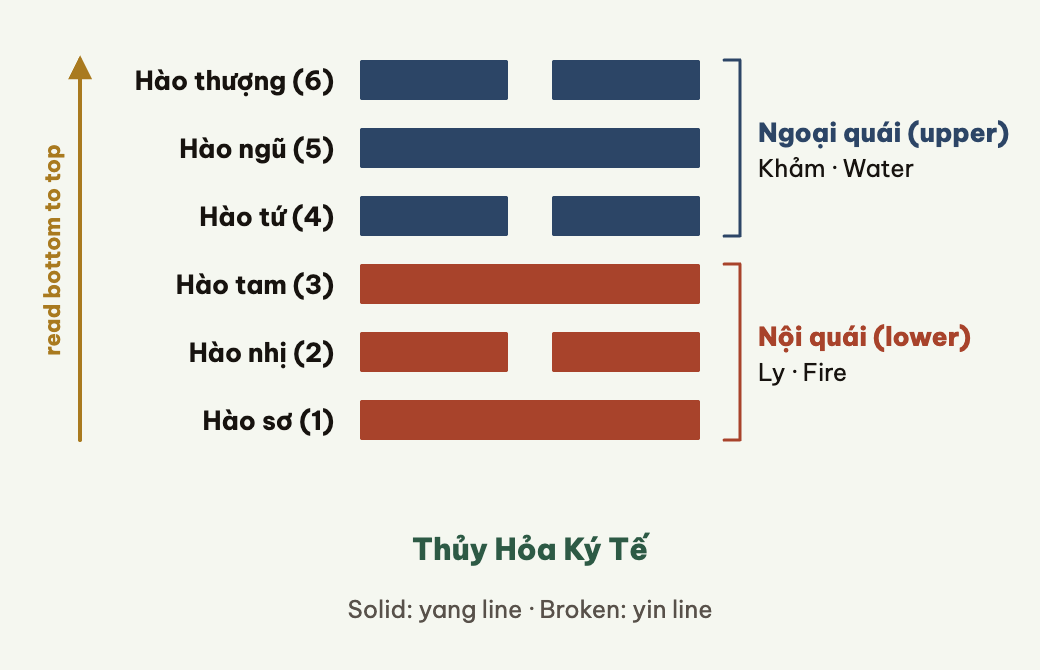
As recorded in Wikipedia's list of the 64 hexagrams, hexagram 37 is named Gia Nhan, with the Unicode symbol ䷤. The name "Phong Hoa Gia Nhan" joins the two trigram names in the order outer first, inner second, following the common convention for naming doubled trigram hexagrams. Horos also states that the hexagram has the image ☴ above ☲, inner trigram Ly, outer trigram Ton, and belongs to the Wood element.
The upper and lower trigrams and the names of the six lines
The six lines are read from the bottom up, named by position and yin or yang nature:
| Line | Position | Yin/Yang | Line name |
|---|---|---|---|
| 1 | Bottom | Yang | So cuu |
| 2 | Second | Yin | Luc nhi |
| 3 | Third | Yang | Cuu tam |
| 4 | Fourth | Yin | Luc tu |
| 5 | Fifth | Yang | Cuu ngu |
| 6 | Top | Yang | Thuong cuu |
The convention "cuu" is used for yang lines, "luc" for yin lines; "so", "nhi", "tam", "tu", "ngu", "thuong" are the order from bottom to top. This is the general convention of the I Ching, not specific to this hexagram.
What do the Judgement and the Image of Gia Nhan say?
The Judgement (Thoan tu) of the hexagram has only three Chinese characters: 家人:利女貞, pronounced in Sino-Vietnamese as "Gia Nhan: Loi nu trinh". According to Horos's explanation, "Gia Nhan" means the people within the household, and "loi nu trinh" means that when the woman holds firm, there is benefit. It should be noted that this is the wording of an ancient text, reflecting the gender-role conceptions of the era in which it arose. Horos also stresses that it should not be read narrowly by gender, but rather as the role of tending to matters within: for a family to be firm, there must be someone who keeps the internal affairs complete.
The Image text reads: 風自火出,家人。君子以言有物而行有恆, in Sino-Vietnamese "Phong tu hoa xuat, Gia Nhan. Quan tu di ngon huu vat nhi hanh huu hang". Translated according to Horos: wind comes out from fire, that is the image of Gia Nhan; the noble person accordingly speaks with substance and acts with constancy. This image is regarded as one of the most practical teachings of the I Ching: speech must have substance, action must have steadiness.
The six line texts of Gia Nhan and their plain-language explanations
The six lines describe six different roles and situations within the family. Below is the original Sino-Vietnamese text with its ordinary reading.
So cuu: setting order from the very start
Original: 閑有家,悔亡, Sino-Vietnamese "Nhan huu gia, hoi vong". Ordinary meaning: setting order for the household from the start brings peace of mind and no later regret. This line corresponds to the stage when one has just begun building something "family-like": moving in together, forming a work group, or taking on a new role at home. At this stage clear rules need to be agreed on, not rigidly, but agreed on early: who handles what, what the hours are, how disagreements are handled.
Luc nhi: tending inner matters, not claiming outer authority
Original: 無攸遂,在中饋,貞吉, Sino-Vietnamese "Vo du toai, tai trung quy, trinh cat". Ordinary meaning: not following one's own will, tending the affairs within the home, holding firm brings good fortune. This line is tied to the role of caring for the inside: meals, spending, keeping the house tidy, looking after the children. This is also a line carrying the social norms of earlier times regarding gender division of labor. Presenting it as historical context is more appropriate than turning it into an imposed prescription for today. The core point that can be drawn is: if one devotes oneself to doing one's part well, the result will be good, without needing to seize every decision.
Cuu tam: too strict is still better than lax
Original: 家人嗃嗃,悔厲吉。婦子嘻嘻,終吝, Sino-Vietnamese "Gia nhan hac hac, hoi le cat. Phu tu hi hi, chung lan". Ordinary meaning: when the household is strict, though there is regret and danger, it is still good; when wife and children laugh and jest laxly, in the end there is regret. This is the line about how to teach and keep discipline at home. Sometimes one must remind, must cause discomfort. The line says plainly: better strict and settled than indulgent and chaotic. A family where each does as they please, no one speaks to anyone, will in the end drift apart.
Luc tu: enriching the household, greatly auspicious
Original: 富家,大吉, Sino-Vietnamese "Phu gia, dai cat". Ordinary meaning: enriching the household, greatly auspicious. This is usually regarded as the finest line of the hexagram. "Phu gia" is not only money, but also warmth, stability, and trust. The person in this position has the ability to bring prosperity to the whole family.
Cuu ngu: the one at the top comes to the family with sincerity
Original: 王假有家,勿恤,吉, Sino-Vietnamese "Vuong cach huu gia, vat tuat, cat". Ordinary meaning: the king comes to the family, do not worry, good fortune. This line speaks of one who has power and position, but who on returning home puts aside all titles and treats relatives with closeness. Outer authority cannot replace inner presence.
Thuong cuu: sincerity and dignity
Original: 有孚威如,終吉, Sino-Vietnamese "Huu phu uy nhu, chung cat". Ordinary meaning: having sincerity and dignity, in the end good fortune. The final line reminds of the qualities of the one who keeps the home long term. Dignity here is not shouting or commanding, but consistency between word and deed. Household members respect one who lives by what they say, not one who shouts louder.
Why does Gia Nhan follow hexagram 36 in the Sequence?
Hexagram 36 is Hoa Trach Khue (the opposing hexagram of Gia Nhan), speaking of separation and diverging paths. In the Sequence, after division has arisen, one must turn back to seek what binds. The family is the closest binding unit, so Gia Nhan follows immediately after Khue. Horos states that the opposing (tong quai) of Gia Nhan is Hoa Trach Khue (hexagram 38), showing that the two hexagrams illuminate each other: one is separation, one is reunion.
This reading also matches the general Sequence of the I Ching, which arranges hexagrams in causal order: one thing leads to another. This is a common reading, not a mandatory rule for all schools.
How is Gia Nhan applied in life?
According to Horos, Gia Nhan is often tied to relationships that have order and clear commitment. In love, the hexagram signals matters tied to family: if one is in love, this may be the time to discuss something more serious such as meeting the parents, moving in together, or marriage. The hexagram supports relationships with order, accompanied by responsibility.
In career, the hexagram suits one managing a small team, a family project, or a business with relatives. Inner order determines success or failure: if it is clear who handles what and who decides what, everything runs smoothly; if authority is muddled and no one dares speak plainly out of politeness, the project will be chaotic.
In wealth, the hexagram suggests money should be managed in a "household" manner: planned spending, regular saving, and not letting money divide relatives. Horos also notes these are suggestions of tendency, not certain predictions.
tracuutuvi.com emphasizes the aspect of family as support: the hexagram is a reminder that on life's path, even amid difficulty and obstacles, family is always a support; any hardship can be overcome if all are of one mind. This site classifies Gia Nhan as auspicious, encouraging right action and the combination of Ton's humility with Ly's clarity.
Where do schools differ in reading Gia Nhan?
There are at least two different approaches. The first reads by image and moral meaning, as Horos presents: the hexagram teaches household order, responsibility, and influence from within outward. The second reads by divination technique, using the Self line, the Officer line, the Six Relatives, the strength or weakness of the day and month, and tracking line changes to judge love, marriage, and career. With the second approach, the same Gia Nhan can yield different conclusions depending on when the divination was cast and the specific question.
One point should be made clear: no school holds the "copyright" on reading Gia Nhan. With the same hexagram, one who reads by image sees a teaching about household order; one who reads by technique sees data for judging a specific situation. Both approaches exist in the tradition, and the student should know which one they are standing in.
Notes when reading Gia Nhan
First, the Judgement phrase "loi nu trinh" is ancient wording carrying the social norms of its era. Reading it as historical context is more appropriate than turning it into an imposed prescription for today.
Second, the line texts describe situations, not commands. Line three says strictness is better than laxity, but that is a judgment in a specific context, not a formula to apply to every family.
Third, the hexagram affirms no absolute fortune or misfortune. The source sites all present Gia Nhan as tending toward good, but that does not mean everything will automatically improve. The hexagram speaks of tendency and conditions: if the internal order is clear, if there is discipline, if there is someone tending the inner duties, the result is favorable; if not, the result will differ.
Fourth, one must distinguish the Chou I line texts from other kinds of divination verse cards. There are card sets such as Khong Minh Than Toan used in folk divination, but that is a text of a different tradition, not the line texts of the Chou I. When reading Gia Nhan, one should compare only with the original Chou I text and commentaries on the Chou I.
The structure of Phong Hoa Gia Nhan in a table
| Item | Value |
|---|---|
| Order in the Chou I | 37 |
| Chinese name | 家人 |
| Upper trigram | Ton (Wind) |
| Lower trigram | Ly (Fire) |
| Six lines, top to bottom | yang, yang, yin, yang, yin, yang |
| Nuclear hexagram | Hoa Thuy Vi Te (hexagram 64) |
| Opposite hexagram | Loi Thuy Giai (hexagram 40) |
| Reversed hexagram | Hoa Trach Khue (hexagram 38) |


