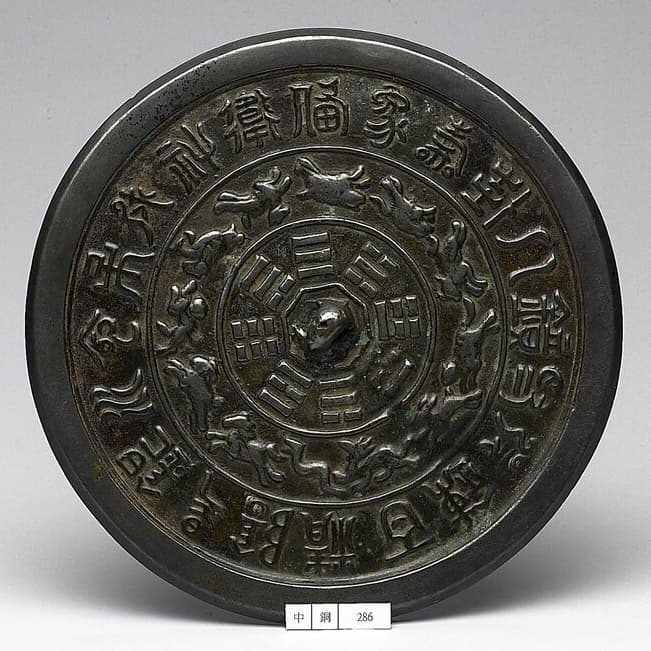
General Introduction to the Hexagram Heaven and Lake Treading
The hexagram Heaven and Lake Treading (in English: Treading, Sino-Vietnamese: 履) is the 10th hexagram in the 64 hexagrams of the I Ching, placed after the hexagram Small Accumulation (Wind Heaven Small Accumulation) and before the hexagram Peace (Earth Heaven Peace). In the I Ching system, each hexagram is not just a divination symbol but also a profound philosophy of the universe and human life. The Treading hexagram is formed from two trigrams: Qian (☰) above, symbolizing Heaven, and Dui (☱) below, symbolizing Lake or Marsh. This combination creates the image of "Heaven and Lake" (Thien Trac).
The term "Ly" in Chinese means "shoes" or "to step." In the philosophical context of the hexagram, it carries the meaning of "to walk upon," "to practice," "to undergo," or "to tread on." The typical image of this hexagram is "Ly ho vi" (treading on a tiger's tail), a metaphor for facing a dangerous situation, but if one knows how to act skillfully and follow propriety, one will not be harmed.
Origin and Historical Context of the Hexagram
According to tradition, the I Ching originated in ancient China and went through many stages of development. Legend has it that Fu Xi drew the Eight Trigrams, King Wen expanded them into 64 hexagrams and wrote the Judgments, while the Duke of Zhou wrote the Line Texts, and Confucius composed the Ten Wings. However, modern research shows that the history of the I Ching's formation is much more complex.
Another perspective was proposed by researcher Nguyen Vu Tuan Anh in works such as "Finding the Roots of the I Ching" (Hong Duc Publishing House, 2020). He suggests that the theory of Yin-Yang and Five Elements, along with the I Ching, may belong to an ancient civilization predating current history, and that the Viet civilization on the southern bank of the Yangtze River could be an important source of Eastern wisdom. Though these remain debatable hypotheses, they open new dimensions for studying the I Ching's origins.
Regardless of its exact origin, the Heaven and Lake Treading hexagram, with its layers of philosophical meaning, is clearly recorded in classical texts such as Zhu Xi's "I Ching" and the "Ten Wings." This hexagram is considered one of the most important, reflecting concepts of ethics, propriety, and caution in action.
Structure and Mechanism of the Hexagram
The Judgment (Hexagram Text)
The Judgment of the Heaven and Lake Treading hexagram is recorded as: "Ly: Ly ho vi, bat kiet nhan, hanh" (履: 履虎尾,不咥人,亨). Roughly translated: "The Treading hexagram: Treading on the tiger's tail, the tiger does not bite, smooth progress." The tiger here symbolizes danger and supreme power (represented by the Qian trigram above). Treading on the tiger's tail without being bitten shows a miraculous success achieved through correct attitude and behavior.
Decoding the Hexagram Structure
According to the line structure, the Treading hexagram has line 5 (a yang line in the highest position of the inner trigram, at the center of the outer trigram) as the ruling line, symbolizing the gentleman in an important position. Line 5 is firm, central, and correct, in a high position (the place of a king or leader). The lower trigram is Dui (☱), with a yin line at its top (line 3), symbolizing instability and vulnerability. This line 3 directly corresponds to the top line of the Qian trigram (line 6), creating a special interaction between the two trigrams.
Notably, line 3 (yin) is in a yang position (position 3 is a yang position in a hexagram), creating "incorrectness" (not in the right place). This line represents a person in a low position who must face danger from above (the Qian trigram). This is precisely the image of "treading on the tiger's tail" in a risky way.
Meaning of the Lines in the Hexagram
Line 1 (Initial Nine): "To ly, vang vo cuu" (素履,往無咎). Meaning: "Walk plainly and simply; proceeding brings no fault." This line teaches that at the start of any career or action, if one maintains a pure, simple nature without ostentation, one will encounter no obstacles.
Line 2 (Second Nine): "Ly dao than than, u nhan trinh cat" (履道坦坦,幽人貞吉). Meaning: "The path is level and wide. A recluse who maintains constancy and correctness is auspicious." This line advises people to live humbly, avoid contention, remain calm, and stay true to their ideals.
Line 3 (Third Six): "Mieu nang thi, bai nang ly. Ly ho vi, kiet nhan, hung. Vu nhan vi vu dai quan" (眇能視,跛能履。履虎尾,咥人,凶。武人為于大君). Meaning: "Blind but thinks he sees; lame but thinks he walks. Treading on the tiger's tail, bitten by the tiger, misfortune. This is a warrior acting for a great ruler." This is a warning to those who lack ability but are ambitious and act recklessly beyond their capacity, inevitably facing danger.
Line 4 (Fourth Nine): "Ly ho vi, suc toc, chung cat" (履虎尾,愬愬,終吉). Meaning: "Treading on the tiger's tail, but with extreme caution and fear, ends in good fortune." This line shows that when facing danger, if one is appropriately fearful and cautious step by step, one can pass through safely.
Line 5 (Fifth Nine): "Quai ly, trinh le" (夬履,貞厲). Meaning: "Walking decisively and resolutely. Maintaining correctness but still cautious because of danger." This line in a high position reminds leaders that decisiveness is necessary, but one must not be arrogant or self-satisfied.
Line 6 (Top Nine): "Thi ly khao tuong, ky thi nguyen cat" (視履考祥,其旋元吉). Meaning: "Look back at the path you have walked, examine omens of good and evil, and return to the Dao for great fortune." The final line teaches self-reflection, reviewing one's entire journey to draw lessons, thereby achieving complete peace.
Philosophical Meaning and Deep Symbols
Caution and Propriety
The core philosophy of the Heaven and Lake Treading hexagram revolves around the concept of "le" (禮, ritual/propriety). In the I Ching, this hexagram is seen as teaching propriety and proper conduct in society. "Ly" means both "to walk" (action) and "ritual" (ceremony, rules). This combination shows that all human actions must be placed within the framework of propriety and social rules.
The image of "treading on the tiger's tail" is a powerful metaphor for dangerous situations in life. The tiger can represent power, superiors, or forces stronger than oneself. Treading on the tiger's tail without being bitten is not random luck but the result of understanding the laws and wise conduct.
Interrelation of Elements
In terms of the Five Elements, the Qian trigram belongs to Metal, and the Dui trigram also belongs to Metal. This coincidence creates a special relationship: two layers of Metal stacked, symbolizing firmness and decisiveness, but also potential conflict if not regulated. However, Dui is Yin Metal (the soft metal of the marsh), while Qian is Yang Metal (the hard metal of heaven). This difference in nature creates mutual support: the softness and flexibility of Dui can soften the rigidity of Qian.
Numerologically, the Treading hexagram is the 10th in the 64 hexagrams. The number 10 symbolizes completion and wholeness in Eastern numerology. This can be understood as the completion of a cycle before entering a new phase (the Peace hexagram, the 11th, symbolizes harmony and smooth progress).
Comparison with Related Hexagrams
The Heaven and Lake Treading hexagram is closely related to the Earth Heaven Peace hexagram (hexagram 11). While Treading teaches caution and overcoming danger through propriety, Peace symbolizes harmony between heaven and earth. Treading can be seen as a prerequisite for reaching the state of Peace: only by knowing how to walk the right path, maintain propriety, and overcome trials (Treading) can one achieve peace and prosperity (Peace).
Additionally, Treading is linked to the Heaven Earth Standstill hexagram (hexagram 12), symbolizing stagnation. If one is not cautious and does not maintain propriety in action, one can fall from the state of Treading (carefully overcoming danger) into Standstill (blockage, no progress).
Applications of the Heaven and Lake Treading Hexagram in Modern Life
In Work and Career
The Treading hexagram offers valuable lessons for employees, especially in the modern workplace. The image of "treading on the tiger's tail" can be understood as working under a difficult boss, in a large corporation, or facing risky projects. The lesson is to act cautiously, respect rules and processes, and especially maintain a humble and proper attitude.
Line 1 reminds beginners to stay simple and unpretentious, not overly confident or showy. Line 4 teaches that even in a high position, one must remain cautious and forward-thinking, not complacent. Line 5 is particularly important for leaders: decisiveness is necessary, but one must not lose caution or become arrogant with power.
In Social Relationships
The Treading hexagram also offers deep lessons on building and maintaining relationships. The word "Le" (ritual) emphasizes the importance of respect and rules of conduct in communication. When facing those with more power or status (the "tiger"), we must be tactful and respectful, but not grovel or lose our own principles.
Line 2 teaches humility and keeping oneself pure amid a chaotic world. It is a lesson on holding firm to life principles, not being tempted by power or materialism. Line 3 is a warning to those trying to rise at any cost, ignoring their true abilities, and then suffering bitter failure.
In Decision-Making
One of the most practical applications of the Treading hexagram is in decision-making. The hexagram teaches that before acting, one should:
- Carefully examine the situation and identify potential risks (the "tiger's tail")
- Honestly assess one's own abilities, not act beyond capacity
- Follow rules, ethical standards, and laws
- Maintain a cautious attitude, avoid arrogance and complacency
- Always review and learn from each decision
Conclusion
The Heaven and Lake Treading hexagram, with its image of "treading on the tiger's tail," is one of the most philosophically rich hexagrams in the 64 hexagrams of the I Ching. It is not just a divination tool but a philosophical system guiding people to act correctly in a world full of risks and uncertainties. The hexagram teaches that caution, propriety, and humility are the keys to overcoming the most dangerous situations.
In today's volatile society, the lessons of the Treading hexagram remain valuable. Though the historical origins of the I Ching may be debated, its philosophical value and practical application are undeniable. The Heaven and Lake Treading hexagram reminds us that the road to success is never even, but if we know how to walk the right path, maintain propriety, and stay cautious, we can overcome all dangers to achieve our goals.
Quick-Reference Table: Hexagram Treading
| Aspect | Content |
|---|---|
| King Wen number | 10 |
| Chinese name | 履 |
| Symbol | ䷉ |
| Vietnamese name | Thiên Trạch Lý |
| Upper trigram | Qian (Heaven), Metal element, Northwest |
| Lower trigram | Dui (Lake), Metal element, West |
| Six lines, first line at the bottom | 1st yang, 2nd yang, 3rd yin, 4th yang, 5th yang, 6th yang |
| Image | Heaven above, lake below: walking where care is required. |
| Reading | An image of moving through a place marked by distance and rank. The focus is on conducting oneself properly before something larger. The caution meant here is awareness, not fear. |
*Số liệu trong bảng khớp với kết quả các công cụ tra cứu trên Nhật Nguyệt.*
