
What is Lôi Thủy Giải and where does it stand among the 64 hexagrams?
Lôi Thủy Giải is hexagram 40 of the 64 I Ching hexagrams, with the Sino-Vietnamese name Lôi Thủy Giải (雷水解), also called simply Giải. The hexagram has two yang lines among four yin lines, with the inner (lower) trigram Khảm ☵ representing water and danger, and the outer (upper) trigram Chấn ☳ representing thunder and movement. Its Five Phases element is Wood. In Unicode it is ䷧.
By traditional reading, the name joins the images of the two trigrams: Chấn is thunder, Khảm is water, hence Lôi Thủy Giải. The image is thunder above, water below, evoking a rainstorm after pent-up pressure, when heavy air is washed clean.
| Attribute | Value |
|---|---|
| Order | 40 / 64 |
| Sino-Vietnamese name | Lôi Thủy Giải (雷水解) |
| Other name | Giải |
| Image | ☳ above ☵ (thunder above water) |
| Inner (lower) trigram | Khảm ☵, water, danger |
| Outer (upper) trigram | Chấn ☳, thunder, movement |
| Five Phases | Wood |
| Time | Giải, time of untangling and loosening |
| Number of yang lines | 2 / 6 |
| Opposite hexagram | Thủy Sơn Kiển (hexagram 39) |
Why does Giải come right after Kiển?
In King Wen's sequence, hexagram 39 is Thủy Sơn Kiển, hexagram 40 is Lôi Thủy Giải. Kiển means hardship and deadlock, obstacles everywhere. Giải means to loosen, untie, make slack. The natural order is that after deadlock there must be a time of opening, so Giải follows Kiển.
Some texts read the sequence through yin-yang waxing and waning: when yin energy has gathered to an extreme, yang begins to return, and Giải is when blockage starts to be pushed back. This reading belongs to ancient cosmology, not a claim about personal fate. The point to keep is the spirit: Giải is not the peak of success, but a transitional phase just past difficulty, not yet fully calm.
What do the Judgment and the Image of Giải say?
The original Chinese of the Judgment (quái từ) is:
> 解:利西南。無所往,其來復吉;有攸往,夙吉
The Sino-Vietnamese reading:
> Giải: Lợi tây nam. Vô sở vãng, kỳ lai phục cát; hữu du vãng, túc cát.
Meaning: Giải is favorable toward the southwest. If there is nowhere to go, returning to the old place is good; if there is something to do, doing it early is good. The southwest is the direction of Khôn, the image of level ground and stability. The Judgment clearly divides two situations after just escaping trouble: if nothing remains, return to ordinary life; if something is unfinished, do not delay.
The original Chinese of the Image:
> 雷雨作,解;君子以赦過宥罪
Sino-Vietnamese:
> Lôi vũ tác, Giải; quân tử dĩ xá quá hựu tội.
Meaning: thunder and rain arise, the image of Giải. The noble person follows this to pardon faults and be lenient with minor offenses. The central image is here: after pent-up thunder, rain falls and the air softens. Ancients reading this hexagram often granted general amnesty and reduced sentences for minor crimes, setting aside old grudges. This is the social context of antiquity, not advice to apply literally today.
The six lines of Giải and their plain readings
The six lines describe six situations after just passing deadlock, from first easing to decisive handling of what remains.
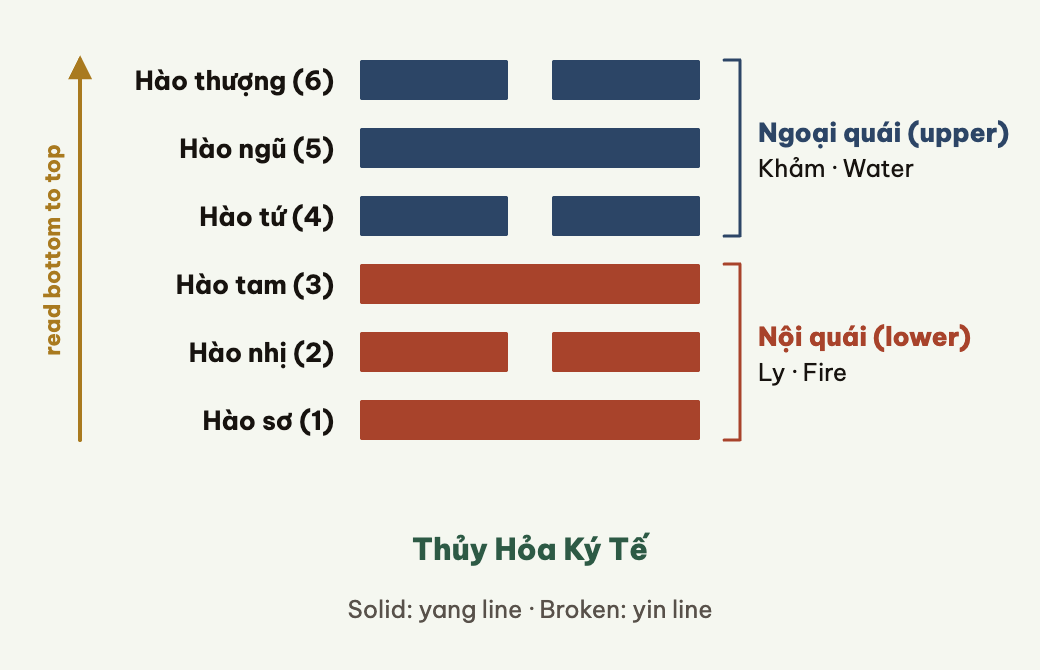
| Line | Sino-Vietnamese text | Meaning |
|---|---|---|
| Sơ lục (line 1) | 无咎 / Vô cữu | No harm |
| Cửu nhị (line 2) | 田獲三狐,得黃矢,貞吉 / Điền hoạch tam hồ, đắc hoàng thỉ, trinh cát | Hunting, catching three foxes, getting a yellow arrow; steadfastness is good |
| Lục tam (line 3) | 負且乘,致寇至,貞吝 / Phụ thả thừa, trí khấu chí, trinh lận | Carrying on the back while riding a carriage, inviting robbers; steadfastness brings regret |
| Cửu tứ (line 4) | 解而拇,朋至斯孚 / Giải nhi mẫu, bằng chí tư phu | Loosen your big toe; when friends come, there is trust |
| Lục ngũ (line 5) | 君子維有解,吉。有孚于小人 / Quân tử duy hữu giải, cát. Hữu phu vu tiểu nhân | The noble person only by loosening is good. There will be proof among petty people |
| Thượng lục (line 6) | 公用射隼于高墉之上,獲之,无不利 / Công dụng xạ chuẩn vu cao dung chi thượng, hoạch chi, vô bất lợi | The lord shoots a falcon on the high wall, catches it; nothing is unfavorable |
Line 1: nothing left to worry about
This line is surprisingly brief, only two characters in the original. It is someone just stepping out of hardship. Everything has just loosened, nothing left to worry about. The line does not urge action, does not push forward, does not warn to retreat. After tension, being allowed a little calm is good. Do not rush to fill the gap with something new when it is not yet needed.
Line 2: catching foxes, picking up a yellow arrow
The three foxes in the I Ching are often read as three types of deceitful people around you: flatterers, slanderers, the self-serving. Here, the one just escaped has a chance to remove these three from life. After removing them, one picks up a yellow arrow, meaning keeping uprightness in hand. The common reading: after escaping, tidy the relationships that caused suffering, and hold to proper conduct.
Line 3: the porter riding a grand carriage
The image is half comic, half sharp: a small person, usually just carrying goods, now rides the carriage of the powerful. Not fitting the position, immediately exposed, becoming prey for robbers. This is the ancient social context, where status and ritual were tightly bound. Modern readings stress: just past hardship, boasting of achievements one does not truly hold invites trouble. The line is not an absolute moral instruction but an observation about the consequences of misplacement.
Line 4: loosening the big toe
The big toe is where someone unsteady clings. In traditional commentary it also stands for a close friend heading the wrong way, a bad habit one still holds, a bond whose time is over but one dares not release. The line says: loosen it. Only when that pull is released do true friends arrive, and sincerity meets sincerity. The period after escape is the time to review what one clings to unnecessarily.
Line 5: the noble person only by loosening is good
This line holds the hexagram's ruling position. One in a high, responsible role, when the time has opened, must actively untie remaining knots. Traditional reading does not encourage lingering or half-hearted ties with those who caused harm. The final result is that petty people reveal themselves. For one managing a group, a family, a project, the line is often read as a sign to clean up thoroughly. Note that noble person and petty person here belong to ancient moral context, not a classification to apply literally today.
Line 6: shooting a falcon on the high wall
The falcon is a bird of prey, often symbolizing a fierce person who has fled to a hard-to-reach place. The lord personally draws the bow, hits, and retrieves. This is the closing line, the most decisive. The common reading: when one has authority and opportunity, one must handle the last danger. Forgiveness is good for small matters, but the root of trouble should not be spared. Handle that root, and nothing is unfavorable.
How is Giải applied in daily life?
Reference sites often use Giải to prompt reflection in a few familiar areas. Note that this is a reference reading, not a firm prediction.
Love
Drawing Giải in love is often read as a relationship just past tension and beginning to ease. Quarrels have settled, misunderstandings cleared, outside pressure reduced. This can be a time to speak honestly and forgive old matters. But line 4 also warns: if long entangled with someone heading the wrong way, this may be the time to let go. Singles drawing this hexagram are often read as just out of an old relationship and ready for something new.
Career
In career, Giải leans toward a phase just out of a stressful project, a workplace conflict, or a period of professional deadlock. Pressure has eased, but do not rush into new work. Line 1 advises a rest. Line 2 suggests tidying professional relationships, cutting colleagues or partners who caused trouble. Unfinished business from the previous phase should be settled, not dragged out, as the Judgment says: if there is something to do, do it early.
Wealth
In money, Giải is often tied to debts just repaid, financial troubles just untangled, or a dispute just resolved. Cash flow begins to open again. This can be a good time to clarify accounts, collect long-standing loans, close open contracts. Line 3 warns: showing money right after getting it invites trouble. Just out of debt, one should stay quiet, avoid risky lending, avoid large emotional investments. Nurturing wealth is often seen as more important than earning it here. This is a reference reading, not investment advice.
Health
In health, Giải is often read as an illness, a long stress period, or a physical issue beginning to ease. Medicine starts working, treatment is on track, the body recovers. But this is the most careless time: feeling better, stopping medicine; feeling well, training hard again; no more fatigue, staying up late again. Line 6 reminds one to finish the root of the illness. Recheck after treatment, follow the doctor, keep healthy habits longer. This is a prompt for reflection, not a substitute for medical diagnosis and treatment.
Is Giải an absolutely auspicious hexagram?
No. The common reading sees Giải as leaning favorable, but not an unconditional promise. The hexagram describes a transitional phase: hardship has passed but not fully calm. Line 3 still warns of misplacement, lines 5 and 6 still demand decisiveness with the root of trouble. Reading only the opening and skipping the end easily misreads it as complete liberation.
Books and schools also differ. Some stress yin-yang waxing, seeing Giải as yang returning after yin's peak. Some lean moral, seeing Giải as amnesty and forgiveness. Some read Giải as a link in cosmic movement, tied to thunder, rain, and plant growth. This article follows the common presentation on current reference sites: taking the Judgment, Image, and six lines as base, then extending to life areas as reflection. Readers should treat it as reference material, not grounds for major decisions on health, finance, or law.
The core lesson of Lôi Thủy Giải
What is worth keeping from Giải is not a fortune prediction, but how it describes a transitional phase often overlooked: just after escaping a hard matter. People often react in two extremes. One is rushing into new work to fill the gap. Two is letting everything go, even unfinished matters. Giải reminds that both are off: if nothing remains, return to ordinary rhythm; if something is unfinished, finish it early.
The Image adds another layer: after pent-up pressure, rain comes to soften the air. Forgiveness, in this reading, is not weakness but a way not to stay stuck in old grudges. Just past hardship but still clinging to old grudges means not truly free. Line 6 closes with a decisive image: some matters must be finished, not endlessly indulged. Between forgiving and finishing, Giải does not choose one side, but distinguishes which matters to forgive and which to handle.
Structure of Lôi Thủy Giải in one table
| Item | Value |
|---|---|
| Order in Zhou Yi | 40 |
| Chinese character name | 解 |
| Upper trigram | Chấn (Thunder) |
| Lower trigram | Khảm (Water) |
| Six lines, top to bottom | yin, yin, yang, yin, yang, yin |
| Nuclear hexagram | Thủy Hỏa Ký Tế (hexagram 63) |
| Reversed hexagram | Phong Hỏa Gia Nhân (hexagram 37) |
| Opposite hexagram | Thủy Sơn Kiển (hexagram 39) |


