
What is Thủy Sơn Kiển and where does it sit among the 64 hexagrams?
Thủy Sơn Kiển (水山蹇) is the 39th of the 64 hexagrams of the I Ching. The hexagram has two yang lines and four yin lines. The outer trigram (upper trigram) is Khảm ☵, the image of water; the inner trigram (lower trigram) is Cấn ☶, the image of mountain, so it is also called the hexagram of Water over Mountain. Its Five Elements phase belongs to Water. The character Kiển (蹇) means hard to walk, the foot unable to step forward, referring to a situation of obstruction where you cannot force your way ahead. The opposite hexagram (tổng quái) of Kiển is Lôi Thủy Giải (hexagram 40), the hexagram of opening up and dissolution.
Kiển should be distinguished from two hexagrams that also speak of hardship but at different stages: Thuần Cấn (hexagram 52) speaks of stopping, while Thủy Lôi Truân (hexagram 3) speaks of the early hardship when things are just being born. Kiển is difficulty midway, when you have already traveled a distance before finding the way blocked.
Why does Kiển follow Khuê in the Sequence of Hexagrams?
According to the way the order of the 64 hexagrams is explained in the I Ching, after Khuê (hexagram 38, the image of separation and difference) comes Kiển. Khuê is division, and division gives rise to danger and blockage, so Kiển follows. This way of reading the Sequence shows that the 64 hexagrams are not a scattered list but a flow of movement: each hexagram is the result of the one before and the premise of the one after. After Kiển comes Giải, because when blockage reaches its end it must open.
The numbering convention and hexagram names in this article follow the list of the 64 hexagrams of the I Ching, cross-checked against the listing on Wikipedia and against the Judgment and line texts according to the HOROS source. There are several transmitted versions of the Chinese characters of the line texts; this article follows the version used by the cited sources.
What does the Judgment of Kiển say?
Original Chinese: 蹇:利西南,不利東北。利見大人,貞吉
Sino-Vietnamese reading: Kiển: Lợi tây nam, bất lợi đông bắc. Lợi kiến đại nhân, trinh cát.
Meaning: Kiển is hard to walk. The southwest is the direction of flat land (Khôn), the northeast is the direction of mountains (Cấn). The idea is that when you meet difficulty you should seek level ground, not keep climbing higher. The Judgment also says "lợi kiến đại nhân": at this time you need to find an experienced person to consult. Holding firm is good, meaning do not rush to give up, and do not rush to press forward.
What stands out is that the Judgment never says "misfortune." It speaks of direction, of the person you should meet, and of the attitude of holding firm. This is the point many people skim past before assuming Kiển is a bad hexagram.
The Image of Kiển and the advice to "turn inward and cultivate virtue"
Original Chinese: 山上有水,蹇。君子以反身修德
Sino-Vietnamese reading: Sơn thượng hữu thủy, Kiển. Quân tử dĩ phản thân tu đức.
Meaning: on the mountain there is dangerous water, that is the image of Kiển. The noble person follows this by turning back to examine himself and cultivate his virtue. This is very practical advice: when the road ahead is blocked, instead of blaming circumstances, ask yourself what you lack. The I Ching treats meeting difficulty not as bad luck but as an opportunity to look back and correct yourself.
The six line texts of Thủy Sơn Kiển
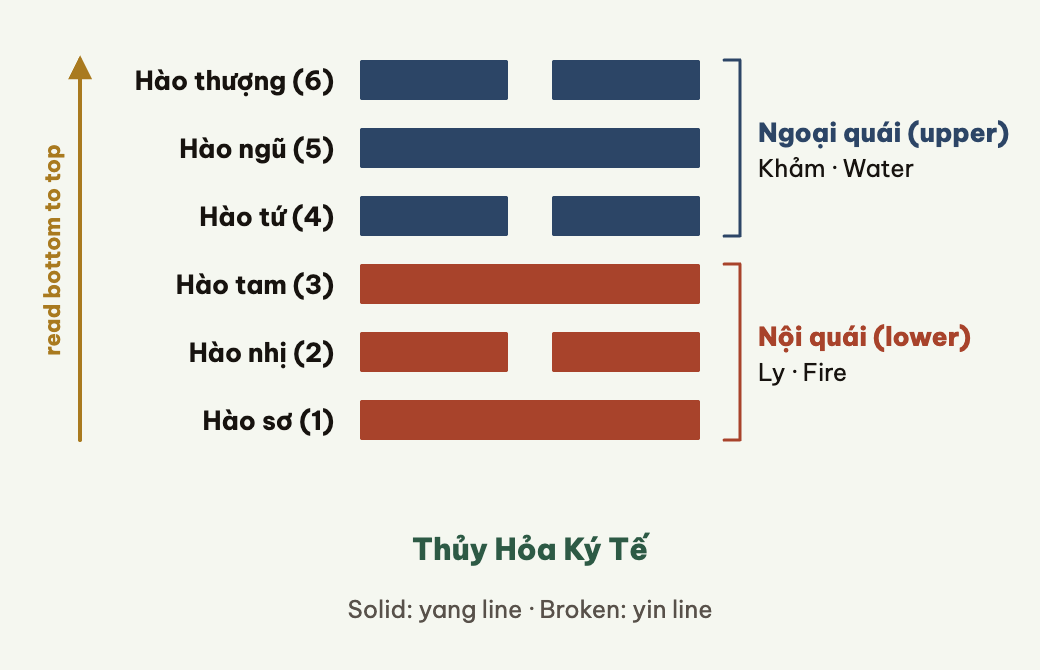
The six lines describe six different situations when meeting obstruction. Read from the bottom up: the first line is the lowest, the top line is the highest.
| Line | Original Chinese | Sino-Vietnamese | Meaning |
|---|---|---|---|
| Sơ lục (line 1) | 往蹇來譽 | Vãng kiển lai dự | Going forward meets difficulty, returning is praised |
| Lục nhị (line 2) | 王臣蹇蹇,匪躬之故 | Vương thần kiển kiển, phỉ cung chi cố | The king's minister meets difficulty upon difficulty, not for his own sake |
| Cửu tam (line 3) | 往蹇來反 | Vãng kiển lai phản | Going forward meets difficulty, returning comes back |
| Lục tứ (line 4) | 往蹇來連 | Vãng kiển lai liên | Going forward meets difficulty, returning meets companions |
| Cửu ngũ (line 5) | 大蹇朋來 | Đại kiển bằng lai | Meeting great difficulty, friends come |
| Thượng lục (line 6) | 往蹇來碩,吉。利見大人 | Vãng kiển lai thạc, cát. Lợi kiến đại nhân | Going forward meets difficulty, returning brings greatness, good. It is favorable to see the great person |
The six lines explained in plain words
Line 1: stopping now is right
Line 1: Going forward meets difficulty, returning is praised. You have just started something and immediately see an obstacle. The first instinct is to force through, but the hexagram says: stopping now is right. Knowing to stop early is not cowardice, it is clarity. Return to prepare more, learn more, then go on later. Rushing when unprepared only adds losses.
Line 2: the difficulty is not your fault
Line 2: Meeting difficulty upon difficulty, not for yourself. This is a situation where you are trying your hardest but the difficulty does not come from your own fault. It may be family circumstances, a relative who needs you, or a responsibility you cannot escape. The line reminds you: doing it for others makes it worthwhile even when hard. Do not give up just because you are tired. Patience here will be recognized.
Line 3: knowing when to choose the time
Line 3: Going forward meets difficulty, returning comes back. The only yang line in the inner trigram. You have strength and will, but the situation does not yet permit advancing. Returning is not failure, it is knowing how to choose the time. The line is very simple: come back, wait, conserve strength. There are periods when the only thing to do is not go.
Line 4: the power of connection
Line 4: Returning meets companions. When you admit you cannot go alone, you begin to find people to go with. This line speaks of the power of connection: call an old friend, ask someone for help, or join a group with the same goal. Going alone is blocked, going with others opens the way.
Line 5: the brightest line of the hexagram
Line 5: Meeting great difficulty, friends come to help. This is the brightest line in the whole hexagram. The difficulty at this stage is great, but you are not alone. Those around you realize you need help and come on their own. This only happens when you have lived decently before and have helped others. Reputation built up beforehand is what takes effect now.
Line 6: returning to something greater
Line 6: Returning brings greatness. The last line carries the most beautiful message of the hexagram. Whoever passes through the Kiển period while keeping their qualities will return with something far greater than at the start. Not greater in money or position, but greater in maturity, in outlook on life, in the ability to bear pressure. The hexagram ends with "lợi kiến đại nhân": seek people with similar experience, they will help you understand more clearly what you have just been through.
Line 2 and the social context of ancient times
The phrase "vương thần kiển kiển, phỉ cung chi cố" is tied to the norms of the feudal era: a minister endures hardship for the king, not for his own private benefit. This is the historical context of a society with clear hierarchy between ruler and subject, not advice for today's reader about absolute loyalty to anyone. The value that can be drawn at a general level is: there are hardships you bear not because you caused them, but because of responsibility toward others. The specific form of that responsibility differs from era to era.
Kiển in the areas of life
Love
Drawing Thủy Sơn Kiển usually signals that a relationship is facing obstacles. It may be distance, family opposition, or two people misunderstanding each other without finding a way to talk. The hexagram does not say "leave," it says "stop, look at yourself first." If the feeling is real, the obstacle will pass. If it is not real, the obstacle is the answer. Anyone wanting to confess or go further should wait, it is not yet the time. Love in the Kiển period needs patience more than haste.
Career
In career, Kiển suggests you are in a period of deadlock. A project does not run, a boss does not listen, colleagues do not cooperate, or simply everything is stagnant. The hexagram advises: do not force it. Instead, turn back to examine yourself. Is there a skill to add? A relationship to mend? A direction you have overlooked? The Kiển period is not for advancing, but for correcting yourself and preparing for when the road opens again.
Wealth
Drawing Kiển for finances usually suggests this is not a time for risk. Large investments, new loans, or business expansion now all carry much risk. Money is in a contracting phase, holding on is already good. The hexagram advises: spend moderately, do not waste, and above all do not pour money into what you do not understand clearly. When Kiển passes, opportunity will come. At that point you need capital, both money and strength, to seize it.
Health
In health, hexagram 39 leans toward caution. The body is in a weak phase or recovering after a long stretch of fatigue. Legs, joints, back, and the circulatory system are areas to watch. The hexagram reminds you this is not a time to push your strength: reduce training intensity, sleep enough, eat nourishing food, and see a doctor if symptoms persist. When the body says "stop," listen. Resting at the right time recovers much faster.
These are reference readings according to tradition, not certain conclusions about anyone's health or finances. Medical and money decisions should be based on real information and professional opinion.
Where schools and books disagree
There are at least three points of difference among traditions of reading Kiển.
- On naming and meaning: the HOROS source uses the name Thủy Sơn Kiển, shortened to Kiển. The list of 64 hexagrams of the I Ching on Wikipedia gives hexagram 39 under a different Sino-Vietnamese reading (Kiển, with the meaning "obstruction, difficulty"), and the English commentary has the translation "Obstruction." Different English translations use words such as "Obstruction," "Hindrance," "Trouble." This is a difference of translation, not of the hexagram.
- On the focus of interpretation: some readings emphasize the Judgment and the Image, treating the whole hexagram as advice on self-cultivation. Other readings, often seen in divination books, go straight into each line and assign a fortune level to each line. These two approaches give different conclusions about how "bad" the hexagram is.
- On the moving line: when casting, the moving line determines which part of the hexagram is read closely. The same Kiển hexagram with different moving lines gives different readings. So Kiển should not be read as a fixed label.
Khổng Minh Thần Toán cards and the Kiển hexagram are two different things
Among the available materials there is the book Khổng Minh Thần Toán, which also has cards bearing the name Thủy Sơn Kiển, for example a card reading "Thủy Sơn Kiển Động Hào Nhất" with outer trigram Khảm, inner trigram Cấn, along with its own card text and commentary by Thông Huyền Đạo Nhân. It should be stated clearly: the card text in Khổng Minh Thần Toán is the text of a separate divination system, not the line texts of the Zhou Yi. The two systems may share hexagram names and trigram images, but the texts and methods of interpretation are entirely different. One should not mix Khổng Minh card text into the Zhou Yi line texts, nor use the Zhou Yi line texts to explain Khổng Minh cards.
The lesson of Thủy Sơn Kiển
Many people remember this hexagram as a "bad" one, but the traditional reading is different. Kiển is not bad, Kiển is true. Everyone's path in life is blocked at some point. This hexagram teaches how to pass through: do not force, do not blame, look at yourself and find companions. Line 5 says "đại kiển bằng lai": meeting great difficulty, friends come. But friends only come to those who have lived decently. You reap what you sow.
The structure of Thủy Sơn Kiển in one table
| Item | Value |
|---|---|
| Order in the Zhou Yi | 39 |
| Chinese character name | 蹇 |
| Upper trigram | Khảm (Water) |
| Lower trigram | Cấn (Mountain) |
| Six lines, from top down | yin, yang, yin, yang, yin, yin |
| Nuclear hexagram | Hỏa Thủy Vị Tế (hexagram 64) |
| Reversed hexagram | Hỏa Trạch Khuê (hexagram 38) |
| Opposite hexagram | Lôi Thủy Giải (hexagram 40) |


