
What is the Shan Ze Sun hexagram among the 64 hexagrams of the I Ching?
Shan Ze Sun (山澤損) is the 41st of the 64 hexagrams of the I Ching, also called Sun (損) for short. The hexagram has two yang lines and four yin lines, with the inner trigram Dui ☱ (lake, marsh) below and the outer trigram Gen ☶ (mountain) above, that is, a mountain above a lake. In the presentation used by HOROS, the hexagram belongs to the Earth element, its time is that of decreasing, restraining, knowing how to yield, and its opposite (the reverse hexagram) is Feng Lei Yi (hexagram 42).
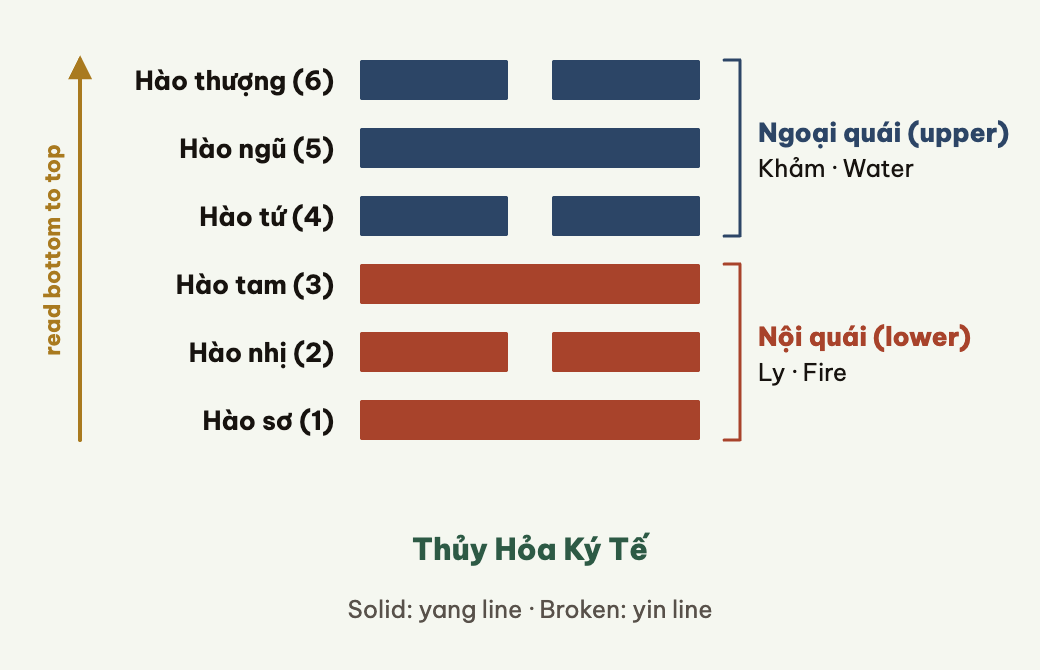
The original image is very concrete: a lake lies at the foot of a mountain, water rises as vapour to feed the plants on the mountain. What is below decreases so that what is above may gain. From that image the I Ching draws a major theme: there are times when one must accept losing a part in order to keep something larger, must yield, must cut back, must actively let go instead of clutching on.
It is important to distinguish clearly between the two words Sun and Yi. Sun is to decrease, Yi is to increase. Among the 64 hexagrams, Sun and Yi form an opposing pair, each is the reverse hexagram of the other, and both stand next to each other in the King Wen sequence. Reading Sun without reading Yi easily misreads Sun as mere loss; in fact Sun is decreasing so that afterwards increase may come in the right place.
The upper trigram, the lower trigram and the names of the six lines
The Shan Ze Sun hexagram has six lines, read from the bottom up:
- Chu Jiu (line 1): yang line, base of the hexagram, written in Chinese characters as 初九
- Liu Er (line 2): yin line
- Liu San (line 3): yin line
- Liu Si (line 4): yin line
- Liu Wu (line 5): yin line, the supreme position in the hexagram
- Shang Jiu (line 6): yang line, top of the hexagram
The two yang lines sit at the two ends (line 1 and line 6), the four yin lines in the middle. This structure is important for understanding why line 1 and line 6 carry the meaning of decreasing for others, while the yin lines in the middle carry the meaning of decreasing oneself or decreasing what one has.
What does the Judgment text of Shan Ze Sun say?
The Judgment text (Tuan text) of the Shan Ze Sun hexagram, according to the original Sino-Vietnamese text recorded at HOROS, is:
損:有孚,元吉,無咎,可貞,利有攸往。曷之用?二簋可用享
Sun: You fu, yuan ji, wu jiu, ke zhen, li you you wang. He zhi yong? Er gui ke yong xiang.
Meaning: Sun is to decrease, to reduce. The Tuan text says that when sincerity is present (you fu), it is greatly auspicious (yuan ji), without fault (wu jiu), able to hold firm (ke zhen), and advancing is also beneficial (li you you wang). By what means? Two simple baskets of offerings suffice for sacrifice (er gui ke yong xiang).
The rhetorical question "He zhi yong?" answering itself with the image of two baskets of offerings is the most notable point of the Judgment text. In ancient ritual, the number of offerings symbolised the degree of solemnity; reducing to two baskets is the bare minimum. The Judgment text affirms that this bare minimum still suffices, provided sincerity remains intact. This is the historical context of the Zhou era, when ritual had begun to swell and the I Ching spoke up to remind that form is not the core.
It must be said clearly: the Judgment text does not promise that decreasing is always good. The condition standing before it is you fu, having sincerity. To decrease while still feeling regret, still calculating, still wanting to hold on does not fall within this statement.
The Image text and the lesson of cheng fen zhi yu
The Image text of the Shan Ze Sun hexagram:
山下有澤,損。君子以懲忿窒欲
Shan xia you ze, Sun. Jun zi yi cheng fen zhi yu.
Meaning: below the mountain there is a lake, that is the image of Sun. The noble person accordingly reduces anger and restrains desire. HOROS remarks that this is one of the most direct statements in the I Ching, and the two things most in need of decrease in a person are anger and greed.
A notable point on the textual level: the Image text does not speak of money or rights, but of two inner states. A high mountain with a lake below, water rising as vapour, is the image of movement from below to above, from low to high, from what one has to what one aspires to. To make that movement possible, one must reduce the part held fast below. Cheng fen and zhi yu are two ways of reducing that held-fast part.
Schools of commentary differ in which aspect they emphasise. One reading leans toward personal cultivation, taking cheng fen zhi yu as a guiding principle of life. Another reading leans toward politics and society, understanding Sun as a policy of reducing the burden on the people. Both readings have a basis in the text, and this article presents both rather than choosing one.
The six line texts of Shan Ze Sun and their explanations
The six line texts below are transcribed from the original Sino-Vietnamese at HOROS. Each line is explained in plain language, with a note on context.
Line Chu Jiu: once your own work is done, go quickly to help
Original text: 已事遄往,無咎,酌損之 (Yi shi chuan wang, wu jiu, zhuo sun zhi).
Meaning: when your own work is done, go quickly to help, no fault, but weigh the measure of decrease. This line speaks to one who is able to help others: complete your own share of the work first, then go and help. The hexagram does not say do not help, it says weigh the measure of decrease. Giving too much while one is not yet steady makes it hard for both sides.
Line Liu Er: hold firm, not decreasing yet still benefiting others
Original text: 利貞,征凶,弗損益之 (Li zhen, zheng xiong, fu sun yi zhi).
Meaning: holding firm is beneficial, advancing to attack is inauspicious, not decreasing yet still benefiting others. This line shows that sometimes the best way to help is to keep one's own position, to do one's own part well. The hexagram warns that if one advances forcefully at this time the result is bad. One's own stability is itself the benefit brought to those around.
Line Liu San: three people walking lose one
Original text: 三人行則損一人,一人行則得其友 (San ren xing ze sun yi ren, yi ren xing ze de qi you).
Meaning: three people walking lose one, one person walking gains a friend. This is the most famous sentence of the Sun hexagram. A group of three is surplus, prone to factions; one person walking alone finds a fitting companion. Applied to life: if a relationship involves three people, three people pooling capital, three people deciding together, one must be reduced. Decrease for compactness, compactness for durability.
Line Liu Si: decrease illness, decrease bad habits
Original text: 損其疾,使遄有喜,無咎 (Sun qi ji, shi chuan you xi, wu jiu).
Meaning: if illness is decreased, joy comes quickly, no fault. What most needs decreasing is not money or time, but bad habits: hot temper, procrastination, greed, envy. Whoever decreases their own bad habits becomes lighter themselves, and those around are glad too. The word "quickly" in the line text shows that the result comes fast when the right thing is decreased.
Line Liu Wu: given a precious turtle that cannot be refused
Original text: 或益之十朋之龜,弗克違,元吉 (Huo yi zhi shi peng zhi gui, fu ke wei, yuan ji).
Meaning: sometimes one is given a precious turtle worth ten peng, cannot refuse it, greatly auspicious. This is the line HOROS judges the finest in the hexagram. When one already knows how to decrease, to yield, to live without greed, blessings come of themselves without being sought. The turtle was a precious object in ancient times, used in divination and ritual; "ten peng" is a unit of currency, meaning great value. "Fu ke wei" means cannot refuse, blessings come because one deserves them.
Line Shang Jiu: not decreasing yet still benefiting others
Original text: 弗損益之,無咎,貞吉,利有攸往,得臣無家 (Fu sun yi zhi, wu jiu, zhen ji, li you you wang, de chen wu jia).
Meaning: not decreasing yet benefiting others, no fault, holding firm is auspicious, advancing is beneficial, gaining helpers without favouritism. The final line shows the highest stage of Sun: one who is already strong enough no longer needs to decrease anything yet still brings benefit to those around, influence radiating naturally. "De chen wu jia" means gaining helpers without favouring anyone, prestige having risen above personal interest.
Why does the Shan Ze Sun hexagram stand after hexagram 40?
In the Sequence narrative, the 64 hexagrams are arranged along a logical thread, not at random. Hexagram 40 is Lei Shui Xie (xie is to untie, to loosen), followed by hexagram 41, Shan Ze Sun. The traditional reasoning: after having untied what was difficult and blocked, one must necessarily decrease the surplus in order to keep the openness just regained.
Hexagram 42 is Feng Lei Yi (yi is to increase), opposing and complementing Sun. Sun then Yi, decrease then increase, that is the rhythm of the Sequence: no period only decreases forever, nor does any period only increase forever. The consequence is that Sun should not be read as a negative pronouncement, but as a stage in a cycle.
Shan Ze Sun in different applied systems
Beyond the I Ching, the name Shan Ze Sun also appears in other applied systems, and students easily confuse them.
| Applied system | How Shan Ze Sun appears | Characteristics |
|---|---|---|
| I Ching (Zhou Yi) | Hexagram 41, with Judgment text, Image text, six line texts | The original text, used for reference and interpretation |
| Ba Zi, Tu Vi | The hexagram name used in tables for reading destiny palaces | No Judgment text or line texts of its own |
| Liu Yao (Na Jia) | A hexagram of the Gen palace, with Earthly Branches and Five Elements assigned to each line | Adds Guan Gui, Qi Cai, Xiong Di, Zi Sun, Fu Mu |
| Khong Minh Than Toan | No separate card for this hexagram | A different verse-card system, not Zhou Yi line texts |
According to the book Khong Minh Than Toan, the Shan Ze Sun hexagram (hexagram 41) lies in the Gen palace, with lines assigned Guan Gui Yin Wood, Qi Cai Zi Water, Xiong Di Xu Earth, Xiong Di Chou Earth, and other lines according to the na jia system. Note: this is an assignment of the Liu Yao system, entirely different from the Judgment text and line texts of Zhou Yi. The verse cards of Khong Minh Than Toan are the verses of another system, not Zhou Yi line texts, so the two systems must not be mixed when interpreting.
According to the book Tuyen Tap Bai Viet Kinh Dich Chon Loc, when interpreting the Shan Ze Sun hexagram with the Liu Yao system for a marriage question, the interpreter needs to look at the empty or solid, moving or still state of the Guan Gui line, not merely its presence. An empty Guan Gui line or one broken by the month has a different meaning from a prosperous Guan Gui line. This is an interpretive technique of the Liu Yao system, not part of the original Zhou Yi content.
Points on which schools disagree about Shan Ze Sun
There are at least three points that need stating clearly because books and schools present them differently.
First, how to understand the word "Sun" in the hexagram name. One reading understands Sun as loss, disadvantage. Another understands Sun as actively reducing, restraining. HOROS leans toward the second reading, and this article follows the second reading, but notes that the first reading still exists in some documents.
Second, the focus of the hexagram. One school emphasises the aspect of self-cultivation (cheng fen zhi yu). Another emphasises the political and social aspect (reducing the burden on the people, reducing taxes, reducing punishments). Both have a basis in the Image text and the line texts.
Third, how to apply the line texts to modern life. The line texts of Zhou Yi arose in the feudal social context of the Zhou era, with norms about hierarchy and the roles of those above and below. Line Liu San with its sentence "three people walking lose one" reflects the ancient social notion of groups and factions. Presenting the line texts is presenting historical context, not offering advice to be applied verbatim to modern society.
What should one avoid when reading Shan Ze Sun?
The first thing to avoid is turning Sun into advice of resignation. The hexagram does not say to accept loss, it says to actively choose what to decrease. The difference between being deprived and actively decreasing is the difference between passivity and initiative.
The second thing to avoid is asserting absolute fortune or misfortune. The Judgment text says greatly auspicious, without fault, but the condition is you fu. Without sincerity that sentence does not apply. The line texts are the same, each line has its own condition.
The third thing to avoid is mixing systems. Shan Ze Sun in Zhou Yi, in Liu Yao, in Ba Zi are three different systems. Each has its own way of interpretation, and the conclusions of one system should not be applied to another.
Applying the spirit of Shan Ze Sun to life
The general spirit of the Shan Ze Sun hexagram lies in the two words cheng fen zhi yu that the Image text mentions: reduce anger, restrain greed. It sounds simple, but these are the two hardest things to decrease in a person. The hexagram does not speak of loss, it speaks of actively putting down what is heavy in order to walk more lightly. There are periods that need increase, periods that need decrease; knowing when to decrease is a form of wisdom.
In love, the Sun hexagram suggests a relationship currently in need of yielding or of accepting the loss of a part. It may be yielding an opinion, reducing the ego, or accepting that the other is not perfect. The hexagram does not say to break up, it says that if one wants to keep it, one must know how to decrease.
In career, the hexagram suggests streamlining: fewer unimportant tasks, fewer ineffective work relationships, fewer projects run in parallel with none finished. Line Liu San states it plainly: three people walking lose one; compactness advances, clutter stalls.
In wealth, the hexagram suggests that in this period money will decrease, but decreasing in the right place is no problem. Spending on health, education, family is a valuable decrease; spending on face, on momentary desire is a wasteful decrease. The Judgment text recalls two simple baskets of offerings suffice: not much is needed, only the right thing.
In health, hexagram 41 reminds that the body currently needs decrease: less overeating, less staying up late, less alcohol, less stress. Line Liu Si says sun qi ji, shi chuan you xi: if bad habits are decreased, joy comes quickly. There is no need to change one's whole lifestyle at once, only to decrease one thing one clearly knows is not good.
The structure of Shan Ze Sun in one table
| Item | Value |
|---|---|
| Position in Zhou Yi | 41 |
| Chinese character name | 損 |
| Upper trigram | Gen (Mountain) |
| Lower trigram | Dui (Marsh) |
| Six lines, from top down | yang, yin, yin, yin, yang, yang |
| Nuclear hexagram | Di Lei Fu (hexagram 24) |
| Reversed hexagram | Ze Shan Han (hexagram 31) |
| Opposite hexagram | Feng Lei Yi (hexagram 42) |


