


TL;DR: The Đế Vượng star is the fifth stage of the Trường Sinh cycle, the highest peak of prosperity, located right after Lâm Quan and right before Suy, so it goes together with the law that extreme prosperity must decline. Along with Trường Sinh, Mộ and Tuyệt, it is one of the four milestone points of the cycle. When encountering Đế Vượng in important cung, fortune and adversity are usually smooth, but one must also guard against the extreme prosperity that must decline.
The Đế Vượng star in the Trường Sinh cycle: the meaning of each stage on the chart
What does the Đế Vượng star in the Trường Sinh cycle mean?
What is the Trường Sinh cycle and where does Đế Vượng sit?
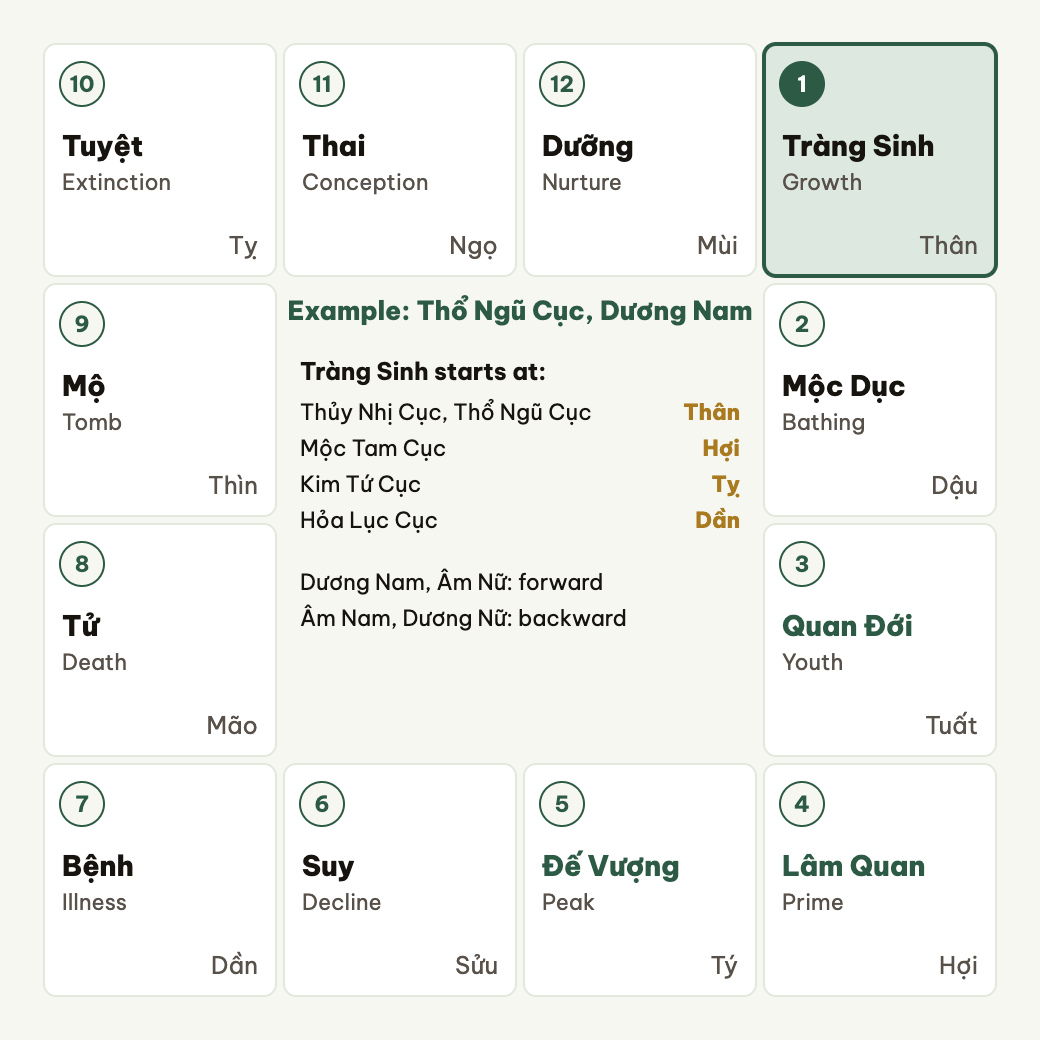
In the treasury of Tử Vi Đẩu Số (Vietnamese astrology), the Trường Sinh cycle is an important system of 12 stars that simulates the life cycle of birth, aging, sickness and death of all things, from their origin to their end. This cycle of stars includes: Trường Sinh, Mộc Dục, Quan Đới, Lâm Quan, Đế Vượng, Suy, Bệnh, Tử, Mộ, Tuyệt, Thai, Dưỡng. Each star carries its own meaning, reflecting a specific stage of development. Among them, Đế Vượng is regarded as the highest peak, the golden age, when power and vitality reach their utmost. Đế Vượng stands right after Lâm Quan and before Suy, marking the moment when everything is ripe, firm and widely influential.
Unlike the main stars (such as Tử Vi, Thiên Phủ) or the auxiliary stars (such as Hóa Lộc, Hóa Quyền), Đế Vượng is not a star with a strong independent character. Its strength lies in its ability to support and amplify the meaning of other stars in the same position. It is like a catalyst, pushing the energy of a palace to its climax, creating fullness, satisfaction and brilliant success.
The origin and philosophy of Đế Vượng
The term "Đế Vượng" can be understood on two levels:
- Đế (帝): Carries the meaning of king, the supreme being, the head, holding ultimate power.
- Vượng (旺): Means prosperity, flourishing, abundant energy, being at the peak period.
Putting the two words together, Đế Vượng symbolizes the image of a king at the most flourishing period of his reign, with power at its absolute. In the philosophy of Âm Dương Ngũ Hành (Yin Yang and the Five Elements), Đế Vượng corresponds to the Hỏa (Fire) element, representing blazing, upright and radiant energy and spreading heat. This is the stage when the elemental energy of a thing reaches its extreme, before the process of decline begins.
In the Trường Sinh cycle, if Trường Sinh is the beginning, the first sprouting, then Đế Vượng is the stage of the ripe sweet fruit, when a person attains the highest level of position, reputation and career. This is when the efforts and struggles of earlier stages (from Quan Đới, Lâm Quan) are duly rewarded.
Which stage of the Trường Sinh cycle is Đế Vượng?
Đế Vượng is the fifth stage of the 12-stage cycle, right after Lâm Quan and right before Suy. This is the highest peak of the whole cycle, and the fact that it sits immediately before Suy is precisely where the law of extreme prosperity inevitably leading to decline is most clearly expressed: once you have reached the top, the next step must be downward.
Đế Vượng stands at the 11th position in the star-counting method of Tử Vi Đẩu Số, but when considered according to the sequence of the 12 stages of the Trường Sinh cycle, it is the fifth stage, after Trường Sinh, Mộc Dục, Quan Đới, Lâm Quan. Different counting methods between systems are normal, while the position of Đế Vượng in the cycle remains consistent: it is the point of ripeness, right before moving into Suy.
When discussing the cycle of the Heavenly Stems through the 12 Earthly Branches, Lâm Quan and Đế Vượng are the two peak stages of strength, but by the natural law that "things at their extreme must reverse", reaching the peak inevitably turns into decline, so the positions Suy, Bệnh, Tử, Tuyệt, Mộ all indicate a decrease in energy or the end of a cycle.
The four landmarks of the Trường Sinh cycle: Trường Sinh, Đế Vượng, Mộ, Tuyệt
Students are usually taught to grasp the four landmarks first, because these are the four most memorable legs of the whole cycle: Trường Sinh is the moment of birth, Đế Vượng is the moment of greatest prosperity, Mộ is the moment of storage, and Tuyệt is the moment when the energy has completely ended.
The tam hợp cục (three-combination frame) in the earthly branches is formed by three branches sitting at the three positions Trường Sinh, Đế Vượng and Mộ in the Trường Sinh cycle. The example the book gives is the tam hợp Hợi, Mão, Mùi forming the Mộc (Wood) frame, with Hợi holding the role of Trường Sinh of Wood, Mão being Đế Vượng, and Mùi being Mộ. That is the convergence of the full energy of an element from its birth, through its peak, until its end, which is why the energy of a tam hợp cục is very strong.
As for Tuyệt, it is the leg where the energy has been cut off, usually regarded as the endpoint of the cycle. When interpreting, one must place a position into the correct Trường Sinh, Mộ, Tuyệt cycle of that element in order to understand its meaning correctly. For the Wood element, the book cites: Hợi is Trường Sinh, Mão is Đế Vượng, Mùi is Mộ, Thân is Tuyệt. When Wood Mộ appears, that is a sign that a stage of the Wood cycle has ended, but an ending does not mean total destruction, because Mộ is where energy is stored to move into a new cycle.
The author stresses that one should not look at a single position in isolation. The same line, if it meets dead energy or is heavily overcome, means the matter will be hard to get through, but if it meets Trường Sinh or Đế Vượng, then however heavy it is, there is still a way to be saved. This is how the four landmarks are used in practice: see which leg of the cycle it is in to estimate the degree.
One point should be made clear where the books are not entirely consistent. The Trường Sinh cycle of Yang Stems runs in one direction and Yin Stems run in the opposite direction, according to the theory of "Yang dies, Yin is born". When discussing Bát Đại Hoàng Tuyền, the Trường Sinh cycle is described starting clockwise from Hợi for Giáp sơn (Wood), then deducing Mộ at Mùi and Tuyệt at Khôn. These are two different ways of framing the issue depending on the school and the application, and readers should be aware of this so as not to confuse them when consulting references.
What does the Đế Vượng star on the chart mean?
When the Đế Vượng star sits in a certain palace on the chart, it brings the following notable characteristics:
- Presence and self-confidence: People with Đế Vượng in the Mệnh palace or shining on the Mệnh often carry the aura of a born leader. They are confident, decisive, far-sighted and never accept mediocrity. They always long to rise to leading positions and to create great influence over those around them.
- Prosperity in both material and spiritual terms: Đế Vượng often brings abundance and sufficiency. Such a person has the ability to create wealth and to enjoy life in a fulfilled way. They have good aesthetic taste and know how to enjoy the fine values of life.
- A high competitive spirit: They dislike weakness, and always want to assert themselves and prove their ability. This can make them rigid, hard to take advice from others, sometimes conservative and authoritarian.
- Clearly rising and falling fortunes: Because it is the peak, Đế Vượng also implicitly signals that extreme prosperity must decline. Their most beautiful period of fortune is often very brilliant, but afterwards there can be setbacks if they do not know how to stay humble and maintain stability.
There is a downside worth noting: if Đế Vượng stands alone without good stars to support it, it easily turns into arrogance and authoritarianism. The book recounts the case of a person with Đế Vượng in the Mệnh palace plus Hỏa Tinh and Linh Tinh, hot-tempered, wanting to dominate others in everything, and when meeting the Sát Phá Tham period, their career rose fast and collapsed just as fast. The advice in the book is that when seeing Đế Vượng in a chart, one should remind that person to keep to the middle way, not to be overly ambitious.
What does Đế Vượng mean in different palaces?
The position where Đế Vượng sits plays a key role in detailed interpretation. Below is an analysis of the meaning when Đế Vượng sits in important palaces:
Đế Vượng in the Mệnh palace
This is the case where Đế Vượng brings its strength to the fullest. A person with Đế Vượng ruling the Mệnh is usually someone with a strong personality, outstanding talent and steadfast will. They are born carrying the qualities of a leader. Their career is usually very successful, attaining a certain reputation and power in society. However, they also easily become arrogant, self-satisfied, and find it hard to accept failure. If the chart also has good stars such as Tử Vi, Thiên Tướng, Hóa Quyền or Hóa Lộc converging, they can become talented leaders with great influence.
Đế Vượng in the Quan Lộc palace
When Đế Vượng rules the Quan Lộc palace, this person's career will take remarkable steps forward, especially in the middle period of life (around the ages of 40 to 50). They are capable and effective at work, trusted by superiors and admired by colleagues. Fame and office are illustrious, and their career flows smoothly. Key positions in state agencies or large-scale enterprises may be held by them. The presence of Đế Vượng shows a solid career with real power, not empty fame.
Đế Vượng in the Tài Bạch palace
Đế Vượng in the Tài Bạch palace is a very good sign for financial capacity. Such a person has an abundant ability to earn money, money comes plentifully and they usually have something put aside. They are not only rich in material terms but also have a sharp business mind. Their golden period of wealth is usually long and stable. However, it should be noted that excessive abundance sometimes makes them spend wastefully and not save. If accompanied by inauspicious stars, wealth can come quickly but also leave quickly.
Đế Vượng in the Phu Thê palace
In marriage, Đế Vượng brings a partner with status, talent and a strong personality. This partner may be the main pillar of the family, with a solid career. However, because both have strong personalities, married life may see conflicts and arguments over power and roles within the family. Harmony is achieved when both know how to respect and yield to each other. If Đế Vượng meets stars such as Thiên Khôi and Thiên Việt, the partner may be someone highly educated and prestigious.
Đế Vượng in the Điền Trạch palace
Đế Vượng in Điền Trạch shows that this person has good fortune regarding houses and land. They may own valuable real estate, spacious and dignified homes. Their family usually has good order and tradition. Such a person may also inherit assets from family or parents. This sufficiency in a place to settle gives them a solid rear base to develop their career.
How does Đế Vượng combine with other stars?
The strength of Đế Vượng is also determined by the stars that accompany it. These combinations create different shades of meaning:
- Đế Vượng meeting good stars (Tử Vi, Thiên Phủ, Hóa Lộc, Hóa Quyền, Thiên Mã): Creates an extremely fulfilled life, with fame, wealth and status all reaching their peak. Such a person can become a figure of great influence in society, with flourishing business and abundant money.
- Đế Vượng meeting Vũ Sát stars (Vũ Khúc, Thất Sát, Phá Quân): Creates a person with an iron will, daring to think and dare to act, ready to face challenges. Their career is often tied to particular fields such as the military, police, surgery or mechanics. They can achieve great success, but the path is not smooth and holds many storms.
- Đế Vượng meeting Văn Tinh stars (Xương, Khúc, Khoa, Giáp): Brings a person with literary talent, deep learning and fame. They succeed in fields such as education, research, journalism and culture and the arts. Their reputation is built on a foundation of knowledge and creativity.
- Đế Vượng meeting Sát Tinh stars (Hỏa Tinh, Linh Tinh, Địa Kiếp, Địa Không): Creates a person with very great ambition, bold, even reckless. They may achieve success quickly but also easily meet sudden failures and heavy losses. Great caution is needed in important decisions.
How does Đế Vượng affect cycles of fortune?
In major and minor fortune periods, when meeting the Đế Vượng star, people usually go through an extremely favourable and successful stage. This is the time when every intention and plan is easily carried out, work advances and wealth is abundant.
- A major fortune period meeting Đế Vượng: This is the most golden stage of life, usually lasting about 10 years. A person in this major fortune period has a great opportunity to change social status and reap many great achievements. This is the right time to carry out large projects, make risky investments or seize important opportunities for advancement.
- A minor fortune period meeting Đế Vượng: In a year meeting Đế Vượng, everything flows smoothly and easily. Study and examinations easily lead to success, business prospers, and health is abundant. This is a wonderful year to pursue personal goals.
However, it should be remembered that Đế Vượng is the peak. After reaching the peak, fortune will enter the Suy stage. Therefore, the ancients advised that when meeting a Đế Vượng fortune, one should take full advantage of the opportunity to build a solid foundation for the future, while keeping oneself humble and avoiding arrogance and self-satisfaction, so as to maintain the results for the long term.
There is also a suggestion to read the four states as a linked chain rather than in isolation. For example, the book gives: when a person has Mộc Dục in the Mệnh, Quan Đới in Quan Lộc, Lâm Quan in Phu Thê and Đế Vượng in Tài Bạch, usually in youth this person is romantic and popular, and only in middle age do they attain great achievements in both career and money. Conversely, if the Mệnh has Đế Vượng while the Phu Thê has Mộc Dục, that person may succeed early but their love life is full of ups and downs. This is a reference way of applying the method, and should not be taken as a certain statement for a specific chart.
Conclusion
The Đế Vượng star in the Trường Sinh cycle is one of the strongest auspicious stars, symbolizing prosperity, power and success at the maximum level. Its presence on a chart shows a life with many opportunities to reach the peak of reputation. However, its meaning is not entirely absolute but depends greatly on the palace position, the accompanying stars and each person's way of behaving. A person with Đế Vượng needs to know how to bring out their confidence and leadership talent, while always maintaining a humble attitude and a willingness to listen, in order to avoid falling into the whirlpool of arrogance and conservatism. Understanding clearly the meaning of Đế Vượng helps each person gain a deeper view of their own potential, and from there devise strategies for developing their career and life in the smartest and most effective way.
Overview article on the topic: What Is Vietnamese Astrology? An Overview of Reading Methods and Foundational Concepts
Summary table of the meaning of the Đế Vượng star when ruling important palaces on the chart.
| Palace | Main meaning | Notable characteristics |
|---|---|---|
| Mệnh | Strong personality, outstanding talent, steadfast will | Prone to arrogance, self-satisfaction, hard to accept failure |
| Quan Lộc | Career advances remarkably, especially in the middle period of life | Trusted by superiors, admired by colleagues |
| Tài Bạch | Abundant ability to earn money, has something put aside | May spend wastefully, does not save |
| Phu Thê | Partner has status, talent and a strong personality | Prone to conflict over power and roles in the family |
| Điền Trạch | Good fortune regarding houses and land | May inherit assets from family or parents |


