
How are Tam Hoi cuc and Tam Hop cuc defined?
Tam Hoi cuc is a group of three Earthly Branches sitting next to each other on the twelve branch cycle, belonging to the same season and the same direction: Dan Mao Thin meeting as Wood cuc in the East, Ty Ngo Mui as Fire cuc in the South, Than Dau Tuat as Metal cuc in the West, Hoi Ty Suu as Water cuc in the North. Tam Hop cuc also has three branches, but one step apart: Than Ty Thin combining as Water, Dan Ngo Tuat as Fire, Hoi Mao Mui as Wood, Ty Dau Suu as Metal.
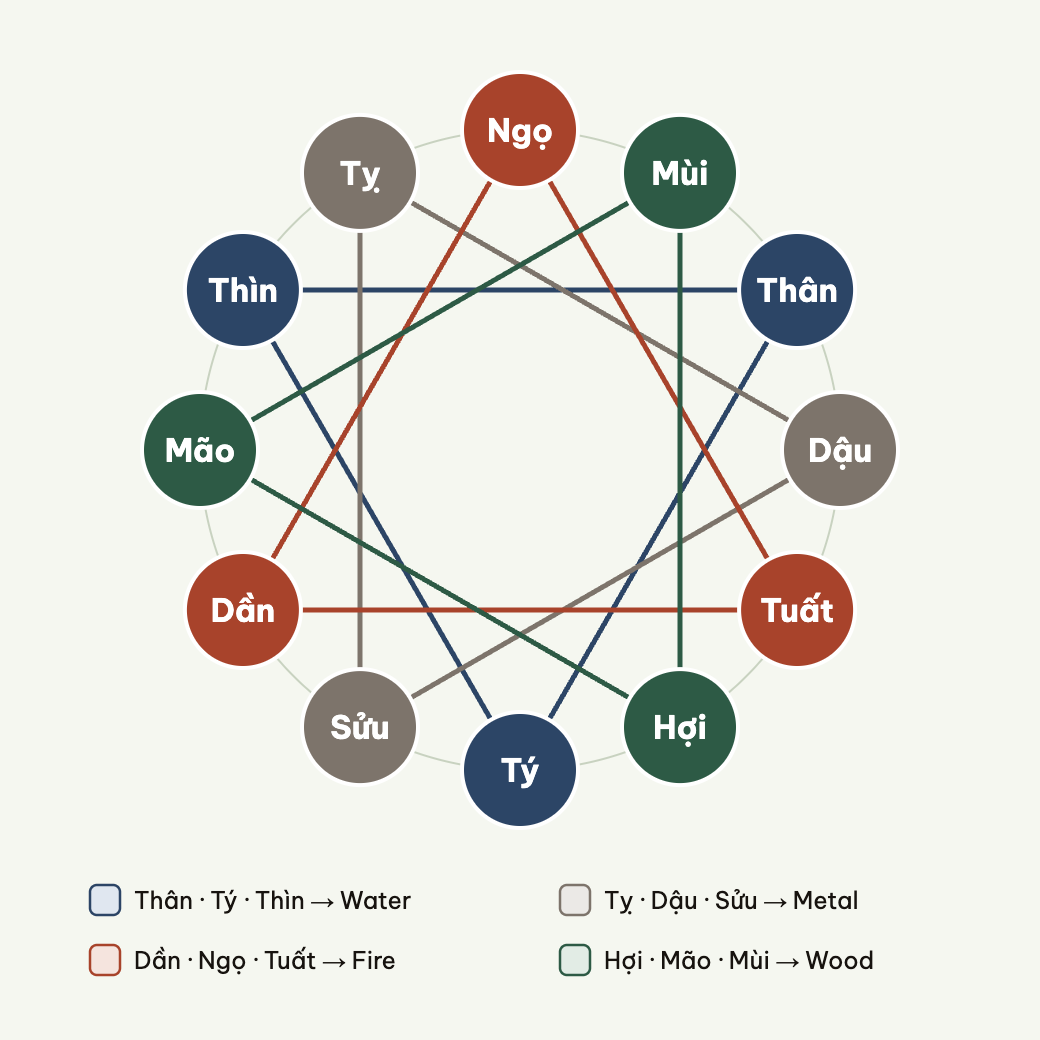
The core difference is that Tam Hoi takes the season as its base, while Tam Hop takes the Truong Sinh (Growth) cycle of one element as its base. This distinction is stated clearly in discussions on the Ly So Vietnam forum and in Bat Tu articles circulating in Vietnam.
Why is Tam Hoi considered the qi of an entire direction?
The three branches in one Tam Hoi are exactly the three months of one season in the Can Chi calendar. Dan, Mao and Thin are the first, middle and last months of spring, so when these three branches appear together, Wood qi is no longer a single branch but the whole of spring gathered. This explanation is recorded in current Bat Tu materials and matches how the question was framed on the Ly So forum: hoi means meeting by direction, gathering qi along an orientation.
Why is Tam Hop tied to Truong Sinh, De Vuong and Mo?
Tam Hop takes the three operating states of one element as its axis. For Water, Truong Sinh is at Than, De Vuong at Ty, Mo at Thin, so Than Ty Thin combines as Water cuc. This reasoning is also presented in discussions on Ly So Vietnam and in Bat Tu articles circulating in Vietnam. In other words, Tam Hop describes an element going from arising, through its peak, to storage; Tam Hoi describes an element ruling an entire season.
Table placing Tam Hoi beside Tam Hop for the same element
| Element | Tam Hoi cuc (three months of one season) | Tam Hop cuc (Truong Sinh, De Vuong, Mo) |
|---|---|---|
| Wood | Dan Mao Thin, East | Hoi Mao Mui |
| Fire | Ty Ngo Mui, South | Dan Ngo Tuat |
| Metal | Than Dau Tuat, West | Ty Dau Suu |
| Water | Hoi Ty Suu, North | Than Ty Thin |
This table shows something easily overlooked: the Tam Hoi of one element may contain a branch that is the Mo storage of another element. For instance Hoi Ty Suu meets as Water, but Suu is the Mo storage of Metal; Than Dau Tuat meets as Metal, but Tuat is the Mo storage of Fire and is also Earth. So when interpreting, one should not look only at the cuc element and ignore the original qi of each branch.
Does Tam Hoi need all three characters?
Yes. Tam Hoi only forms a cuc when all three branches are present. If one branch is missing it is no longer Tam Hoi but shifts to the ban hoi form. This point is stated clearly in discussions on the Ly So Vietnam forum and in Bat Tu articles circulating in Vietnam.
What is ban hoi and which pairs count?
Ban hoi is the case where only two of the three branches of a Tam Hoi appear together. For the Eastern Wood direction, ban hoi includes Dan Mao and Mao Thin; for the Southern Fire direction, Ty Ngo and Ngo Mui; and similarly for the other directions. Notably, Dan Thin is not counted as ban hoi, because these two branches are not adjacent within the Tam Hoi. This rule is given in discussions on the Ly So Vietnam forum.
When does ban hoi take effect?
According to Bat Tu articles circulating in Vietnam, ban hoi only takes effect when the missing branch appears in the Da Van or Luu Nien, at which point ban hoi becomes a full Tam Hoi. When the four pillars simultaneously contain clashing force, ban hoi cannot fully control the clash, unless the element of the combination transformation is strong enough in qi to block the clash.
Do they need to be adjacent?
For ban hoi, yes. Two branches must stand next to each other on the twelve branch cycle to be called ban hoi; two branches one step apart do not count. For a full Tam Hoi the three branches are adjacent by definition, so the question of adjacency only arises in the ban hoi form.
When Tam Hoi, Tam Hop and Luc Hop appear together, which is heavier?
Most documents rank strength from strongest to weakest as Tam Hoi, Tam Hop, half Tam Hop, then Luc Hop. This order is given in Bat Tu articles circulating in Vietnam and in discussions of Can Chi compatibility on Ly So Vietnam. The consequence is that when a chart has both Tam Hoi and Luc Hop on the same group of branches, the main interpretation should follow Tam Hoi, while Luc Hop is overshadowed or reduced in effect.
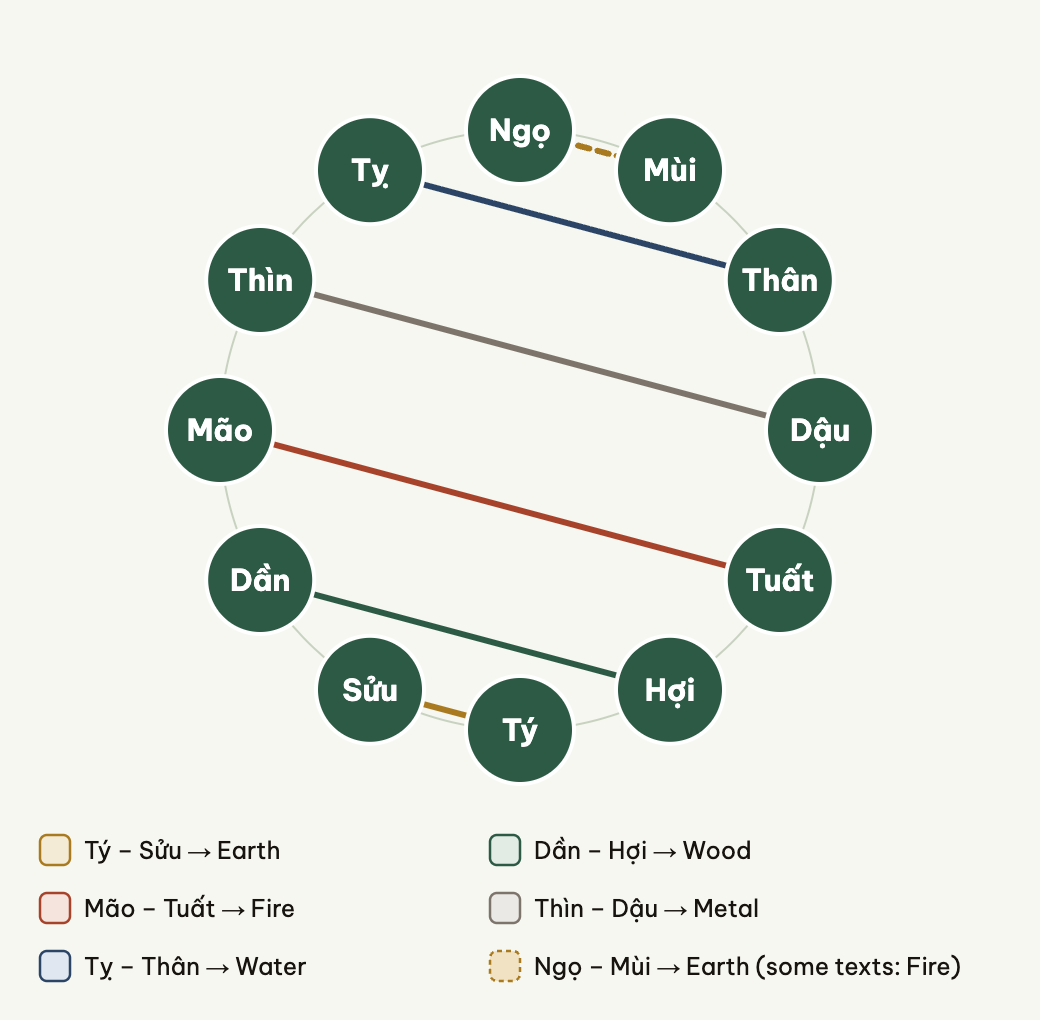
For example Hoi Ty Suu already forms a Water Tam Hoi, in which Ty and Suu are also a Luc Hop pair. Because Tam Hoi is stronger, the main direction of interpretation is the Water cuc, while the Ty Suu Luc Hop only plays a secondary role.
Where the schools disagree
Not every book places Tam Hoi above Tam Hop. Some sources rank the two as equal, treating both as strong combinations and weighing them by birth season, leading stem transformation and root qi. Naming also diverges: in Tu Binh Chan Thuyen, the word hoi is used for Tam Hop, with the familiar phrasing tam hoi such as Than Ty Thin. Meanwhile Uyen Hai Tu Binh has no separate Tam Hoi section, and adds Thin Tuat Suu Mui earth cuc to the Tam Hop group.
How should the Thin Tuat Suu Mui earth cuc be understood?
This point needs to be stated clearly because it is easily confused. Thin Tuat Suu Mui are the four Mo storages of the four elements, not a Tam Hoi in the sense of three months of one season. Grouping three of these four branches into an earth cuc is a phrasing found in some documents, but it is not mentioned by orthodox books. In discussions on the Ly So Vietnam forum, the view put forward is that this phrasing does not belong to the orthodox system. So when Thin Tuat Suu Mui appears in a chart, one should interpret by the original qi of each branch and by Mo storage, and should not assume it is a Tam Hoi of Earth.
Does Tam Hoi change the fortune of a chart?
Tam Hoi and Tam Hop can change the outlook of a chart, but they should not be viewed as a fixed auspicious or inauspicious sign. When an element is successfully transformed by Tam Hoi, that element becomes very strong and can dominate the situation. If the chart is already strong in that element, Tam Hoi can push it into imbalance; if the chart is lacking, Tam Hoi can partly compensate. Bat Tu articles circulating in Vietnam also stress that combination transformation is not always good: if the Day Master cannot turn the strength of the combination into something usable, or if the transformed element runs against the Useful God, the result can be unfavorable.
What role does leading transformation play?
According to Bat Tu articles circulating in Vietnam, Tam Hoi needs a Heavenly Stem of the same element to lead the transformation if it is to transform strongly. Dan Mao Thin needs Giap or At for Wood qi to be firm; Ty Ngo Mui needs Dinh for Fire to flourish; Than Dau Tuat needs Canh or Tan; Hoi Ty Suu needs Nham or Quy. Without a leading transformation stem, the branches still link but do not fully transform, and each branch will reveal its own qi.
Should one convert this into a strength number?
Some current documents assign Tam Hoi a strength of about 72 degrees and Tam Hop about 60 degrees. This conversion is not common in classical books, and it is itself inconsistent across modern documents, so it should only be treated as a relative quantification. What is more reliable is the principle: Tam Hoi gathers the qi of an entire season and is therefore usually judged stronger than Tam Hop, but the exact gap depends on each school's understanding.
Key points to remember when interpreting
Tam Hoi and Tam Hop differ in their construction axis: one is three months of one season, the other is the three states Truong Sinh, De Vuong and Mo of one element. Tam Hoi needs all three branches to form a cuc; missing one branch turns it into ban hoi, and ban hoi has only two adjacent pairs, with Dan Thin excluded. When several combinations appear together, most documents prioritize Tam Hoi, then Tam Hop, then Luc Hop, but some sources rank Tam Hoi and Tam Hop as equal. Naming also differs between Tu Binh Chan Thuyen and Uyen Hai Tu Binh, and the Thin Tuat Suu Mui earth cuc is a phrasing outside the orthodox system. Tam Hoi or Tam Hop should not be read as a fixed auspicious or inauspicious sign, but placed beside birth season, leading transformation stem, root qi and the Useful God of the whole chart.


