
What is a great limit in Tu Vi?
A great limit is one of the two main layers of fortune in a Tu Vi chart, alongside the minor limit. If the natal chart, also called the fixed chart, describes the whole person, family, career, wealth, and health of the native throughout life, then the great limit divides that life into ten-year stages. Each stage anchors to one of the twelve palaces, and that palace temporarily plays the role of the Menh palace for the whole decade.
The site tracuutuvi.com describes fortune as changes in luck, misfortune, or ups and downs within a certain period, and divides fortune into two types: dai van and tieu van. In Vietnamese Tu Vi, "dai van" and "dai han" are often used interchangeably, both meaning the ten-year stage. To judge a specific year, one must add the minor limit layer; to judge a month, one adds the monthly limit layer. The smaller the time unit, the more factors must be weighed and the easier it is to err.
Which palace does a great limit start from, and which direction does it move?
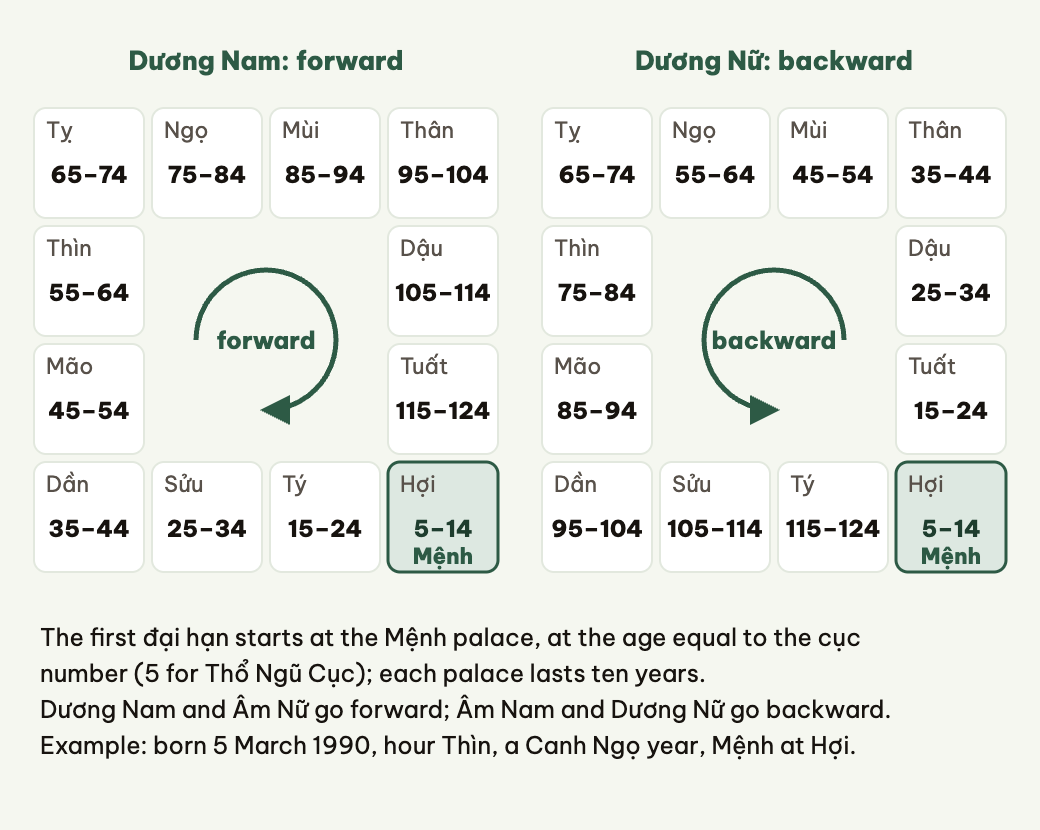
The first great limit always starts from the Menh palace of the natal chart. From there, each subsequent great limit shifts to an adjacent palace, in a direction depending on gender and the yin or yang of the birth year. The book Dau So Tinh Thanh, volume 1, part 1, states the rule clearly: Duong Nam and Am Nu go clockwise, Am Nam and Duong Nu go counterclockwise, each palace ruling ten years.
In other words, there are four groups of natives:
- Duong Nam, a male born in a yang lunar year: goes clockwise, from Menh to Phu Mau, Phuc Duc, Dien Trach, and onward.
- Am Nu, a female born in a yin lunar year: also goes clockwise like Duong Nam.
- Am Nam, a male born in a yin lunar year: goes counterclockwise, from Menh to Huynh De, Phu The, Tu Tuc, and onward.
- Duong Nu, a female born in a yang lunar year: also goes counterclockwise like Am Nam.
In Tu Vi dau so Menh van phan tich, Tu Tang Sinh cites the case of a young lady born in the year Giap Thin; because she is Duong Nu, her great limit direction is counterclockwise. Her first great limit falls around ages 5 to 14; after age 14, the great limit palace moves to the Huynh De palace, ruling the ten years from 15 to 24. The same sequence continues for the remaining eleven palaces.
At what age does a great limit begin?
The starting age of the first great limit is not always one, but equals the Cuc number of the Menh palace, counted in mu tuoi. The book Dau So Tinh Thanh gives the example of Thuy nhi cuc, where the first great limit is at the Menh palace, from 2 to 11; the second great limit from 12 to 21; later limits extend by the same principle. From that starting number, each stage adds ten years.
| Cuc of the Menh palace | Starting age of first great limit (mu tuoi) | First great limit | Second great limit |
|---|---|---|---|
| Thuy nhi cuc | 2 | 2 to 11 | 12 to 21 |
| Moc tam cuc | 3 | 3 to 12 | 13 to 22 |
| Kim tu cuc | 4 | 4 to 13 | 14 to 23 |
| Tho ngu cuc | 5 | 5 to 14 | 15 to 24 |
| Hoa luc cuc | 6 | 6 to 15 | 16 to 25 |
The table above is only the standard frame for the first and second great limits; from the third onward, simply add ten years to the previous mark. Note that most Vietnamese documents count by mu tuoi, the lunar age, which is one more than the solar age. This is one of the points where schools do not fully agree, discussed below.
How to read a specific great limit
When a great limit enters a palace, that palace is treated as the Menh palace of those ten years. To judge, we do two things in parallel: examine the tam phuong tu chinh of the great limit palace, and examine the can of the great limit palace.
Regarding tam phuong tu chinh, the great limit palace plays the main role, while the three trine palaces and the opposite palace play supporting roles. Stars sitting in the great limit palace, stars shining in from the trine and opposite palaces, and stars flanking the palace are all weighed. The book Tu Vi kinh nghiem, lower volume, has a verse saying that if the tam phuong is full of malefic stars but meets Triet, it can still be saved, while if all four directions are beautiful but meet Tuan, the beauty is lost. This means Triet and Tuan can reverse the situation of a great limit, in one direction or the other.
Regarding the can of the great limit palace, this is often overlooked. The can of the great limit palace differs from the birth-year can, so it produces its own set of Tu Hoa for those ten years. Tu Tang Sinh cites a chart in his book where the great limit enters the Ty palace, around ages 33 to 42. Here, the Tai Bach palace of the great limit is at Canh Than, causing Thien Dong Hoa Ky to fall into the Menh palace of the great limit; at the same time, the Quan Loc palace of the great limit is at Binh Thin, causing Thien Dong Hoa Loc to also fall into the Menh palace of the great limit. A single star Thien Dong carries both Hoa Loc and Hoa Ky, creating a mixed situation within those very ten years. This is why one cannot simply read the stars present in the natal chart and conclude for the whole decade.
Why does the same great limit palace give different results?
The great limit palace itself does not say good or bad. The book Tu Vi dau so Menh van phan tich emphasizes that the four chart layers, Ban Menh, Dai Han, Luu Nien, and Luu Nguyet, link together in a layered control; if one link breaks, the final result cannot form. The same great limit palace, placed in two different natal charts, gives two different stories.
An example recorded in Vietnamese Tu Vi documents: someone met a great limit considered very bad, with fallen main stars clashing with the Menh, yet built success from nothing. According to the explanation given, that great limit palace may lie within the age trine, or the Menh may have Tuan or Triet removing the deadlock. This shows one should not apply a rigid formula to every chart.
The book Tu Vi kinh nghiem, lower volume, also has notable pairings between great limit and minor limit: a bad ten years meeting a good year is only average; a good ten years meeting a bad year is less bad; a good ten years meeting a good year prospers; a bad ten years meeting a bad year is very hard. This is a proportional reading, not adding and subtracting good and bad stars.
A fictional example chart
To picture how it moves, let us build a hypothetical chart: a male born in a yang lunar year, so Duong Nam, with the Menh palace at Dan, and the Cuc being Tho ngu cuc.
Because he is Duong Nam, the great limit goes clockwise. Because it is Tho ngu cuc, the starting age is 5.
| Great limit | Palace | Age range (mu tuoi) |
|---|---|---|
| First | Menh at Dan | 5 to 14 |
| Second | Phu Mau at Mao | 15 to 24 |
| Third | Phuc Duc at Thin | 25 to 34 |
| Fourth | Dien Trach at Ty | 35 to 44 |
| Fifth | Quan Loc at Ngo | 45 to 54 |
Suppose the Quan Loc palace at Ngo has the can Binh. When the fifth great limit enters this palace, we use the can Binh to fly the transformations, then see which palaces of the natal chart those transformations fall into, and also examine the tam phuong tu chinh of the Ngo palace. If the Ngo palace has fallen main stars but the trine and opposite palaces bring many auspicious stars, the great limit can still be usable. Conversely, if the main stars are strong but all four sides are malefic stars, the beauty is broken.
This example only illustrates how it moves and how to read it. No real chart is built here, and no conclusion is drawn about any specific person.
Where schools disagree
There are at least three notable differences among schools and books.
First is the change point of the great limit. Most Vietnamese documents count by mu tuoi, the lunar age plus one. But some judge by the actual birthday, holding that the great limit changes on the exact birth date rather than at the start of the lunar year. The book Dau So Tinh Thanh states clearly it is mu tuoi, and most Vietnamese Tu Vi documents follow this. The two approaches differ by a few months to a year at each mark, enough to change the conclusion of an event falling exactly at the junction.
Second is the "luu dai han" method of counting each year within the great limit, common in Vietnamese books. Instead of only considering the whole ten-year block, one also counts each year within it to know which year is the focus. The book Tu Vi kinh nghiem, lower volume, has a section comparing great limit and minor limit in this way. The specific counting differs among books, and not every book records it the same.
Third is the method of the Tu Hoa school. This school does not only read the stars present in the great limit palace, but rearranges the twelve great limit palaces into a new chart, then uses the can of each palace in that new chart to fly transformations. In Kham Thien Tu Hoa, collection no. 1, there is a passage discussing that when the great limit overlaps with the position of Hoa Ky tied to an object, such as real estate, then those ten years will see events related to real estate. This reading requires building a separate great limit board, not just looking at the sitting stars.
It should also be noted that the very way of starting the great limit has been questioned. Some documents record that when checking many charts with unusual events, people found that applying a different starting method gave more matching results; but others hold that one cannot hastily reject the common starting method, and must observe further on many charts with clear events. This is an open issue, with no common conclusion.
A great limit is only a frame, not a verdict
The most important thing when reading a great limit is to remember it is a time frame for comparison, not a sentence for ten years. The same great limit palace, placed beside a strong natal chart, tells a very different story from beside a weak one. The same set of stars, meeting Tuan or Triet, changes direction. The same main star, depending on the palace can, transforms into Loc or Ky. And the same great limit, placed in a sequence of adjacent great limits, takes on different meaning, because the previous and next great limits can dissolve or worsen each other.
So when seeing a great limit with many auspicious stars, one should not immediately conclude those ten years are certainly good. When seeing a great limit with many malefic stars, one should not immediately conclude those ten years are certainly bad. A responsible reading states clearly the great limit palace, the shining stars, the palace can, and the related fortune layers, then lets the reader compare with their own real circumstances.


