
What is Tang Can (Hidden Stems)?
Tang Can (also called Ren Yuan, or the hidden heavenly stems of the earthly branches) are the heavenly stems concealed inside each earthly branch. An earthly branch is not a single pure element but a combination of qi, in which one element dominates and is called main qi (Ban Khi), while one or two secondary elements are called middle qi (Trung Khi) and residual qi (Du Khi). When reading BaZi, a student cannot look only at the four stem characters on the heavenly stems; each earthly branch must be opened up to see what lies inside, because most of an element's real strength sits in this hidden layer.
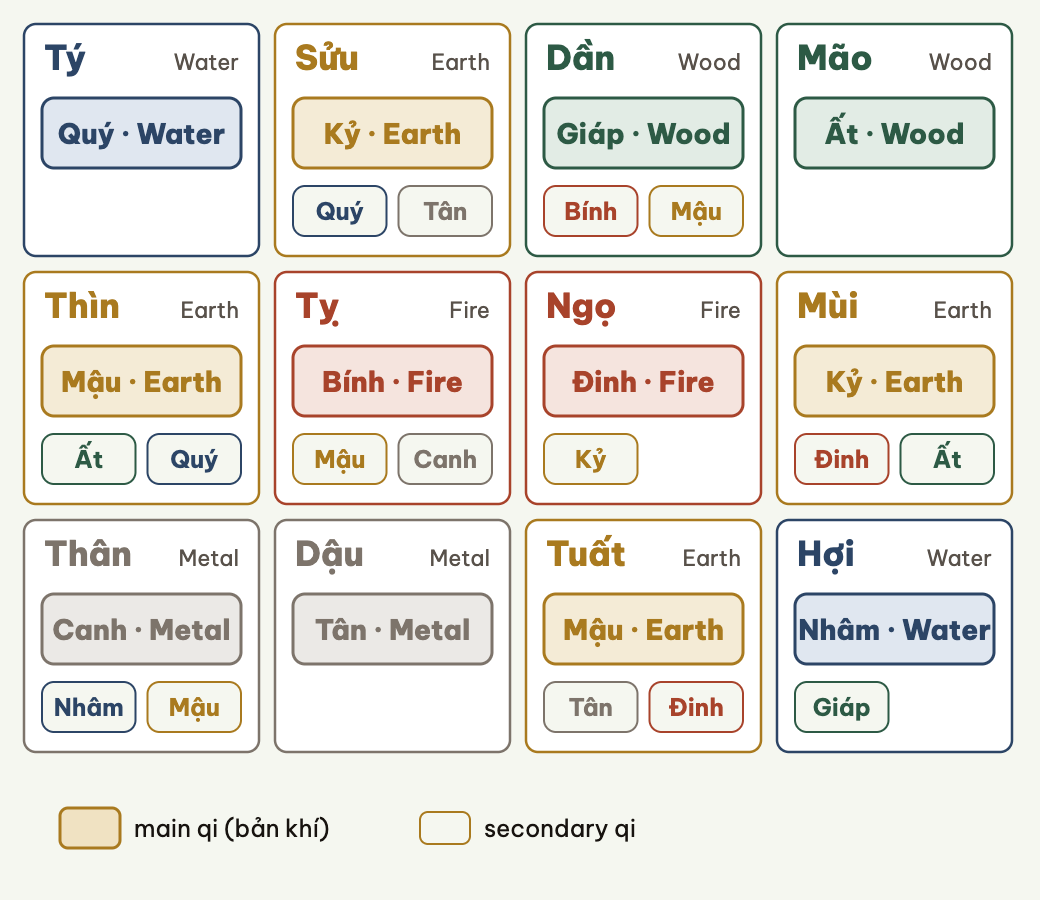
The common understanding in Tu Binh texts is that each earthly branch is like a storehouse, and the heavenly stem showing on top is only the part laid out. If a stem is exposed but no branch supports it, it can still be considered hollow (hu phu), meaning present without roots. Conversely, a stem that is not exposed but sits inside a branch can still act when a Da Yun or Liu Nian activates exactly that character.
Why are they called main qi, middle qi and residual qi?
These three layers reflect how strong each stem is inside the branch. Main qi is the dominant element, holding most of the qi power. Middle qi is the secondary element, usually coming from the next stage in that element's Truong Sinh (Long Life) cycle. Residual qi is what remains of the previous element, or the qi settled in a tomb storehouse (mu kho). In practice, the order of priority when judging a structure (cach cuc) is usually: main qi exposed first, then middle qi, then residual qi, and only then the element currently dominant in the chart.
Table of hidden stems for the 12 earthly branches
The table below follows the most common convention in Vietnamese and Chinese Tu Binh texts. The polarity column follows the stem itself; for example, Giap is yang wood and At is yin wood.
| Earthly branch | Main qi | Middle qi | Residual qi |
|---|---|---|---|
| Ty | Quy (yin water) | none | none |
| Suu | Ky (yin earth) | Quy (yin water) | Tan (yin metal) |
| Dan | Giap (yang wood) | Binh (yang fire) | Mau (yang earth) |
| Mao | At (yin wood) | none | none |
| Thin | Mau (yang earth) | At (yin wood) | Quy (yin water) |
| Ty (Snake) | Binh (yang fire) | Canh (yang metal) | Mau (yang earth) |
| Ngo | Dinh (yin fire) | Ky (yin earth) | none |
| Mui | Ky (yin earth) | Dinh (yin fire) | At (yin wood) |
| Than | Canh (yang metal) | Nham (yang water) | Mau (yang earth) |
| Dau | Tan (yin metal) | none | none |
| Tuat | Mau (yang earth) | Tan (yin metal) | Dinh (yin fire) |
| Hoi | Nham (yang water) | Giap (yang wood) | none |
The four branches Ty (Rat), Mao, Dau and Hoi usually hold only one hidden stem, so they are called the four branches of pure qi (chuyen khi). The other eight are mixed qi, among which Thin, Tuat, Suu and Mui are the four tomb storehouses (tu mo kho), and their hidden stems are usually considered the most complex.
Why is a branch character usually heavier than a stem character?
In Tu Binh, the earthly branch is regarded as the root and the heavenly stem as the tip. Classical texts stress that no matter how many heavenly stems are exposed, without an earthly branch as their base their force cannot be strong. The line "nhat cac trung du khi thong can, kha de nhat cac thau can chi Ti Kiep" in the BaZi collection volume 5 means: even a little residual qi in an earthly branch giving the heavenly stem a root is enough for that stem to counterbalance a Ti Kiep exposed on the heavenly stems.
Three reasons make a branch usually heavier than a stem:
- The earthly branch is tied to season and solar terms. One branch character carries the qi of a whole month, while a heavenly stem is just a single character.
- The earthly branch holds multiple layers of qi. A branch like Dan can hold three elements at once, wood, fire and earth, while a stem represents only one element.
- The earthly branch decides thong can (rooting). Without a branch as root, a heavenly stem is considered hollow (hu phu), and even when exposed it struggles to act.
This does not mean the heavenly stem is useless. The heavenly stem decides the exposed, easily seen part, and is where a structure (cach cuc) clearly takes shape. But reading only the heavenly stems while ignoring the earthly branches easily leads to errors about the strength of each element.
Thau Can and Thong Can: the two strength measures right after the month command
Once the month command (nguyet lenh) is determined, the next two measures usually used are Thau Can and Thong Can. These are two different concepts that are often confused.
Thau Can (also called xuyen thau, exposed stem) is when a stem hidden in an earthly branch reappears on the heavenly stem of one of the four pillars. For example, if the month branch is Dan, which hides Giap, and the heavenly stems contain the character Giap, this is called Giap thau can from Dan. Only when a hidden stem is exposed on the heavenly stems does it have a chance to act clearly. If the hidden stem is not exposed, according to the BaZi collection volume 9 it is considered to have no chance to act yet and must wait for a Da Yun or Liu Nian to activate it.
Thong Can is when a heavenly stem has roots in an earthly branch. A stem is called thong can when the earthly branch of its own pillar, or of another pillar, hides a stem of the same element. For example, for a Day Master Giap wood, if the four pillars contain the branch Dan or Mao, then Giap is considered thong can. If Giap stands alone with no wood branch supporting it, it is considered hollow (hu phu). According to the BaZi collection volume 6, thong can is one of the key concepts beside the month command for judging the strength of the Day Master.
The difference can be summed up as follows: thau can is about a hidden stem going up to the heavenly stems, while thong can is about a heavenly stem finding roots in the earthly branches. These two measures complement each other, and both stand after the month command in the order of evaluation.
Where schools disagree on hidden stems
The table above is the common convention, but not every text records it the same way. Four differences commonly appear.
Does Dan hide Mau or not?
Some texts record Dan as hiding only Giap and Binh, leaving out Mau. The reason is that wood controls earth, and Dan is the month of flourishing wood, so earth struggles to stand firm in Dan. Others still record Dan as hiding Mau, arguing that Dan is the Truong Sinh stage of Binh fire, and fire generates earth, so Mau has support. This difference directly affects the thong can assessment for a Day Master of Mau earth or Ky earth when Dan is present in the chart.
Does Ty (Snake) hide Canh, or Canh and Mau?
Some texts record Ty (Snake) as hiding Binh, Canh and Mau. Others record only Binh and Canh, dropping Mau. The reason for dropping Mau is that fire is dominant in Ty (Snake) and earth is scorched, so it struggles to exist. The reason for keeping Mau is that Ty (Snake) is the Lam Quan stage of Mau earth in the Truong Sinh cycle, so earth is still present. This point affects the reading of wealth star (tai tinh) for a water Day Master, or resource star (an tinh) for a metal Day Master.
Does Ngo hide Ky or not?
Many texts record Ngo as hiding Dinh and Ky. Others record only Dinh, leaving out Ky. The reason for dropping Ky is similar to the Ty (Snake) case: fire in Ngo is at De Vuong, and earth is burned. The reason for keeping Ky is that Ngo is the De Vuong stage of Ky earth according to some Truong Sinh tables. This difference affects the reading of the Eating God (thuc than) or Hurting Officer (thuong quan) for a fire Day Master.
The Ren Yuan Tu Lenh tables differ between texts
Ren Yuan Tu Lenh is the table dividing the days of a month among the hidden stems, that is, which stem holds command for how many days. This table is not consistent across texts. Some divide the month of Dan into Giap holding 7 days, Binh 7 days and Mau 16 days. Others divide Giap 7 days, Binh 7 days and Mau 16 days but reverse the order. Some drop Mau entirely and divide only Giap and Binh. This difference makes the determination of which stem truly holds command on the birth day depend on the text the reader follows. In practice, many choose their own school's table as the standard and state clearly which convention they follow, rather than mixing several tables.
Hidden stems in practice: timing and activation
According to the BaZi collection volume 5, when a Da Yun or Liu Nian brings a heavenly stem that duplicates or combines with a hidden stem in the earthly branch of the natal chart, events related to that hidden stem may occur. The effect of the Da Yun or Liu Nian at that time is equivalent to the effect of that hidden stem itself. If the hidden stem is a favorable element (hy dung), it is a good sign; if it is an unfavorable element (ky than), it may be a difficult period.
For example, if the chart has the branch Tuat, whose hidden stems are Mau, Tan and Dinh, then entering a Da Yun or meeting a Liu Nian containing the character Dinh can activate matters related to Dinh, such as fire-related work, writing, or romance. This approach explains why some charts show no wealth star on the surface, yet when a Da Yun stirs the right hidden wealth character, wealth qi suddenly appears.
Points to note when using the hidden stems table
The hidden stems table is a tool, not an absolute truth. Three things are worth remembering.
- The table shows possibility, not outcome. A hidden stem present in a branch does not mean it always acts. It needs to be exposed (thau can), or activated by a Da Yun or Liu Nian.
- Order of priority matters more than quantity. Main qi is always considered first, even if middle qi or residual qi is more exposed.
- Points where texts differ should be stated clearly. A student should choose one table as the standard and stay consistent throughout the reading, rather than switching tables case by case for convenience.
Tang Can, Thau Can and Thong Can are three foundational concepts linking the exposed and hidden parts of a chart. Understanding these three correctly makes BaZi reading less dependent on intuition and less likely to miss elements lying quietly inside the branches.


