



TL;DR: Thiên Khốc and Thiên Hư both start from the Ngọ palace corresponding to a Tý year, but Thiên Khốc is counted backward while Thiên Hư is counted forward, so the two stars are always symmetrical across the Tý-Ngọ axis. Thiên Hư is always in the same palace as Tuế Phá of the Thái Tuế cycle, according to the table at the end of the article. They signify sorrow and loss, rarely determine good or bad fortune on their own, and are considered well placed only when accompanying conditions are fully met, not simply because they occupy Tý or Ngọ.
What Are Thiên Khốc and Thiên Hư in Tử Vi Đẩu Số?
Thiên Khốc and Thiên Hư both belong to the group of Bại Tinh (Destructive Stars), with the Water element, and are part of the Lục Bại set comprising Đại Hao, Tiểu Hao, Thiên Khốc, Thiên Hư, Tang Môn and Bạch Hổ. According to the common presentation on reference pages, Thiên Khốc carries the image of a teardrop, governing sorrow, loneliness, melancholy and difficulties in expressing emotions; Thiên Hư governs depletion, loss, a sense of emptiness and disappointment. When they travel together, this pair is described as the weeping of heaven, implying a person who often laments their lot and whose mind is never at peace.
It must be said straight away that these are two minor auxiliary stars. They are not principal stars, they do not determine the fortune or misfortune of a palace, and they should not be read as a prophecy of grief for the native.
How Are Thiên Khốc and Thiên Hư Placed by Birth Year Branch?
The method for placing these two stars is recorded in the book Đẩu số tinh thành (Thiên Hỏa Đồng Nhân): Đại Hao starts from the Ngọ palace corresponding to the Tý year and is counted backwards to the birth year branch; Thiên Hư starts from the Ngọ palace corresponding to the Tý year and is counted forwards to the birth year branch. According to the understanding common among Tử Vi (Vietnamese astrology) researchers, the method for placing Thiên Khốc is recorded as follows: take the Ngọ palace as the position of the Tý year, then run counter-clockwise to the earthly branch of the birth year and stop, that is the palace of Thiên Khốc.
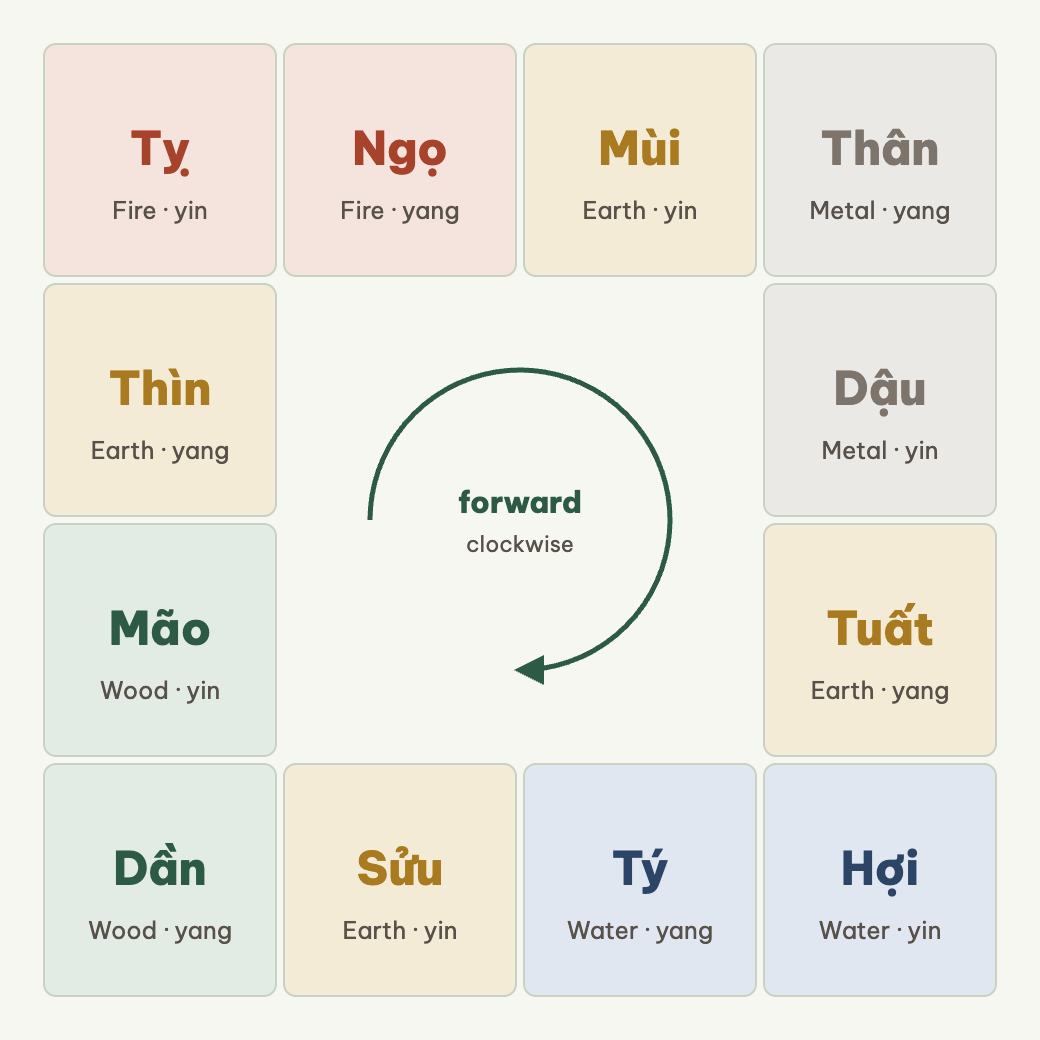
Thus Thiên Khốc and Thiên Hư both start from a single point (the Ngọ palace corresponding to the Tý year) but travel in two opposite directions. The result is that for every birth year branch, the two stars are always symmetrical to each other across the Tý-Ngọ axis. To look up each branch, see the table at the end of the article.
Why Is Thiên Hư Always in the Same Palace as Tuế Phá?
According to common belief, Thiên Hư is always in the same palace as Tuế Phá. The Thái Tuế cycle consists of twelve stars: Thái Tuế, Thiếu Dương, Tang Môn, Thiếu Âm, Quan Phù, Tử Phù, Tuế Phá, Long Đức, Bạch Hổ, Phúc Đức, Điếu Khách, Trực Phù. The method of determination: place Thái Tuế at the palace corresponding to the birth year, treat that as the first palace, count forwards to the seventh palace to obtain the position of Tuế Phá, which is also the position of Thiên Hư.
The reason Thiên Hư is always in the same palace as Tuế Phá is that Tuế Phá also starts from the Ngọ palace corresponding to the Tý year and is counted forwards, exactly matching the rule for placing Thiên Hư. This is a very convenient point for learners: one need only remember where Tuế Phá is to know where Thiên Hư is. The table at the end of the article places the Tuế Phá column next to the Thiên Hư column for easy comparison.
Where Are Thiên Khốc and Thiên Hư in Their Favorable Positions?
This is where the sources are not entirely consistent, and it needs to be stated clearly.
According to common belief, Thiên Khốc is in a favorable position in seven palaces: Tý, Sửu, Mão, Ngọ, Mùi, Dậu, and in a weakened position in six palaces: Dần, Thìn, Tỵ, Thân, Tuất, Hợi. This page also records that Thiên Hư is in a favorable position at Tý and Ngọ, and that unless it sits at Tý or Ngọ, in every other palace it carries a bad meaning.
Meanwhile, in a discussion on the Lý số Việt Nam forum, someone put forward the view that Khốc Hư is in a favorable position at both Mão and Dậu, meaning the favorable zone is Tý Ngọ Mão Dậu rather than only Tý Ngọ. Also in that discussion thread, one member argued that Khốc Hư forms a favorable configuration only at Tý Ngọ, because there they share a palace and, meeting many auspicious stars, produce a person of great intellect, powerful speech and rhetorical talent; if Sát Phá in a favorable position shares the palace, then renown is resounding and authority and rank are high. Another member recounted a case of Khốc Hư residing at Mão Dậu in a favorable position, not sharing a palace but opposing Mệnh and Thân, and remarked that they themselves were gentle-natured, seldom melancholy, and spoke softly and cautiously.
So there are at least two views: one that the favorable zone is only Tý Ngọ, and another that extends it to Tý Ngọ Mão Dậu. This article does not choose either as the standard, because both are circulating among researchers.
The Meaning of Thiên Khốc and Thiên Hư When They Occupy the Palaces
Because they are Bại Tinh, wherever these two stars sit, they usually make that palace more sluggish and heavy. Below are some typical palaces according to traditional belief.
At the Mệnh Palace
A person with Thiên Khốc at Mệnh is described as having a face suffused with sadness, a taciturn and withdrawn nature, an inner life full of melancholy, given to overthinking, prone to pessimism, with a poor memory and a distracted mind. As for career, the path of office and fame is full of obstacles in the early days, and one easily gets entangled in gossip, but with perseverance success may come later. As for marriage, the path of love is not smooth, and husband and wife easily fall into discord. As for wealth, youth is spent toiling and rushing about.
A person with Thiên Hư at Mệnh is described similarly: pale skin, dark circles around the eyes, a dull complexion, a weak and sorrowful nature, full of sentiment and melancholy. However, there is one notable exception: when Thiên Hư sits at Tý or Ngọ, this page records that the person has determination, high willpower, and talent for literature and persuasive speech. This is precisely the basis for the saying that Khốc Hư is in a favorable position at Tý Ngọ.
At Other Palaces
When Thiên Khốc sits at the Phụ Mẫu palace, parents toil and are pessimistic; but if it meets Thiên Hư at Tý Ngọ, then the parents toil in youth yet succeed in old age, with food and wealth in store. When it joins Thiên Mã and Điếu Khách at Dần or Thân, the parents are talented and meet good opportunities.
At the Phúc Đức palace, Thiên Khốc causes loss of blessings and longevity, and the clan has many who toil; but if in a favorable position, the ancestral graves are peaceful and the family enjoys blessings and fortune. At the Điền Trạch palace, it governs toil and loss of money when building a house; particularly when sitting at Dần or Thân, one has a affinity for real estate business. At the Quan Lộc palace, career is difficult in the early days but later brings office and fame. At the Nô Bộc palace, one has few close friends, and colleagues do not stay attached for long.
With Thiên Hư, when it sits at Phụ Mẫu, the parents build their lives from empty hands, inherit no ancestral property, but are always a support for their children. At Phúc Đức, there are few blessings and fortunes, life is not smooth, and one easily becomes discouraged; if in a weakened position, it governs loss of longevity and a tendency to be entangled with spiritual attachments. At Điền Trạch, one has one's own house but encounters difficulties, and money dwindles; if it meets Hồng Loan and Thiên Hỷ, household members easily fall ill or meet sudden misfortune.
When Do Texts Consider Khốc Hư Auspicious?
This is the most interesting part of the topic, because a set of stars carrying the meaning of grief nonetheless has combinations that are evaluated as favorable configurations.
Khốc Hư Sharing a Palace at Tý Ngọ
When the two stars share a palace at Tý or Ngọ, it is held that they no longer exert a purely negative influence but transform into rhetorical talent, great intellect and powerful speech. The discussion on Lý số Việt Nam also mentions the case of additionally meeting Sát Phá in a favorable position sharing the palace, which brings resounding renown and high authority and rank.
However, also on that forum, one member raised a very noteworthy counterargument: Khốc Hư at Tý Ngọ is only a necessary condition, not a sufficient one, and it cannot be that any chart with Khốc Hư sitting at Tý Ngọ will have a famous later life. This view is reasonable because any configuration requires the convergence of many factors, not just one set of stars.
Khốc Hư Meeting Thiên Mã and the Khốc Khách Mã Set
When Thiên Khốc joins Thiên Mã and Điếu Khách at Dần or Thân, it governs talented parents who meet good opportunities. This is a variant of the Khốc Khách Mã set, that is, Thiên Khốc, Điếu Khách and Thiên Mã converging.
In the discussion thread about the Khốc Hư Tý Ngọ configuration on Lý số Việt Nam, someone analysed the case of a person born in the Tý year with Khốc Hư at Ngọ, sharing a palace with Tuế Phá, in a triple harmony with Thiên Mã in a favorable position at Dần, in a combination that also included Cô Thần at Dần, Quả Tú at Tuất, Phượng Các at Tuất, and with no Đào Hoa, Hồng Loan or Thiên Hỷ. The interpretation offered was: effort (Thiên Mã) changes (Tuế Phá) one's fate, and the fruit of success (Phượng Các) is the reward for days of silent, arduous, lonely striving (Cô Quả).
The book Tử Vi Đẩu Số phú giải by Thái Vân Trình has the line Châu Mãi Thần tiền bần hậu phú, do hữu Khốc Hư chính hướng, and this book explains it as: the Châu Mãi Thần Mệnh palace placed at Ngọ with Khốc Hư occupying it means poverty in youth and wealth and honour later. This is an example showing that with the same set of stars, the reading can shift from sorrow to effort and then reward, depending on the accompanying combination.
Khốc Hư Meeting Thiên Hình
When Thiên Hình travels with Thiên Khốc and Thiên Hư at Mệnh or Thân, it is hard to escape illness in the body, and one easily contracts chronic disease. This is a combination considered unfavorable, quite different from the favorable configurations mentioned above.
Application in Decade and Yearly Period Analysis
The book Tử Vi kinh nghiệm, volume two, contains a passage analysing a chart of a Mậu Thìn year, Dương Nam, reaching the Mậu Tý period. In this period, according to the book, the native meets two Kình Dương, two Khốc, two Hư, two Hao, together with Thái Tuế, Tang Môn and Điếu Khách. The book calls this situation the Mã đới kiếm trùng phùng period and judges it frightening, likening the native to a dim lamp before the wind. What is noteworthy is that the book emphasises the element of trùng phùng, that is, the stars being doubled because they appear both in the original chart and in the yearly chart, rather than Khốc Hư itself being frightening.
This is an important note when analysing periods: yearly Khốc Hư needs to be placed beside the other yearly stars and compared with the original chart, and should not be isolated to draw a conclusion.
How Should One Read Thiên Khốc and Thiên Hư Correctly?
Bringing together the sources above, a few practical points can be drawn.
First, these are minor auxiliary stars, belonging to the Bại Tinh group, governing sorrow and depletion, and usually affecting the spirit and emotions more than great events. They should not be read as a prophecy of grief for the native.
Second, the position of the two stars is entirely determined by the birth year branch, and does not depend on the birth hour or birth day. People born in the Tý and Ngọ years have Khốc Hư sharing a palace at Ngọ and Tý, people born in the Mão and Dậu years have Khốc Hư sitting at Mão and Dậu themselves, and for the remaining years the two stars separate. To look up each branch, see the table at the end of the article.
Third, Thiên Hư is always in the same palace as Tuế Phá, so when interpreting Thiên Hư one must interpret it together with Tuế Phá. Thiên Hư carries the meaning of illusion, of insubstantiality, which may be excessive worry or an unrealistic plan; standing beside Tuế Phá, it produces a person with strong critical thinking but who sometimes doubts themselves, sees flaws in everything and wants to tear down and rebuild from the start.
Fourth, the places where the sources are inconsistent need to be stated clearly. As for the favorable zone, some sources mention only Tý Ngọ, while others extend it to Tý Ngọ Mão Dậu. As for the conditions for forming a configuration, some hold that Khốc Hư at Tý Ngọ is only a necessary condition, not enough to conclude a famous later life. Readers should regard these as views currently in circulation, not as the single truth.
Fifth, the interpretation of Khốc Hư's fortune or misfortune depends greatly on the accompanying star combination. With the same Khốc Hư set, meeting Thiên Mã, Điếu Khách, Phượng Các and Cô Quả it is read as effort followed by reward; meeting Thiên Hình it is read as chronic disease; meeting Sát Phá in a favorable position it is read as renown. The two stars themselves decide nothing on their own.
Which Palace Are Thiên Khốc and Thiên Hư In According to the Birth Year Branch?
The table is calculated using exactly the placement method of the Tử Vi charting tool. The Tuế Phá column is taken from the Thái Tuế cycle of the same chart, so as to show that Thiên Hư is always in the same palace as Tuế Phá.
| Star | Chinese character | Placement method |
|---|---|---|
| Thiên Khốc | 天哭 | In the Tý year at the Ngọ palace, counted backwards to the birth year branch. |
| Thiên Hư | 天虚 | In the Tý year at the Ngọ palace, counted forwards to the birth year branch; always in the same palace as Tuế Phá. |
| Birth year branch | Thiên Khốc | Thiên Hư | Tuế Phá |
|---|---|---|---|
| Tý | Ngọ | Ngọ | Ngọ |
| Sửu | Tỵ | Mùi | Mùi |
| Dần | Thìn | Thân | Thân |
| Mão | Mão | Dậu | Dậu |
| Thìn | Dần | Tuất | Tuất |
| Tỵ | Sửu | Hợi | Hợi |
| Ngọ | Tý | Tý | Tý |
| Mùi | Hợi | Sửu | Sửu |
| Thân | Tuất | Dần | Dần |
| Dậu | Dậu | Mão | Mão |
| Tuất | Thân | Thìn | Thìn |
| Hợi | Mùi | Tỵ | Tỵ |


