What does a sustainable business model for a spirituality app need?
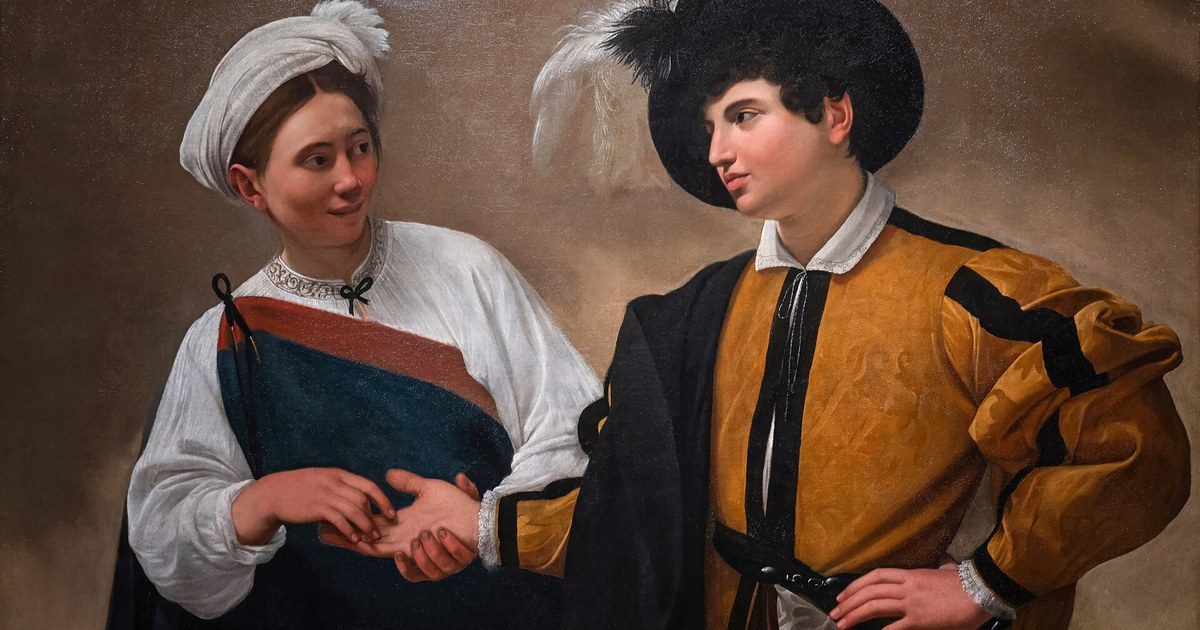
Image: Caravaggio (khoảng 1595), Bảo tàng Capitolini, Roma (CC0, public domain), source
In Caravaggio's "The Fortune Teller", painted around 1595, a young woman holds a young man's hand to read his palm, looking him straight in the eye. Look closely and you see her finger quietly slipping the ring off his hand. Four hundred years later the same business is still around: tell people what they fear, then take their money while they are afraid.
This post asks the opposite question: how can a spirituality product earn money in a way that makes it more trusted the longer it runs?
How do the shortcut and the loop differ?
The shortcut runs one way; the loop comes back around. The shortcut says this year is unlucky, then sells rituals, amulets and objects to fix it. It sells for a while, but every buyer who figures it out is a buyer who never returns, and who tells others.
The loop works the other way: sourced knowledge builds trust, trust makes people willing to try, people who find it useful invite their family, a family using it has reasons to come back, and the money goes back into the knowledge.
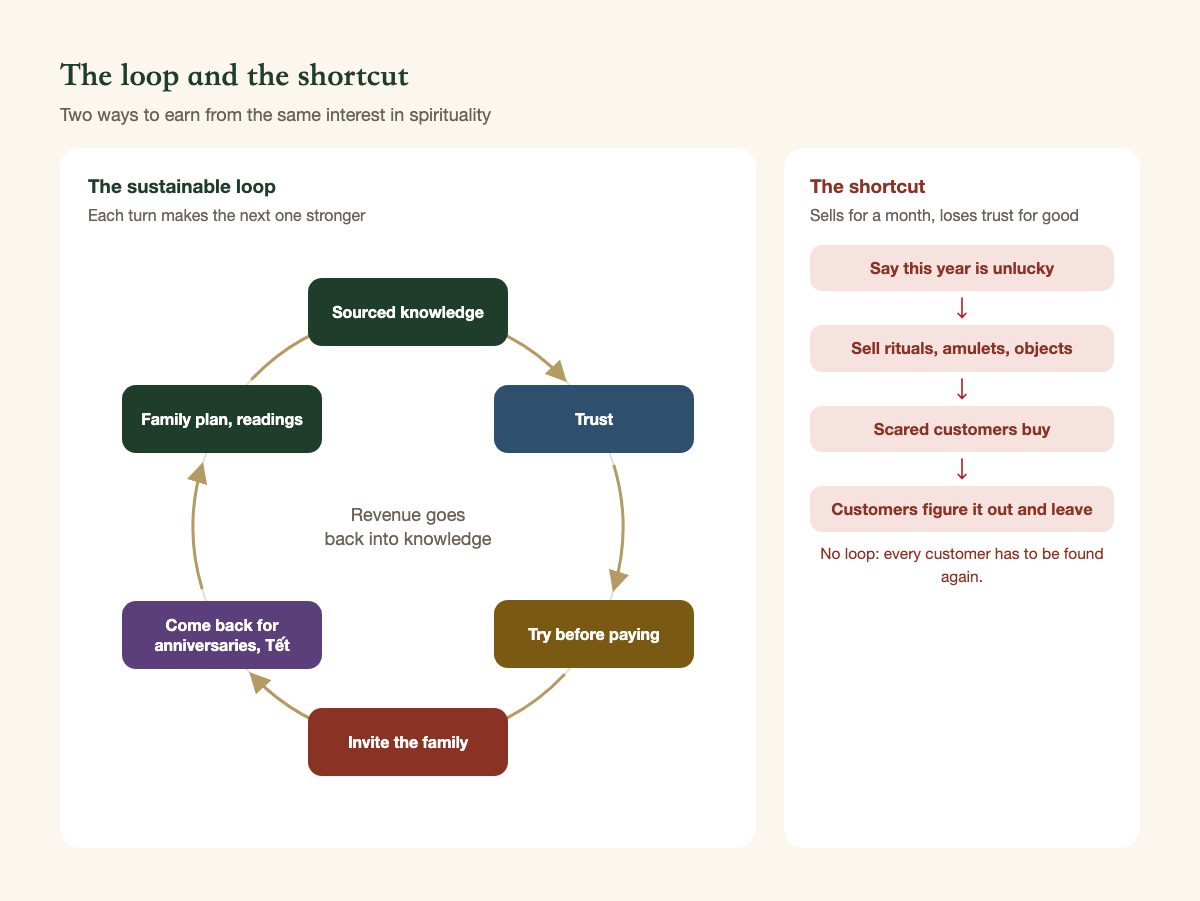
The five points below are the five steps of that loop, as Nhật Nguyệt practises them.
1. Why must the knowledge be solid before selling anything?
Because you can't charge for an answer when you can't explain where it comes from. At Nhật Nguyệt, every claim in an article has a footnote to a specific source. Every tool result states which part is a calendar calculation, which part is one school's rule, which part is folk belief, and what has never been proven.
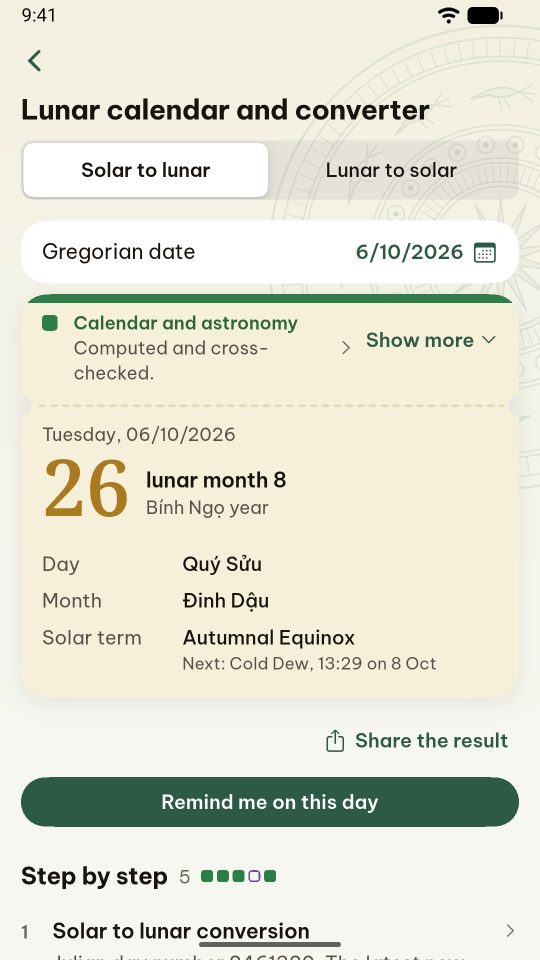
Understanding your own work also tells you where to stop. Lunar dates can be calculated and checked against astronomical data. A birth chart can only be set up correctly according to the books; no study has shown that its eight characters correspond to a person's life. Saying so doesn't weaken the product. It makes people trust the rest.
2. Where does user safety stand against revenue?
First, even when it costs revenue. People often turn to spirituality at hard moments: a death in the family, a breakup, a difficult year. That is also when they are easiest to lead. A few rules Nhật Nguyệt keeps:
- No remedies for sale: no amulets, no ritual packages, no "pay to avoid bad luck".
- Readings never call a year or a month "bad". Tools that mention age-related unlucky years report them as folk belief, with a note that they are unproven.
- Questions about self-harm don't get a chart. The assistant answers with support and a hotline number.
Leaning towards logic doesn't mean mocking belief. Ancestor anniversaries, choosing dates and family customs are real parts of many families' lives. What has to go is the superstition used to frighten people and to sell.
3. What is trust built from?
From things people can check, not from promises. Trust here doesn't come from praising your own reliability. It comes from things users can verify themselves:
- The source of each claim, at the end of each article.
- A public corrections log that shows which errors were fixed and when.
- Open calendar datasets anyone can download and compare.
Trust builds slowly and breaks quickly. So every sales decision should face one question: if users knew exactly how we do this, would they still trust us?
4. Why let people try before they pay?
Because in a field full of scams, users have good reason to be suspicious first. Almost every Nhật Nguyệt lookup tool works without signing up. New accounts get one in-depth reading free, so people can read it and judge it before spending anything.
People pay once they've seen the care, not before. It's slower in the first month, but the people who pay already trust you, so they stay.
5. How do families create a network effect?
Through the dates a family already keeps together. One person creates a group, adds grandfather's death anniversary and invites parents and siblings. When the day comes, the whole group is reminded, with a checklist of what to prepare and the address of the family hall for directions.
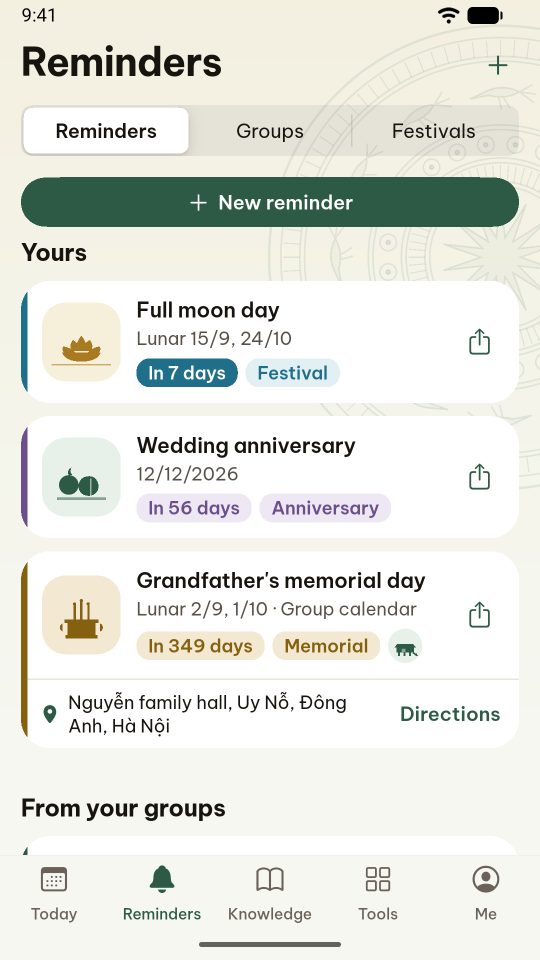
Every new member makes the group more useful for everyone else. No ad has to persuade each person: the invitation comes from family. It's the most natural network effect a product about customs can have, because Vietnamese families are already a network.
6. How do you keep users without tricks?
By following the rhythm of real life. Lunar dates return every month: the full moon, the first day. Anniversaries return every year. Tết returns every spring. When a product is tied to dates a family already keeps, people come back because they need to, not because of a streak or a nagging notification.
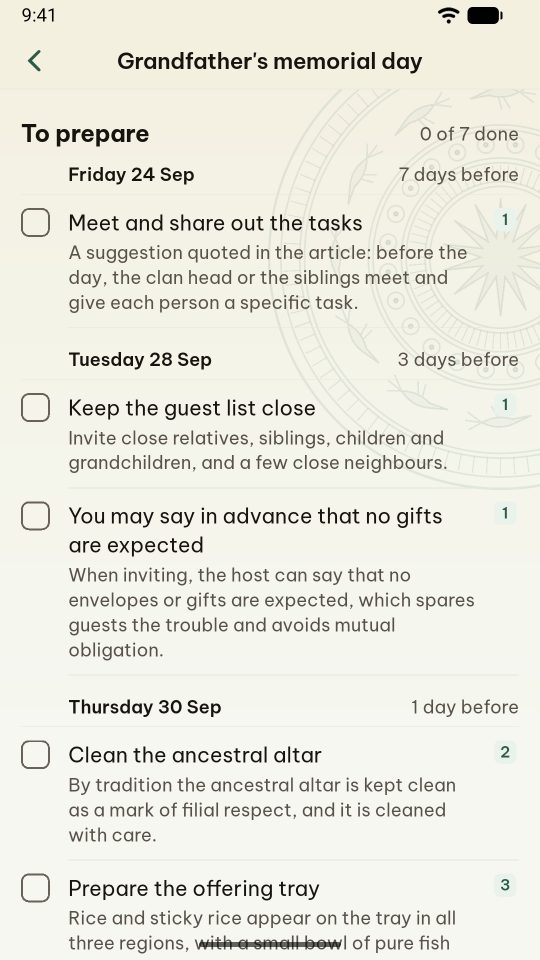
Reminders can arrive a month, a week and a day ahead. The checklist lists what to do and who does it. Next year, on the same day, the group is reminded again. Nobody had to design this loop: it already exists in the culture.
So where does the money come from?
From things people have already found valuable, not from fear.
- A family plan: for larger groups and more ways to keep the family's dates together.
- In-depth readings: a full reading of the chart through the books, paid per reading.
- No ads, and no remedies for sale.
This model grows more slowly than the shortcut. But each turn leaves something that compounds: more knowledge, more trust, one more family.