What is Na Yin?
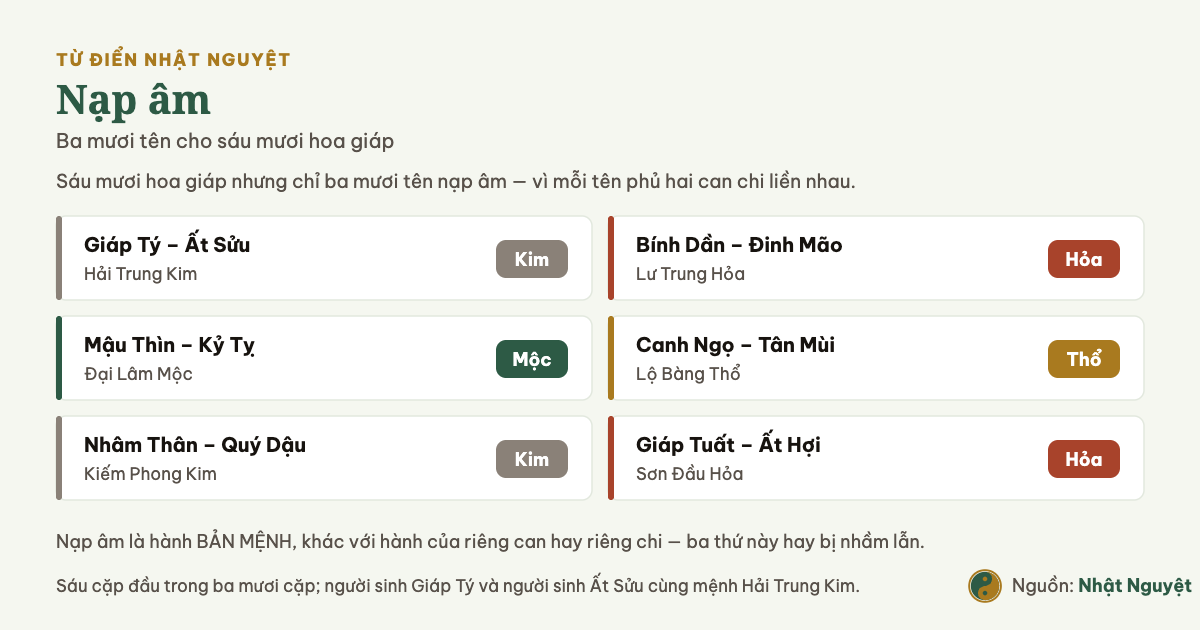
Na Yin (納音) is a method of combining Heavenly Stems and Earthly Branches to create a new name, along with a Five Elements attribute, for each of the 60 combinations in the Sixty Jiazi cycle. Each Stem-Branch pair such as Jiazi, Yichou is assigned a specific Na Yin, for example Hai Zhong Jin, Lu Zhong Huo. These names often carry metaphorical imagery and are used to interpret personality, fortune, as well as applications in feng shui, date selection, and age compatibility.
Origin and Principles
According to tradition, Na Yin originates from the theory of Stems and Branches and the Five Elements, possibly appearing since the Han dynasty or earlier in ancient calendrical texts. The calculation is based on the interaction between Stem and Branch, often through the Five Elements of the Stem and Branch, or using pre-made tables. Each Na Yin is named after a specific image such as water in a stream (Da Xi Shui), gold under the sea (Hai Zhong Jin), fire in a furnace (Lu Zhong Huo). These names not only describe the element but also suggest its quality and strength.
Practical Applications
In astrology and feng shui, Na Yin is often used to determine a person's destiny element based on their birth year. For instance, a person born in the year of Jiazi is considered to have the Hai Zhong Jin destiny. Additionally, Na Yin is used to select auspicious dates and times, examine compatibility between ages, or supplement elements in home arrangement. However, it should be noted that this is traditional knowledge for reference, not scientifically verified.
Distinction from Easily Confused Terms
Na Yin differs from the Five Elements of individual Stems and Branches. Each Stem and Branch has its own element, but Na Yin is the combined element of the pair, which may differ. For example, Jia belongs to Wood, Zi belongs to Water, but the Na Yin of Jiazi is Metal (Hai Zhong Jin). Na Yin is also not identical to "destiny" in the natal Five Elements, as destiny can be understood as the element of the birth year according to Na Yin, but sometimes interpreted differently. Moreover, Na Yin is not an independent system but part of the broader Stem-Branch theory.
Note
Na Yin is a concept in traditional metaphysics, for reference. Readers should combine it with other factors and not regard it as absolute truth.