What is a Ba Tu major cycle and how does it differ from the original chart?
A major cycle is a chain of ten year periods in a Ba Tu chart, each step a new pair of stem and branch derived by the chart setter from the month pillar, not already present in the four original pillars. The four pillars of year, month, day, and hour form eight characters called the original chart, describing the underlying structure of the chart, while the major cycle is the layer of time running through that structure, changing once every ten years. The Ba Tu system generally uses the stems and branches of the birth year, month, day, and hour as raw material, in which the stem of the day pillar is called the Day Master or Day Stem, serving as the reference point for all other factors. The major cycle does not change that reference point, it only brings new stems and branches onto the table and forces the reader to observe how the original chart reacts to them.
This must be clearly distinguished from the major cycle in Tu Vi. The Tu Vi major cycle is divided by the chart's cuc number, each of the twelve palaces taking on a ten year period, and one reads the Tu Vi major cycle by moving the Menh, Tai Bach, Quan Loc, and Phuc Duc palaces to new positions. The Ba Tu major cycle has no palaces and no cuc number, it is a linear chain of stems and branches, so the two share the term major cycle but the data is entirely different.
Why does a major cycle run forward or backward?
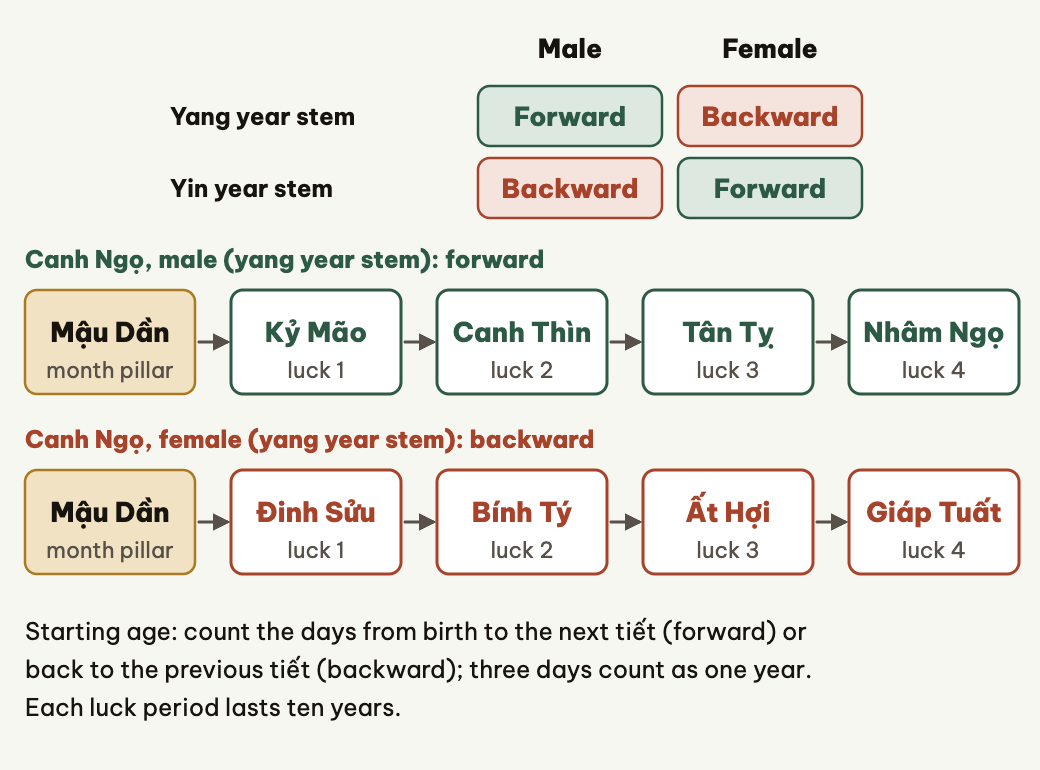
The direction of a major cycle is decided by two factors at once: the gender of the person whose chart is being set and the yin yang of the birth year stem. The common convention is that yang male and yin female run forward, yin male and yang female run backward, following the existing order of the Luc Thap Hoa Giap (the Sixty Jia Zi cycle). In other words, one does not choose the direction, it is fixed from the year stem and gender, and one then simply steps forward or backward from the month pillar.
A concrete example makes this easier to picture. A person born in the year Giap Ty, with the birth month as the At Suu pillar. The year stem Giap is yang. If male, that is yang male, the cycle runs forward: the first major cycle is Binh Dan, the second Dinh Mao, the third Mau Thin, advancing through the sixty jia zi cycle. If also born in Giap Ty year with At Suu month but female, that is yang female, the cycle runs backward: the first major cycle is Giap Ty, the second Quy Hoi, the third Nham Tuat, retreating in the exact reverse order of the jia zi cycle. The direction is not a formality, it determines the entire sequence of stems and branches the person will pass through in life, so getting one of the two inputs wrong makes the whole table wrong.
It should also be said clearly that this is a convention, not a testable truth. In Ba Tu research circles, people accept it because of the system's internal consistency, not because there is any way to verify experimentally that a yang male must run forward.
How is the starting age counted from days to the nearest solar term?
The starting age is the number of years, months, and days from birth to when the first major cycle takes effect. The chart setter counts the distance from the birth date and hour to the nearest solar term in the direction of the cycle: if the cycle runs forward, count to the term ahead; if backward, count back to the term behind. Once the number of days is known, it is converted at three days to one year, one day to four months, one hour to five days, then added to the birth date to give the starting point.
For example, if the distance to the term is fifteen days and the cycle runs forward, fifteen divided by three gives five years, so the first major cycle begins at about age five. If the distance is sixteen days, the first fifteen days become five years and the remaining odd day becomes four months, giving a starting point of five years and four months. This three days to one year ratio is the central convention of setting major cycles, and also the place most prone to error if the chart setter works by hand without rechecking the solar terms.
Why three days? The usual explanation is to take the rhythm of the solar terms as nature's measure of time, then map that rhythm onto the time of a human life. A year has about three hundred sixty five days, and a full cycle of solar terms also closes within roughly that span, so one day in the distance to the term is treated as corresponding to one third of a year of age. This is the system's reasoning, not a physical measurement, and schools still adjust around this figure.
Can a major cycle table be built with the calculation core?
Hand calculation should be avoided. The existing Ba Tu calculation core, for example LapBatTu together with solar term data, only produces the four pillars and background information, with no major cycle function. To get a correct major cycle table, a function must be added that takes the four established pillars, gender, and the solar term table as input, and returns the direction, the starting point, and the stem branch sequence of eight major cycles. Adding this function is a technical necessity, not an option, because hand calculation easily errs in three places: identifying the nearest solar term, converting odd days into months, and stepping the stems and branches in the correct direction.
Below is the eight major cycle table of a sample chart, built with a calculation core that has the major cycle function added. The sample chart uses a male born in the year Giap Ty, month At Suu, with the hour omitted to focus on the cycles. Since it is yang male the cycle runs forward, and assuming the distance to the term is fifteen days, the starting point is about age five.
| Major cycle | Stem and branch | Age range | Cycle stem | Cycle branch |
|---|---|---|---|---|
| 1 | Binh Dan | 5 to 15 | Binh | Dan |
| 2 | Dinh Mao | 15 to 25 | Dinh | Mao |
| 3 | Mau Thin | 25 to 35 | Mau | Thin |
| 4 | Ky Ty | 35 to 45 | Ky | Ty |
| 5 | Canh Ngo | 45 to 55 | Canh | Ngo |
| 6 | Tan Mui | 55 to 65 | Tan | Mui |
| 7 | Nham Than | 65 to 75 | Nham | Than |
| 8 | Quy Dau | 75 to 85 | Quy | Dau |
This table is only a frame of stems and branches and a frame of ages. It says nothing about fortune or misfortune, because to know those one must place each stem branch pair in relation to the original chart and its useful god.
How is a ten year major cycle read against the useful god?
Reading a major cycle means comparing its stem and branch with the favorable and unfavorable elements of the original chart, not looking up a ready made table of good and bad. First the useful god and the unfavorable god of the chart must be determined, that is, which element benefits and which harms the Day Master in that specific structure. How to determine the useful god was discussed in a separate article on the useful god, and how to measure the Day Master's strength was discussed in the article on strength and weakness, so here only the conclusion is reused without repeating the reasoning.
Once the favorable and unfavorable elements are known, the reading principle is fairly direct: if the cycle's stem and branch fall into a favorable element, that period is smoother; if they fall into an unfavorable element, that period is harder, and the degree depends on whether that stem branch is combined, clashed, or punished by the original chart. A major cycle whose stem is favorable but whose branch is unfavorable will not read the same as one where both stem and branch are favorable. This is also why the question of whether stem or branch carries more weight matters so much.
On this point the schools do not agree, and the reader should know which convention they are following. One direction, tied to the commentary style of Tu Binh Chan Thuyen, holds that when reading a cycle the stem of the cycle is taken as primary, each cycle treated as one character then matched with the favorable and unfavorable elements of the chart, while reading the natal chart takes both stem and branch of the four pillars matched with the month command. Another direction, common in popular practice, takes the branch of the cycle as primary, based on the direction of the branch, for example Dan Mao Thin belong to the east, Ty Ngo Mui to the south, Than Dau Tuat to the west, Hoi Ty Suu to the north. On Vietnamese Ba Tu forums, these two directions are still compared against each other, and some use precisely this difference to test whether a chart should be read as strong or weak.
This article does not choose a side in advance. The presentation here is to state both, and when reading a specific chart to note which direction is being used, so the reader is not confused between two contradictory results.
Five years stem, five years branch, or all ten years?
A common practical question is how the stem and branch share the ten years of a major cycle. One way is to split in half: the first five years lean toward the stem, the last five toward the branch. Another way treats stem and branch as present together throughout the ten years, differing only in degree of influence. Yet another treats the stem as the opening part and the branch as the closing part, emphasizing whichever part suits the question being asked.
No convention is accepted by all schools. What should be done when reading is to state clearly which division is being used, and stay consistent throughout, rather than taking the stem at one moment and the branch at another according to the desired result.
What do the annual cycle and tue van tinh lam mean?
The annual cycle is the stem and branch of a specific year, layered over the major cycle currently in effect. Tue van tinh lam is the case where the stem and branch of the annual cycle coincide with the stem and branch of the major cycle, that is, that year and that cycle carry the same pair of characters. This phrase describes a coincidence at the level of stems and branches, and its degree of influence must still be read through the favorable and unfavorable elements of the original chart, it is not automatically good or bad.
According to the presentation in Tuyen tap bai viet Ba Tu chon loc so 9, when reading the annual cycle the branch of the annual cycle plays the decisive role in fortune and misfortune, while the stem of the annual cycle is usually only secondary. This document also notes an exception: if the stem of the annual cycle is in a strong state, generated by the branch of the annual cycle or of the same element, then it does participate significantly in generation and control with the natal chart and the major cycle, slightly changing the situation. Also according to that document, when the stem of the annual cycle is a favorable element but is controlled or combined away by another element in the natal chart, the good cannot manifest, and conversely if it is an unfavorable element but is controlled, the bad is also reduced. This is a graded reading, not a fixed addition and subtraction formula.
How is an annual cycle clashing or controlling a major cycle read?
When the annual cycle clashes with or controls the major cycle, the general principle is to consider whether both sides are favorable or unfavorable before speaking of the result. Tuyen tap bai viet Ba Tu chon loc so 9 puts it this way: if the branch of the annual cycle is a favorable useful god and is generated and supported by the major cycle, that year is smooth; if the branch of the annual cycle is an unfavorable element and the major cycle generates and supports it, that year is unfavorable; if the branch of the annual cycle is favorable but is controlled by the major cycle, the good is reduced, sometimes only to an ordinary level; and if the branch of the annual cycle is unfavorable but is controlled by the major cycle, the bad is also reduced. This document also emphasizes the resonance between the annual cycle and the major cycle, while noting that punishment, clash, meeting, and combination between the annual cycle and the pillars of the natal chart must also be considered.
It should be said clearly that this is the reading of one specific document, not a rule accepted by all schools. In practice, the same year of clash between the annual cycle and the major cycle can be read by one school as strong change and by another as the removal of a blockage, depending on the favorable or unfavorable nature of the relevant stems and branches in the chart being read.
Why can a major cycle not be read apart from the original chart?
A major cycle is only added stems and branches, while the capacity to react to them lies in the original chart. The same Tan Mui major cycle reads quite differently for a person whose original chart needs the metal element than for one whose chart already has too much metal. The same annual cycle clashing with the month pillar reads differently for a person whose month pillar is favorable than for one whose month pillar is unfavorable. If the major cycle is separated from the original chart, the reader is left with only a neutral string of stems and branches, with no basis for speaking of fortune or misfortune.
The practical consequence is that the order of reading must be fixed: set the original chart, determine strength and the useful god, set the major cycles, then layer the annual cycle on. Reversing the order, for example starting from a year with an event and working backward to the useful god, is a method that easily produces arbitrary conclusions.
Where do the schools still differ?
Beyond the question of stem or branch weight, there are at least three practical differences worth noting.
- Rounding the starting age. Some schools keep the exact years, months, and days after conversion, some round up or down for convenience, and some convert the remainder into months and drop the days. The difference is only a few months but can push an event into the previous or following year.
- Counting by nominal age or actual age. Nominal age adds one year from birth, actual age counts from the birth date. Which age a major cycle table uses depends on the setter's convention, and when comparing two tables from different sources one must check which age they use before concluding they disagree.
- Whether tieu van is used. Tieu van is a shorter cycle layer than the major cycle, usually tied to each year in the period before the first major cycle takes effect, or used alongside the annual cycle depending on the school. Some schools drop tieu van entirely and use only major cycle plus annual cycle, some still use it. This is a difference in system scope, not a difference in calculation within one system.
Practical conclusion
To set and read Ba Tu major cycles correctly, four steps are needed in order: determine the direction from gender and the yin yang of the year stem, calculate the starting point from the distance to the solar term at three days to one year, build the stem branch sequence with a major cycle function rather than by hand, and read each cycle by placing it beside the useful god and favorable or unfavorable elements of the original chart before layering the annual cycle on. Any conclusion about fortune or misfortune should be presented only as a tendency toward smooth or rough in a period, with the convention used clearly noted, because the schools themselves have not agreed on the core points of this reading method.