What Is Chính Quan in the Ten Gods?
Chính Quan is the god that controls the Day Master but has opposite yin-yang polarity. For example, a Giáp Mộc (yang wood) Day Master meets Tân Kim (yin metal), or a Ất Mộc (yin wood) Day Master meets Canh Kim (yang metal). Because the polarity differs, this control carries a benevolent managerial quality, like law and government running a society. Chính Quan represents legitimate reputation, discipline, order, responsibility, and for female charts, the husband.
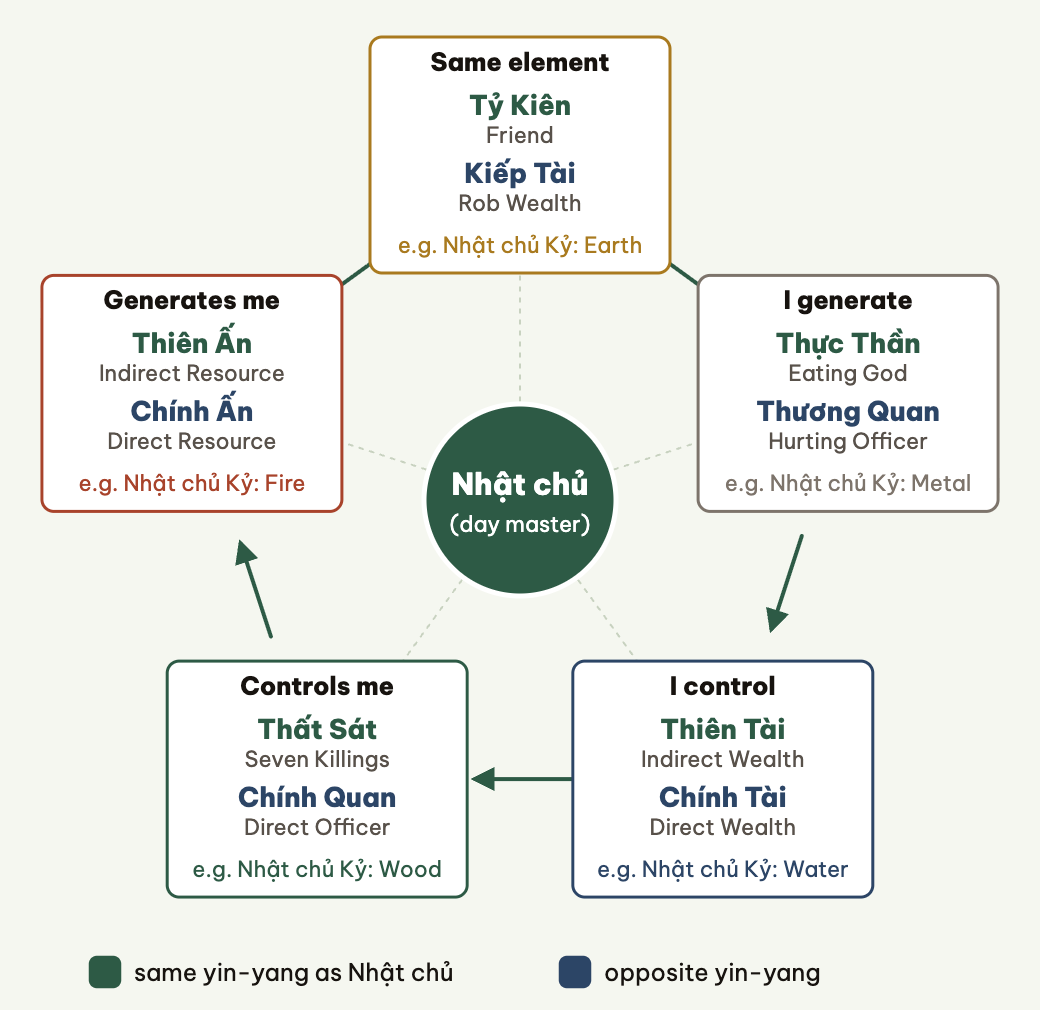
Thất Sát (also called Thiên Quan) also controls the Day Master but shares the same yin-yang polarity. A Giáp Mộc Day Master meets Canh Kim, or Ất Mộc meets Tân Kim. Same polarity means stronger control, leaning toward authority, competition, pressure, and sometimes violence. Classical texts often list Chính Quan and Thất Sát as the first two structures of the Proper Structures (Chính Cách), both representing power and social status but with different flavors.
Table of Chính Quan for the Ten Day Masters
Each Day Master has one heavenly stem as its Chính Quan, determined by the control relationship with opposite polarity. The table below lists all ten cases.
| Day Master | Chính Quan | Note |
|---|---|---|
| Giáp (yang wood) | Tân (yin metal) | Metal controls wood, opposite polarity |
| Ất (yin wood) | Canh (yang metal) | Metal controls wood, opposite polarity |
| Bính (yang fire) | Quý (yin water) | Water controls fire, opposite polarity |
| Đinh (yin fire) | Nhâm (yang water) | Water controls fire, opposite polarity |
| Mậu (yang earth) | Ất (yin wood) | Wood controls earth, opposite polarity |
| Kỷ (yin earth) | Giáp (yang wood) | Wood controls earth, opposite polarity |
| Canh (yang metal) | Đinh (yin fire) | Fire controls metal, opposite polarity |
| Tân (yin metal) | Bính (yang fire) | Fire controls metal, opposite polarity |
| Nhâm (yang water) | Kỷ (yin earth) | Earth controls water, opposite polarity |
| Quý (yin water) | Mậu (yang earth) | Earth controls water, opposite polarity |
How Does Chính Quan Differ from Thất Sát?
The core difference lies in yin-yang polarity. Chính Quan has opposite polarity, so its control is affectionate, like a strict but fair superior. Thất Sát has the same polarity, so its control is unfeeling, like a fierce competitor or pressure from circumstances. In manifestation, Chính Quan brings stability, legitimate fame, an orderly career path recognized by society. Thất Sát brings strength, decisiveness, sometimes pressure, but if subdued and transformed, it can achieve great success in highly competitive fields.
In marriage, for female charts, Chính Quan is the formal husband, while Thất Sát is a lover or unofficial husband. Classical texts note cases where a female chart has Chính Quan hidden in the earthly branches and Thiên Quan exposed on a stem, resulting in marrying a weak husband but having a capable lover. For male charts, Chính Quan represents children and work, career, and prestige with superiors.
When Does a Chart Form the Chính Quan Structure?
The Chính Quan structure forms when Chính Quan holds the month command or is exposed on a stem, and meets the conditions of a strong Day Master, Tài generating it, and Ấn transforming it. Specifically, the basis for determining the structure is the month command. Each month branch contains one to three hidden stems in the order of primary qi, middle qi, and residual qi. Any of those stems appearing on the year, month, day, or hour pillar is chosen as the structure. For example, a Bính fire day born in the Thân month: the Thân branch hides Canh, Nhâm, Mậu. If Nhâm water appears on a stem, it is identified as a Quan structure. If Canh metal appears, it is a Tài structure.
The condition for the Chính Quan structure to succeed in reputation is a strong Day Master, Tài tinh generating Quan, and no destruction by Thương Quan. Classical texts say: "A chart with one position of Chính Quan, without Thiên Quan and Thương Quan, is extremely noble." When Chính Quan meets Thương Quan, the career path meets obstacles, the person is prone to demotion and constant dissatisfaction with reality.
Regarding the roles of Tài and Ấn in the Chính Quan structure, the generating-controlling relationship is Tài generates Quan, Quan generates Ấn, Ấn generates the Day Master. This is a forward generating chain. When all three are strong and affectionate, wealth and honor together are normal. Classical texts record: "Tài generates Quan, Quan generates Ấn, Ấn generates the Day Master, wealth and honor together." Conversely, if this chain is broken or has a destroyer, the outcome differs. The trap lies in Tài đa thân nhược (excessive Wealth, weak Day Master). When Tài tinh is too strong and the Day Master is weak, money not only fails to bring prosperity but causes hardship, earning and then losing. Classical texts warn: "Excessive Tài, weak Day Master, moving into Quan territory with strong Tài, seeing Tài rob qi, Quan controls the Day Master, not only no fortune but a hundred disasters."
Why Is Chính Quan Afraid of Thương Quan?
Thương Quan is the god the Day Master generates, with the same polarity as the Day Master, strong in draining qi and often destroying Quan. When Chính Quan is the useful god, Thương Quan is the unfavorable god. For example, an Ất Mộc Day Master, Chính Quan is Canh Kim, Thương Quan is Bính Hỏa. Bính Hỏa controls Canh Kim, meaning Thương Quan controls Chính Quan. The consequence is a person struggling in career, possibly envied by superiors or entangled in legal trouble.
The remedy is to find an element that controls Thương Quan, such as the heavenly stems Nhâm or Quý Water (Chính Ấn). When Chính Ấn appears, it both controls Bính Hỏa, protects Chính Quan, and indirectly supports the Ất Mộc Day Master. This is the case of "Chính Ấn as the rescue of Chính Quan."
However, schools disagree on whether Thương Quan meeting Quan is a disaster or a blessing. Some schools consider Thương Quan seeing Quan a disaster, especially when the Day Master is weak and Quan is the useful god. Other schools hold that when the Day Master is strong, Thương Quan meeting Quan can be auspicious, because Thương Quan drains the strong Day Master and Quan tinh is used to manage, creating a balanced state. This article follows the common convention in classical texts such as Tử Bình Chân Thuyên and Tam Mệnh Thông Hội, treating Thương Quan seeing Quan as something to guard against, but notes the differing view of some modern schools.
What Weakness Is Quan Sát Hỗn Tạp?
Quan Sát hỗn tạp is when both Chính Quan and Thất Sát appear in the chart, and the Day Master is not strong enough to distinguish or control both. For example, an Ất Mộc Day Master has both Canh Kim (Chính Quan) and Tân Kim (Thất Sát) appearing together. This condition causes unstable career, difficulty determining direction, or encountering unhealthy competition. To resolve, an element may be needed to combine away the Thiên Sát, keeping only Chính Quan. For instance, a yin stem as Thương Quan can combine away the Thiên Sát. Classical texts also record: "A chart with one position of Chính Quan, without Thiên Quan and Thương Quan, is extremely noble," showing that Quan Sát hỗn tạp is considered a minus.
How Does Chính Quan Differ for Female and Male Charts?
For female charts, Chính Quan is the husband. When Chính Quan is in the husband palace (day pillar) and not clashed or broken, the marriage is stable. Conversely, Thiên Quan in the husband palace signals a lover or unofficial husband. For male charts, Chính Quan represents children and work, career, and prestige with superiors. To predict career, observe how Chính Quan governs position and authority within the legitimate system. Those with Chính Quan clearly exposed, a strong Day Master, and no disturbance from Thương Quan often pass exams with honor and hold clean offices.
Classical texts also note cases of Chính Quan being broken. For example, a male chart born in the Quý Tị year, Giáp Dần month, Kỷ Sửu day, Mậu Thìn hour, at first glance Chính Quan holds the command, seeming a wealthy and noble structure. However, Tị and Sửu secretly support Thương Quan, completely destroying the dignity of the Quan tinh. That person's life is tied only to fields, with no rank or reputation. Thus a pillar with Quan tinh does not necessarily mean becoming an official, because if it falls into a broken structure, the outcome is entirely different.
How Does Manh phái Read a Quan tinh That Is "Hư Thấu"?
According to Manh phái documents, a Quan tinh that is hư thấu (falsely revealed) does not represent real power or office, but relates to reputation, intelligence, and leadership ability. A person with a falsely revealed Quan tinh often possesses sharp intellect and flexible thinking, but does not necessarily hold an openly powerful position. The characteristic is having fame, being respected by others for intelligence and flexibility. If the Quan tinh or its source is controlled, the person can achieve in culture, education, or hold high degrees. The Manh phái oral formula says: "Quan Sát controlled means becoming an official; Quan Sát controlled means having culture, degrees." A falsely revealed Quan tinh often indicates subtle influence, without display.
How Does Chính Quan Differ from Other Gods in the Ten Gods?
The Ten Gods are Tỷ Kiên, Kiếp Tài, Thực Thần, Thương Quan, Chính Tài, Thiên Tài, Chính Quan, Thất Sát, Chính Ấn, Thiên Ấn. Chính Quan is the only god that controls the Day Master with opposite polarity, playing a benevolent managerial role. It differs from Chính Tài in that Chính Tài is controlled by the Day Master with opposite polarity, representing legitimate assets. It differs from Chính Ấn in that Chính Ấn generates the Day Master with opposite polarity, representing education, culture, protection. In the generating-controlling chain, Tài generates Quan, Quan generates Ấn, Ấn generates the Day Master, forming a cycle that nourishes the Day Master.
Notes When Interpreting Chính Quan
Chính Quan is not always good. If the Day Master is weak and Quan is strong, the person easily faces pressure, overwork, and declining health. Then Ấn is needed to transform it or Tỷ Kiếp to support the Day Master. Conversely, if the Day Master is strong and Quan is weak, Tài is needed to generate Quan, helping Quan function. Classical texts also distinguish successful and failed Chính Quan structures based on the presence of Tài, Ấn, and the absence of Thương Quan, Thiên Quan.
Modern destiny schools have different views on the useful god. Some follow Tử Bình Chân Thuyên, holding that the useful god is the element of the structure and does not change with annual and luck cycles. Others hold that the useful god can change when annual and luck stems intervene, breaking the balance of the original chart, and a new balancing element must be chosen. This difference affects how Chính Quan is interpreted in each specific chart. Researchers should know which school they follow to avoid confusion.
To learn more about determining strength and weakness and choosing the useful god, you can refer to related articles in the Bát Tự section of Tâm An.