
What Is a Palace Stem on a Tử Vi Chart?
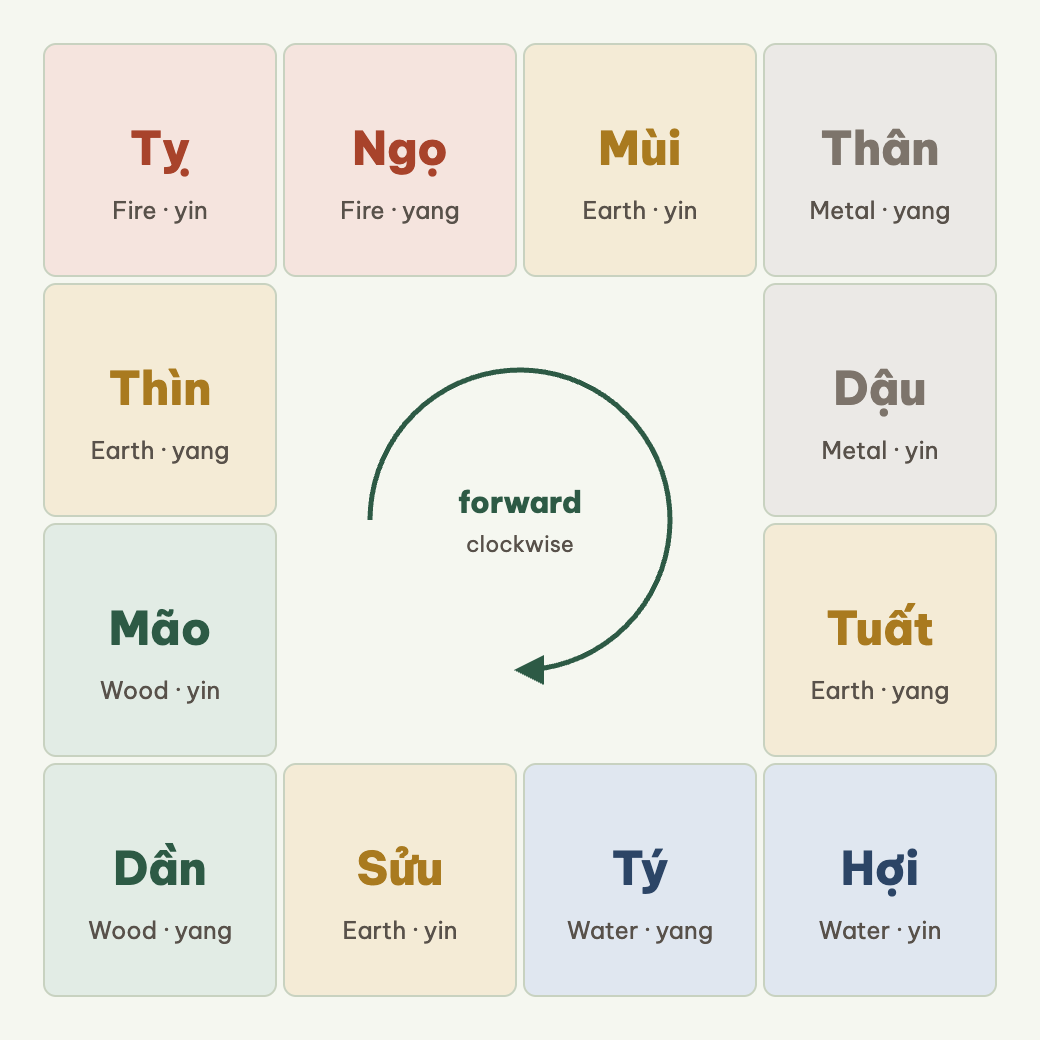
A palace stem is the heavenly stem attached to each earthly branch in the twelve palaces of a Tử Vi chart. The twelve earthly branches Tý, Sửu, Dần, Mão, Thìn, Tị, Ngọ, Mùi, Thân, Dậu, Tuất, Hợi are fixed on the chart and do not change from person to person. Assigning stems to these palaces depends only on the birth-year stem. The book Đẩu số tinh thành (volume 1, part 1) presents the twelve earthly branches divided into yin and yang by odd and even positions: Tý, Dần, Thìn, Ngọ, Thân, Tuất are yang, while Sửu, Mão, Tị, Mùi, Dậu, Hợi are yin. According to the same book, the earthly branches govern the Five Elements by group: Dần and Mão belong to Wood, Tị and Ngọ to Fire, Thân and Dậu to Metal, Tý and Hợi to Water, and Thìn, Tuất, Sửu, Mùi to Earth.
Once each palace has a stem, each palace becomes a stem-branch pair. For example, in a Giáp year, the Dần palace is Bính Dần, the Mão palace is Đinh Mão, and the Thìn palace is Mậu Thìn. That stem-branch pair is the input for many subsequent calculations in the chart.
How Does the Ngũ Hổ Độn Method Calculate the Palace Stems?
The Ngũ Hổ Độn method takes the birth-year stem as the anchor and counts forward from the Dần palace. The book Đẩu số tinh thành (volume 1, part 1) records the mnemonic used for months, called the Ngũ Hổ Độn khởi nguyệt quyết, with the following content: for a Giáp or Kỷ year, start at Bính Dần; for an Ất or Canh year, start at Mậu Dần; for a Bính or Tân year, start at Canh Dần; for a Đinh or Nhâm year, start at Nhâm Dần; for a Mậu or Quý year, start at Giáp Dần. From the Dần palace, count forward, adding one stem for each subsequent palace along the cycle of ten heavenly stems.
The book Kỳ Môn Chỉ Quy (volume 1) lists Ngũ Hổ Độn among the starting methods of Kỳ Môn, alongside Ngũ Thử Độn, showing that this method is a tool shared by many schools, not just Tử Vi. In Tử Vi, the same formula is applied to the twelve earthly branch palaces instead of the twelve months.
The forward-counting mechanism can be illustrated with an example. A person born in a Giáp year starts at Bính Dần: the Dần palace is Bính Dần, the Mão palace is Đinh Mão, the Thìn palace is Mậu Thìn, the Tị palace is Kỷ Tị, the Ngọ palace is Canh Ngọ, the Mùi palace is Tân Mùi, the Thân palace is Nhâm Thân, the Dậu palace is Quý Dậu, the Tuất palace is Giáp Tuất, and the Hợi palace is Ất Hợi. At this point the stem cycle has completed ten steps from Bính, so the Tý palace repeats Bính, that is Bính Tý, and the Sửu palace repeats Đinh, that is Đinh Sửu. This counting method gives the same result whether starting from the Dần palace or going around in the order Tý, Sửu, Dần, Mão, because both are forward counts around the twelve-branch cycle.
Why Do Tý and Sửu Repeat the Stems of Dần and Mão?
There are ten heavenly stems but twelve earthly branches, so when spreading ten stems over twelve palaces, the last two palaces in the cycle must receive stems already used. In the Tử Vi assignment, those two palaces are Tý and Sửu. Specifically, the stem of Tý matches the stem of Dần, and the stem of Sửu matches the stem of Mão. A way of reasoning states the consequence clearly: a palace carrying the birth-year heavenly stem, called the Lai Nhân Cung, cannot be located at Tý or Sửu, because these two earthly branches have no separate heavenly stem in the twelve-palace cycle.
This is where many people raise questions. If Tý and Sửu have no separate stems, on what basis is the Tứ Hóa flying from these two palaces done, and when is the repeated stem used and when not. The documents are not fully consistent on this point, and the degree of its influence varies by school.
Table of Stem-Branch for the Twelve Palaces by Five Birth-Year Stem Groups
The table below is generated automatically by the system's calculation core, not typed by hand. The vertical column is the five birth-year stem groups, and the horizontal row is the twelve earthly branch palaces.
| Birth-year stem group | Tý | Sửu | Dần | Mão | Thìn | Tị | Ngọ | Mùi | Thân | Dậu | Tuất | Hợi |
|---|---|---|---|---|---|---|---|---|---|---|---|---|
| Giáp, Kỷ | Bính Tý | Đinh Sửu | Bính Dần | Đinh Mão | Mậu Thìn | Kỷ Tị | Canh Ngọ | Tân Mùi | Nhâm Thân | Quý Dậu | Giáp Tuất | Ất Hợi |
| Ất, Canh | Mậu Tý | Kỷ Sửu | Mậu Dần | Kỷ Mão | Canh Thìn | Tân Tị | Nhâm Ngọ | Quý Mùi | Giáp Thân | Ất Dậu | Bính Tuất | Đinh Hợi |
| Bính, Tân | Canh Tý | Tân Sửu | Canh Dần | Tân Mão | Nhâm Thìn | Quý Tị | Giáp Ngọ | Ất Mùi | Bính Thân | Đinh Dậu | Mậu Tuất | Kỷ Hợi |
| Đinh, Nhâm | Nhâm Tý | Quý Sửu | Nhâm Dần | Quý Mão | Giáp Thìn | Ất Tị | Bính Ngọ | Đinh Mùi | Mậu Thân | Kỷ Dậu | Canh Tuất | Tân Hợi |
| Mậu, Quý | Giáp Tý | Ất Sửu | Giáp Dần | Ất Mão | Bính Thìn | Đinh Tị | Mậu Ngọ | Kỷ Mùi | Canh Thân | Tân Dậu | Nhâm Tuất | Quý Hợi |
Looking at the table, the pattern is visible: the Dần palace always carries the starting stem of the group, the Tý palace always matches the stem of the Dần palace, and the Sửu palace always matches the stem of the Mão palace, exactly as stated above.
What Is the Palace Stem Used For?
The palace stem is not a decorative detail. It is the input for three common calculations.
Determining the Ngũ hành cục via the nạp âm of the Mệnh palace's stem-branch pair
Once the stem-branch pair of the Mệnh palace is known, one looks up the nạp âm of that pair to get the Ngũ hành cục of the chart. For example, in a Giáp year, if the Mệnh palace is at Dần, the stem-branch pair is Bính Dần; looking up the nạp âm gives an element, from which the cục is determined. The cục is the parameter used to place Tử Vi and the main stars, so the palace stem here plays a mandatory intermediate role: without the palace stem there is no stem-branch pair, no nạp âm lookup, and no cục.
Flying the Tứ Hóa according to each palace's stem
This is where the palace stem is used most in the Tứ Hóa and Khâm Thiên schools. A way of reasoning states that the heavenly stems used for Tứ Hóa include the birth-year stem, the stems of the twelve palaces, the stem of the đại hạn palace, and the stem of the lưu niên palace. From each of these stems, four transformations Lộc, Quyền, Khoa, Kỵ are flown out and land in other palaces on the chart. This book also distinguishes Hóa Nhập, Hóa Xuất, and Tự Hóa, and holds that the auspiciousness or inauspiciousness of Lộc or Kỵ cannot be concluded in just a few words; it must be placed together with the palace position to be interpreted. However, the book also notes that Hóa Kỵ is not entirely bad, and Hóa Lộc is not entirely good.
A way of reasoning gives a specific example of combining the palace stem with the lưu niên stem: if the lưu niên is Canh Thìn and the Thìn palace on the chart carries the stem Bính, then one must use simultaneously the Thìn palace, the fixed stem Bính, and the Canh stem of the lưu niên to transform into the four images, from which the direction of movement and the meaning of the image are inferred. This approach turns the palace stem into a fixed layer of data, compared against the dynamic layer of the year being examined.
Setting the stem for the đại hạn palace
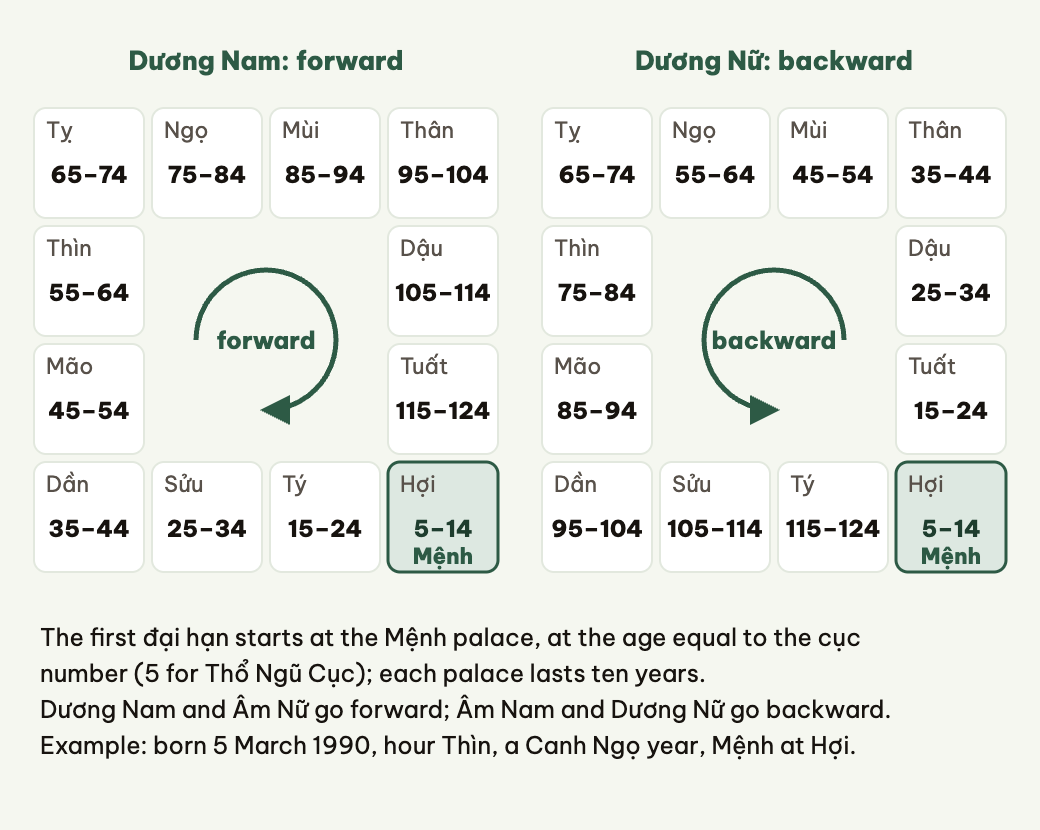
When entering an đại hạn, the đại hạn palace is also assigned a heavenly stem by the same forward-counting principle from the Dần palace based on the stem of the year that opens the đại hạn. That stem is then used to fly the Tứ Hóa for the ten-year period, creating a separate Tứ Hóa layer for the đại hạn. Here the palace stem plays the role of a time marker, not a fixed attribute of the person.
How Do Different Schools Use the Palace Stem Differently?
The degree of use of the palace stem is not the same across schools, and this is where it should be stated clearly rather than lumped together.
The Tam Hợp school uses the palace stem almost only to determine the cục. The palace stem enters the chart, the nạp âm is looked up at the Mệnh palace to get the Ngũ hành cục, and then it almost stops there. The main interpretation methods of this school run on the star system, palace positions, and tam phương tứ chính, without taking the palace stem as an axis.
The Tứ Hóa and Khâm Thiên schools take the palace stem as the axis of Tứ Hóa flying. The stem of each palace is used to fly out the Tứ Hóa, and the network of Tứ Hóa flying between palaces becomes the main interpretation tool. For this school, the palace stem is not only for determining the cục but is also part of the interpretation system.
Regarding the stems of the two palaces Tý and Sửu, some people raise questions because these two palaces have no separate stems. A way of reasoning acknowledges this phenomenon through the concept of Lai Nhân Cung, and states that this palace cannot be at Tý or Sửu. How to handle the repeated stems at these two palaces when flying Tứ Hóa remains a point not fully consistent among documents.
Should the Palace Stem Be Read as Good or Bad?
No. The palace stem is a calculation step; it does not by itself indicate auspiciousness or inauspiciousness. It is the input for determining the cục, flying the Tứ Hóa, and setting the đại hạn stem, but it does not carry independent auspicious or inauspicious content. With the same palace stem, interpretation results can differ depending on the palace position, the accompanying star system, and the school being used. A way of reasoning also emphasizes that defining the auspiciousness or inauspiciousness of Lộc and Kỵ cannot be separated from the palace position, and each transformation has both a reverse and an obverse side. Therefore, assigning good or bad to each palace stem is a leap beyond what this calculation provides.
When Is the Palace Stem Not Used?
In many purely Tam Hợp interpretation methods, the palace stem, after determining the cục, almost does not appear again. In Tứ Hóa interpretation methods, the palace stem appears continuously, but its interpretive value depends on the palace that initiates the flying and the palace that receives the transformation. Some documents also use the palace stem to examine relationships with the birth-year stem or the lưu niên stem, as in the example of Canh Thìn and Bính Thìn mentioned above. These places show that the palace stem is a layer of data that can be exploited at many levels, depending on the school and the purpose of interpretation.


