
What are the four pillars and why must they be built by solar terms?
Tu Tru, also called BaZi, is four pairs of can chi (heavenly stem and earthly branch) recording the year, month, day, and hour of birth. The year pillar is called nien tru, the month pillar nguyet tru, the day pillar nhat tru, and the hour pillar thoi tru. Four pillars make exactly eight characters, which is why the name BaZi exists. The book Dau So Tinh Thanh states that to obtain the four pillars one usually must consult a perpetual calendar, and for Tu Vi Dau So the method of building the four pillars is also debated by different schools in different directions.
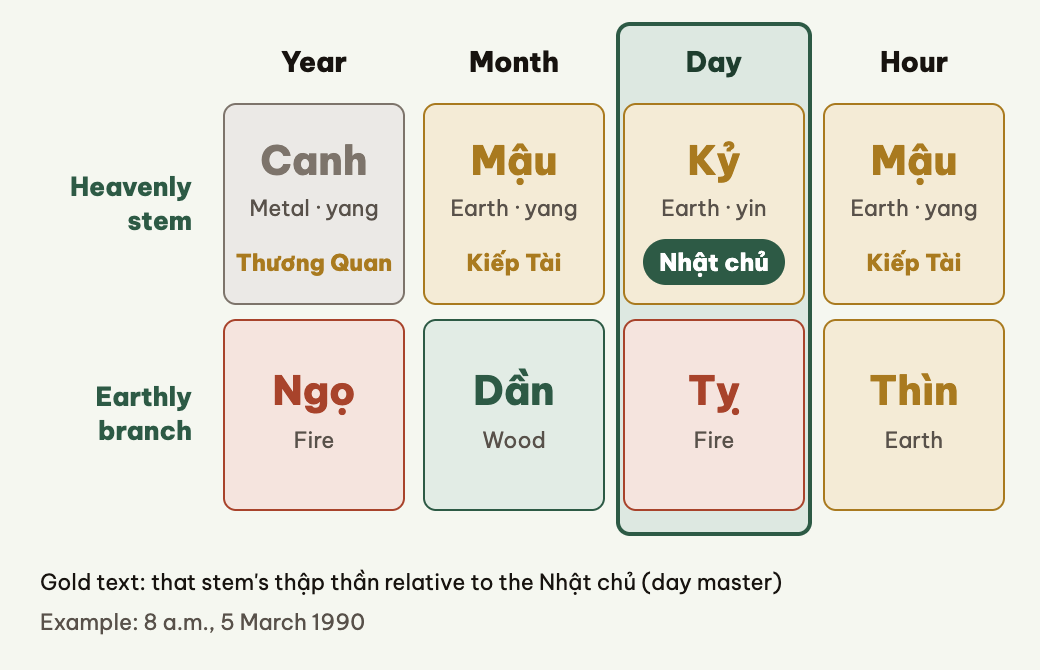
What separates building the four pillars from ordinary calendar lookup is the time marker: BaZi uses neither the administrative marker nor the lunar calendar marker, but the solar term marker. The Earth's orbit around the Sun is cut by solar terms into twenty-four points, two adjacent points fifteen degrees apart, and every two terms combined form one khi month. According to Tuyen Tap Bai Viet BaZi Chon Loc No. 5, when building the four pillars the birth time must be determined very precisely and divided based on solar terms, not merely on the lunar calendar in the usual way.
Does the year pillar change at Lap Xuan or at the first day of Tet?
The year pillar changes at the Lap Xuan solar term, not at the first day of Tet Nguyen Dan. Folk age counting and year-pillar placement in BaZi differ fundamentally on this point.
According to Tuyen Tap Bai Viet BaZi Chon Loc No. 1, the marker of the new year in terms of khi van is not the lunar transition from old year to new year, but Lap Xuan itself. Anyone born before the moment of Lap Xuan keeps the old year's pillar; anyone born after that moment has moved to the new year's pillar. This book gives an example: suppose Lap Xuan of the Dinh Hoi year falls on the 17th day of the twelfth lunar month at 3:30 a.m.; then a person born the same day at 3 a.m. still keeps the Dinh Hoi year pillar, while a person born at 4 a.m. the same day has already moved to the Mau Ty year pillar.
Tuyen Tap Bai Viet Kinh Dich Chon Loc No. 1 also records the same convention: the lunar year is counted from the day of Lap Xuan, not from the first day of Tet Nguyen Dan, so a person born before Lap Xuan still belongs to the old lunar year's age. The consequence is that two people born a few clock hours apart, one before and one after the moment of Lap Xuan, can carry two completely different year pillars, and the entire interpretation that follows differs as well.
Does the month pillar change at the solar term or by lunar month?
The month pillar changes at the solar term, not the lunar month. Specifically, the twelve months in BaZi are marked by twelve terms, each term opening one khi month:
| Khi month | Opening term | Earthly branch of the month |
|---|---|---|
| First month | Lap Xuan | Dan |
| Second month | Kinh Trap | Mao |
| Third month | Thanh Minh | Thin |
| Fourth month | Lap Ha | Ti |
| Fifth month | Mang Chung | Ngo |
| Sixth month | Tieu Thu | Mui |
| Seventh month | Lap Thu | Than |
| Eighth month | Bach Lo | Dau |
| Ninth month | Han Lo | Tuat |
| Tenth month | Lap Dong | Hoi |
| Eleventh month | Dai Tuyet | Ty |
| Twelfth month | Tieu Han | Suu |
The earthly branch of the month pillar is therefore fixed by the term: passing Lap Xuan moves to the Dan branch, passing Kinh Trap moves to the Mao branch, regardless of the lunar date. The stem of the month pillar is what must be derived, and the derivation relies on the stem of the year pillar.
How is the month stem derived from the year stem by Ngu Ho Don?
The month stem is derived from the year stem by the Ngu Ho Don mnemonic, the rule for determining the stem of the Dan month, then counting forward for the remaining months.
Ngu Ho Don has five lines, each corresponding to a pair of year stems:
- Giap or Ky year: the Dan month starts as Binh Dan.
- At or Canh year: the Dan month starts as Mau Dan.
- Binh or Tan year: the Dan month starts as Canh Dan.
- Dinh or Nham year: the Dan month starts as Nham Dan.
- Mau or Quy year: the Dan month starts as Giap Dan.
Tuyen Tap Bai Viet Kham Thien Tu Hoa Chon Loc No. 3 explains the basis of this rule through the five-element combination: Giap and Ky combine into Tho (Earth), so counting forward from Binh Dan to the Thin position gives Mau Thin, and Mau belongs to Tho; At and Canh combine into Kim (Metal), so counting from Mau Dan to Thin gives Canh Thin, and Canh belongs to Kim; Binh and Tan combine into Thuy (Water), so counting from Canh Dan to Thin gives Nham Thin, and Nham belongs to Thuy. This explanation shows Ngu Ho Don is not purely a mechanical count but tied to the combination relations of the heavenly stems.
Below is the month stem table derived from the year stem, built directly from the calculation core rather than typed by hand:
| Year stem | Dan | Mao | Thin | Ti | Ngo | Mui | Than | Dau | Tuat | Hoi | Ty | Suu |
|---|---|---|---|---|---|---|---|---|---|---|---|---|
| Giap, Ky | Binh | Dinh | Mau | Ky | Canh | Tan | Nham | Quy | Giap | At | Binh | Dinh |
| At, Canh | Mau | Ky | Canh | Tan | Nham | Quy | Giap | At | Binh | Dinh | Mau | Ky |
| Binh, Tan | Canh | Tan | Nham | Quy | Giap | At | Binh | Dinh | Mau | Ky | Canh | Tan |
| Dinh, Nham | Nham | Quy | Giap | At | Binh | Dinh | Mau | Ky | Canh | Tan | Nham | Quy |
| Mau, Quy | Giap | At | Binh | Dinh | Mau | Ky | Canh | Tan | Nham | Quy | Giap | At |
Checking each cell of this table against the month can chi table in the Wikipedia article Sexagenary cycle, they match: the Dan month of a Giap or Ky year is Binh Dan, the Dan month of an At or Canh year is Mau Dan, and so on through the sixty-cycle. The mnemonic "Giap Ky hoan gia Giap" mentioned in Uyen Hai Tu Binh Toan Tap belongs to the Ngu Thu Don rule used for hours, not months, so the two mnemonics must be clearly distinguished: Ngu Ho Don for months, Ngu Thu Don for hours.
How is the day pillar counted continuously through the sixty-cycle?
The day pillar is counted continuously through the Luc Thap Hoa Giap (60-cycle), independent of the year stem or month stem. The sixty-cycle is the least common multiple of the ten heavenly stems and twelve earthly branches, so pairing stems with branches in order gives sixty combinations before returning to Giap Ty. Because ten and twelve share only the common factor two, only stem-branch pairs of the same parity can pair together, and pairs of differing parity such as Giap with Suu do not appear in the cycle. The Wikipedia article Sexagenary cycle sets out this structure clearly.
It is worth noting that the day pillar runs continuously, not interrupted at Lap Xuan or at any term. A day in BaZi is always one stem-branch combination in the sixty-cycle, and the next day is the combination immediately after. Determining the day pillar therefore requires a known base point, then counting forward or backward to the day sought.
How is the hour stem derived from the day stem by Ngu Thu Don?
The hour stem is derived from the day stem by the Ngu Thu Don mnemonic, the rule for determining the stem of the Ty hour, then counting forward for the remaining hours. The earthly branch of the hour is fixed: Ty, Suu, Dan, Mao, Thin, Ti, Ngo, Mui, Than, Dau, Tuat, Hoi, each hour two clock hours long.
Dau So Tinh Thanh records the Ngu Thu Don mnemonic as: "Giap Ky hoan gia Giap, At Canh Binh tac so, Binh Tan thoi Mau Ty, Dinh Nham Canh Ty cu, Mau Quy khoi Mau Ty". The meaning is: on a Giap or Ky day the Ty hour is Giap Ty; on an At or Canh day the Ty hour is Binh Ty; on a Binh or Tan day the Ty hour is Mau Ty; on a Dinh or Nham day the Ty hour is Canh Ty; on a Mau or Quy day the Ty hour is Nham Ty. This book also notes that within the same day, roughly 0:01 to 1:00 and roughly 23:01 to 24:00 both belong to that day's Ty hour, while from 24:01 onward is the next day's Ty hour. This is the book's view, and as the section below shows, not every school follows it.
The hour stem table derived from the day stem, built from the calculation core:
| Day stem | Ty | Suu | Dan | Mao | Thin | Ti | Ngo | Mui | Than | Dau | Tuat | Hoi |
|---|---|---|---|---|---|---|---|---|---|---|---|---|
| Giap, Ky | Giap | At | Binh | Dinh | Mau | Ky | Canh | Tan | Nham | Quy | Giap | At |
| At, Canh | Binh | Dinh | Mau | Ky | Canh | Tan | Nham | Quy | Giap | At | Binh | Dinh |
| Binh, Tan | Mau | Ky | Canh | Tan | Nham | Quy | Giap | At | Binh | Dinh | Mau | Ky |
| Dinh, Nham | Canh | Tan | Nham | Quy | Giap | At | Binh | Dinh | Mau | Ky | Canh | Tan |
| Mau, Quy | Nham | Quy | Giap | At | Binh | Dinh | Mau | Ky | Canh | Tan | Nham | Quy |
Checking each cell against the hour can chi table in the Wikipedia article Sexagenary cycle, they match completely: the Ty hour of a Giap day is Giap Ty, the Ty hour of an At day is Binh Ty, and so on. One can cross-check independently: the hour stem table above is in fact the month stem table shifted by two palaces, because both rest on the same principle of pairing stems through the cycle. This overlap is a way to self-check when programming or looking up by hand.
Does the Ty hour change the day at 23:00 or at 00:00?
This is where schools disagree. There are two understandings of the Ty hour, usually called tao Ty and van Ty.
In the tao Ty naming, the Ty hour begins at 23:00 the previous night, meaning 23:00 has already entered the new day. In the van Ty naming, the Ty hour begins at 00:00, meaning 23:00 to 24:00 still belongs to the old day, and the day changes only when the clock strikes 00:00. Dau So Tinh Thanh advocates taking 00:00 as the day-change marker, and states clearly that this differs from the method of deriving the four pillars in menh ly. Thus that book itself acknowledges that in menh ly four-pillar work a different calculation exists.
On ly so forums this question is raised quite often. A discussion on Ly So Viet Nam raises the case of a baby born at 23:02, and the respondent states that under the default time frame 23:00 to 1:00 is the next day's Ty hour, meaning 23:00 is the start of the new day, but also notes that this is speaking in terms of technical calculation and the default time frame, not that 22:59 mechanically belongs to the Hoi hour and 23:01 to the Ty hour.
For the chart builder, this is a decision that must be settled before calculating. This site's calculation core chooses the 23:00 marker: from 23:00 onward the new day is counted, so the Ty hour belongs to the next day. This choice must be remembered when comparing results with another tool using the 00:00 marker, because the same birth moment can give two different day pillars, and therefore two different charts.
Is there a conversion to true solar time by birth longitude?
This too is where schools disagree, and where the practical effect is larger than beginners usually think.
Clock time is administrative time, divided evenly by time zone. The time of the ancients was measured locally, based on the sun's shadow. Within the same time zone, two places differing in longitude have different true solar times: each degree of longitude corresponds to four minutes, so two places four and a half degrees apart in longitude have true noon moments about eighteen minutes apart, even though the clocks in both places read the same number. A discussion on Ly So Viet Nam gives the example of Nha Trang and Ha Tien in the same administrative time zone but about eighteen minutes apart in solar time.
The consequence is that for people born near the boundary between two hours, using clock time or true solar time can lead to two different hour pillars. There is also an opinion that the term markers should likewise be converted to local time, because the moment of Lap Xuan is an astronomical event, not an administrative regulation.
This site's calculation core chooses clock time UTC+7, not converted to true solar time by birth longitude. The reason is so that programmed results are consistent and verifiable, and also because most users look up using the time written on the birth certificate. Users who want to try the true solar time method can add or subtract the minutes by longitude themselves, then rebuild the chart to compare.
How must the hour be converted for people born in southern Vietnam before 1975?
People born in southern Vietnam in the period before 1975 must convert the hour, because at that time the South used UTC+8 while the North used UTC+7. A discussion on Ly So Viet Nam records exactly this point: southern time was one hour ahead of northern time, and this was the consequence of an administrative regulation, not of nature.
That means if a document records a time in the South during that period, to build the four pillars by UTC+7 one must subtract one hour. A person born at 1 a.m. by the time on the document in the South may actually be 0:00 by UTC+7, and if falling in a boundary zone this one-hour subtraction can push the hour pillar to another branch, or even push the day pillar to another day if falling near the day-change marker.
Therefore, before building a chart for a person born in the South before 1975, one must check the marker against the Asia/Ho_Chi_Minh time zone data to determine exactly which period used which zone, then convert to UTC+7 before feeding it into the calculation core. This is a mandatory step, not to be skipped, because being one hour wrong can make both the hour pillar and the day pillar wrong.
A sample chart born close to Lap Xuan
To see clearly the effect of the Lap Xuan marker, take a case born close to this moment. Suppose the moment of Lap Xuan of a year falls at 3:30 a.m. on the 17th day of the twelfth lunar month. A person born at 3 a.m. the same day, thirty minutes before Lap Xuan, carries the old year's year pillar. A person born at 4 a.m. the same day, thirty minutes after Lap Xuan, carries the new year's year pillar. These two charts are only one clock hour apart but differ in the year pillar, and because the month stem is derived from the year stem, the month pillar may differ as well.
When built with LapBatTu, the chart of the person born before Lap Xuan gives the old year's stem-branch pair at the year pillar, and the Dan month or Suu month depending on whether the moment is still before or after the term opening the khi month. The chart of the person born after Lap Xuan gives the new year's stem-branch pair at the year pillar, and certainly the Dan month at the month pillar. This example shows why one must look up the moment of the solar term and cannot merely look at the lunar date.
After building the chart correctly, where does one read each pillar?
This article stops where the chart has been built correctly: the four stem-branch pairs have been determined by the correct four steps, with the choices about the day-change marker and time zone stated clearly. The interpretation of each pillar is outside this article's scope.
According to Tuyen Tap Bai Viet BaZi Chon Loc No. 5, each pillar is tied to its own group of aspects: the year pillar is usually tied to ancestors, origins, and the living environment of early life; the month pillar represents career, parents, and the character of adulthood; the day pillar sits at the native themself, spouse, and personal upheavals; and the hour pillar represents children, late-life career, and plans and wishes. Four separate articles on the year pillar, month pillar, day pillar, and hour pillar will go into each of these parts.
It must be stressed that building the four pillars correctly is only a necessary condition. A chart by itself does not state absolute fortune or misfortune, and the same stem-branch combination can correspond to very different circumstances depending on the major cycle, annual cycle, and life context. Tuyen Tap Bai Viet BaZi Chon Loc No. 5 also notes that a chart that looks skewed can still achieve success if there is a resolving factor, while a balanced chart whose khi does not flow can also meet many difficulties.


