Why is the Phu Thê palace the starting point but not the ending point?
The Phu Thê palace, also called the Phối palace or the Marriage palace, is one of the twelve palaces on a Tử Vi chart, representing the native's love relationship, spouse, and married life. Before marriage, this palace can point to a lover or romantic partner; after marriage, it points to the wife or husband. As presented by Tracuutuvi.com, the Phu Thê palace indicates whether the bond is heavy or light, whether it comes early or late, the pattern of how love develops, and partly the personality, talents, views, and marriage expectations of the spouse.
But reading the Phu Thê palace alone is very easy to get wrong. There is a way of reading that speaks of a "marriage-defining triangle" consisting of Mệnh, Phu Thê, and Phúc Đức, in which the Mệnh palace is also seen as the "Phúc Đức of Phu Thê", reflecting the spouse's thinking and outlook. In other words, to understand your partner you must first understand yourself, because the Mệnh palace is the root of all interpretation.
What are the four palaces that surround Phu Thê, and in what order should they be read?
According to Tracuutuvi.com, the tam phương of the Phu Thê palace consists of Phu Thê, Thiên Di, and Phúc Đức; the opposite palace of Phu Thê is Quan Lộc. These are the four palaces to open right after examining the home palace.
- Phúc Đức: the "qi-position" of Phu Thê. To know whether the marriage is auspicious or inauspicious, whether fortunes rise or fall, whether the bond is lasting or full of ups and downs, one must also read Phúc Đức.
- Thiên Di: within the tam hợp of Phu Thê, used to see affinity with the opposite sex, the external environment, the movement of romantic destiny, and the impact of outside circumstances on the relationship.
- Quan Lộc: the opposite palace, showing the external affinity and external behavior of the relationship. Tracuutuvi.com notes that books also use Quan Lộc to look at outside relationships and cases of divorce and remarriage.
- Tài Bạch: not among the four palaces above, but Tracuutuvi.com holds that it should also be read when assessing the degree of mutual treatment, interaction, and weight between the two people, because Tài Bạch is the "position of how affection is treated". When Tài Bạch is bad, according to this site, it can break affection more strongly than the Phu Thê home palace itself.
There is also a way of reading that stresses that the Phu Thê palace speaks not only of destiny and personality but also hints at the "outcome after marriage", including the ups and downs and trials of married life. This approach matches Tracuutuvi.com's guidance: one must combine Phu Thê, Phúc Đức, Thiên Di, Quan Lộc, and additionally Tài Bạch, rather than looking at a single palace.
Table of Phu Thê palace positions by Mệnh palace
| Mệnh palace located at | Phu Thê palace located at | Four palaces surrounding Phu Thê |
|---|---|---|
| Tý | Thìn | Quan Lộc at Tuất, Thiên Di at Thân, Phúc Đức at Tý |
| Sửu | Tỵ | Quan Lộc at Hợi, Thiên Di at Dậu, Phúc Đức at Sửu |
| Dần | Ngọ | Quan Lộc at Tý, Thiên Di at Tuất, Phúc Đức at Dần |
| Mão | Mùi | Quan Lộc at Sửu, Thiên Di at Hợi, Phúc Đức at Mão |
| Thìn | Thân | Quan Lộc at Dần, Thiên Di at Tý, Phúc Đức at Thìn |
| Tỵ | Dậu | Quan Lộc at Mão, Thiên Di at Sửu, Phúc Đức at Tỵ |
| Ngọ | Tuất | Quan Lộc at Thìn, Thiên Di at Dần, Phúc Đức at Ngọ |
| Mùi | Hợi | Quan Lộc at Tỵ, Thiên Di at Mão, Phúc Đức at Mùi |
| Thân | Tý | Quan Lộc at Ngọ, Thiên Di at Thìn, Phúc Đức at Thân |
| Dậu | Sửu | Quan Lộc at Mùi, Thiên Di at Tỵ, Phúc Đức at Dậu |
| Tuất | Dần | Quan Lộc at Thân, Thiên Di at Ngọ, Phúc Đức at Tuất |
| Hợi | Mão | Quan Lộc at Dậu, Thiên Di at Mùi, Phúc Đức at Hợi |
The table above is built on the rule that the Phu Thê palace always lies four positions clockwise from the Mệnh palace, the Quan Lộc palace is symmetric with Phu Thê across the Mệnh axis, and Thiên Di and Phúc Đức fill the two remaining corners of the tam hợp. When checking a chart, simply match the position of the Mệnh palace to derive the whole set of five palaces to read.
Which stars are commonly considered love stars?
Tracuutuvi.com lists the group of stars governing love as Đào Hoa, Hồng Loan, Hỷ Thần, Long Đức, and Nguyệt Đức; when one of these stars appears in the Mệnh, Thân, or Nô Bộc palace, that year is considered to bring love. The group governing marriage matters includes Phượng Các, Thanh Long, and Long Trì; when the tiểu hạn has one of these three stars, that year is considered to have marriage developments, and one must additionally check the lưu niên đại vận before concluding.
There is a passage discussing Hồng Loan and Thiên Hỷ as a pair of stars that often travel together, carrying the meaning of happy events and marriage. The same source records a view that Hồng Loan governs marriage, while Thiên Hỷ leans toward joy, increase in household members, and sometimes early marriage. However, the book also notes that the presence of these two stars is not always an absolutely auspicious sign, but must be placed in the overall chart, considering interaction with other stars and position within the palace.
Regarding Hàm Trì, Thiên Diêu, and Đào Hoa, Tracuutuvi.com places Đào Hoa in the love-star group. The position of Đào Hoa by birth year branch is set according to the table below:
| Birth year branch | Đào Hoa position |
|---|---|
| Tý | Dậu |
| Sửu | Ngọ |
| Dần | Mão |
| Mão | Tý |
| Thìn | Dậu |
| Tỵ | Ngọ |
| Ngọ | Mão |
| Mùi | Tý |
| Thân | Dậu |
| Dậu | Ngọ |
| Tuất | Mão |
| Hợi | Tý |
Cô Thần and Quả Tú, by contrast, are placed by Tracuutuvi.com in the group of "stars obstructing marriage matters". According to this site, if that year a love path has appeared, or the two people have loved each other for many years, yet the tiểu vận meets one of the three stars Đẩu Quân, Quả Tú, or Cô Thần, they usually cannot come together. The book Tử vi đẩu số Mệnh vận phân tích (Từ Tăng Sinh) also mentions the lone-and-widowed star group including Vũ Khúc, Thất Sát, and lone-seated malefic stars; if the Phu Thê palace of the đại hạn or lưu niên falls into this state, that year it is hard to form a pair.
However, it must be said clearly that these are conventions of each school and each book, not absolute truth. The same Hồng Loan star is placed in relation to Thiên Hỷ, with a warning against one-sided understanding.com places it in the love-star group together with Đào Hoa, Hỷ Thần, Long Đức, and Nguyệt Đức. Readers should note both presentations rather than choosing one.
How to trace a year with marriage events through đại hạn and lưu niên
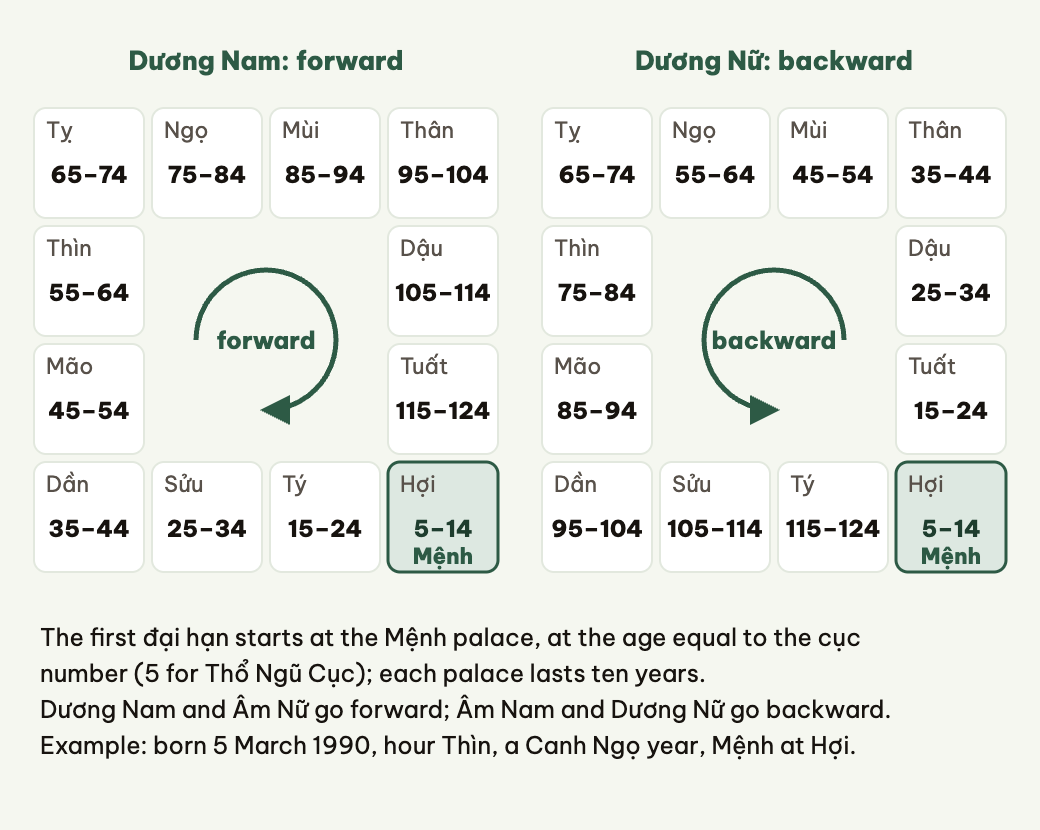
Tracuutuvi.com guides how to find the tiểu hạn: males go clockwise, females go counterclockwise, two years return to the old position, starting from ages 1, 13, 25, 37, 49, 61, 73, 85, 97. The tiểu hạn relies on the four tam hợp Hợi Mão Mùi, Dần Ngọ Tuất, Thân Tý Thìn, Tỵ Dậu Sửu. Each age tam hợp starts the first year of the cycle from the palace opposite the last branch in the tam hợp; for example, the Dần Ngọ Tuất group starts tiểu hạn at Thìn, the Hợi Mão Mùi group starts tiểu hạn at Sửu. Regarding lưu niên đại vận, this site describes the đại vận cycle divided into twelve palaces, each palace being a ten-year đại vận, and the lưu niên đại vận is the development of that đại vận within one year; the calculation depends on Âm Dương and gender.
The book Tử vi đẩu số Mệnh vận phân tích (Từ Tăng Sinh) gives a two-step procedure for examining a year's marriage fortune. In the first step, successively determine the Phu Thê palace of the đại hạn and the Phu Thê palace of the lưu niên, then examine the characteristics of the stars placed there. If inside there are lone-and-widowed stars such as Vũ Khúc, Thất Sát, lone-seated malefic stars, or the tam phương of the Mệnh palace gathers all three kinds of stars, then forming a bond that year is very hard. In the second step, check whether Hóa Kỵ according to the heavenly stem of the đại hạn Phu Thê palace clashes into the lưu niên Phu Thê palace; if there is a clash, one must wait until the next year. If the heavenly stem of the lưu niên Phu Thê palace carries the three auspicious transformation stars (Lộc, Quyền, Khoa) entering the Mệnh, Phu Thê, Phúc Đức, Quan Lộc, and Tài Bạch palaces, then marriage signs all appear.
This book also gives another tracing method: since most people today meet first and then consider marriage, when seeking the marriage year, the first thing is to examine Tứ Hóa by the stem of the Nô Bộc palace to see whether they enter Mệnh or the Phu Thê palace. If Hóa Kỵ clashes into the Phu Thê palace, most do not form a pair; if Hóa Kỵ does not clash into the Phu Thê palace, we then trace Tứ Hóa by the stem of the lưu niên Phu Thê palace, and if they all enter the tam hợp of the original Mệnh or the palace opposite the year's position, it is considered to meet the conditions for marriage.
The Tứ Hóa school uses the Phu Thê palace stem to transform and trace three layers of Hóa Kỵ
According to Từ Tăng Sinh's book Tử vi đẩu số Mệnh vận phân tích, when interpreting marriage, the stem of the Phu Thê palace is used to transform. This book explains Hóa Lộc as idea, Hóa Quyền as action and achievement, and Hóa Kỵ as carrying the meaning of "sticking together"; when Hóa Kỵ enters a palace position related to marriage, there is a chance to bind the partner. This is a different view from the common understanding that Hóa Kỵ is only bad.
The phenomenon of multi-layered Kỵ clash is illustrated with an example: the innate Phu Thê palace transforms Kỵ into the đại hạn Phu Thê palace, and at the same time the đại hạn Phu Thê palace self-transforms Kỵ clashing into itself. According to a master quoted by the book, if the transforming palace clashes two layers of Kỵ into Phu Thê, it is hard to be a good matter. The appearance of Kỵ overlapping at both layers proves that this đại hạn has upheaval, difficulty, or deep entanglement in the marriage relationship; however, the book also reminds that Hóa Kỵ inherently carries the meaning of hardship and toil, not always of losing one of the pair.
There are some ways of reading Hóa Kỵ entering Phu Thê: it can indicate deep entanglement with the spouse, the spouse having poor health or being clumsy and careless, easily envied; many difficulties before marriage but still able to marry; a spouse with a good career will support oneself. The same book also records the case of Hóa Kỵ entering the opposite palace, where the spouse follows every step very closely, meaning there is entanglement and control from the other side. These are arguments of one school, not a general rule for everyone.
What does Vương Đình Chi say about Hồng Loan and Thiên Hỷ as marriage-year indicators?
According to records in Tracuutuvi.com, the love-star group includes Đào Hoa, Hồng Loan, Hỷ Thần, Long Đức, and Nguyệt Đức, and the marriage-star group includes Phượng Các, Thanh Long, and Long Trì. The common practice is that when the tiểu hạn has one of the three stars Phượng Các, Thanh Long, or Long Trì, that year has marriage developments, then one additionally checks the lưu niên đại vận to conclude.
However, one important note must be stated clearly: according to records of Tử Vi researchers, Vương Đình Chi holds that using Hồng Loan and Thiên Hỷ as marriage-year indicators often does not manifest. This means that although Hồng Loan and Thiên Hỷ are seen as the pair of stars governing marriage and happy events, using just these two stars to determine the marriage year is still a controversial practice and not always correct. Readers should note this is a point where schools disagree, rather than presenting it as if there were only one way.
The method of pairing two charts and Thái Tuế nhập quái
A single chart is not enough to conclude marriage tendencies, because marriage is the interaction of two destinies. From this observation, modern Tử Vi practitioners developed the Tương Khê theory and the Thái Tuế nhập quái method. According to Horos.vn, the Tương Khê theory was developed by Tử Vân tiên sinh around 1990, stressing that a person's marriage destiny does not exist independently but is always influenced by the destiny of the spouse. When two people marry or bond in love for a long time, their charts "tương khê" with each other, creating mutual effects that change each person's life tendencies.
According to Horos.vn, before the Tương Khê theory, Tử Vi masters often found it difficult to explain why two people born at the same hour, with the same chart, have different married lives. The Tương Khê theory and the Thái Tuế nhập quái method were put forward to solve this problem. The application is to always analyze the couple in parallel: compare the Mệnh palace, Phu Thê palace, and fortune periods of the two people to see the overall picture. Horos.vn gives an example: if the male chart shows the wife has a strong personality, we compare whether the female chart has a configuration suitable for that role; if one person has a rich romantic destiny, we must consider whether the other person's chart can accept that or will create jealousy and instability.
This is a modern approach, not a classical rule, and should also be read as a reference tool rather than a verdict. Even Horos.vn stresses that a single chart is not enough to conclude marriage tendencies.
So can a chart decide marriage, divorce, or who suits you?
No. No chart can decide marriage, divorce, or who suits you. A Tử Vi chart describes tendencies, context, patterns of reaction, and points to note in a relationship; it is not a pre-signed contract. The books and websites cited above all present different ways of interpretation, some agreeing, some conflicting, and that very diversity shows this is a field of interpretation rather than a precise predictive science.
Therefore, a chart should not be used to force a marriage to happen, nor to forbid a marriage. Consulting a chart should only serve as reference to understand oneself, understand the other, recognize points of friction, and proactively adjust one's behavior. The final decision always belongs to the person, and so does responsibility for the relationship.