
What do the first three lines of a Tử Vi chart contain?
The first three lines of a Tử Vi chart record three different pieces of background data: the yin yang male female quality of the native, the ngũ hành cục of the Mệnh palace, and the bản mệnh nạp âm of the year of birth. They are not three names for the same thing but three independent data points, each intervening at a different stage of building and reading a chart. Misreading any one of them can throw off the entire star placement that follows.
These lines are usually printed right below the native's name and birth date and time. Beginners often skip them because they look like administrative detail, when in fact they are the keys to constructing the rest of the chart.
What is yin yang male female, and what does it decide?
Yin yang male female is the yin yang quality of the year of birth combined with gender, and it decides the direction in which major periods and the Tràng Sinh and Bác Sĩ rings run. This is the information that determines whether the chart is read forward or backward, so a mistake here shifts the whole fortune section.
Two ways of determining the yin yang quality of the year of birth currently coexist. The common way on today's online chart generators takes the last digit of the year of birth: an odd number is a Yin year, an even number a Yang year. The second way, mentioned in the book Địa Lý Gia Truyền Bí Thư Đại Toàn, looks at the pairing of the can and chi of the year of birth: a Yang can paired with a Yin chi gives Yang Male or Yin Female, a Yin can paired with a Yang chi gives Yin Male or Yang Female. These two methods do not always agree, and this is one point on which schools have not settled.
On palace convention, the Yang palaces are Tý, Dần, Thìn, Ngọ, Thân, Tuất; the Yin palaces are Sửu, Mão, Tỵ, Mùi, Dậu, Hợi. When the yin yang quality of the year of birth matches the yin yang quality of the palace where Mệnh is placed, we have âm dương thuận lý; when they diverge, we have âm dương nghịch lý.
Where is ngũ hành cục calculated from?
Ngũ hành cục is calculated from the can of the year of birth paired with the chi of the palace where Mệnh is placed, looked up by the nạp âm element of that can chi pair. The book Đẩu số tinh thành (Thiên Hỏa Đồng Nhân) presents this method very compactly: take the can of the Mệnh palace as the row, the chi of the Mệnh palace as the column, and the intersection gives the ngũ hành cục. For example, a Mệnh palace with can Giáp and chi Tý gives Kim tứ cục; can Giáp and chi Dần gives Thủy nhị cục.
A clear distinction is needed: the can used to look up cục is the can of the Mệnh palace, not the can of the year of birth. The can of the Mệnh palace is itself derived from the can of the year of birth through the method of placing the Mệnh palace, so in practice cục still depends indirectly on the year of birth, but the same year of birth does not always give the same cục. Two people born in the same year but different months and hours can have their Mệnh palace in two different branches and therefore two different cục.
Table for looking up cục by the can and chi of the Mệnh palace, reconstructed from the table in Đẩu số tinh thành:
| Can of Mệnh palace | Tý, Sửu | Dần, Mão | Thìn, Tỵ | Ngọ, Mùi | Thân, Dậu | Tuất, Hợi |
|---|---|---|---|---|---|---|
| Giáp, Ất | Kim tứ cục | Thủy nhị cục | Hỏa lục cục | Kim tứ cục | Thủy nhị cục | Hỏa lục cục |
| Bính, Đinh | Thủy nhị cục | Hỏa lục cục | Thổ ngũ cục | Thủy nhị cục | Hỏa lục cục | Thổ ngũ cục |
| Mậu, Kỷ | Hỏa lục cục | Thổ ngũ cục | Mộc tam cục | Hỏa lục cục | Thổ ngũ cục | Mộc tam cục |
| Canh, Tân | Thổ ngũ cục | Mộc tam cục | Kim tứ cục | Thổ ngũ cục | Mộc tam cục | Kim tứ cục |
| Nhâm, Quý | Mộc tam cục | Kim tứ cục | Thủy nhị cục | Mộc tam cục | Kim tứ cục | Thủy nhị cục |
This table shows that cục has only five values: Thủy nhị cục, Mộc tam cục, Kim tứ cục, Thổ ngũ cục, Hỏa lục cục. The number attached is not random; it is tied to the age at which major periods begin, as shown below.
How does cục fix the position of the Tử Vi star?
According to Đẩu số tinh thành, once cục is known, the chart builder pairs cục with the lunar day of birth to look up the position of the Tử Vi star. The book gives an example: someone of Thủy cục born on the first day has Tử Vi in Sửu, born on the second day has Tử Vi in Dần, born on the third day also in Dần. In other words, cục and day of birth are two coordinates fixing Tử Vi, not the day of birth alone.
Some forum materials go further, holding that the position of the Tử Vi star is what actually determines the nature of cục, while the ngũ hành number is only an outer layer of expression. This view is not the common reading in Tử Vi textbooks and has not been widely tested, so learners should know it for reference rather than adopt it as a standard in place of the cục lookup table.
How does cục decide the starting age of major periods and the Tràng Sinh ring?
The number of cục is the age at which major periods begin. Thủy nhị cục starts major periods at age 2, Mộc tam cục at 3, Kim tứ cục at 4, Thổ ngũ cục at 5, Hỏa lục cục at 6. Each major period lasts ten years, and twelve major periods complete one circuit of the twelve palaces.
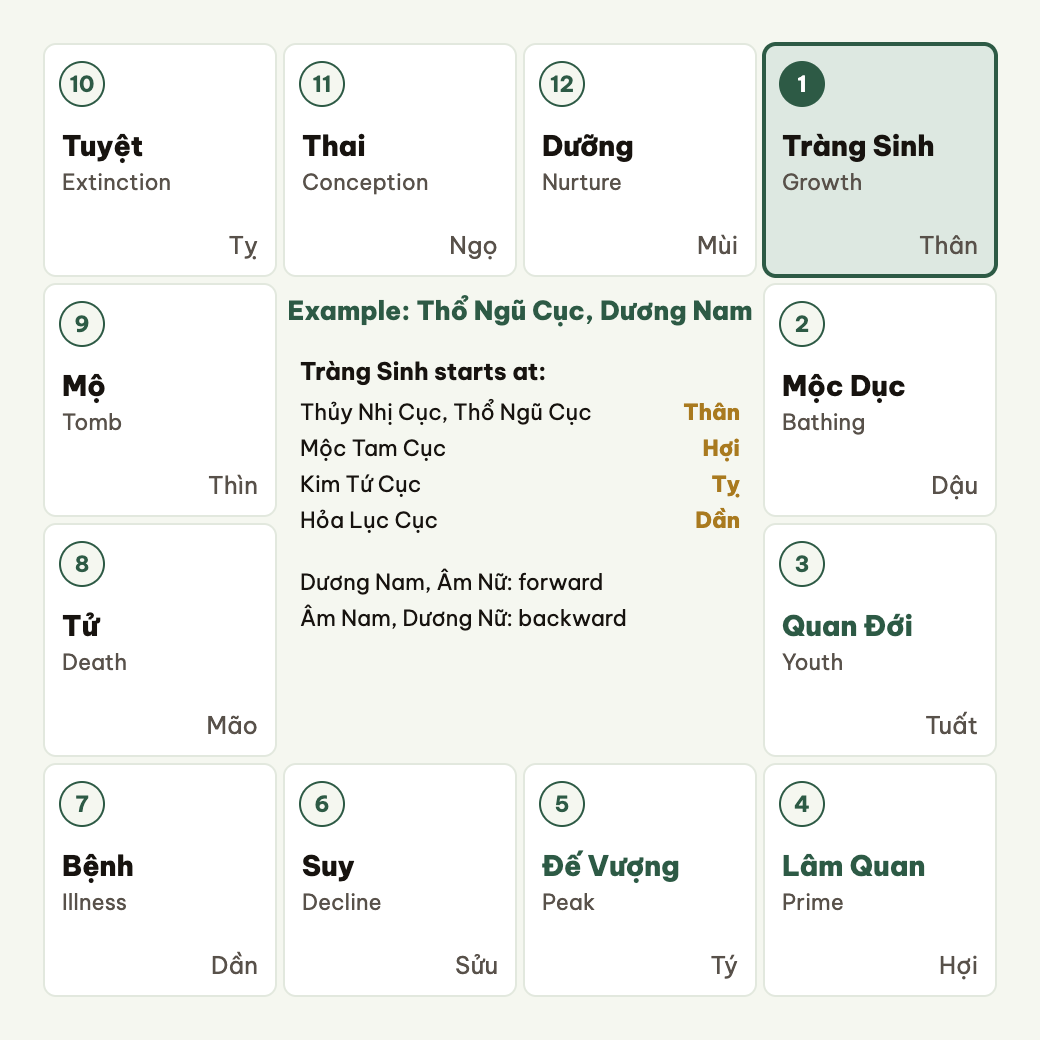
Table comparing cục with the starting age of major periods and the first six stages:
| Cục | Starting age | Stage 1 | Stage 2 | Stage 3 | Stage 4 | Stage 5 | Stage 6 |
|---|---|---|---|---|---|---|---|
| Thủy nhị cục | 2 | 2 to 11 | 12 to 21 | 22 to 31 | 32 to 41 | 42 to 51 | 52 to 61 |
| Mộc tam cục | 3 | 3 to 12 | 13 to 22 | 23 to 32 | 33 to 42 | 43 to 52 | 53 to 62 |
| Kim tứ cục | 4 | 4 to 13 | 14 to 23 | 24 to 33 | 34 to 43 | 44 to 53 | 54 to 63 |
| Thổ ngũ cục | 5 | 5 to 14 | 15 to 24 | 25 to 34 | 35 to 44 | 45 to 54 | 55 to 64 |
| Hỏa lục cục | 6 | 6 to 15 | 16 to 25 | 26 to 35 | 36 to 45 | 46 to 55 | 56 to 65 |
The remaining six stages continue by adding ten years each, completing the circuit of the twelve palaces. The direction of these stages is decided by yin yang male female, as noted above.
Cục is also the marker for starting the Tràng Sinh ring. The Tràng Sinh ring has twelve stages: Tràng Sinh, Mộc Dục, Quan Đới, Lâm Quan, Đế Vượng, Suy, Bệnh, Tử, Mộ, Tuyệt, Thai, Dưỡng. The starting point of this ring depends on cục, so two people of different cục will have the Tràng Sinh ring placed in two different positions even on the same day of birth.
What is bản mệnh nạp âm used for?
Bản mệnh nạp âm is the element of the can and chi of the year of birth, looked up in the Lục Thập Hoa Giáp, and it differs from cục. Cục takes the can and chi of the Mệnh palace, while bản mệnh takes the can and chi of the year of birth. Each element in nạp âm is further divided into six types, thirty in all across the five elements; for example, the Kim element has Sa trung kim, Kim bạc kim, Hải trung kim, Kiếm phong kim, Bạch lạp kim, Thoa xuyến kim; the Thủy element has Thiên hà thủy, Đại khê thủy, Đại hải thủy, Giản hạ thủy, Tuyền trung thủy, Trường lưu thủy.
In the common understanding, bản mệnh is the native's essence, while cục is the circumstances and living environment the native constantly encounters. Ngũ hành cục also carries directional meaning: Thủy nhị cục leans toward wisdom, Mộc tam cục toward benevolence, Kim tứ cục toward righteousness, Thổ ngũ cục toward trust, Hỏa lục cục toward propriety. This is a traditional assignment of meaning, not a scientifically verified conclusion.
How do schools apply the Mệnh Cục comparison differently?
The comparison of the five elements between bản mệnh and cục yields five types: Mệnh cục bình hòa when the two elements are the same, Cục sinh Mệnh, Mệnh sinh Cục, Cục khắc Mệnh, Mệnh khắc Cục. The direction of generation and overcoming follows the five element cycle: Kim generates Thủy, Thủy generates Mộc, Mộc generates Hỏa, Hỏa generates Thổ, Thổ generates Kim; Kim overcomes Mộc, Mộc overcomes Thổ, Thổ overcomes Thủy, Thủy overcomes Hỏa, Hỏa overcomes Kim.
The book Thẩm Trúc Nhưng, Trạch vận tân án (translated and edited by Lê Việt Anh) restates this cycle and notes that it runs one way only: Mộc generates Hỏa but Hỏa does not generate Mộc, Kim overcomes Mộc but Mộc does not overcome Kim. Misreading the direction of effect is the source of many skewed readings.
This is where schools disagree most clearly. Some treat Mệnh cục bình hòa and Cục sinh Mệnh as the two best types, Mệnh sinh Cục as a type that must sacrifice to nourish circumstances, and the two overcoming types as flawed. But other schools hold that this comparison is only a secondary layer of information, its weight depending on whether Mệnh is strong or weak. Some materials give the example of a person born in the year Bính Tý, Mệnh Giang Hà Thủy, cục Thổ, that is Cục khắc Mệnh, but if Mệnh is strong and Cục weak the reading can still lean auspicious. In other words, there is no fixed formula turning a Mệnh Cục pair into an absolute good or bad conclusion.
Why does the number of cục diverge from the ngũ hành numbers in Lạc Thư?
This question has long been raised on metaphysics forums and still has no answer accepted by all schools. According to Lạc Thư, the numbers of Thủy are 1 and 6, and the numbers of Hỏa are 2 and 7. But in Tử Vi, Thủy is nhị cục (2) and Hỏa is lục cục (6). The other three elements match: Mộc is 3, Kim is 4, Thổ is 5.
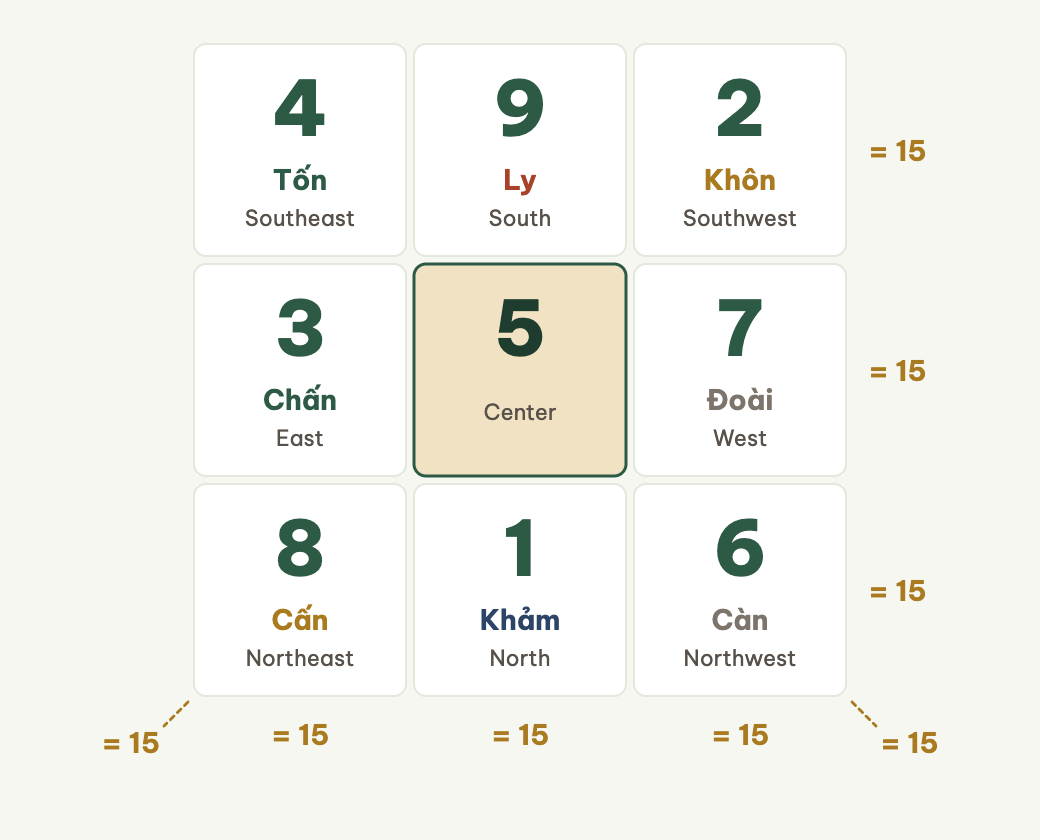
At least three explanations circulate. The first holds that this is merely convention, and convention depends on the coordinate origin, so it need not match Lạc Thư. The second holds that there was a transmission error and proposes swapping Thủy and Hỏa, but swapping would also require changing the nạp âm table of the Lục Thập Hoa Giáp, which would break the logic between can pairing and chi pairing. The third seeks an explanation in another frame of reference, such as studies of Hà Đồ, but has not reached a conclusion accepted by most practitioners.
It is worth noting that Tử Vi textbooks such as Đẩu số tinh thành present the cục lookup table as a given fact, without proof. Learners should know this is an open point of the system, not a settled one.
Is âm dương thuận lý a decisive factor?
Today's online chart generators often state clearly whether the quality is thuận lý or nghịch lý in the thiên bàn section. But how much weight this factor receives varies widely between schools. Some see âm dương thuận lý as a sign of consistency between inner nature and outer expression, hence fewer conflicts and easier favorable conditions. Other schools barely use the concept in reading, treating it as descriptive rather than quantitative.
Even among those who value it, many materials concede it is only a relative influence. Some people are âm dương thuận lý yet indecisive and miss opportunities, while others are nghịch lý but compensate with will and perseverance. So reading the first three lines of a chart should be treated as establishing the frame, not as concluding a person's fate.
In what order should the three factors be combined?
The reasonable order is: determine yin yang male female first to know the direction; look up cục from the can and chi of the Mệnh palace to know the position of the Tử Vi star, the starting point of the Tràng Sinh ring, and the starting age of major periods; then look up bản mệnh nạp âm to compare generation and overcoming with cục. These three steps are independent in data but sequential in logic, and no later step replaces an earlier one.
One point to remember is that all three factors are only a frame. They do not replace star placement, do not replace palace reading, and certainly do not permit absolute conclusions about a person's finances, health, or fortune.


