What are the Ten Gods?
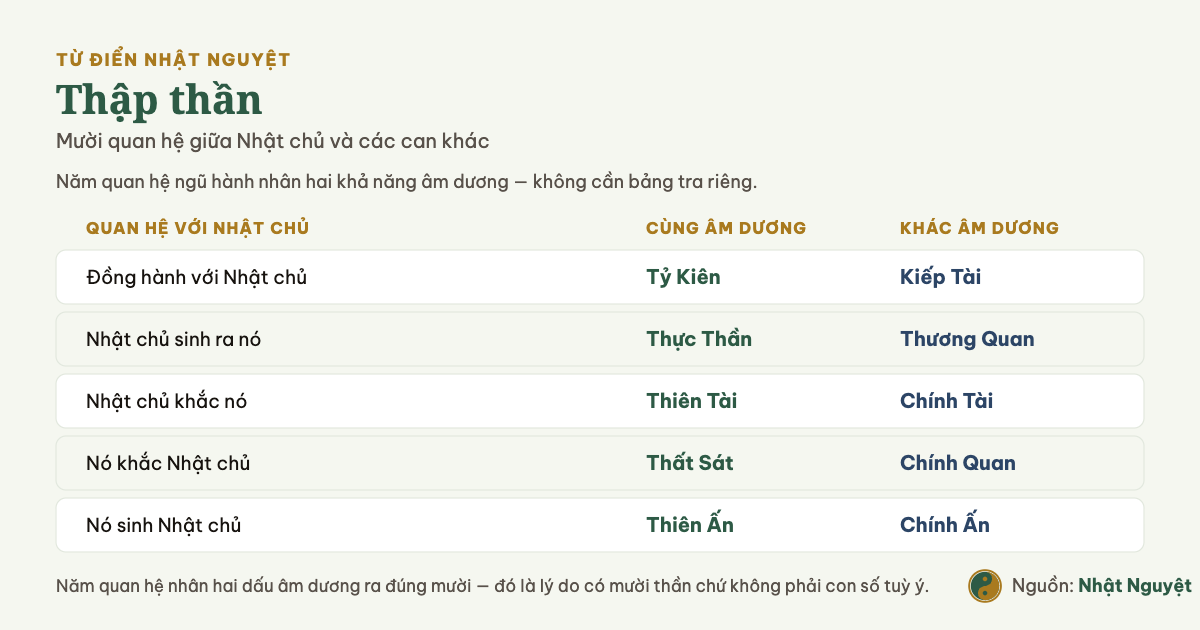
The Ten Gods (十神) are ten relationships of generation and control between the Day Master (the heavenly stem of the birth day) and the other stems and branches in a Four Pillars chart. These ten relationships are: Direct Resource, Indirect Resource, Direct Officer, Indirect Officer (Seven Killings), Direct Wealth, Indirect Wealth, Eating God, Hurting Officer, Friend (Parallel), and Rob Wealth. They are determined based on the five elements and yin-yang of the Day Master compared with each stem and branch, forming a symbolic system to interpret personality, career, wealth, marriage, and social relationships.
Origin and usage
The Ten Gods are not ten deities but ten categories of relationships, originating from the theory of generation and control among the five elements in ancient Eastern philosophy. When constructing a Four Pillars chart, the interpreter takes the day stem as the center, then compares it with other stems and branches to identify each God. Each God carries its own set of meanings: Friend and Rob Wealth relate to self, siblings, friends, and competition; Eating God and Hurting Officer relate to talent, creativity, and self-expression; Direct Wealth and Indirect Wealth relate to wealth and social connections; Direct Officer and Seven Killings relate to authority, pressure, and responsibility; Direct Resource and Indirect Resource relate to learning, protection, and intuition. A common approach is to examine which God is strong or weak, which is well-formed or broken, to make an overall assessment.
Distinguishing from easily confused terms
The Ten Gods are often confused with the "ten stars" in Zi Wei Dou Shu, but these are two different systems: Zi Wei Dou Shu uses stars in twelve palaces, while Four Pillars uses the Ten Gods in four pillars. The Ten Gods also differ from the "five elements" because the five elements only refer to Metal, Wood, Water, Fire, and Earth, while the Ten Gods specify the relationship between the Day Master and other stems and branches into ten categories. Additionally, the Day Master is the center for determining the Ten Gods; it is not one of the ten Gods itself.
Notes for reference
The Ten Gods are traditional knowledge in Four Pillars divination, for reference only, and have not been scientifically verified. Readers should view this as a cultural symbolic system, not use it to decide important life matters.