Why you must determine Yang Dun or Yin Dun before setting up the plate
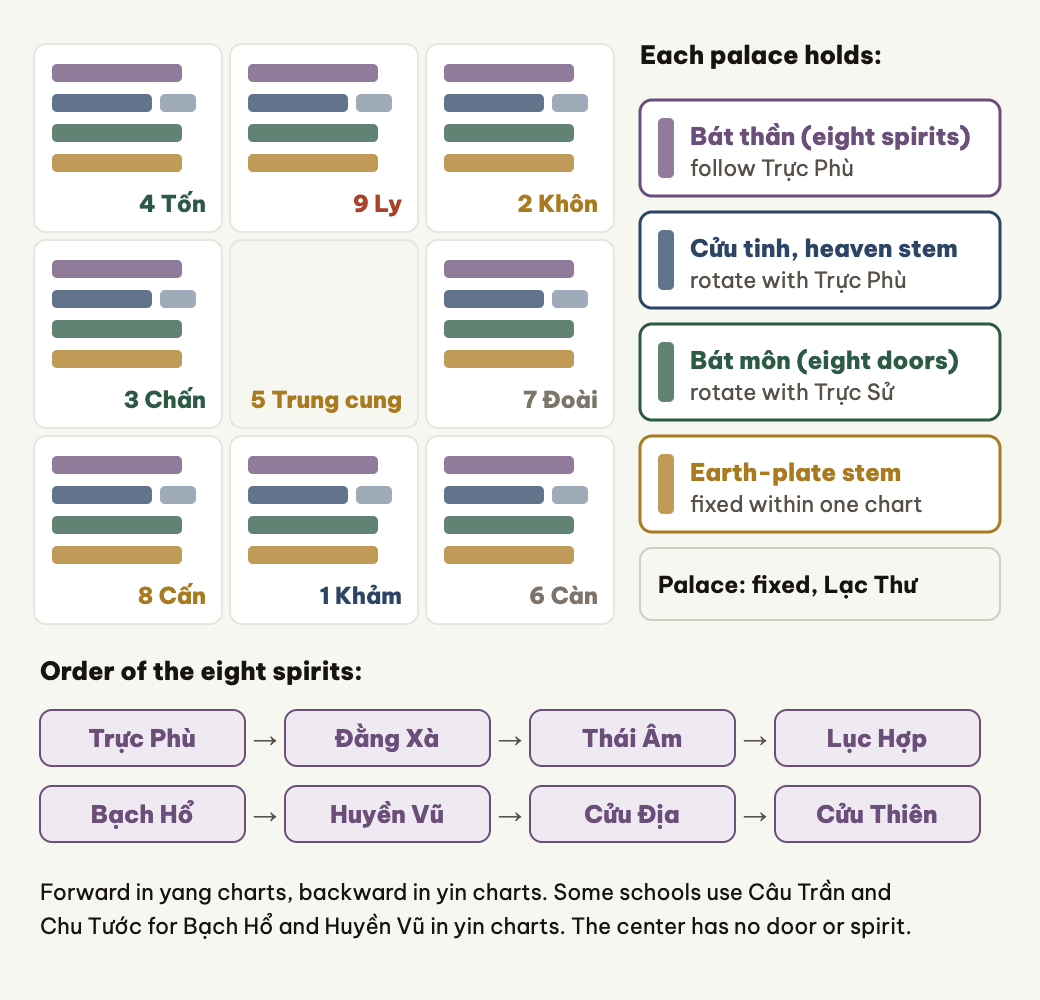
To set up a Qi Men Dun Jia plate for a specific day and hour, the first thing is to know whether you are in Yang Dun or Yin Dun, then which ju number applies. Without these two pieces of information you cannot place the nine stars, eight gates and eight spirits onto the nine palaces. The book Qi Men Zhi Gui, volume 1, opens its section on determining the ju by stating clearly: in fixing the Qi Men ju, the solar term and the fu tou are the two most essential matters, because the three yuan of the fu tou have a fixed cycle while the solar terms of the four seasons are not fixed, so one must master the correct receiving method before using super spirit, qi continuation, cutting and supplementing, and leap ju to adjust for alignment.
The underlying principle is fairly simple: a year has 24 solar terms, each solar term lasts about 15 days, divided into three yuan of 5 days each. The first yuan is the upper yuan, the second is the middle yuan, the third is the lower yuan. Each yuan corresponds to its own ju number. Added across the year this makes 72 ju by solar term, but after removing duplicates only 18 ju remain in repeated use, comprising 9 Yang Dun ju and 9 Yin Dun ju.
How does the solar term decide Yang Dun or Yin Dun?
The common convention in Qi Men books takes Dong Zhi and Xia Zhi as the two markers. From Dong Zhi up to but not including Xia Zhi, use Yang Dun; from Xia Zhi up to but not including Dong Zhi, use Yin Dun. The folk mnemonic is "dong zhi yang sheng, xia zhi yin sheng", because Dong Zhi is when yang qi begins to rise again, and Xia Zhi is when yin qi begins to rise again.
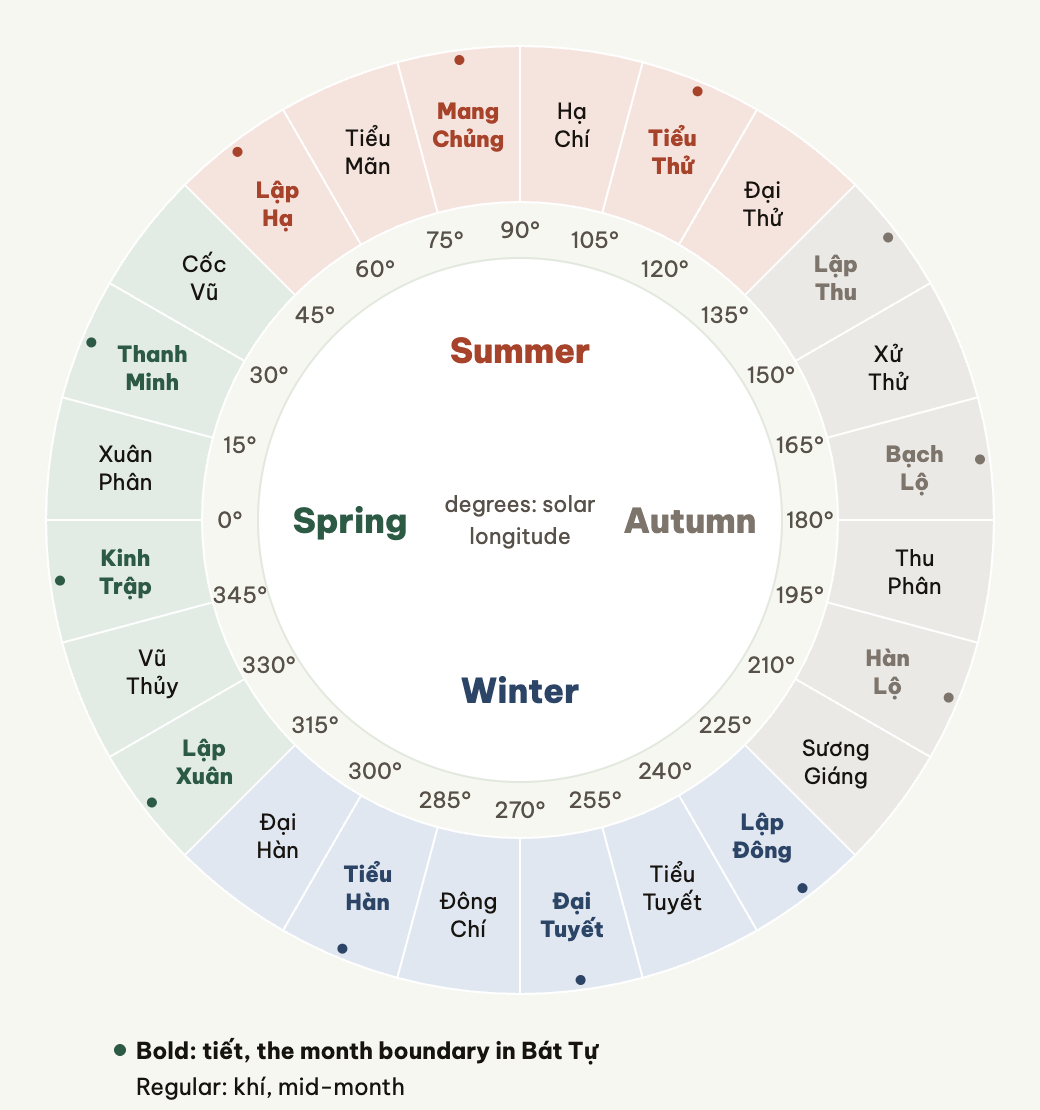
The accompanying ju numbers follow the same rule. In Yang Dun, Dong Zhi uses ju 1, Xiao Han and Da Han use ju 2 and 3, then continue increasing through the terms until before Xia Zhi. In Yin Dun, Xia Zhi uses ju 9, Xiao Shu and Da Shu use ju 8 and 7, then decrease until before Dong Zhi. This counting method appears in many Qi Men Dun Jia editions, including the Qi Men Dun Jia Bi Ji Quan Shu circulated in Vietnam.
One easily confused point: Yang Dun and Yin Dun are not two different systems, but two opposite directions of layout on the same plate. In Yang Dun the ju numbers increase in the forward direction, in Yin Dun the ju numbers decrease in the reverse direction. The book Qi Men Dun Jia Miao Bi by Qiu Jin Han, when discussing the annual ju, also restates this forward and reverse rule, and holds that the heavenly way turns to the left so the yin part uses reverse.
How does the fu tou decide upper, middle or lower yuan?
According to Qi Men Zhi Gui, volume 1, the days Jia Zi, Ji Mao, Jia Wu, Ji You are the fu tou of the upper yuan; the days Jia Yin, Ji Si, Jia Shen, Ji Hai are the fu tou of the middle yuan; the days Jia Chen, Ji Wei, Jia Xu, Ji Chou are the fu tou of the lower yuan. In other words, every 5 days the earthly branch of the fu tou shifts to a new group, and that branch group decides which yuan you are in.
The comparison table below summarises this convention:
| Branch group of the fu tou | Corresponding yuan |
|---|---|
| Zi, Wu, Mao, You | Upper yuan |
| Yin, Shen, Si, Hai | Middle yuan |
| Chen, Xu, Chou, Wei | Lower yuan |
For example, a Jia Zi day belongs to the upper yuan, a Jia Yin day to the middle yuan, a Jia Chen day to the lower yuan. When the three yuan are finished, one solar term is finished and the next solar term begins.
Why does the fu tou sometimes arrive before the solar term and sometimes after?
The fu tou is counted by the 60-day cycle of the sixty jia zi, while the solar term is counted by the sun's actual position on the ecliptic. These two cycles do not divide evenly into each other, so the fu tou and the solar term usually differ by a few days. Qi Men Zhi Gui, volume 1, calls the phenomenon of the fu tou arriving before the solar term "super spirit", and the solar term arriving before the fu tou "qi continuation".
When super spirit occurs, the fu tou has arrived but the solar term has not, so one still uses the ju of the old solar term until the new solar term actually hands over. When qi continuation occurs, the solar term has arrived but the fu tou has not, so one temporarily borrows the lower yuan ju of the old solar term for the first days of the new solar term, then when the new fu tou arrives one switches to the ju of the new solar term.
These two adjustments are together called cutting and supplementing. Cutting is trimming back part of the old solar term's ju, supplementing is adding ju for the new solar term. Qi Men Zhi Gui stresses that without grasping cutting and supplementing, super spirit and qi continuation have no basis, and without grasping leap ju, cutting and supplementing are also wrong.
When must a leap be set and why?
A solar term does not last exactly 15 days but about 15 days 2 hours 5 ke, that is slightly more than 15 days. For each solar term using 180 hours (15 days x 12 hours), the surplus of 2 hours 5 ke gradually accumulates. When that surplus is enough to shift a whole yuan, one must set an extra leap ju to compensate, called a leap ju. Qi Men Zhi Gui, volume 1, states clearly: that surplus is the leap ju, and the method of setting the leap must rest on the accumulation of the surplus across many solar terms, not simply setting a leap whenever Mang Zhong or Da Xue arrives as some mistakenly believe.
Qi Men Zhi Gui also criticises the common understanding that a leap is set whenever Mang Zhong and Da Xue pass. According to the book, if one mechanically sets the leap at those two terms, the three yuan will be misaligned, yin and yang will be wrong, and the principle no longer holds. This is a point on which Qi Men schools are not fully agreed: some schools follow the fixed leap at Mang Zhong and Da Xue, other schools follow flexible cutting and supplementing based on the actual deviation between fu tou and solar term. This article presents both views and does not assert that either school is absolutely correct.
Why do 1,080 ju reduce to only 18 ju in use?
According to Qi Men Dun Jia Bi Ji Quan Shu, a year has 360 days, each day 12 hours, making 4,320 ju if counted for every hour. But when laying out the plate, one finds many ju repeat. For example Dong Zhi and Jing Zhe give the same layout, Qing Ming and Li Xia give the same layout, Gu Yu and Xiao Man likewise, and many other solar term pairs repeat similarly. After removing duplicates, the number 4,320 reduces to 1,080 ju, meaning each ju repeats about four times.
Among those 1,080 ju, counted by solar term there are 24 terms per year, three yuan per term, making 72 ju. But these 72 ju also repeat, each ju repeating four times, so they reduce to 18 ju: 9 Yang Dun ju and 9 Yin Dun ju. The number 18 ju is the minimal framework that Qi Men users work with daily.
The song "Yan Bo Diao Sou Qi Men Ge", quoted in Qi Men Dun Jia Bi Ji Quan Shu, also records this path: earlier generations created 1,080 ju, Tai Gong reduced it to 72, and in the Han dynasty Zhang Zi Fang reduced it to 18 ju. Qi Men Zhi Gui, volume 1, also restates the numbers 1,080 and 18 in its discussion of leap ju. Thus 18 ju is not a new invention but the result of merging duplicates over many generations.
From the xun shou to Zhi Fu and Zhi Shi for a specific hour
Once the ju number is known, the next step is to find the xun shou of the hour under consideration. The xun shou is the first stem-branch of a 10-hour xun in the sixty jia zi. For example, an hour in the Jia Zi xun has Jia Zi as its xun shou; an hour in the Jia Xu xun has Jia Xu as its xun shou.
From the xun shou, consult the table to know which star and which gate are on duty. Qi Men Dun Jia Miao Bi by Qiu Jin Han gives a concrete example: in Yang Dun ju 1, at the Jia Zi hour Tian Peng is Zhi Fu and Xiu Men is Zhi Shi; at the Jia Xu hour Tian Rui is Zhi Fu and Si Men is Zhi Shi; at the Jia Shen hour Tian Chong is Zhi Fu and Shang Men is Zhi Shi; at the Jia Wu hour Tian Fu is Zhi Fu and Du Men is Zhi Shi; at the Jia Chen hour Tian Qin is Zhi Fu and Si Men is Zhi Shi; at the Jia Yin hour Tian Xin is Zhi Fu and Kai Men is Zhi Shi. Every 10 hours the pair Zhi Fu and Zhi Shi changes.
Quick reference table for Yang Dun ju 1:
| Xun shou | Zhi Fu | Zhi Shi |
|---|---|---|
| Jia Zi | Tian Peng | Xiu Men |
| Jia Xu | Tian Rui | Si Men |
| Jia Shen | Tian Chong | Shang Men |
| Jia Wu | Tian Fu | Du Men |
| Jia Chen | Tian Qin | Si Men |
| Jia Yin | Tian Xin | Kai Men |
After knowing Zhi Fu and Zhi Shi, the plate setter places the Heaven Plate by the rule "Zhi Fu added to the hour stem": look at which palace the stem of the current hour sits in on the Earth Plate, then place the Zhi Fu star into exactly that palace. Qi Men Dun Jia Miao Bi illustrates: in Yang Dun ju 1, at the Jia Zi hour Zhi Fu is Tian Peng, added to Kan palace 1, called fu yin; at the Yi Chou hour the Earth Plate Yi is in palace 9, so bring Tian Peng into palace 9; at the Bing Yin hour the Earth Plate Bing is in palace 8, so bring Tian Peng into palace 8; at the Ding Mao hour the Earth Plate Ding is in palace 7, so bring Tian Peng into palace 7. Yin Dun follows the same rule, only the direction differs.
A worked example from day and hour to Zhi Fu and Zhi Shi
Take a specific case to see the whole path. Suppose we need to set a plate for the day Ji Mao, hour Jia Zi, in the Xiao Xue solar term of 1997. First determine the solar term: Xiao Xue falls between Xia Zhi and before Dong Zhi, so use Yin Dun. Next determine the yuan: the day Ji Mao has earthly branch Mao, belonging to the group Zi Wu Mao You, that is the upper yuan. According to the ju number table for Xiao Xue, the upper yuan uses ju 5, so this is Yin Dun ju 5.
Next find the xun shou: the hour Jia Zi belongs to the Jia Zi xun, whose xun shou is Jia Zi. Compare with the Zhi Fu and Zhi Shi table for Yin Dun ju 5, and the Jia Zi xun gives a specific star and gate pair. Then place the Heaven Plate by the rule Zhi Fu added to the hour stem: the hour stem is Jia, check the Earth Plate of Yin Dun ju 5 to see which palace Jia sits in, then place the Zhi Fu star into that palace. From there unfold the nine stars, eight gates and eight spirits in the reverse direction of Yin Dun. The final result is a complete Qi Men plate for the Jia Zi hour of the Ji Mao day.
This case also shows the role of the leap ju. According to discussion on the Ly So Vietnam forum, in 1997 the fu tou was far from the solar term so a leap had to be set at the Mang Zhong term, making the Ji Mao day of Xiao Xue count as upper yuan, Yin Dun ju 5. Without the leap, that day would fall in a different yuan and yield a different ju number. This is exactly where the leap ju operation directly affects the final result.
Where the schools disagree
There are at least three points on which Qi Men books and schools still differ. The first is how to set the leap: the school following the fixed method sets the leap at Mang Zhong and Da Xue, the school following flexible cutting and supplementing relies on the actual deviation. Qi Men Zhi Gui, volume 1, sides with cutting and supplementing and criticises the fixed method, but in practice some still use the fixed method because it is simpler.
The second is the total ju number. The Qi Men Dun Jia Bi Ji Quan Shu circulated in Vietnam has the line "one thousand and eighty numbers at the outset", that is 1,080 ju. Meanwhile, some opinions on forums hold that the correct number must be 2,880 to divide evenly by the 64 I Ching hexagrams, the 60 jia zi and the 9 Luo Shu palaces. This is an unresolved debate, and this article records both numbers rather than asserting one side.
The third is how to understand Zhi Shi. The book Thuat So Lac Thu (Qi Men Dun Jia Nguyen Thuy) defines Zhi Shi as "the Shi of what is on duty", that is the usage form of the qi star in each hour branch, different from the common understanding that Zhi Shi is simply the gate on duty. This difference affects interpretation, but does not affect the step of looking up the ju number and setting the plate.
Applications and limits
The whole chain of operations above, from determining the solar term, determining the yuan, looking up the ju number, finding the xun shou, obtaining Zhi Fu and Zhi Shi, to setting the plate, is a highly technical procedure. Beginners often err at the leap ju step because they do not notice the deviation between fu tou and solar term. Experienced practitioners usually prepare a table of 24 solar terms times three yuan for quick reference, avoiding mistakes.
It should be noted that Qi Men Dun Jia is an ancient calculation system, based on convention and knowledge handed down through generations, not an experimental scientific model. The old books also do not fully agree on leap ju and the total number of ju. Therefore, when using Qi Men for reference, it should be seen as a cultural and historical perspective, and should not be used to make important decisions about finance, health or other weighty matters.


