
Where is fortune and misfortune read from on a cast Qi Men chart?
After the Qi Men Dun Giap chart is set, the chart has four basic layers for interpretation: the stem layer (heaven plate and earth plate), the gate layer (Eight Gates), the star layer (Nine Stars) and the spirit layer (Eight Spirits). Fortune and misfortune do not lie in one separate layer but in the relations between layers, of which the relation between the heaven plate stem and the earth plate stem is the most densely recorded. The book Ky Mon Chi Quy devotes a whole section titled Ten Stems mutual clash to listing each stem pair, and Khau Kim Han's Ky Mon Don Giap dieu bi also uses this very layer as its backbone when discussing advancing troops, pitching camp and guarding against surprise attack.
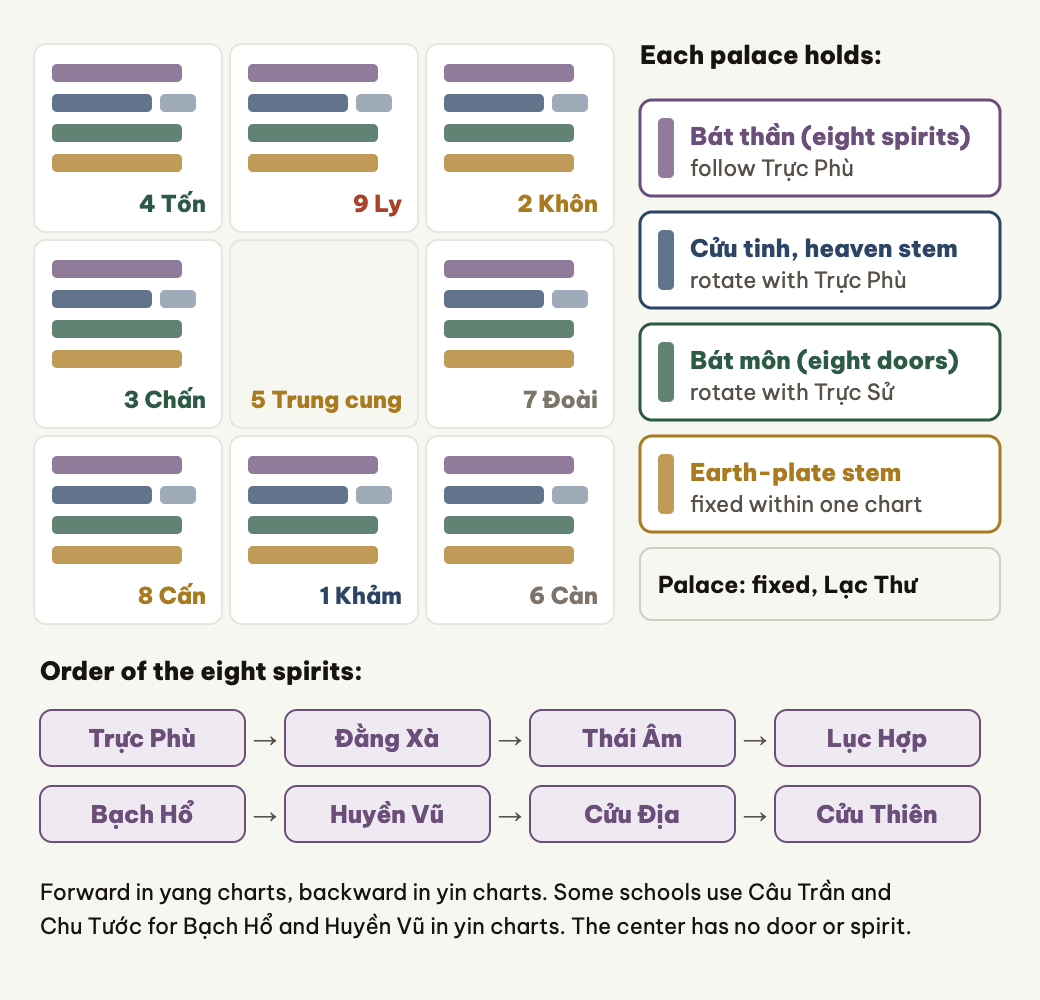
The four groups of patterns usually read together are: the Ten Stems mutual clash, Tam Tra and Cuu Don, the inauspicious patterns (Luc Nghi kich hinh, Tam Ky nhap mo, Mon bach), and Phan Ngam together with Phuc Ngam. Each group catches a different kind of situation, so the interpreter must place them side by side to reach a conclusion, not just look up one table and decide.
What is the Ten Stems mutual clash and how is it read?
The Ten Stems mutual clash is the reading of a heaven plate stem meeting an earth plate stem in the same palace, each pair giving a pattern name and a separate judgement. Ky Mon Chi Quy records: Mau gia Binh is Thanh Long phan thu, movement is greatly favourable, but if it meets bach mo or kich hinh then a good matter turns into a bad one; Binh gia Giap is Phi dieu diet huyet, also in the auspicious spirit group; Tan gia At is Bach Ho xuong cuong; At gia Tan is Thanh Long dao tau; Quy gia Dinh is Dang Xa yeu kieu; Dinh gia Quy is Chu Tuoc dau giang.
Ky Mon Don Giap dieu bi adds a reading oriented to military use: Phan thu, Diet huyet, Tam Tra, Cuu Don are the auspicious group but strongly avoid lower clashing with upper; when the hour stem clashes with the day stem it means the lower offends the upper, the host defeats the guest. The book also warns that Ho xuong cuong, if it does not meet Kinh Mon and Khai Mon, is unfavourable to the guest, while Phan thu is greatly favourable to the host's troops and the guest is also not unlucky.
| Heaven plate stem | Earth plate stem | Pattern name | Judgement recorded in Ky Mon Chi Quy |
|---|---|---|---|
| Mau | Mau | Phuc ngam | All matters blocked, stillness and defence are good |
| Mau | At | Thanh Long hop linh | If the gate is auspicious the matter is auspicious, if the gate is inauspicious the matter is inauspicious |
| Mau | Binh | Thanh Long phan thu | Movement is greatly favourable, but meeting bach mo or kich hinh turns good into bad |
| Mau | Dinh | Thanh Long dieu minh | Seeking fame, meeting nobles is favourable, meeting mo bach gives rise to gossip |
| Mau | Ky | Quy nhan nhap nguc | Public and private matters are both unfavourable |
| Mau | Canh | Truc phu phi cung | Auspicious matters turn inauspicious, inauspicious matters turn more inauspicious |
| Mau | Tan | Thanh Long chiet tuc | With an auspicious gate helping, one can still plan, with an inauspicious gate one loses wealth, legs and feet have ailments |
| Mau | Nham | Long nhap thien lao | Both yin and yang are unfavourable |
| Mau | Quy | Thanh Long hoa cai | With an auspicious gate it draws blessings, with an inauspicious gate there are many disappointments |
| At | Mau | Loi am hai duong | Meeting an inauspicious gate or bach it breaks wealth and harms people |
The table above only cites the beginning of the Ten Stems mutual clash section in Ky Mon Chi Quy, that is the pairs taking Mau and At as heaven plate stem. The book continues with the pairs At gia Binh, At gia Dinh, up to Quy gia Quy, ten stems times ten stems, but most of the remaining printed text has lost characters, so it cannot be reconstructed intact here. It is worth noting that for the same stem pair, Ky Mon Chi Quy and Ky Mon Don Giap dieu bi sometimes give different names, and the reading also leans to different purposes: one leans to ordinary matters, one leans to military action.
Tam Tra and Cuu Don: the group of patterns considered auspicious
Tam Tra is three auspicious patterns, Cuu Don is nine auspicious patterns, both belonging to the group that Ky Mon Don Giap dieu bi classifies as auspicious but avoiding lower clashing with upper. Ky Mon Don Giap dieu bi states clearly: Phan thu, Diet huyet, Tam Tra, Cuu Don and the like strongly avoid lower clashing with upper. That is, even if it is an auspicious pattern, if a lower clashing with upper situation appears the advantage is reversed.
Regarding Cuu Don, Ky Mon Don Giap dieu bi has a passage on Dia Don, Thien Don, Nhan Don, Than Don, Quy Don, Long Don, Ho Don, Phong Don, Van Don. Some editions record specific conditions: Nhan Don when Mon Huu combines with Ky Dinh and Thai Am on the same earth plate, then troops may be sent out; Than Don when Ky Binh combines with Sinh Mon and Cuu Thien. However, this very book also acknowledges that when applied to military matters many don methods are not seen to be effective, and holds that the cause may lie in ignoring the principles of Yin and Yang, gate opening and closing, and the transformations of Thien Cam.
| Don name | Condition recorded in Ky Mon Don Giap dieu bi | Note |
|---|---|---|
| Nhan Don | Mon Huu combines with Ky Dinh and Thai Am on the same earth plate | Troops may be sent out |
| Than Don | Ky Binh combines with Sinh Mon and Cuu Thien | Belongs to the auspicious group |
| Remaining don | Dia Don, Thien Don, Quy Don, Long Don, Ho Don, Phong Don, Van Don | The book acknowledges many cases of no effect when used in military matters |
It must be said clearly: the conditions of each don are not copied identically across the books. Some editions record only the don name without full conditions, some record conditions but differ on the accompanying gate and spirit. Therefore, when looking up Cuu Don, one should compare at least two editions before use.
Common inauspicious patterns: Luc Nghi kich hinh, Tam Ky nhap mo, Mon bach
Luc Nghi kich hinh is an inauspicious pattern that both Ky Mon Chi Quy and Ky Mon Don Giap dieu bi classify as severe. Ky Mon Chi Quy records: Giap Ty lin Chấn, Giap Tuat lin Khon, Giap Than lin Can, Giap Ngo lin Ly, Giap Thin lin Ton, Giap Dan lin Ton, called kich hinh; at such a time it is taboo to use troops, pitch camp, set out on a journey, or plan matters, all unfavourable. Ky Mon Don Giap dieu bi further stresses: Luc Nghi kich hinh is most inauspicious, even if Luc Nghi acts as Truc phu it should not be used.
Tam Ky nhap mo is the second inauspicious pattern. Ky Mon Chi Quy records: At ky reaching Khon, Binh ky reaching Can, Dinh ky reaching Can is Tam Ky nhap mo; taboo for marching troops, all matters auspicious turn not auspicious, inauspicious turn not inauspicious, it is the image of no achievement. The book explains by the twelve stages of life: At is yin wood, born at Ngo, buried at Tuat, so At reaching Can (including Tuat, Can, Hoi) is entering the tomb; Binh is fire, born at Dan, buried at Tuat, so Binh reaching Can is also entering the tomb; Dinh is yin fire, born at Dau, buried at Suu, so Dinh reaching Can (including Suu, Can, Dan) is entering the tomb. Ky Mon Don Giap dieu bi also records Tam Ky nhap mo bach vo nhat thanh, that is a hundred matters not one accomplished.
Mon bach is an inauspicious pattern concerning the relation between the Eight Gates and the palaces. Ky Mon Chi Quy records: Huu Mon lin Ly, Khai Mon and Kinh Mon lin Chan and Ton, Sinh Mon and Tu Mon lin Kham, Thuong Mon and Do Mon lin Khon and Can, Canh Mon lin Doai and Can, called the eight gates clashing with the palace, that is bach cung. Palace clashing with the eight gates is called che cat mon; when the palace bach ches, auspicious matters turn not auspicious, inauspicious matters turn not inauspicious; when inauspicious palace and inauspicious gate che together, disaster is heavier. This is the layer read by position, different from the layer read by stem pair.
How do Phan Ngam and Phuc Ngam differ?
Phan Ngam and Phuc Ngam are the two patterns most mentioned when discussing movement and stagnation on a Qi Men chart. Ky Mon Chi Quy records: when Star, Fu, Gate return to their original palace it is called Phuc ngam; at such a time all plans should only be still and defensive, one should not act rashly, if one hastily advances troops one will surely be besieged, even with an auspicious gate it cannot be used. Also according to Ky Mon Chi Quy, when Luc Giap gia Luc Mau, that is the Mau stem of the heaven plate meeting the Mau stem of the earth plate, it is Phuc ngam, all matters blocked, stillness and defence are good.
Phan ngam is described by Ky Mon Don Giap dieu bi as a case of movement, which may be good or bad depending on accompanying factors; the book records: Phan ngam with an auspicious pattern should also advance troops, should take advantage of chaos to break and kill. As for Phuc ngam, one should hide troops, secretly let the enemy fall into one's ambush, and if one wants to send troops one must choose Cuu Thien, Khai Mon and Truc phu. The book warns that Phan ngam is not good, Phuc ngam requires guarding against mishap.
An easily confused point is that Phan ngam and Phuc ngam in Qi Men do not entirely coincide with Phan ngam and Phuc ngam in Huyen Khong flying stars. In Huyen Khong, whole-chart Phuc ngam occurs when the Mountain and Facing Stars enter the central palace in forward flight and the nine palaces are all unmoved, while Phan ngam occurs when the Mountain Star or Facing Star of a palace is opposite to the original Lo Thu number. These are two different systems of convention, and the definition of one should not be applied to the other.
Where do the books differ?
The first difference is in pattern names. Ky Mon Don Giap dieu bi records Quy gia Dinh as Dang Xa yeu kieu, some editions record Dang Xa yeu kieu, and yet another records yeu kieu. For the same stem pair the pattern name is not consistent, so when consulting one should note all variants. Ky Mon Chi Quy in the Ten Stems mutual clash section records Mau gia At as Thanh Long hop linh, while some other documents record Thanh Long hoi thu; these two names are not identical.
The second difference is in the conditions of some don. Ky Mon Don Giap dieu bi records the conditions of Nhan Don and Than Don fairly specifically, but the remaining don are only named. Some editions add conditions for Dia Don, Thien Don, but they do not coincide. Therefore there is no single Cuu Don table recognised by all books.
The third difference is in how the auspicious and inauspicious groups are arranged. Ky Mon Chi Quy places Thanh Long phan thu and Phi dieu diet huyet in the auspicious spirit group, but also warns that if they meet bach mo or kich hinh then good turns to bad. Ky Mon Don Giap dieu bi places Phan thu, Diet huyet, Tam Tra, Cuu Don in the auspicious group but avoiding lower clashing with upper. Thus the same pattern has a different degree of auspiciousness between the two books.
Is reading a Qi Men chart a verified prediction?
No. It must be said clearly: these are conventions of the school, recorded in Ky Mon Chi Quy, Ky Mon Don Giap dieu bi and Don Giap Luoc Giai, not verified predictions. Ky Mon Don Giap dieu bi itself acknowledges that many don methods, when applied to military matters, are not seen to be effective. Ky Mon Chi Quy in its preface also recounts the case of a man who claimed to be skilled in Qi Men, was given a military task but lost everywhere he fought, then quietly left, and the preface author comments that the man perhaps had not grasped the true point of the school.
Therefore, when reading a Qi Men chart, one should treat the patterns as a language describing situations according to the school's conventions, not as a verdict on outcomes. The same pattern, placed in different contexts, will be interpreted differently; and the books also do not agree with one another on the degree of fortune or misfortune. A learner should state clearly which book's convention they are following before concluding.
Applying the four groups of patterns in one reading
When reading a cast chart, the usual order is: first consider Phuc ngam or Phan ngam to know whether the chart is still or moving; consider Luc Nghi kich hinh, Tam Ky nhap mo, Mon bach to eliminate blocked situations; consider the Ten Stems mutual clash to know how the host and guest stems stand; and finally consider Tam Tra, Cuu Don to seek an auspicious position. Ky Mon Don Giap dieu bi also notes an additional principle of time: in yang time the heaven plate should be strong, in yin time the earth plate should be strong.
One more point to remember: the patterns do not replace one another. Phan thu may be auspicious but if kich hinh is also met the judgement reverses; Tam Ky nhap mo may cancel the effect of another auspicious pattern. This is why Ky Mon Don Giap dieu bi stresses placing patterns within the whole chart rather than looking up each item separately.


