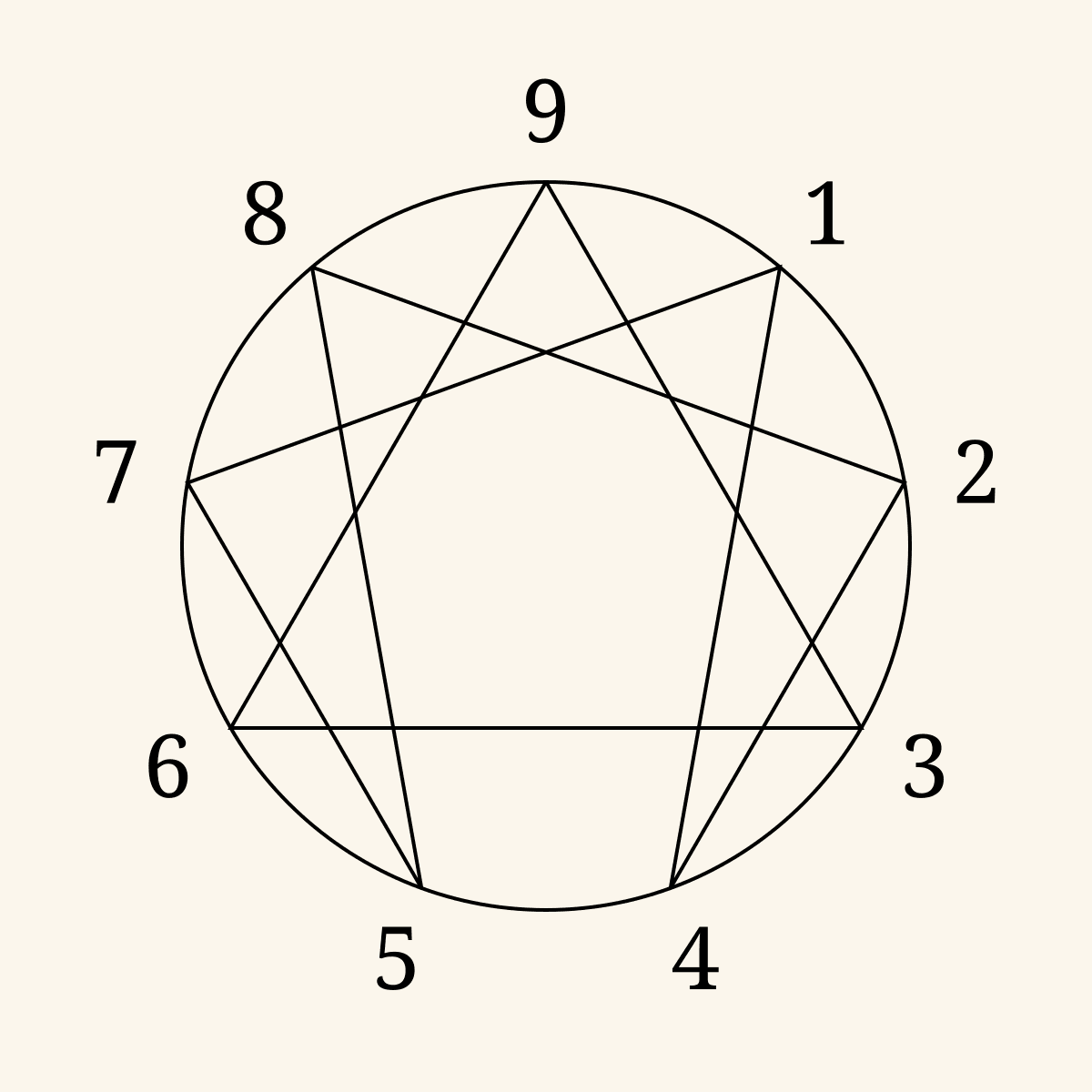
Does the Enneagram really have nine types?
The short answer: to date, no study has proven that personality data naturally divide into exactly nine types as the Enneagram diagram claims. Hook and colleagues' (2020) systematic review of 104 research samples concluded the evidence remains mixed: Enneagram scales correlate reasonably with the Big Five model, but no study has reproduced the nine-type structure through factor analysis. In other words, the Enneagram measures some real personality traits, but the nine-type map is a theoretical scheme not confirmed by data.
This article is not about Enneagram users. It is about the test and the data: what happens when the Enneagram is examined using standard psychometric methods.
What is factor analysis and why does it matter here?
Factor analysis is a statistical method used to see whether a set of questions or measurement items naturally group into certain clusters (factors). When applied to a personality questionnaire, it answers the question: do the items fall into exactly the number of clusters the theory predicts, and are those clusters stable across different samples?
For the Enneagram, the theory predicts nine distinct clusters. If the model is correct, factor analysis on large data should yield nine corresponding factors, and the items of each type should load strongly on their own factor and weakly on the others. That is the most basic test.
Hook and colleagues (2020) reviewed 104 research samples on the Enneagram and noted: no study has derived a nine-type structure from factor analysis data. This is a major gap, because the nine-type structure is the core of the entire system. If that core does not appear in the data, then all interpretations of the nine types remain theoretical interpretations, not descriptions of data.
Kind of knowledge: School: EnneagramSchool's interpretation. How one school or one book reads it; other schools may read it differently. The five labelsThe original texts of the Enneagram system itself present the nine types as a fixed map, where each person belongs to one dominant type, with wing types and levels of development. That is how the system defines itself. But that definition is not evidence that the map matches psychometric data.
How well does the RHETI hold up?
The RHETI (Riso-Hudson Enneagram Type Indicator) is one of the most widely used Enneagram measurement tools. Newgent and colleagues (2004) tested the reliability and validity of this inventory on a sample of university students in the United States, and the results were rated at level B: acceptable internal consistency, but mixed construct validity.
It is important to clarify what level B means. This is a preliminary result, not yet widely replicated across many independent groups, and still debated among researchers. Acceptable internal consistency means the questions within the same scale tend to be answered consistently with one another. But mixed construct validity means that when testing whether the scales truly measure nine distinct types, the results are unclear.
In other words, the RHETI measures something stable, but that stable something may not be the nine types as the theory describes. A scale can have internal consistency while still not measuring the structure it claims to measure.
| Study | Sample and scope | Main result | Evidence level |
|---|---|---|---|
| Hook et al. (2020) | Systematic review of 104 samples | Mixed evidence, no study has derived exactly nine types | A |
| Newgent et al. (2004) | University students, United States | RHETI: acceptable internal consistency, mixed construct validity | B |
| Sutton et al. (2013) | Exploratory study | Enneagram correlates with some work outcomes | B |
Enneagram at work: what does the exploratory research say?
Sutton and colleagues (2013) attempted to apply the Enneagram to the work context, examining whether Enneagram type correlates with work-related outcomes. This is an exploratory study, meaning the authors themselves framed the question and acknowledged the results are only preliminary.
The results showed some links between Enneagram type and work outcomes, but this is exploratory research at level B: not yet replicated across many independent groups, and not sufficient to conclude that the Enneagram predicts performance or work behavior.
Note the scope of the data. This study was conducted in a specific context, not on Vietnamese people, and should not be generalized to all groups. Preliminary results in one place do not automatically hold elsewhere.
Why do many people still find the Enneagram useful?
Kind of knowledge: Folk beliefFolk belief. What people believe, avoid or pass on by word of mouth, recorded as a belief, not as a checked fact. The five labelsMany people use the Enneagram as a language for self-reflection: they read the nine type descriptions, find one that fits, then use that language to observe their own motives, reactions, and conflicts. In folk usage and in practitioner communities, this is a common way to use it, and it can provide a meaningful experience for the user.
Two things need to be distinguished. One is whether the Enneagram is structurally accurate. The other is whether using the Enneagram is helpful for a person. These two things are not the same.
There is a real effect that arises from belief: belief changes behavior, and behavior changes outcomes. When a person believes they are type 8 and need to learn to listen, that belief can make them pay more attention to listening, and changed behavior can lead to changed outcomes in relationships. That effect is real, but it is not evidence that the Enneagram correctly guessed that person's type. In other words, the Enneagram can be useful because it provides a framework for self-observation, not because it has been proven structurally correct.
Kind of knowledge: School: EnneagramSchool's interpretation. How one school or one book reads it; other schools may read it differently. The five labelsAuthors in the Enneagram tradition, such as Riso and Hudson, present the nine types as a map for personal development, with healthy and unbalanced levels. That is the interpretation of that school. Modern research does not consider the nine-type structure proven.
Where the evidence is still lacking
Kind of knowledge: UnprovenNot enough evidence. Someone has claimed it, but no source or study is strong enough to confirm it. The five labelsThe historical origins of the Enneagram linked to Ichazo and Naranjo lack academic sources in this article's reference list. It should be noted: this article has no academic source to assert details about the system's formation, so it does not go deep into that part.
There is also no research on Vietnamese people regarding the Enneagram structure. Existing results come mainly from samples in the United States and some Western countries, in specific contexts. It should not be generalized to Vietnamese people without data from Vietnam.
The evidence is thin in both directions. On one side are studies supporting the Enneagram, but mostly at level B, not yet widely replicated. On the other are critiques, but no large study has definitively proven the nine-type structure wrong. The current state is: no one has proven it, and no one has fully refuted it either.
How should you read Enneagram research results?
When reading an article that says "research shows the Enneagram is valid," check three things. First, what did that study measure: the internal consistency of the scale, or the nine-type structure? These are different things. Second, who was the sample, where, and what year. Results on US university students do not automatically hold for Vietnamese people. Third, have those results been replicated, or is it a single study?
Hook and colleagues (2020) reviewed 104 samples and concluded the evidence is mixed. This is level A: consensus among researchers about the current state of evidence. That means researchers generally agree there is not enough evidence to confirm the nine-type structure.
This does not mean the Enneagram is worthless. It means the Enneagram is a theoretical system not yet fully tested, and users should know that when using it.
Enneagram and Big Five: two different measurement systems
One notable point in Hook and colleagues' (2020) review is that Enneagram scales correlate reasonably with the Big Five. This suggests the Enneagram measures some real personality traits, at least those overlapping with Big Five dimensions.
But reasonable correlation does not mean the Enneagram measures something new that the Big Five does not. Nor does it mean the nine-type structure is confirmed. A scale can correlate with the Big Five while still lacking its own nine-type structure.
The Big Five is the most researched model with the strongest data base in personality psychology. The Enneagram, despite its popularity in practitioner communities, still lacks an equivalent data base. This is a fact worth knowing when comparing the two systems.
Conclusion: useful and accurate are two different things
The Enneagram measures some things related to personality, but the nine-type structure has not been confirmed by data. The evidence is thin in both directions: not enough to affirm, nor enough to fully deny.
If you use the Enneagram for self-reflection and find it helpful, that does not contradict the above conclusion. Useful and accurate are two different things. What matters is knowing what you are using: a self-observation framework, or a scientifically verified description. Currently, the Enneagram belongs to the first category.
For an overview of the nine types and how to identify them, see also What is the Enneagram? 9 personality types and how to identify them.