What Is the Enneagram and Why Is It Different from Other Personality Systems?
The Enneagram is a personality system made up of nine types, each shaped by a deep-seated motivation and a core fear. What sets it apart from many other personality frameworks is that it does not merely describe outward behavior; it focuses on the question of what drives you to act the way you do. Two people may behave similarly yet belong to different types, because the underlying motivation is entirely different.
It should be said clearly from the start: the Enneagram is traditional, reference knowledge for self-exploration, and it has not been scientifically validated as a psychological diagnostic tool. It is not a substitute for psychological or medical advice, and it should not be used to label, judge, or make firm predictions about anyone's finances, health, or marriage.
Where Does the Enneagram Come From?
The origins of the Enneagram are often traced to spiritual and contemplative traditions, and the symbol of nine points on a circle with connecting lines appeared in spiritual literature long ago. In the 20th century, various authors and researchers developed it into a structured personality model with concepts such as core fear, core desire, integration and disintegration arrows, and centers of intelligence.
Because it has passed through many layers of development and interpretation, Enneagram literature can differ in places. Readers should treat it as a reference framework for self-observation rather than a fixed table of truths.
How Do the 9 Enneagram Types Differ?
The nine types are usually referred to by short names, each suggesting a dominant tendency. Type 1 is the Reformer, oriented toward correctness and principle. Type 2 is the Helper, finding self-worth by becoming indispensable to others. Type 3 is the Achiever, driven by accomplishment and recognition. Type 4 is the Individualist, pursuing uniqueness and emotional depth.
The next group includes Type 5, the Investigator, who craves knowledge and independence; Type 6, the Loyalist, operating on a need for security and loyalty; and Type 7, the Enthusiast, who loves novelty and experience. Type 8 is the Challenger, strong, decisive, and drawn to control. Finally, Type 9 is the Peacemaker, oriented toward inner calm and the avoidance of conflict.
It is worth noting that no type is better or worse than another. Each has its own strengths and points to watch, and a person's level of maturity matters more than their type number.
How Can You Identify Your Own Enneagram Type?
The most reliable way is to observe the motivations beneath your own behavior, not just the surface behavior itself. A useful question is: when you are stressed or afraid, which direction do you tend to move, and what makes you feel safest?
A common approach is to read descriptions of all nine types, narrow down to the two or three closest to you, then carefully compare their core fears and core desires. Many people recognize their type not from a single reading but through months of self-observation in different situations, especially under pressure.
One source of confusion is that many types look similar on the surface. For instance, dedication can appear in Type 1, Type 2, and Type 6, but the motivation behind each is different. Understanding the mechanism of motivation therefore matters more than memorizing lists of traits.
What Do the Integration and Disintegration Arrows Mean?
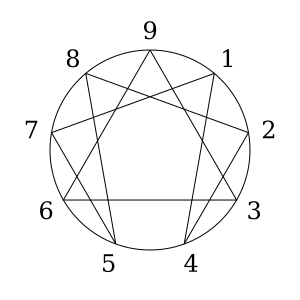
Each type is connected to two others by lines on the symbol, forming two directions commonly called the integration arrow and the disintegration arrow. When a person is healthy, mature, and balanced, they tend to learn the positive qualities of the type in the integration direction. When stress is prolonged or balance is lost, they tend to show the less healthy traits of the type in the disintegration direction.
For example, Type 1 in health moves toward Type 7, learning flexibility and enjoyment; under stress it falls toward Type 4 with sadness and self-criticism. Type 7 is the reverse, integrating toward Type 5 to learn depth and acceptance of limits, and disintegrating toward Type 1 with perfectionism and harshness. Other arrow pairs such as 2 and 4, 3 and 6, 5 and 8, 6 and 9, 8 and 2, and 9 and 3 follow a similar logic.
It is important to stress that the arrows are not predictions of the future or of fate. They describe tendencies of psychological movement at different levels of maturity and stress, and each person experiences this in their own way.
What Role Do the Centers of Intelligence and Groupings Play?
Beyond the nine individual types, the Enneagram also groups types into three centers, often described as the instinctive, emotional, and thinking centers. Each center represents an area of psychological energy that people regularly process, and each type belongs primarily to one center.
This grouping helps explain why some types are closely related in how they respond to the world. It also underlies more advanced concepts such as wings and instinctual variants, which are usually introduced once a learner has grasped the nine basic types. These topics belong to the advanced layer and are typically presented separately in each type's article.
What Can the Enneagram Be Used For in Daily Life?
Its most common application is self-awareness. When people understand their own motivations and fears, they can recognize recurring patterns of reaction and gain more choice instead of reacting on autopilot. In relationships, understanding another person's type can reduce judgment and increase empathy, because we see their behavior as coming from a need different from our own.
However, the Enneagram should not be turned into a labeling tool or an excuse for behavior. Saying "I am this type, so I must be this way" misuses the system. The Enneagram is best seen as a mirror for self-observation, not a fixed verdict on a person. Any conclusion about yourself should be checked against real experience and held with an open mind.
What Are Common Misunderstandings About the Enneagram?
The most common misunderstanding is treating the Enneagram as a test with a fixed result, when in fact determining your type requires honest self-observation and often takes time. Another is believing the type determines one's entire personality, when each person is also shaped by circumstances, culture, education, and life experience.
Many people also confuse the Enneagram with other personality systems, or expect it to predict life events such as career, marriage, and finances with precision. Such expectations go far beyond the reference nature of this system. A healthy approach is to treat the Enneagram as a tool that opens up self-understanding, combined with critical thinking and without absolutizing any description.