Introduction to the Enneagram and Type 4
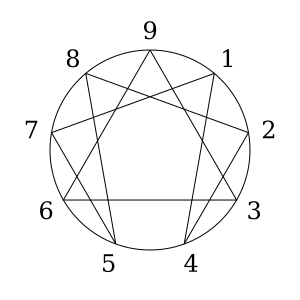
The Enneagram is a personality classification system that describes nine distinct types, each with its own worldview, core motivations, and core fears. Unlike assessments like MBTI or Big Five, which focus on surface preferences and behaviors, the Enneagram delves into inner motivations, personal values, and unconscious reaction patterns. One of the most important and distinctive elements of the Enneagram is the concept of integration and disintegration arrows, which shows that personality is not fixed but always moves between different psychological states.
Type 4, often called The Individualist or The Romantic, is a personality type that yearns to find a unique identity and deep meaning in life. They have a rich inner world, are sensitive to beauty, and always want to express their uniqueness. Their core fear is being ordinary, meaningless, or lacking a distinct identity. Because of this, they often compare themselves to others and feel a sense of lack of something that others seem to have.
In the context of career guidance, understanding Type 4 can help young people of this type identify suitable work environments where they can use their creativity and sensitivity. However, for holistic development and avoiding psychological pitfalls, understanding the mechanics of the integration and disintegration arrows is crucial.
How the Arrows Work in the Enneagram
Each number in the Enneagram diagram is connected to two other numbers via two lines. One line points to the integration direction, meaning that when a person is in a healthy, developed psychological state, they adopt the positive traits of the personality type the arrow points to. The other line points to the disintegration direction, describing the negative behaviors a person may fall into when stressed, anxious, or mentally unhealthy.
It is important to emphasize that these arrows do not mean a person will "turn into" another type. Instead, they describe shifts in defense mechanisms and behavioral patterns. A Type 4, whether integrating or disintegrating, still retains the core traits of Type 4, but how they express those traits is influenced by the energy of Type 1 or Type 2.
This mechanism can be compared to a musician playing their main instrument but occasionally switching to a supporting instrument to create new tones. The musician is still themselves, but the music produced has a different color. Understanding these arrows helps each person recognize their current state and have strategies to move toward the positive direction.
The Disintegration Arrow: Type 4 Moving Toward Type 2
Mechanism and Causes of Disintegration
When a Type 4 falls into a state of stress, fatigue, or hurt, they tend to move toward the negative traits of Type 2, The Helper. This disintegration often stems from Type 4's core fear: a sense of deficiency and incompleteness. When they feel their identity is threatened or unrecognized, they seek external validation more intensely.
Instead of looking inward and accepting their lack as part of the human experience, they begin to demand attention and affection from others as a way to fill the inner void. They may become clingy, dependent, and use subtle manipulative behaviors to keep others close. This contrasts sharply with the image of a healthy Type 4, who can stand on their own feet and find wholeness from within.
Specific Behavioral Signs of Disintegration
When disintegrating toward Type 2, a Type 4 may exhibit the following:
- Becoming overly affectionate and clingy: They may call or text their partner or best friend constantly, feeling extreme anxiety if they do not receive a quick reply. They tend to do anything to please others but with an unspoken expectation that the person must reciprocate affection proportionally.
- Playing the victim to attract attention: They may exaggerate their difficulties and pain to receive comfort and care. This differs from honest sharing, as the main purpose is to control others' emotions and keep them in the relationship.
- Losing personal boundaries: A healthy Type 4 highly values privacy and independence. When disintegrating, they may become boundary-less, interfering too deeply in others' lives or allowing others to invade their personal space, as long as they feel needed.
- Feelings of jealousy and possessiveness: They may feel threatened by anyone approaching their loved ones, as this stirs up the fear of abandonment and becoming meaningless.
Consequences of Prolonged Disintegration
If disintegration lasts, a Type 4 may spiral into self-destructive patterns. Over-reliance on external validation makes them increasingly disconnected from themselves. They may become bitter and resentful when they feel they have given too much without receiving equally. This creates a vicious cycle: the more they feel lack, the more they cling, the more they exhaust others and push them away, thus increasing the fear of abandonment.
The Integration Arrow: Type 4 Moving Toward Type 1
Mechanism of Integration
In contrast to disintegration, when a Type 4 is in a healthy, balanced, and mature psychological state, they naturally move toward the positive traits of Type 1, The Perfectionist. This is a positive process, not a personality change but an expansion of inner resources.
Type 1 represents principles, discipline, objectivity, and the ability to act rightly. When Type 4 integrates these qualities, they do not lose their creativity and emotional depth. Instead, they learn to structure those emotions into meaningful products, works, or actions. They begin to see themselves and the world more objectively, escaping the overly subjective view of their own deficiencies.
Specific Behavioral Signs of Integration
A successfully integrated Type 4 will have the following traits:
- Discipline and persistence in work: They no longer wait for inspiration to strike before starting. Instead, they build regular work habits, knowing that peak creativity often comes after hard work. They can complete major projects that they previously abandoned halfway.
- Objectivity and fairness: They learn to view things from multiple perspectives, no longer being too absorbed in their subjective emotions. This helps them make wiser decisions in work and relationships.
- Transforming emotions into principled action: Instead of just complaining about their fate, they use their painful experiences to create valuable art or engage in meaningful social activities. They no longer see pain as something to indulge but as material to build with.
- Emotional self-discipline: They learn to observe their emotions without being overwhelmed by them. They can feel sadness or hurt but not let those emotions dominate their entire behavior.
Benefits of Integration for Personal Growth
Integration toward Type 1 helps Type 4 overcome their core fear of ordinariness not by becoming more outstanding but by becoming truer to themselves. When they act according to clear principles and discipline, they build a solid identity that does not depend on comparison with others. They realize that true uniqueness comes from expressing oneself fully and authentically, not from seeking exotic experiences or dramatizing life.
Detailed Comparison of the Two States
To gain the clearest perspective, we can compare these two states through the following table:
| Criterion | Disintegration State (Toward Type 2) | Integration State (Toward Type 1) |
|---|---|---|
| Primary motivation | Seeking external validation, filling a sense of lack | Expressing authentic identity through principled action |
| Dominant emotions | Anxiety, clinging, jealousy, resentment | Calmness, confidence, clear purpose |
| Typical behaviors | Demanding attention, dependence, subtle manipulation | Discipline, objectivity, persistence, responsibility |
| Self-perception | Seeing oneself as a victim, lacking, incomplete | Seeing oneself as a creative person capable of building value |
| Interaction with others | Clinging, boundary-crossing, demanding emotional reciprocation | Respecting boundaries, giving healthily, without ulterior motives |
| Relationship with work | Difficulty focusing, easily abandoning, waiting for inspiration | Disciplined, building habits, completing projects |
Practical Applications of Understanding the Arrows
In Personal Development
Understanding these two arrows helps Type 4 individuals recognize early signs of disintegration so they can adjust in time. When they feel themselves starting to cling, demand excessive attention, or feel irrational jealousy, they can remind themselves that this is a sign of imbalance and need to return to themselves. They can practice emotional observation exercises, meditation, or simply spend time alone to recharge.
In Work and Career
For Type 4 individuals working in creative fields such as design, writing, or art, integrating Type 1 qualities is key to turning talent into sustainable success. They need to build a clear work process, set specific standards, and commit to completing work on time. This does not diminish creativity but rather creates a safe framework for creativity to be best expressed.
In Relationships
In love and friendship, Type 4 individuals who understand their disintegration arrow learn not to turn their fear of abandonment into pressure on their partner. They learn to love healthily, without demanding and without manipulation. Conversely, when integrated, they become a deep, loyal, and responsible partner who knows how to build a relationship based on mutual respect and understanding.
The Role of the Enneagram in Modern Career Context
In an increasingly volatile labor market, choosing a career based on passion and strengths is more important than ever. Many young people are still influenced by social stereotypes when choosing majors based on trends or perceived wealth, leading to rising unemployment despite increasingly common degrees. Tools like the Enneagram, MBTI, Holland, or Big Five can help each person understand their inner motivations and personal values.
For a Type 4, forcing themselves into a dry, repetitive, and non-creative job can be a disaster. They will quickly feel bored, lose meaning, and fall into a state of disintegration. Conversely, if they understand their integration mechanism, they can proactively seek jobs that allow them to use their creativity but also have clear structures and processes to help them maintain discipline. They also learn to turn their deep emotional experiences into advantages in professions like psychology, counseling, writing, or art.
Conclusion
The integration and disintegration arrows are among the most profound and valuable aspects of the Enneagram. For Type 4, understanding this mechanism not only helps them recognize their psychological pitfalls but also points to a specific path for growth. When they learn to integrate the qualities of Type 1, they are no longer trapped in a spiral of negative emotions but can transform their experiences into lasting values. They become more grounded, not because they suppress emotions but because they learn to use them effectively.
The maturity of a Type 4 is a journey from accepting their own lack to realizing that wholeness is not something to be sought externally, but a state that can be built from within through conscious and disciplined actions. The Enneagram is not a tool to label or confine people to a fixed mold, but a map to help each person better understand their own developmental journey.
