Enneagram Type 3 – The Achiever: Overview
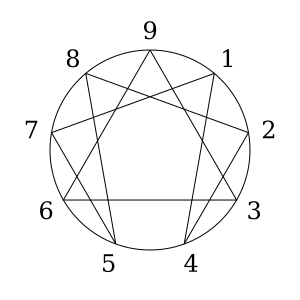
Enneagram is a personality system with 9 types, represented by a circle of points connected by a triangle and hexagon, symbolizing diversity and interrelation. Type 3 – The Achiever – is outgoing, ambitious, and highly attuned to their public image.
Unlike Type 1 (driven by perfection) or Type 8 (driven by power), Type 3 is fueled by the need for recognition and success. They constantly set goals, conquer challenges, and desire to be valued.
Core Motivation and Unconscious Fear
- Motivation: To be loved, admired, and respected for achievements. They equate self-worth with external success.
- Fear: Being invisible, seen as a failure, or having no value without accomplishments.
- Defense mechanism: Identification – they merge with their success image, sometimes losing touch with real feelings.
Key Characteristics
- Goal-oriented: They know exactly what they want and create action plans. They dislike ambiguity.
- Highly adaptable: They can shift roles to fit different environments, impressing diverse audiences.
- Performance-driven: They measure value by tangible outcomes – sales, awards, promotions.
- Relationship style: They connect through achievements, often struggling to engage with raw emotions without offering solutions.
- Image-conscious: They care deeply about how they appear, sometimes creating distance from their true self.
Strengths
- Exceptional productivity: They turn ideas into action quickly, sustaining high energy over long periods.
- Inspirational: Their confidence and drive motivate teams through challenges.
- Versatile: They adapt easily to new corporate cultures and roles.
- Strategic thinking: They choose smart paths to optimize resources and reach goals efficiently.
Points to Note and Potential Blind Spots
- Burnout: They neglect rest, leading to exhaustion and mental health issues.
- Detachment from emotions: They may not recognize their own sadness, anger, or loneliness.
- Difficulty with failure: A minor setback can feel like total worthlessness; they may hide mistakes.
- Inauthenticity: To impress, they may embellish achievements, creating distance in relationships.
Comparison with Other Types
| Aspect | Type 3 | Type 1 | Type 7 |
|---|---|---|---|
| Motivation | Success & recognition | Rightness & perfection | Fun & freedom |
| Fear | Invisibility, failure | Error, corruption | Limitation, pain |
| Behavior | Goal-chasing, image-optimizing | Principled, disciplined | Exploratory, novelty-seeking |
| Weakness | Burnout, emotional distance | Rigidity, self-criticism | Superficiality, scattered |
Healthy Growth Path for Type 3
1. Connect with inner values
Ask daily: “If no one saw my success, would I still do this?” This helps distinguish true passion from attention-seeking. Appreciate non-achievement qualities like kindness and patience.
2. Allow yourself to fail
Face mistakes openly instead of hiding them. Sharing struggles with trusted people reduces pressure. Change self-talk from “I’m worthless” to “What can I learn?”
3. Build non-achievement relationships
Spend time with family and friends without discussing work or achievements. Practice empathetic listening – just be present without rushing to solve.
4. Manage energy and health
Schedule rest as a mandatory task, not a reward. Engage in non-competitive activities like yoga, meditation, or nature walks to reconnect with body and emotions.
5. Balance “doing” and “being”
Type 3 often defines themselves through action. Learn to simply exist and enjoy the present moment. Mindfulness meditation is a useful tool. Remind yourself that value lies not only in titles but in the depth of your soul.
Conclusion
Type 3 is one of the most dynamic and influential personalities in the Enneagram. They excel as leaders, founders, and employees when channeling their drive positively. However, to achieve sustainable happiness, Type 3 must overcome the fear of invisibility by building an inner identity independent of achievement. When they learn to love themselves unconditionally, they succeed not only in career but also in inner depth.