Introduction to Enneagram and Type 6 - The Loyalist
The Enneagram is a personality classification system consisting of nine different types, each representing a unique worldview and core motivation. Among them, Type 6, also known as The Loyalist, is one of the most complex and fascinating personality types. They are driven by a need for safety and belonging, always in a state of heightened vigilance to guard against potential dangers in their environment. Type 6 individuals are responsible, reliable, loyal, and have foresight, but they are also prone to anxiety, doubt, and indecisiveness.
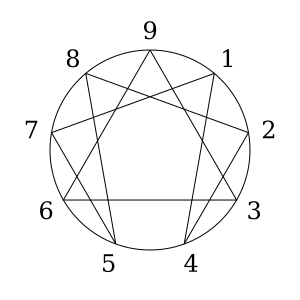
What sets the Enneagram apart from other personality assessment tools like MBTI or the Big Five, which typically describe static traits, is its emphasis on movement and growth. Each type is not static but constantly shifts between different psychological states. This movement is represented by the arrows on the Enneagram diagram, indicating the integration and disintegration paths for each type. For Type 6, the two most important arrows are the one pointing to Type 9 and the one pointing to Type 3.
Basic Principles of the Integration and Disintegration Arrows
Before delving into the specific case of Type 6, it is essential to understand these two core concepts. The integration arrow (also known as the security arrow) represents a state achieved when a person is healthy, balanced, and psychologically growing. At that point, they adopt and express the most positive qualities of another type on the diagram. Conversely, the disintegration arrow (or stress arrow) represents a state a person falls into when they are stressed, unbalanced, or breaking down. At this time, they exhibit the most negative and unhealthy traits of another type.
It is crucial to emphasize that this movement is not a complete change of one's core personality type. A Type 6 will never truly become a Type 9 or Type 3. Instead, they temporarily borrow the energies, coping mechanisms, and perspectives of those types under certain psychological conditions. Understanding these two arrows provides an invaluable map for personal development, helping individuals recognize where they are on their psychological journey and how to return to a state of balance.
Disintegration Arrow: Type 6 Moves Toward Type 3 Under Stress
When a Type 6 individual falls into a state of extreme stress, anxiety, or feels threatened, they tend to disintegrate toward Type 3, also known as The Achiever. This is a paradoxical but easily recognizable psychological shift.
Transition from Anxiety to Image
The essence of Type 6 is anxiety about safety and a lack of self-trust. When anxiety exceeds their tolerance threshold, instead of continuing to sink into insecurity, they may unconsciously switch to a completely different coping strategy: focusing on building an external image of strength, success, and reliability. This explains why a healthy Type 6, who is usually humble and authentic, can become overly concerned with status, reputation, and achievements when stressed.
Negative Traits of Type 3 Emerge in Type 6
When disintegrating toward Type 3, a Type 6 may exhibit the following behaviors:
- Becoming dishonest: The fear of being seen as weak or insecure may lead them to exaggerate accomplishments, hide mistakes, or even lie to protect their image in the eyes of others.
- Over-focusing on performance and achievement: They channel all their energy into work and measurable goals as a way to prove their worth and dispel internal feelings of insecurity.
- Becoming competitive and comparative: Instead of cooperating, they may start comparing themselves to others and feel envious of the success of colleagues and friends.
- Losing connection with true emotions: To maintain a strong image, they may suppress their own anxious, fearful, and vulnerable feelings, leading to detachment in relationships.
- Becoming deceitful and manipulative: In the most severe cases, Type 6 may use deceptive tactics to achieve their goals, which is entirely contrary to their inherent values of honesty and integrity.
Practical Example of Disintegration
Imagine a Type 6 employee facing enormous pressure from a critical project and a demanding boss. Instead of sharing difficulties with colleagues (a healthy behavior for Type 6), he begins to feel extremely insecure about his position. To cope, he throws himself into overworking, taking on more tasks to prove his competence. He starts badmouthing a colleague behind their back to undermine their credibility, and when asked about progress, he always claims everything is going well, hiding the real challenges. This is when a Type 6 is disintegrating toward Type 3, exhibiting inauthentic and image-driven behaviors.
Integration Arrow: Type 6 Moves Toward Type 9 When Healthy
In contrast to disintegration, when a Type 6 individual feels safe, loved, and achieves inner balance, they begin to integrate the positive qualities of Type 9, also known as The Peacemaker. This is the highest state of development a Type 6 can attain.
Transition from Vigilance to Serenity
The key to this integration lies in Type 6 learning to let go of the need for constant control and vigilance. Type 9 is known for its ability to find inner peace, accept things as they are, and trust the natural flow of life. When Type 6 absorbs this energy, they are no longer haunted by worst-case scenarios.
Positive Traits of Type 9 Emerge in Type 6
A successfully integrated Type 6 will exhibit the following admirable qualities:
- Remarkable calmness and relaxation: They no longer overreact to stressors. They learn to maintain a composed and steady mindset even in chaotic situations.
- Deep trust in themselves and others: They gradually replace doubt with trust. They believe in their ability to handle any situation and trust the goodwill of those around them.
- Openness and inner tranquility: They no longer feel the need to control everything. They can accept surprises and view problems more objectively, rather than through a lens of threat.
- Ability to connect deeply with the present: Instead of worrying about the future, they learn to appreciate the present moment and enjoy life's simple pleasures.
- Becoming an excellent leader and teammate: When no longer dominated by fear, Type 6's inherent loyalty and dedication manifest in the healthiest way. They become a solid pillar, providing a sense of safety and peace for themselves and those around them.
Practical Example of Integration
Take the same Type 6 employee in a high-pressure environment, but one who has reached an integrated state reacts very differently. He is still aware of the project's risks, but instead of panicking, he calmly creates a detailed contingency plan. He proactively communicates openly with colleagues about challenges and works together to find solutions. He is not afraid to admit uncertainties and is open to feedback. In a tense meeting, he remains composed, offers objective analysis, and helps the team reach a consensus. He radiates a confidence and stability that comes from within, unlike the usual anxiety.
Significance of the Two Arrows in Type 6 Development
Understanding these two arrows is not just theoretical knowledge but also a highly practical tool. For a Type 6, recognizing that they are falling into the disintegration state toward Type 3 is a crucial step for self-correction. When they notice themselves becoming overly concerned with image, achievements, or engaging in opaque behaviors, they can remind themselves that this is not their true self but merely a reaction to stress. From there, they can find ways to return to a balanced state through activities that make them feel safe and connected.
Conversely, understanding the integration arrow gives Type 6 a clear goal to strive for. They know that the peace and trust they long for are not something distant but a state achievable by nurturing Type 9 qualities. Practicing mindfulness, learning to let go of worry, and building self-trust are concrete steps on this integration path.
Comparative Analysis: Differences Between the Two States
To gain the clearest perspective, the two states can be compared in the table below:
| Characteristic | Disintegration State (toward Type 3) | Integration State (toward Type 9) |
|---|---|---|
| Motivation | Fear of being seen as insecure, weak; desire to prove worth | Desire for peace, trust, and inner connection |
| Dominant emotion | Tension, anxiety, envy, pressure | Calmness, relaxation, contentment, trust |
| Behavior | Chasing achievements, building image, competing, possibly dishonest | Letting go of control, openness, listening, cooperation, authenticity |
| Problem-solving approach | Overreacting, hiding, isolating | Calm analysis, seeking support, objective perspective |
| Relationships | Can become distant and insincere due to fear of hurt | Connected, trusting, a solid support for others |
The key difference lies in the source of motivation. In disintegration, Type 6's behavior is driven by fear and insecurity, leading them to seek external safety through achievements and recognition. In integration, their behavior stems from an inner place of peace and trust, allowing them to connect with the world authentically and without defensiveness.
Conclusion
The integration and disintegration arrows are an inseparable part of the Enneagram map, and for Type 6, they open up a meaningful development path. Disintegration toward Type 3 is a warning about the pitfalls when fear dominates, while integration toward Type 9 serves as an ideal model of maturity and balance. Understanding both paths not only helps Type 6 individuals understand themselves better during difficult times but also equips them with the necessary tools to continuously strive toward a better version of themselves.
