


TL;DR: The comprehensive compass (la kinh) is a specialized feng shui tool, more complex than an ordinary compass, with lines such as Tam Hợp and Tam Nguyên. To measure house orientation accurately, avoid magnetic interference (stand at least 1 to 2 meters away from electronic devices, cars, and large metal objects), remove metal items, and take multiple measurements to average the values.
What Is the Comprehensive Compass (La Kinh)?
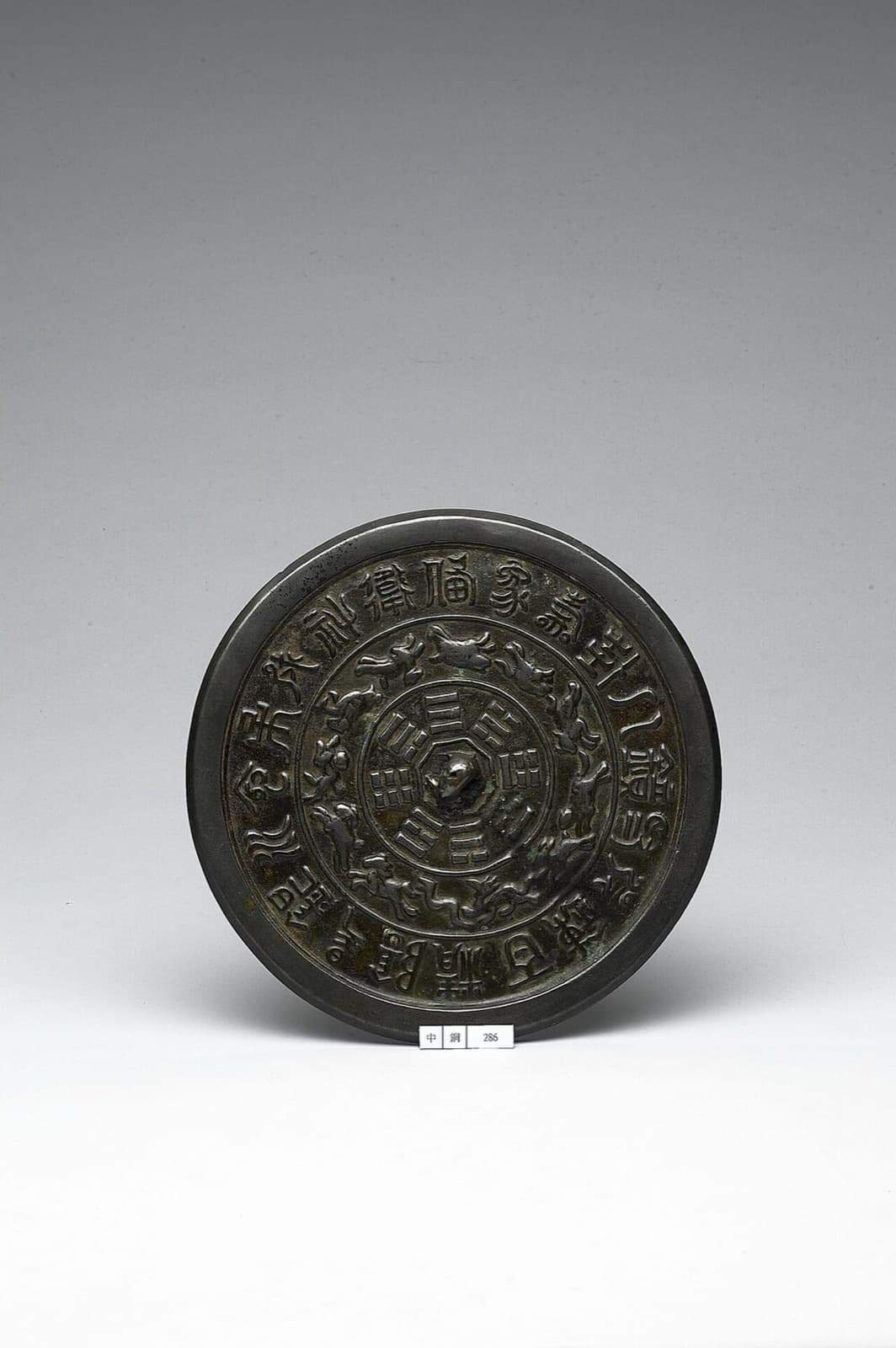
In feng shui practice, especially in the Bát Trạch (Eight Mansions) school, accurately determining the direction of a house and the direction of its main door is the most fundamental and important step. Many people mistakenly believe that simply observing the sunrise or sunset is enough, but this method is imprecise and easily skewed. Feng shui experts use a specialized tool called a feng shui compass, also known as a la kinh (羅經). This is a complex instrument, combining a magnetic compass with many rings of astronomical and geographical information, usually intended only for those with deep expertise.
However, in modern feng shui applied to homes, using an ordinary compass with clear degree markings is entirely sufficient for basic needs. This compass is typically mounted on a plastic ruler printed with an arrow to make orientation and alignment easy.
The Steps for Measuring House Direction in Practice
What Should Be Prepared Before Measuring House Direction?
To get the most accurate measurement, the following rules should be strictly observed:
- Avoid magnetic interference: Do not stand near electrical devices, cars, underground piping systems, or large metal objects, as they can deflect the compass needle. Specifically, you should stand at least 1 to 2 meters away from electronic devices, cars and large metal structures.
- Remove metal items from your person: Mobile phones, watches, necklaces, rings and belts with metal buckles all need to be taken off and kept away from the measurement position.
What Is the Process for Measuring House Direction?
- Standing position: Stand with your back to the house, about 1 to 1.5 meters away from it. This posture helps you measure the direction the house is facing.
- Posture and how to hold it: Spread your feet slightly to keep your balance. Place the compass in the palm of your hand, at hip level, so that the arrow printed on the plastic ruler points straight ahead (that is, away from the house).
- Rotate the compass: Rotate the compass dial until the colored needle tip (usually red) aligns exactly with the letter N (short for North) on the compass face.
- Read the result: Read the number on the outer ring of the compass that lies on the same straight line as the arrow on the plastic ruler. This number is the degree value of the house direction.
Why Measure Several Times and Take the Average?
To ensure accuracy, you should repeat the measurement process at least three times. Between measurements, shift your body slightly to the left or right while keeping the same distance to the house. If the three results differ, calculate the average of the three values.
For example: three measurements give results of 200, 196 and 202 degrees. The house direction will be (200 + 196 + 202) : 3 = 199 degrees. If the difference between measurements is greater than 15 degrees, you are very likely being affected by the magnetic field of electrical devices or metal. Change your position and measure again from the start.
How to Convert Degrees into Directions
A compass circle has 360 degrees, divided into 8 main directions, each occupying a 45-degree angle. To determine the house direction from the measured degree value, you can refer to the following conversion table:
| Direction | Degree Range | Main Marker |
|---|---|---|
| North (N) | 337.5 - 22.5 | 0 |
| Northeast (NE) | 22.5 - 67.5 | 45 |
| East (E) | 67.5 - 112.5 | 90 |
| Southeast (SE) | 112.5 - 157.5 | 135 |
| South (S) | 157.5 - 202.5 | 180 |
| Southwest (SW) | 202.5 - 247.5 | 225 |
| West (W) | 247.5 - 292.5 | 270 |
| Northwest (NW) | 292.5 - 337.5 | 315 |
You can also calculate it yourself without the table above. Picture the 360-degree circle, where each direction has a central marker. For example, the 0-degree or 360-degree marker is North, 90 degrees is East, 180 degrees is South, 270 degrees is West. Each direction extends 22.5 degrees to each side of the central marker. For example, North extends from 337.5 degrees to 22.5 degrees. Southeast has its central marker at 135 degrees, extending from 112.5 degrees to 157.5 degrees.
How to Measure the Direction of the Main Door?
For the main door, the measuring principle is similar, but the standing position is different. You need to stand in the middle of the doorway, with your back to the inside of the house and your face toward the outside. Then carry out the following steps:
- Measure for the first time at the initial standing position.
- Step forward one pace, measure for the second time.
- Step back one pace from the initial position, measure for the third time.
If there is a discrepancy between measurements, calculate the average. If the house has several entrances, choose the door that the whole family uses most often for the measurement.
How to Measure House Direction for High-Rise Apartments?
Determining direction for apartments in a high-rise building is different:
- From the 1st floor to the 9th floor: The apartment's direction is considered to match the direction of the whole building, because it is still mainly influenced by the land.
- From the 10th floor upward: Since it is no longer under the direct influence of the land, the apartment's direction is determined based on the direction with the widest view and the most light. Usually, that is the side with large glass doors, which provides the main source of dương khí (yang energy) for the apartment.
What Is the Tam Hợp La Kinh?
The Tam Hợp la kinh is a specialized line of compass, named after the four tam hợp cục (three-harmony combinations) of the earthly branches. The book Thẩm Trúc Nhưng, Trạch vận tân án states that compasses are broadly divided into two types, the Tam hợp bàn (Vị bàn) and the Quái bàn (Dịch bàn); the Tam hợp bàn is said by tradition to have been created by Dương Quân Tùng.
The four tam hợp cục are:
- Thủy cục (Water combination): Thân - Tý - Thìn.
- Mộc cục (Wood combination): Hợi - Mão - Mùi.
- Kim cục (Metal combination): Tỵ - Dậu - Sửu.
- Hỏa cục (Fire combination): Dần - Ngọ - Tuất.
Details on how each combination operates are presented in the article tam hợp cục.
How do the three 24-mountain rings of the Tam Hợp la kinh differ?
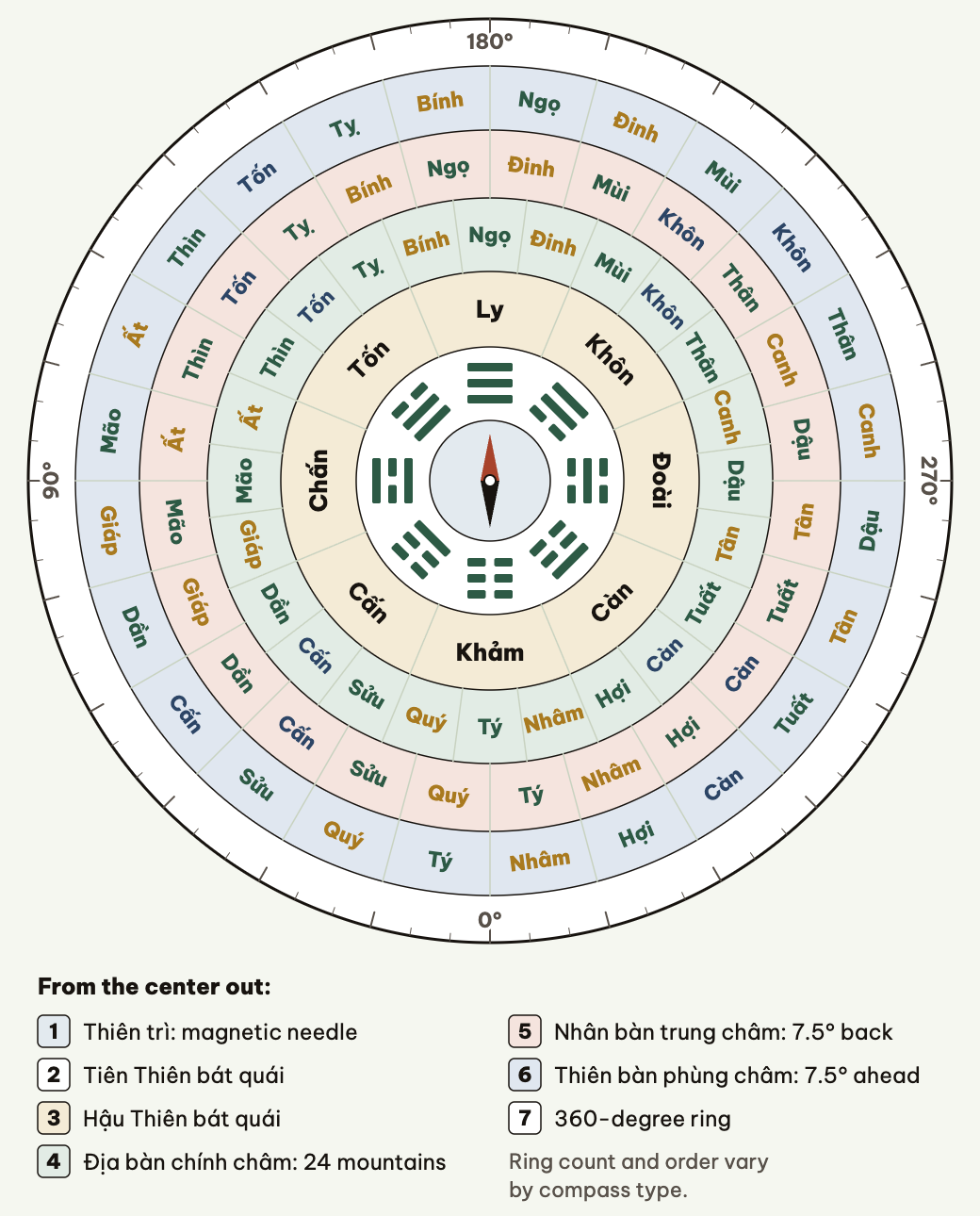
According to the content of volume 2 of the book Phong thủy cổ đại Trung Quốc: lý luận và thực tiễn, three needles and three plates make up the compass, including the Địa bàn chính châm, the Thiên bàn phùng châm and the Nhân bàn trung châm. Each plate is divided into twenty-four cells of equal width, 15 degrees, collectively called the Nhị Thập Tư Sơn (Twenty-Four Mountains). These three 24-mountain rings are placed offset from one another, not perfectly overlapping.
- Địa bàn chính châm: used to measure the sitting mountain and the facing mountain. The book records that when the compass needle points exactly at the center of Tý Ngọ, it is called chính châm.
- Nhân bàn trung châm: the book records that when the needle points exactly between Tý Quý and Ngọ Đinh, it is called trung châm. According to the explanation in the book, the trung châm bears the name Nhân bàn in order to match the meaning of the Three Powers: Heaven, Earth and Humanity.
- Thiên bàn phùng châm: according to the book, if the needle points exactly at the gap between Nhâm Tý and Bính Ngọ, it is called phùng châm; people determined the North-South direction by measuring the sun's shadow using plants and a gnomon, and absorbing light from the sky.
According to what is recorded in the book, the scholar Vương Chấn Đạc once stated that the Tý Ngọ needle points to the magnetic pole, the phùng châm points to the Tý Ngọ of the gnomon's shadow, and the trung châm points to the Tý Ngọ of the North Pole, and that scientific research into the three plates and three needles still needs to await the future. This is a point where the source material has not reached a conclusion, so it is noted here for reference only.
Why do the 24 mountains orient more finely than the eight directions?
Each of the eight directions is 45 degrees wide, while each of the 24 mountains is 15 degrees wide, meaning the la kinh orients three times more finely. For example, the South direction with its 180-degree marker is divided into three mountains: Bính from 157.5 to 172.5 degrees, Ngọ from 172.5 to 187.5 degrees, Đinh from 187.5 to 202.5 degrees. Thanks to this, users can distinguish three mountains within the same direction, instead of lumping them together as one 45-degree direction.
What Is the Tam Nguyên La Kinh?
The Tam Nguyên la kinh takes its name from the division of time into Thượng Nguyên, Trung Nguyên and Hạ Nguyên, each 60 years, together forming a 180-year cycle. This cycle is further divided into nine vận (periods), each 20 years, and is the foundation of the Huyền Không Phi Tinh (Flying Star) school. Details of how it is calculated are presented in the article tam nguyên cửu vận.
What is engraved on the innermost ring around the Thiên trì?
The innermost ring around the Thiên trì is engraved with the Tiên Thiên Bát Quái (Earlier Heaven Bagua) and the Hậu Thiên Bát Quái (Later Heaven Bagua). Determining house direction uses the Hậu Thiên Bát Quái, while the Tiên Thiên Bát Quái represents the primordial state. The differences and how to use these two bagua are presented in the article tiên thiên và hậu thiên bát quái.
How many rings does a full la kinh have?
A full la kinh usually has about 20 to 36 rings. Besides the 24-mountain ring, the la kinh also has the Nhị Thập Bát Tú ring, comprising the 28 constellations of ancient Chinese astronomy, and the Lục Thập Giáp Tý ring. The book Thẩm Trúc Nhưng, Trạch vận tân án mentions the Lục Thập Giáp Tý ring in the context of mountains committing Phần ngâm and Phục ngâm according to each vận, but does not present it as a separate section on the function of this ring, so here we only note its presence.
Can You Teach Yourself to Use a La Kinh at Home?
Yes, but it should be divided into two levels. Basic direction measurement with a compass that has degree markings is something a beginner can do right away, as long as they grasp the measuring process and avoid magnetic interference. To read the deeper rings, one should learn the 24 mountains first, since that is the root orientation layer, and only then move on to the rings for calculating vận such as Tam Nguyên Cửu Vận. The book Thẩm Trúc Nhưng, Trạch vận tân án also emphasizes that anyone who wants to study Huyền Không learning must first master the nine stars on the palm of the hand.
Important Notes When Measuring House Direction
The traditional feng shui compass (la kinh) is an extremely complex tool with many rotating rings containing different layers of information such as the Bagua, Heavenly Stems, Earthly Branches, 28 Stars, and so on. Using a la kinh proficiently requires many years of study and practice. For beginners and for applying feng shui to homes in the modern way, using an ordinary compass is enough and far more practical. The most important thing remains care during the measurement process and the ability to analyze the results in order to apply feng shui principles correctly.
Overview article for the topic: What is feng shui? Foundational principles and how to apply it


