
How do annual palaces and annual stars differ?
Annual palaces and annual stars are two concepts that get mixed up constantly. The annual palace refers to a palace position: whichever palace on the chart carries the earthly branch of the year being read is the annual palace. Annual stars, also called traveling stars, are stars that are not fixed in the natal chart but are placed additionally according to the stem and branch of the year being read, lasting within one year before being replaced by the next year's layer.
In the common presentation on tracuutuvi.com, annual stars are stars with a mobile quality, moving by year or by decade luck, temporarily affecting fortune within a defined period. They are placed on the chart each year based on the native's age or decade luck, helping picture events, opportunities and challenges that may surface that year.
Put another way, the natal chart is the base map, and the annual stars are a layer of ink drawn over that map for each year. Same base map, different ink each year.
How is the annual palace determined?
The annual palace is the palace carrying the branch of the year being read. In a Rat year the Rat palace is the annual palace, in a Monkey year the Monkey palace is the annual palace, and so on through the twelve earthly branches. The page tracuutuvi.com gives the example that in a Giap Ty year the Ty palace is taken as the Thai Tue position, in a Binh Than year the Than palace is taken as the Thai Tue position, and when judging fortune people usually take the three directions and four cardinal points of that year's Thai Tue position.
The point to remember is that annual stars start from the stem of the year being read, not the stem of the palace. This is where beginners often slip, because the natal chart also has a stem written on each palace.
Is Luu Thai Tue the same as the annual palace?
In position, Luu Thai Tue coincides with the annual palace, but in role it is not entirely identical. Luu Thai Tue is the presiding star of the annual star layer, marking and activating the palace it occupies. According to tracuutuvi.com, Luu Thai Tue is determined by the earthly branch of the year being read, has an important effect on the palace it occupies, and is usually used as the lead when judging the annual reading.
This star has two faces. Tracuutuvi.com describes Luu Thai Tue as governing yearly change, able to highlight events, raise the social attention directed at the native, and open chances for self-expression, but also prone to drawing gossip, arguments, pressure or responsibility. Meeting auspicious stars it leans toward opportunity and reputation, meeting malefic stars it leans toward conflict, dispute or trouble.
It should be said clearly: this describes a tendency, not a sentence. The same Luu Thai Tue placed in a palace with a good or bad foundation gives very different results.
What stars make up the common annual star set?
The number of annual stars has no agreed figure across books. According to the Trung Chau school that tracuutuvi.com cites, the stars in decade luck, annual, monthly, daily and hourly layers include Luu Thai Tue, Luu Loc Ton, Luu Thien Ma, Luu Kinh Duong, Luu Da La, Luu Van Xuong, Luu Van Khuc, Luu Thien Khoi, Luu Thien Viet, Luu Tu Hoa, plus thirty-six stars belonging to the three groups Tuong Tien Chu Tinh, Tue Tien Chu Tinh and Bac Si Tien Chu Tinh.
Another, shorter listing appears on astrology forums: nine annual stars affecting fortune are Thai Tue, Tang Mon, Bach Ho, Thien Hu, Thien Khoc, Loc Ton, Kinh Duong, Thien Ma and Da La. The same page notes that Viet Viem Tu places stars by year and adds the Thai Tue ring, Thien Khong, Quan Sach, the Loc Ton ring, the Trang Sinh ring, Khoi and Viet.
This difference is not right versus wrong, it is a matter of detail. Books using few stars read loosely, books using many stars read closely but also get tangled easily.
Luu Tang Mon and Luu Bach Ho
Luu Tang Mon follows Luu Thai Tue, offset two palaces forward. Luu Bach Ho sits in the palace opposite Luu Tang Mon. Astrology forums describe that when Luu Tang Mon and Luu Bach Ho meet many weakening and malefic stars, the year tends toward mourning, illness or decline.
Read that sentence correctly. The Tang Ho pair is a sign to pay attention, not a sign that mourning is required. Placed beside good stars and a solid foundation palace, the meaning drops sharply.
Luu Thien Khoc and Luu Thien Hu
These two stars are placed by their own counting method. Starting from the Ngo palace for a Rat year, count backward to the palace named for the year being read to place Luu Thien Khoc; count forward to the palace named for the year being read to place Luu Thien Hu. Astrology forums group them among malefic and weakening stars, governing illness and sorrow, and note that if Luu Thien Khoc meets the fixed Thien Khoc in the same palace, or Luu Thien Hu meets the fixed Thien Hu, the severity increases.
Luu Loc Ton, Luu Kinh Duong and Luu Da La are placed by the year's stem
This is the part that can be tabulated most clearly, because all three stars follow the stem of the year being read. Loc Ton in the natal chart is placed by the birth year stem, so Luu Loc Ton is placed by the year stem, and Luu Kinh Duong and Luu Da La are the two stars flanking Luu Loc Ton, following the rule that Loc Ton always sits between Kinh Duong and Da La.
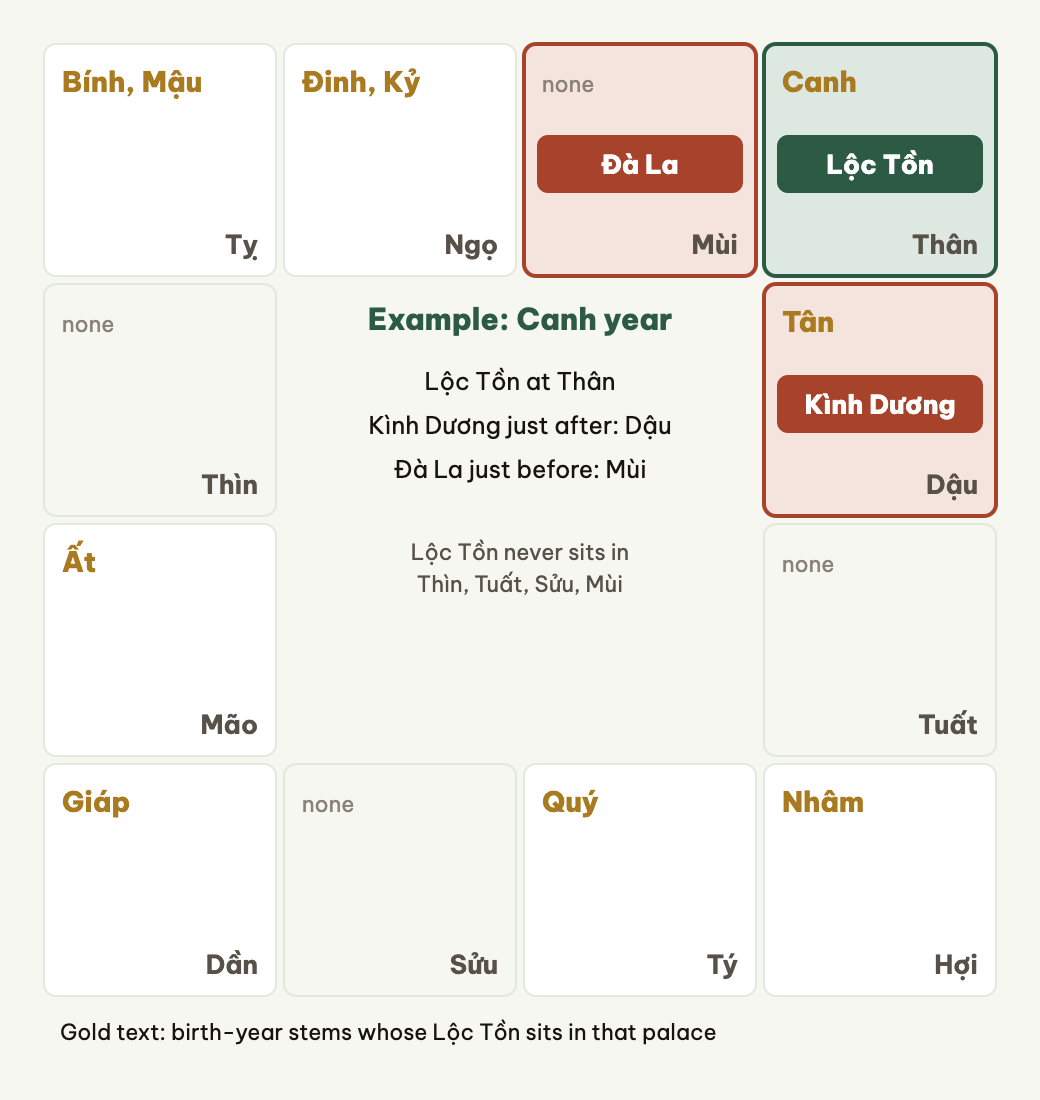
The rule for Loc Ton's position by heavenly stem is basic knowledge in this field: Giap at Dan, At at Mao, Binh at Ty, Dinh at Ngo, Mau at Ty, Ky at Ngo, Canh at Than, Tan at Dau, Nham at Hoi, Quy at Ty. From that, Kinh Duong and Da La follow.
| Year stem | Luu Loc Ton | Luu Kinh Duong | Luu Da La |
|---|---|---|---|
| Giap | Dan | Mao | Suu |
| At | Mao | Thin | Dan |
| Binh | Ty | Ngo | Thin |
| Dinh | Ngo | Mui | Ty |
| Mau | Ty | Ngo | Thin |
| Ky | Ngo | Mui | Ty |
| Canh | Than | Dau | Mui |
| Tan | Dau | Tuat | Than |
| Nham | Hoi | Ty | Tuat |
| Quy | Ty | Suu | Hoi |
This table is generated by the calculation core following the placement rule for Loc Ton, Kinh Duong and Da La, not typed cell by cell.
In meaning, Luu Loc Ton is the year's wealth star, while Luu Kinh Duong and Luu Da La are two stars carrying obstruction and friction. The book Tu Vi Kinh Nghiem, lower volume, discusses Loc, Ma, Kinh, Da, Thai Tue and Khoc Hu when judging a year, and stresses that meeting many stars of the same type within one year markedly raises the level of attention.
Luu Thien Ma
Luu Thien Ma governs movement, travel, change of residence or work during the year. Its position follows the branch of the year being read, and its placement also follows the principle of the three harmonies with the year branch. Thien Ma is usually read together with Loc Ton or Hoa Loc, forming the Loc Ma configuration, meaning money tied to movement.
The book Tu Vi Chon Loc number 1 discusses Thien Luong meeting Thien Ma, holding that when these two combine and wealth stars such as Loc Ton or Hoa Loc are added, the person can succeed in fields requiring movement, trade or working abroad; but if Thien Ma meets Thien Luong in a weak position or alongside Kinh Duong, Da La, Hoa Tinh, Linh Tinh, Khong Kiep, the fine image can turn into wandering and drifting. This is an example of the same star in two different combinations giving two opposite faces of meaning.
Luu Tu Hoa by the year's stem
Luu Tu Hoa is a second transformation layer, placed by the stem of the year being read, overlaid on the birth-year Four Transformations already on the natal chart. The Four Transformations table by heavenly stem is basic knowledge, recorded in Dau So Tinh Thanh volume 1: for example, someone born in a Giap year has Hoa Loc as Liem Trinh, Hoa Quyen as Pha Quan, Hoa Khoa as Vu Khuc, Hoa Ky as Thai Duong.
| Year stem | Hoa Loc | Hoa Quyen | Hoa Khoa | Hoa Ky |
|---|---|---|---|---|
| Giap | Liem Trinh | Pha Quan | Vu Khuc | Thai Duong |
| At | Thien Co | Thien Luong | Tu Vi | Thai Am |
| Binh | Thien Dong | Thien Co | Van Xuong | Liem Trinh |
| Dinh | Thai Am | Thien Dong | Thien Co | Cu Mon |
| Mau | Tham Lang | Thai Am | Huu Bat | Thien Co |
| Ky | Vu Khuc | Tham Lang | Thien Luong | Van Khuc |
| Canh | Thai Duong | Vu Khuc | Thai Am | Thien Dong |
| Tan | Cu Mon | Thai Duong | Van Khuc | Van Xuong |
| Nham | Thien Luong | Tu Vi | Ta Phu | Vu Khuc |
| Quy | Pha Quan | Cu Mon | Thai Am | Tham Lang |
This table is also generated by the calculation core following the Four Transformations table, not typed by hand.
One important technical point: a star carrying a traveling transformation is sometimes absent from the natal chart. If the natal chart has no Van Xuong, a Tan year still has Luu Hoa Ky as Van Xuong, and it is still read. That means the annual Four Transformations layer does not depend on whether that star appears in the natal chart.
In what order do you read a specific year on a chart?
The common order in Vietnamese books goes from large to small: decade luck first, then the annual palace, then the minor limit, then the annual stars are laid on to fine-tune.
Step one, identify the current decade luck. The decade is a ten-year frame, giving the broad context of the period.
Step two, find the annual palace, the palace carrying the branch of the year being read. This is the center of the year.
Step three, cross-check the minor limit. The minor limit is a system counted by age, following its own rule, and does not always fall in the same palace as the annual palace. When the two coincide, the combined effect is clearer.
Step four, lay the annual stars and annual Four Transformations on, reading them in relation to the main and supporting stars already in that palace.
An illustrative example with a fictional chart for 2027
Suppose a fictional chart where the native has the Menh palace at Suu and is running decade luck at the Ty palace. 2027 is a Dinh Mui year.
The annual palace for 2027 is the Mui palace, since Mui is the year branch. Luu Thai Tue sits at Mui. Luu Tang Mon goes two palaces forward, at Dau. Luu Bach Ho sits opposite Dau, at Mao.
With the year stem Dinh, Luu Loc Ton is at Ngo, Luu Kinh Duong at Mui, Luu Da La at Ty. Notably Luu Kinh Duong lands exactly on the annual palace, and Luu Da La lands on the current decade luck palace.
Luu Tu Hoa for a Dinh year: Hoa Loc is Thai Am, Hoa Quyen is Thien Dong, Hoa Khoa is Thien Co, Hoa Ky is Cu Mon. If the Mui palace holds Cu Mon, then that year the annual palace has Luu Thai Tue, Luu Kinh Duong and Luu Hoa Ky together. This is a noteworthy combination, but you must read further to see whether Cu Mon is in a strong or weak position, whether Tuan Triet is present, and whether any good star restrains it.
This example only illustrates how to assemble the star layers, it is not to say what 2027 will bring for that fictional chart.
Where do the schools disagree?
There are at least four significant differences between schools and books.
First, how to read a year. Common Vietnamese books read the year by combining the minor limit with the annual stars. The Four Transformations school instead builds a separate annual chart, rearranges the twelve palaces by the year being read, then flies transformations on that board. The book Kham Thien Tu Hoa Chon Loc number 2 discusses identifying the annual palace and using the Four Transformations of the annual palace stem as the main driver of the year's events, while checking whether the palace stems produce Ly Tam Loc or Huong Tam Loc. This book also discusses the phenomenon called "wealth entering a bottomless movement", warning of instability in wealth and opportunity, and advising caution in spending and investment.
Second, the number of annual stars used in each book differs, as noted above.
Third, some stars carrying traveling transformations are absent from the natal chart. How to handle this also differs between schools.
Fourth, the book Kham Thien Tu Hoa Chon Loc number 1 discusses the Phi Phuc mechanism, flying Loc, Quyen, Khoa and Ky from a higher time layer to a lower one: from the prenatal to decade luck, from decade luck to the annual, then monthly, daily and hourly. This approach is not common in mainstream Vietnamese books, so readers should know which system they follow to avoid mixing the two.
Why should annual stars not be read as a verdict for the whole year?
Annual stars are an adjustment layer, not a deciding layer. They only modify within one year, and their value depends on the foundation palace, the main stars already present, the current decade luck and the natal chart as a whole.
The same Luu Thai Tue entering Menh is described by tracuutuvi.com as a year with many changes, prone to gossip, arguments, health and other possibly troublesome matters, but it also states clearly that this describes a tendency, not a fixed conclusion, and that a good foundation gives a different result. The book Tu Vi Kinh Nghiem, lower volume, when judging a year with many repeated stars, also only says it is a year worth attention, and stresses the role of the person's virtue and conduct.
In short: annual stars show what may surface in the year, not what will certainly happen.


